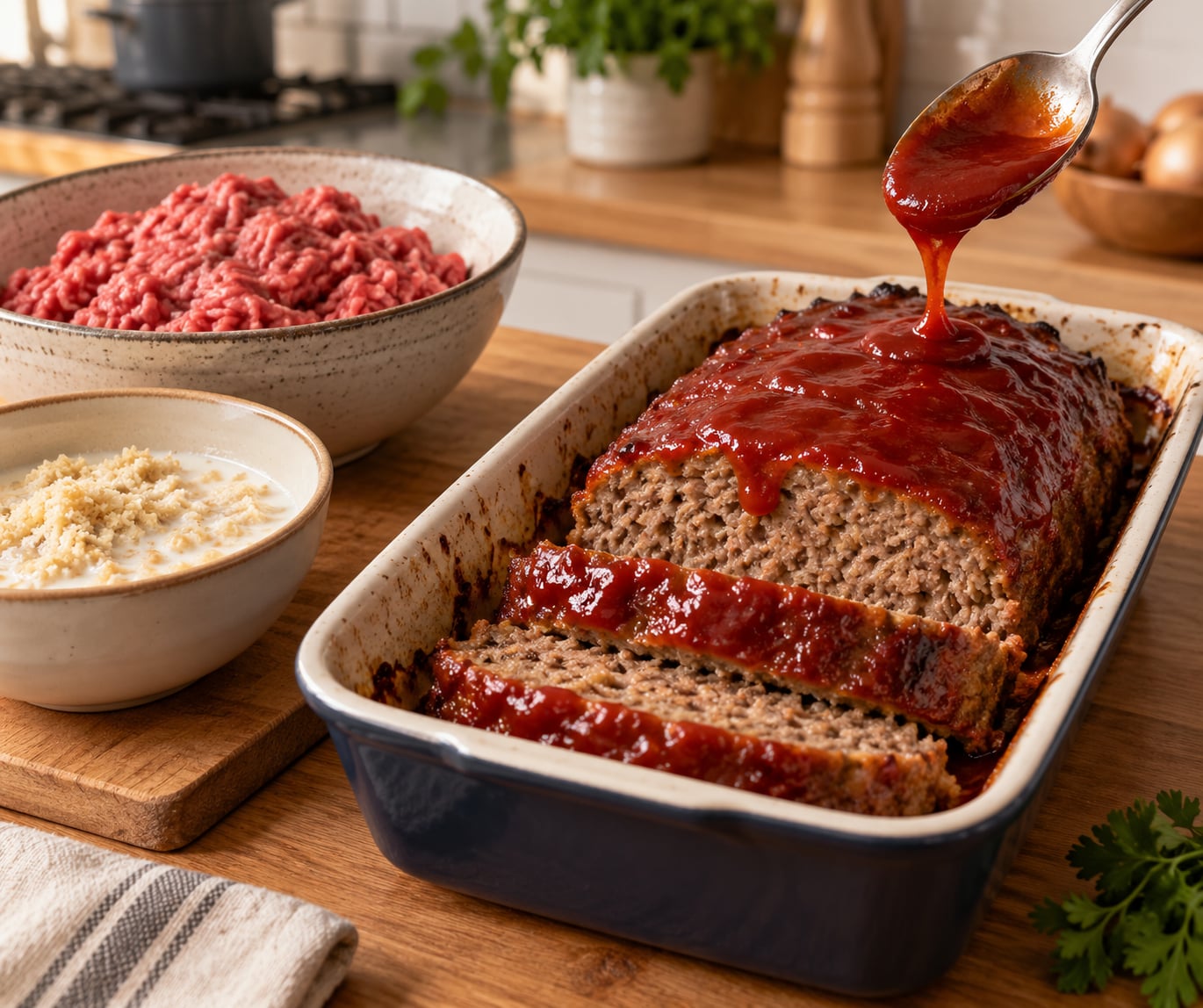
Learning how to make meatloaf that is not dry comes down to four things: meat with enough fat in it, a filler that has been soaked so it holds water, a mixture handled gently rather than kneaded, and a bake that stops at 160°F on the thermometer instead of at some guessed time. Get those right and the loaf stays juicy straight out of the oven.
The reason so many meatloaves turn dry is that each fix feels optional on its own. You choose a lean blend because it seems tidier, skip the bread because the recipe did not list it, stir the bowl until it looks uniform, and leave it in the oven until the kitchen smells done. Nothing about that reads as a mistake while you are doing it.
Here are the key steps for a moist meatloaf, in the order they matter:
- Use ground beef with at least 15% fat, ideally 80/20, so there is fat left to keep the loaf tender.
- Soak the breadcrumbs in milk or broth before they go in, so the filler carries water into the meat instead of drawing it out.
- Mix with a light hand and stop the moment everything is combined. Overmixed meatloaf turns dense and rubbery.
- Bake at 325°F to 350°F, add a shallow pan of water on the rack below, and pull the loaf at 160°F internal.
- Rest it tented in foil for 10 to 15 minutes before the first slice, so the juices redistribute instead of running out.
Everything below builds on those five, with the ratios, timings and failure signs worked out in detail. The whole method takes about an hour and a half, most of it unattended.
Table of Contents
- What You Need
- The meat
- The moisture-rich additions
- Seasoning and sauce
- Equipment
- Step-by-Step: How to Make Meatloaf That Is Not Dry
- 1. Choose a Meat-to-Moisture Ratio
- 2. Add Moisture-Rich Ingredients
- 3. Mix the Meat Loaf Gently
- 4. Shape the Loaf Without Compacting It
- 5. Use a Two-Part Glaze
- 6. Bake Gently and Add a Moisture Trap
- 7. Check Doneness and Rest the Loaf
- Common Mistakes
- What to do with a loaf that is already dry
- Reheating, freezing, and make-ahead
- Frequently Asked Questions
- How do you keep meatloaf moist?
- Why is my meatloaf always dry?
- What liquid can I add to meatloaf to keep it moist?
- Should meatloaf be covered while baking?
- How long does a 2 lb meatloaf take at 350 degrees?
- What is the one ingredient upgrade for better meatloaf?
- Conclusion
What You Need
Quantities below build one standard 2-pound meatloaf, which is the size most home ovens handle well and the size all the timings here assume. Double it and you double the time, roughly, not the temperature.
The meat
Two pounds of 80/20 ground chuck is the reliable choice. Ground chuck carries more fat and more flavor than ground sirloin, and that fat is what stays in the loaf after cooking. If you buy a blend labeled 80/20, you do not need to do anything else about the meat. If you buy 85/15 or 90/10, add a little more liquid with your filler to compensate.
The moisture-rich additions
These are the ingredients that do the actual work of keeping the loaf moist.
- Bread or breadcrumbs, soaked: 1 to 1.5 cups of fresh breadcrumbs, or 2 to 3 slices of stale bread torn up, soaked in about half a cup of milk, buttermilk, or broth for 10 minutes.
- Egg: one to two eggs. The egg binds the loaf together and holds water in the protein matrix.
- Sauce in the mix: a third of a cup of ketchup, barbecue sauce, or tomato sauce. It adds sugar for browning and liquid for moisture.
- Vegetables, cooked: a small onion and a carrot, finely diced and sautéed in butter or oil, then cooled. Raw onion at 350°F will never cook through; sautéing first softens it and releases its moisture into the loaf.
Substitutions work. Quick-coating rolled oats replace breadcrumbs and make the loaf gluten-free, crushed saltines work, and an 8-ounce can of tomato sauce can stand in for the milk in the panade. Readers in cooking forums swap all three in for the same reason: the moisture source matters more than which one you pick.
Seasoning and sauce
Salt, black pepper, garlic powder, dried thyme, Worcestershire sauce, and a prepared Italian seasoning blend are enough. Go easy on the dried herbs, because a heavy hand of them reads as grassy rather than savory and cooks people into blaming flavor for what is really a moisture problem.
For the top, a glaze of ketchup, brown sugar, and Worcestershire sauce, or a jar of barbecue sauce, gives you a caramelized surface that would be difficult to get any other way.
Equipment
A 9×5-inch loaf pan, or a rimmed baking sheet if you prefer a free-form loaf, plus a wire rack for resting and an instant-read thermometer. The thermometer is the one tool that changes your results, because it takes the guesswork out of the single step that ruins most loaves.
Step-by-Step: How to Make Meatloaf That Is Not Dry
1. Choose a Meat-to-Moisture Ratio
Start with 80/20 ground beef and adjust from there. Fat is the carrier of flavor and the thing that keeps ground meat tender after it cooks, and lean meat has almost none of it to give. Popular recipes disagree about this. Some tell you to use 90% to 93% lean, some say 80/20, and the AI summaries on search results pages tend to say 80/20. Both can work, but they are not making the same loaf.
The higher-fat advice assumes a loaf with a soaked panade, a short bake, and a rest. The leaner advice assumes less care elsewhere. If you are following a lean-meat recipe, add extra liquid with the filler and check the temperature early, because lean meat has no cushion.
| Ground meat | Fat | What you get |
|---|---|---|
| 80/20 ground chuck or beef | 20% | Best all-around choice. Moist, tender, holds together when sliced. |
| 85/15 ground beef | 15% | Very good. Slightly lighter crumb, add a splash more liquid with the filler. |
| 90/10 ground beef | 10% | Works only with a soaked panade and a short bake. Leaner flavor, drier edges. |
| 93/7 or 95/5 | 5 to 7% | Dry and crumbly on its own. Blend half ground pork, or add olive oil and extra sauce. |
| Ground turkey | varies | Very lean. Keep it moist with an 80/20 beef and pork blend, a tablespoon of olive oil, or mushroom gravy worked into the mix. |
If you want a flavor boost while keeping the ratio, a half-pound of ground pork swapped in for beef adds fat and moisture and leans the loaf toward a sausage texture. Readers on home cooking forums settle on the same tradeoff: a beef and pork blend is the standard fix when the beef on hand is lean.
2. Add Moisture-Rich Ingredients
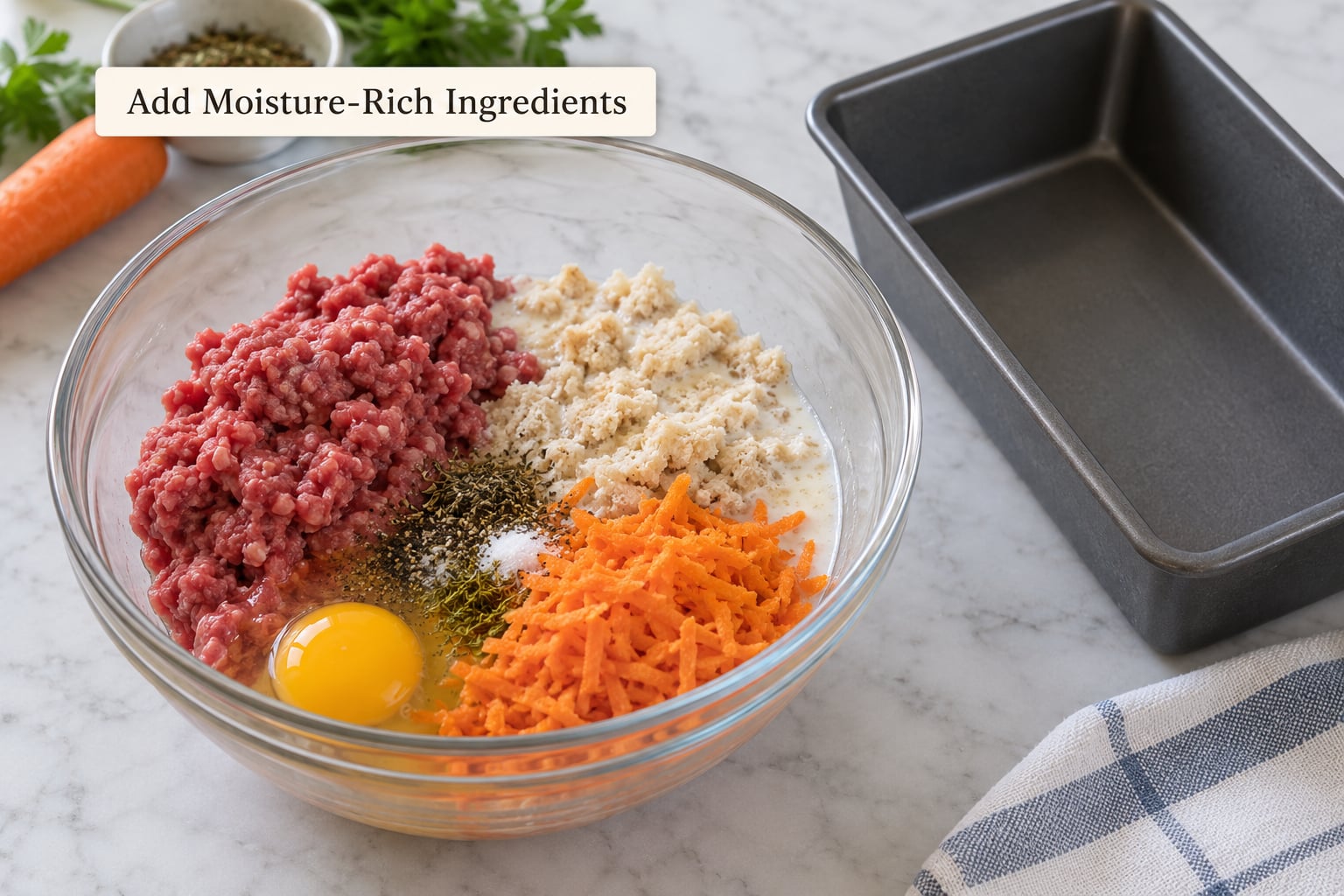
Soaking the filler is the single biggest upgrade you can make. Dry breadcrumbs absorb moisture from the meat around them, so they work against you by a small margin. Bread soaked in milk or broth carries that water into the loaf instead, which is why a panade stays juicy while a dry crumb version does not.
For a 2-pound loaf, soak 1 to 1.5 cups of breadcrumbs in about half a cup of milk for 10 minutes, then squeeze out nothing and add them straight to the meat. You want the crumbs damp, not dripping. The same ratio works with 2 or 3 slices of stale bread torn into pieces, which is what many older recipes call for.
Egg follows the meat by weight: one egg per pound is plenty, and two is the ceiling for a 2-pound loaf. More egg means a spongier, drier texture, because you are adding protein that sets firm without adding fat.
Vegetables count as moisture when they are cooked first. Sauté diced onion, carrot, and celery in butter or olive oil until soft, then let them cool before mixing them in. A shredder-grated zucchini works too, and one home cook on a cooking forum reported it disappears entirely into the finished loaf while adding both moisture and bulk.
Work a third of a cup of ketchup, barbecue sauce, or tomato sauce into the mix as well. It seasons the inside of the loaf, not just the top, and it contributes sugar for browning and water for moisture in the same move.
3. Mix the Meat Loaf Gently
Overmixing is the mistake that turns a moist loaf into a dense one. Ground meat is muscle fibers held together with loose connective tissue, and kneading it develops those proteins into a springy network, the same way gluten does in bread dough. The result slices like a hamburger patty and chews like rubber.
Use this method instead:
- Put the soaked bread, egg, sauce, and seasonings in the bowl first and stir just those together.
- Crumble the raw meat into the bowl in chunks rather than adding it as a compact block.
- Use a fork or your fingers to break the meat into the wet mixture. Turn the bowl a quarter turn between passes.
- Stop as soon as no streaks of wet bread or raw meat color remain.
You are looking for a loose, slightly lumpy mixture. Large uneven lumps are fine and even preferable; they melt into tender pockets instead of a uniform brick. Signs of overworking show up as a mixture that is sticky, glossy, and elastic, or one that stretches when you pull it apart.
4. Shape the Loaf Without Compacting It
Shape the loaf by hand and press only as hard as it takes to hold together. Pressing squeezes water out of the meat before it ever reaches the oven, which is moisture you cannot get back. A gently handled loaf may look slightly loose going into the pan and will set into a solid slice on its own during the first 20 minutes of baking.
There are three good ways to shape it. A greased loaf pan gives you the tightest, most tender slice and cooks fastest, but a narrow pan also traps fat at the bottom. A rimmed baking sheet with a free-form oval browns better on the outside and takes a few minutes longer to cook through. Mini loaf pans or a muffin tin give you portion control for lunchboxes and game-day service, and the smaller the portion, the less time it spends losing moisture.
Leave about an inch of room in the pan. A pan that is much larger than the loaf gives the meat a wide, shallow surface and lets it bake dry from the edges inward, and that is the oversized-pan problem behind a lot of disappointing results.
5. Use a Two-Part Glaze
Split your sauce rather than using it all at once. Glaze the raw loaf lightly before it goes in, using a thin coat of ketchup or barbecue sauce. That early layer seals the surface, so the moisture inside has less chance of escaping as steam.
Add the main glaze in the final 10 to 15 minutes, after the loaf has set and its juices have stopped moving around inside. A brown sugar and ketchup glaze added late caramelizes properly and gives you a glossy top. Adding everything at the start is what produces a pale, tacky loaf with a dry core.
6. Bake Gently and Add a Moisture Trap
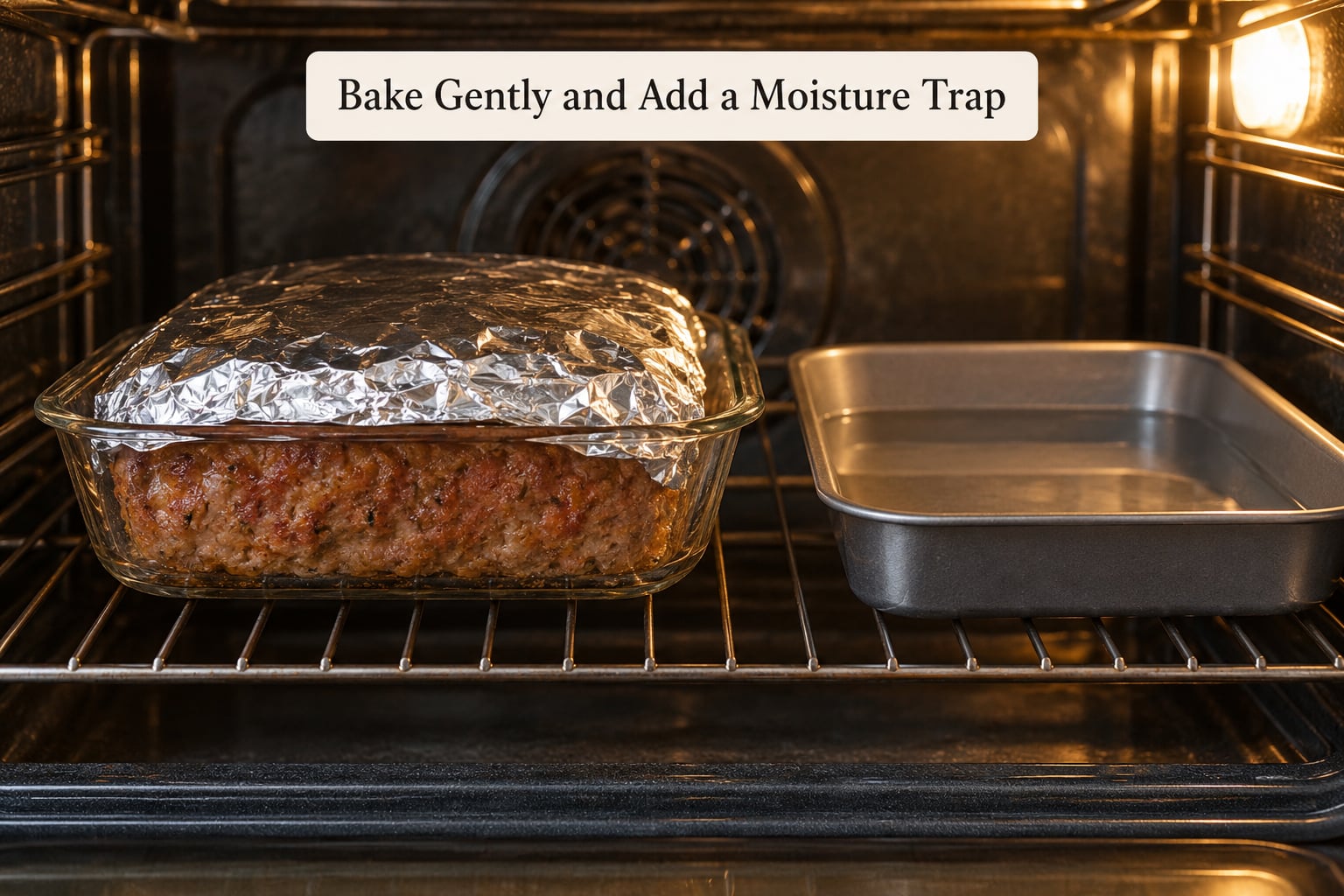
Bake at 325°F or 350°F. A moderate oven cooks the loaf at a pace that keeps the interior from boiling out its water before the proteins set, and 350°F is hot enough to brown the glaze within the time it takes to cook the middle. Above 400°F you trade moisture for crust color you did not ask for.
| Loaf weight | At 350°F | At 325°F | Target internal |
|---|---|---|---|
| 1 lb | 35 to 40 min | 40 to 45 min | 160°F / 71°C |
| 1.5 lb | 45 to 55 min | 55 to 65 min | 160°F / 71°C |
| 2 lb | 55 to 65 min | 65 to 80 min | 160°F / 71°C |
| 3 lb | 80 to 95 min | 95 to 115 min | 160°F / 71°C |
Think of those times as a starting point for checking, not as the answer. Start checking with the thermometer at the low end of the range, because a lean loaf finishes sooner than a fatty one.
Two habits cut the evaporation rate further. First, set a shallow roasting pan with a cup of water on the rack below the loaf, so the oven holds a layer of steam instead of drawing moisture out of your food. Second, tent the loaf loosely with foil for the first third of the bake if the top is browning quickly, then remove it so the glaze can caramelize.
That covers the covered-versus-uncovered question, which is the one most recipes dodge. Covering is helpful for lean meat, for large or deep loaves, and for the first part of the bake, because trapped steam is what slows evaporation. Uncovering for the last stretch is what gives you the crust. The moisture trap in the oven below the pan, which most people do not think of, gets you much of the same benefit as foil without the soggy top.
7. Check Doneness and Rest the Loaf
Push the probe into the thickest part of the loaf, away from the pan, and read it. Ground meat is safe to eat at 160°F, which is 71°C, and that is the number to pull at. The reason so many people overbake is the fear that 160°F leaves it underdone; the fear pushes them to 170°F or 180°F, and every extra 10 degrees squeezes out moisture that never comes back.
Carryover cooking finishes roughly 5 to 10 degrees past the reading, so pull at 160°F rather than chasing a higher number. That also means an instant-read thermometer is more useful here than a slow-cook one, which is what most recipes recommend by habit rather than by logic.
Rest the loaf on a wire rack, tented loosely with foil, for 10 to 15 minutes. Resting is not about cooking; it is about letting the juice redistribute through the crumb instead of pooling in the bottom of the pan and running out at the first cut. A loaf that goes straight from the oven to the board is measurably drier on the plate than the same loaf rested, and it will also fall apart when you try to slice it.
Common Mistakes
Most dry meatloaves fail in a recognizable way, and reading the finished loaf tells you which mistake happened. Here is how to diagnose yours.
| What you see | What caused it | What to change next time |
|---|---|---|
| Dense, chewy, rubbery slices | Overmixed meat | Mix only until combined, using the fold method in step 3. |
| Crumbly, falls apart when sliced | Meat too lean, or too much filler | Move up to 80/20, or cut the filler back toward 15% of the meat weight. |
| Dry edges, moist middle | Oversized pan, or a long bake | Use a pan that fits the loaf with an inch of clearance, and pull at 160°F. |
| Pale, tacky surface | All the glaze added too early | Thin coat up front, main glaze in the last 10 to 15 minutes. |
| Dry all over with no crust | Covered in foil for the whole bake | Uncover for the last third so the surface can dry and brown. |
| Raw onion or pepper in the middle | Vegetables added raw | Sauté and cool them before mixing, or use less. |
The mistake I see most is using an oversized pan. It is the least obvious of the six, because the loaf looks fine and even slightly impressive, but a wide, shallow shape gives the meat more surface area to lose moisture through and less center to cook through.
A note on draining: do not pour off the fat before serving. Some cooks do it because a greasy pan looks messy, and it costs the loaf the juices that keep it moist on a second day. Spoon the fat off the top if you must, but keep the liquid beneath it.
What to do with a loaf that is already dry
If a loaf has already come out dry, the texture cannot be reversed, but the meal can be improved in a few minutes. The simplest fix is a pan gravy: warm the reserved drippings from the bottom of the loaf pan with a splash of stock and a spoonful of flour, whisk until it thickens, and spoon it over each slice.
Other fast moves work nearly as well. Drizzle the slices with the pan juices, wrap slices in foil and warm them in a 350°F oven for 10 minutes to let the steam re-moisten the crumb, or serve it as a sandwich with mayonnaise, which adds moisture and keeps the loaf together on the plate.
Reheating, freezing, and make-ahead
Reheat meatloaf in a covered dish or wrapped in foil, not uncovered on a sheet pan. A microwave works fine, though it leaves the edges drier than a covered oven reheat. Reheated slices benefit from a small splash of broth or ketchup in the dish.
Meatloaf freezes well. Let it cool completely, wrap it tightly, and keep it for two to three months; thaw in the refrigerator overnight rather than on the counter. For the best texture after freezing, reheat it covered from chilled with a splash of broth, and skip the fresh glaze.
You can also assemble the loaf up to a day ahead and refrigerate it raw, shaped and uncovered, then bake straight from the cold fridge. Add about 10 minutes to the bake time and check the temperature a little earlier than usual.
Frequently Asked Questions
How do you keep meatloaf moist?
Keep meatloaf moist by starting with a blend that has real fat in it, such as 80/20 ground beef, then adding a moisture-rich binder like breadcrumbs soaked in milk. Mix only until the ingredients are combined, shape the loaf without pressing it down, bake at 325°F to 350°F with a pan of water below, pull it at 160°F, and rest it for 10 to 15 minutes before slicing.
Why is my meatloaf always dry?
Dry meatloaf usually comes from four things: a very lean meat mixture, overmixing the meat until it turns dense, an oversized pan, or a bake that runs well past 160°F. Skipping the soaked filler and slicing before the rest both add to it. Fix the fat ratio first, then the mixing, then use a thermometer instead of a timer.
What liquid can I add to meatloaf to keep it moist?
Milk, buttermilk, broth, diluted tomato sauce, barbecue sauce, and stock all work, and the choice matters less than the amount. The liquid should match the breadcrumbs you are using, roughly half a cup of milk to one to one and a half cups of crumbs. An 8-ounce can of tomato sauce can replace the milk entirely without drying the loaf.
Should meatloaf be covered while baking?
Covering helps most with lean meat, large or deep loaves, and the first third of the bake, because the trapped steam slows evaporation. Uncover for the final stretch so the glaze browns and the top firms up instead of going soggy. A roasting pan of water on the rack below the loaf gives you some of the same moisture benefit without foil.
How long does a 2 lb meatloaf take at 350 degrees?
A 2-pound loaf takes about 55 to 65 minutes at 350°F, and 65 to 80 minutes at 325°F. Start checking with a thermometer at about 50 minutes rather than waiting for the clock, because lean mixtures finish sooner. The loaf is done at 160°F internal, and it carries over a few degrees while it rests, so do not wait for a higher reading.
What is the one ingredient upgrade for better meatloaf?
Soak the breadcrumbs in milk before mixing them in. That single change does more for moisture than anything else on the ingredient list, because soaked bread carries water into the loaf instead of pulling water out of the meat. Quick-coating rolled oats, crushed saltines, and stovetop stuffing mix all work the same way when soaked.
Conclusion
Dry meatloaf is fixable, and the fixes are small. Start with a properly seasoned 80/20 beef blend, include a moisture-rich binder by soaking your breadcrumbs in milk, mix with a light hand until the ingredients are just combined, and bake at a moderate 325°F to 350°F with a pan of water below to slow evaporation.
Then pull the loaf at 160°F on the thermometer and rest it tented in foil for 10 to 15 minutes. Those last two steps are where most people skip ahead, and they are the difference between a loaf that stays juicy on the plate and one that needs a pan gravy to hide.
What ground meat do you usually use for meatloaf? If you have been getting dry results with a lean blend, the ratio is the first thing I would change.