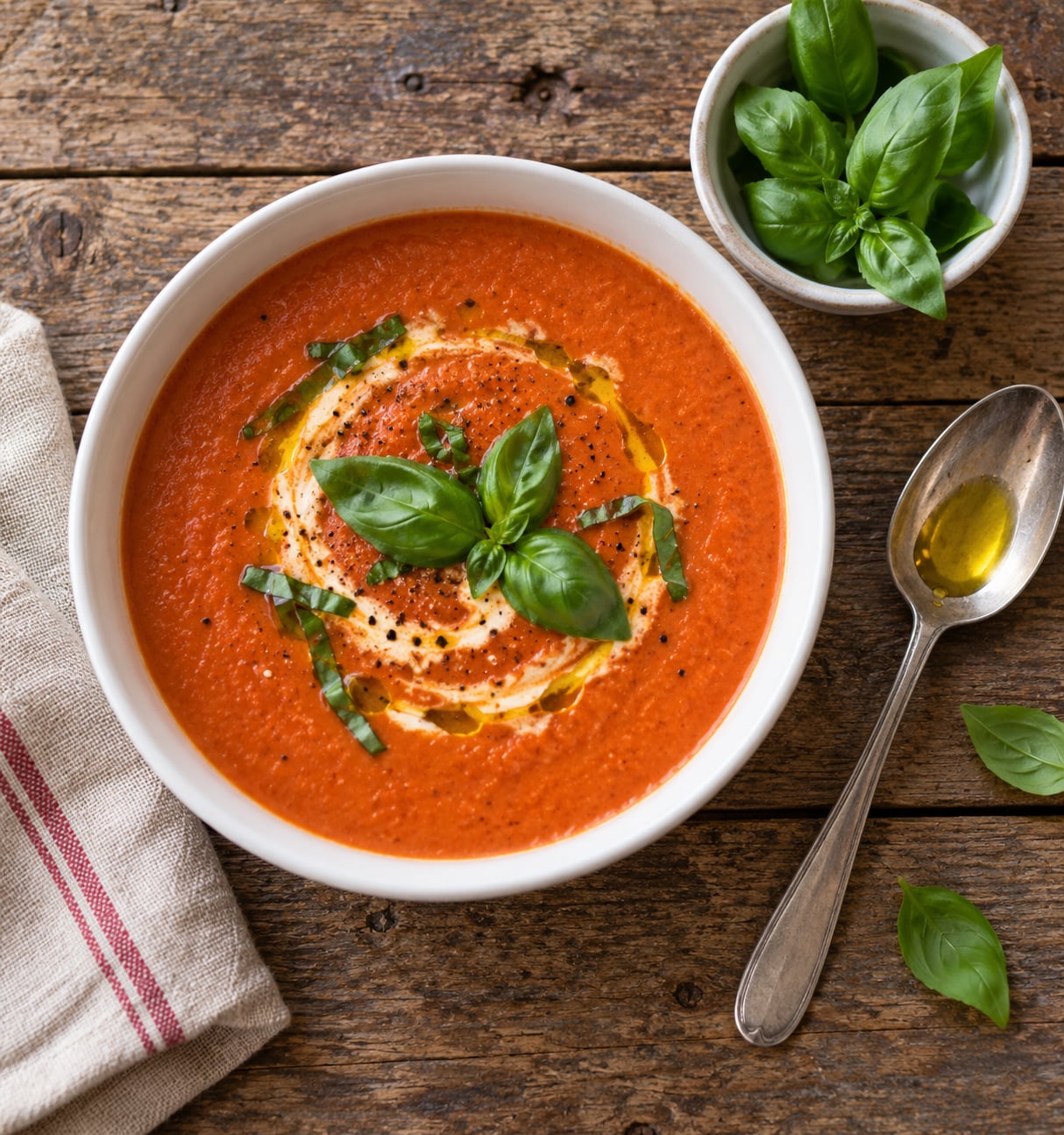
To make tomato basil soup creamy, pull one or more of three levers: blend the soup until every bit of tomato pulp is suspended, add fat such as cream or butter, or add starch such as potato, bread or a cornstarch slurry. Blending alone is free and takes 90 seconds. Cream adds richness. Starch adds body without dairy. Most good bowls combine two of the three.
That matters because a tomato soup can be fully pureed and still taste thin. The pulp is what reads as creaminess, and until it is actually broken down, more stock will not fix it. It just dilutes what you have.
Below is the whole method, the quantities for four servings, and the fixes for the three things that go wrong most often: watery soup, curdled dairy and black basil.
Table of Contents
- What You Need
- Step-by-Step: How to Make Tomato Basil Soup Creamy
- Step 1: Build the Flavor Base
- Step 2: Simmer the Tomatoes and Broth
- Step 3: Blend for a Silky Texture
- Step 4: Add Cream or a Dairy-Free Thickener
- Step 5: Finish and Adjust the Soup
- Common Mistakes and How to Fix Them
- How to Choose the Creamiest Method
- How to Store Tomato Basil Soup
- Frequently Asked Questions
- Can I make tomato basil soup creamy without heavy cream?
- What is the best way to thicken tomato basil soup?
- Why did my tomato basil soup turn out watery?
- How do I keep cream from curdling in tomato soup?
- Can I use milk or half-and-half in tomato basil soup?
- How long does homemade tomato basil soup keep?
- Conclusion
What You Need
This base makes about four 12-ounce servings and takes roughly 40 minutes.
- 2 tablespoons olive oil (30 ml), plus 2 tablespoons butter (30 g) if you want a rounder base
- 1 yellow onion, diced (about 1 cup / 150 g)
- 3 garlic cloves, thinly sliced
- 2 x 28-ounce cans whole peeled tomatoes (800 g each), undrained
- 3 cups low-sodium chicken or vegetable broth (710 ml)
- 1 to 1.5 pounds cubed Yukon Gold potato (450-680 g), optional but this is the invisible thickener
- 1 packed cup fresh basil (about 25 g), plus dried basil or 1 teaspoon dried basil for the simmer
- 1 teaspoon sugar, optional, to balance the acidity of the tomatoes
- 1/2 cup heavy cream (120 ml) added off the heat, or 1/2 cup full-fat coconut milk for a dairy-free version
- Kosher salt and black pepper to taste, plus 1/4 cup grated Parmesan
An immersion blender is the tool that matters here. A countertop blender works, but blending hot soup in batches takes twice as long and needs a towel over the lid.
For a lactose-free version, swap the cream for full-fat coconut milk or an unsweetened cashew cream, and use vegetable broth instead of chicken. For a lower-fat bowl, use half-and-half in place of the cream and expect less richness but the same body if the potato stays in.
Step-by-Step: How to Make Tomato Basil Soup Creamy
Step 1: Build the Flavor Base
Heat the olive oil and butter in a heavy pot over medium heat. Add the onion and a pinch of salt, then cook 6 to 8 minutes until the onion is soft and translucent at the edges. Add the garlic for the final minute.
You are looking for onions that have gone soft and lost their raw bite, not onions that have browned. Browning adds sweetness, which is fine, but it also darkens the color of the finished soup and can push it toward bitter once the tomatoes cook down. That is the single most common mistake in the flavor base.
If you are using potato, add the cubes now with 1/2 cup of the broth and cook them 5 minutes until they start to soften at the edges. They will finish cooking during the simmer.
Step 2: Simmer the Tomatoes and Broth
Crush the canned tomatoes by hand as you drop them in, then add the remaining broth, the dried basil, 1 teaspoon sugar and a few grinds of pepper. Bring the pot to a boil, then turn the heat down until you see a bubble every second or two. Simmer, partly covered, for 25 to 30 minutes.
A rolling boil is not what you want. It skims off aromatics and can make the soup taste flat no matter how much cream goes in later. A gentle simmer concentrates the tomato flavor and keeps the basil oils from evaporating.
The potato is ready when a knife slides through a cube with no resistance. If you skipped the potato, this is the point where you can reduce instead: simmer uncovered for another 10 minutes until the liquid level drops and the soup thickens on its own.
Step 3: Blend for a Silky Texture
This is where most of the creaminess actually comes from. Tomato soup reads as thin because of suspended pulp, not because of liquid, so pureeing that pulp into the broth is what creates a body you can taste with no added fat at all.
With an immersion blender, set the blade just below the surface and pulse in short bursts, angling it toward the bottom of the pot so the last of the solids get pulled in. Keep the blade submerged the whole time or the lid will splatter. Work for a full 60 to 90 seconds, scraping the sides once halfway through. Stop when there are no visible flecks and the soup coats the back of a spoon.
There is a style dial here if you want one. Blend until completely smooth for a silky bisque, or stop at about 75 percent smooth for a rustic soup with a little texture. That partial blend is where the potato helps most, since it keeps some bite.
With a countertop blender, cool the soup for 5 minutes first, fill the jar no more than halfway, drape a kitchen towel over the lid and hold it down firmly, then pulse in 5-second bursts. Pour each batch into a second pot and repeat until the pot is empty. Do not fill a blender jar more than half with hot liquid; the steam pushes the lid off and you will be wearing the soup.
Step 4: Add Cream or a Dairy-Free Thickener
Turn the heat off and let the soup sit for a minute or two before anything dairy goes in. Then stir the cream in a little at a time and taste after each addition. Adding all 1/2 cup at once is how you get a soup that is suddenly thinner than you wanted.
Here is how the main options differ:
- Heavy cream adds the most richness and the most calories. Stir in 1/4 to 1/2 cup per quart of soup and stop when the spoon leaves a clean line.
- Half-and-half gives you roughly two-thirds the richness of cream at a lighter weight. Use 1:1.
- Whole milk works and is the cheapest dairy option, but it is the least forgiving. Add it off the heat and keep it below a simmer, or it can break.
- Evaporated milk is the underrated one. Because the water is already gone, it adds body and a rounded sweetness without thinning the soup, and it holds together better on reheating. Use 1:1.
- Full-fat coconut milk is the best dairy-free swap for richness. Use 1:1 and expect a faint coconut note, which disappears if you add 1 teaspoon sugar.
- Greek yogurt adds tang and body. Use 1/2 cup per quart and whisk it in a bowl with a little warm broth before stirring it through, off the heat.
If you are avoiding dairy entirely, the starch route is the one that works: keep the potato in, simmer 2 slices of torn sourdough in the broth for the last 10 minutes and blend them in, or whisk in 1 tablespoon of cornstarch slurry per quart.
Stir the cream or milk in and then keep the soup below 140F or warm but never boiling. Boiling a cream-enriched soup is the fastest way to curdle it.
Step 5: Finish and Adjust the Soup
Taste before you season. Canned tomatoes and broth are already salty, so the fix for a flat-tasting creamy tomato soup is often salt, not more cream. Add kosher salt a pinch at a time until the tomato flavor tastes bright rather than muted, then add black pepper.
If it still tastes sharp, add 1 teaspoon sugar, half a teaspoon at a time. Sugar does not make it sweet; it pulls the acid back into balance.
Stir in the fresh basil now, off the heat, torn or shredded by hand rather than chopped. Save 1/4 cup to scatter over each bowl at the table. To adjust thickness, stir in broth a quarter cup at a time to loosen, or warm the soup uncovered for five minutes to tighten it. Serve at around 140F, hot enough to smell the basil but below the temperature where dairy starts to protest.
Ladle it into bowls and finish with Parmesan and a drizzle of olive oil. For leftovers, cool the soup in shallow containers rather than the stockpot.
Common Mistakes and How to Fix Them
The soup is watery. Usually the broth was too generous, or the soup was not simmered long enough to cook off water. Do not add more broth. Simmer uncovered for 10 to 15 minutes and stir in a cornstarch slurry (1 tablespoon cornstarch whisked into 2 tablespoons cold water per quart) if it is still thin. This is the most common complaint I see, and the answer is always concentration, not dilution.
The soup is too thick. You over-reduced it or used too much potato. Whisk in warm broth or water, 1/4 cup at a time, and stop as soon as it ribbons off the spoon.
The dairy curdled or the soup turned grainy. The cream went in too hot, or the soup boiled after you added it. Take it off the heat and whisk hard, fast and cold for about a minute. That breaks the protein into small pieces and emulsifies it back into the liquid, so you get a slightly thinner soup instead of curds. If it is badly split, an immersion blender with the soup barely warm is the surest fix. Next time, add dairy below 140F and never bring it to a boil.
The soup tastes flat after blending. That is a suspension and seasoning problem, not a blending problem. Blend another 30 seconds, add salt, then check the acid balance with sugar or a squeeze of lemon.
The basil turned black or bitter. Long boiling cooked the leaves into the broth. Pull the fresh basil out before the final simmer and add it off the heat. The black flecks will not bother most people, but the aroma is gone.
The soup turned grainy after freezing. Cream and starch both separate when frozen and break when thawed. Freeze cream-free versions when you can, cool the soup fully, leave a finger of space in the container, and reheat slowly on the stove with a splash of broth and a whisk.
How to Choose the Creamiest Method
Different priorities point to different methods. If the soup is already cooked and simply tastes thin, blending is your fastest fix. If you are planning the dish from scratch and want restaurant-level texture with no dairy, starch and blending together do the work.
| Method | What you add | Effort | Texture result | Dietary fit | Best use |
|---|---|---|---|---|---|
| Blend thoroughly | Nothing | 90 seconds | Silky, light-bodied | Vegan, gluten-free | Soup that already tastes thin |
| Starch in the pot | Potato, torn bread, white beans or a slurry | 10-30 minutes of simmering | Full body, coats the spoon | Gluten-free with potato or beans | Cream-free bowls, meal prep |
| Reduce the broth | Nothing | 10-15 minutes uncovered | Concentrated, slightly rustic | Any | When you do not want to add anything at all |
| Add cream or dairy | 1/4 to 1/2 cup per quart | One minute off the heat | Rich, slippery, restaurant-style | Vegetarian | Dinner parties and cold weather |
| Whisk in fat | Butter, olive oil, crème fraîche | One minute | Glossy, rounded | Vegetarian | Finishing a thinner soup |
| Roux or slurry | Butter and flour, or cornstarch | 5 minutes | Thick, almost bisque-like | Vegetarian | Rescuing a very thin batch |
The combination that wins most often is blending plus starch for body, then a small amount of cream for flavor. If you want to know how to make tomato basil soup creamy without dairy at all, use the potato and torn bread together and skip step 4 entirely.
How to Store Tomato Basil Soup
Cool the soup before you store it. Ladle it into shallow containers so it cools within about two hours, then cover them tightly and refrigerate. Tomato soup keeps 3 to 4 days in the refrigerator at or below 40F.
For the freezer, leave about 1 inch of headroom, cool the soup completely first, and freeze in a freezer bag or a lidded container. It keeps 2 to 3 months. Get it out of the cold with the refrigerator or a cold bowl of water rather than the counter, then thaw it gently on the stove over low heat.
Cream-enriched soup and dairy-free versions behave differently after thawing. Dairy tends to separate and can taste slightly grainy, so stir in a splash of broth and whisk hard as it warms. A potato or bread-starch version holds its texture surprisingly well, and a coconut milk version reheats fine as long as you keep the heat low. Fresh basil does not survive freezing well, so stir in a new handful when you reheat.
Reheat only the portion you plan to eat and bring it to 165F, stirring now and then. Let it simmer for a couple of minutes, not a rolling boil.
Frequently Asked Questions
Can I make tomato basil soup creamy without heavy cream?
Yes, and most people get a better result than cream gives them. Simmer 1 to 1.5 pounds of cubed Yukon Gold potato in the broth for the last 20 minutes, then blend the whole pot until smooth. The potato starch does the work cream would do. You can also simmer 2 slices of torn sourdough in the broth for the final 10 minutes and blend those in. Finish with a tablespoon of olive oil or a swirl of butter for slip.
What is the best way to thicken tomato basil soup?
Start by simmering it uncovered for 10 to 15 minutes, which concentrates the liquid without adding anything. If it is still thin, whisk 1 tablespoon of cornstarch into 2 tablespoons of cold water per quart and stir it in while the soup is hot. It thickens within a minute. For a longer cooking route, add cubed potato at the beginning and blend it in at the end. Avoid adding more broth, which makes the problem worse.
Why did my tomato basil soup turn out watery?
Two causes account for nearly every watery batch: too much broth, and not simmering long enough. Liquids release water as the tomatoes cook, so the pot needs time and a gentle boil to shed it. Simmer uncovered for 10 to 15 minutes and stir in a cornstarch slurry if it is still loose. A second cause is blending too early, before the tomatoes have collapsed, which leaves you with thin liquid and chunky pulp instead of a suspension.
How do I keep cream from curdling in tomato soup?
Add dairy with the heat off or very low, and never let the soup boil afterward. Acid plus agitation plus heat is what breaks the protein. If it already split, whisk hard and fast, sometimes with a tablespoon of cold water, until the fat re-emulsifies into the liquid. The soup will be slightly thinner than you wanted but smooth again. Blending it with an immersion blender while it is only warm is the surest rescue for a badly split batch.
Can I use milk or half-and-half in tomato basil soup?
Both work at a 1:1 swap for heavy cream, with half-and-half landing closer to the original richness. Whole milk gives you the lightest result and is the least forgiving, so add it off the heat and keep it below a simmer. For the best dairy texture without the risk, use evaporated milk, which has already lost its water, so it adds body instead of thinning the soup. Evaporated milk also reheats and freezes more gracefully than cream.
How long does homemade tomato basil soup keep?
Refrigerated at or below 40F in a sealed container, tomato basil soup keeps 3 to 4 days. Cool it in shallow containers first so it drops to a safe temperature within about two hours. In the freezer it keeps 2 to 3 months, though cream-based versions often separate and come back grainy, while potato or bread-starch versions hold their body better. Add fresh basil after reheating rather than before freezing.
Conclusion
Simmer the tomato broth long enough to cook off water, then blend the whole pot for a full 90 seconds before anything else goes in. That single step fixes most thin soups on its own.
After that, adjust by eye: starch or reduction for body, cream or olive oil for richness, salt for brightness, and a little sugar if the tomatoes still taste sharp. Tear the fresh basil in off the heat, keep it under a simmer once dairy is added, and serve around 140F so the basil aroma is at full strength.