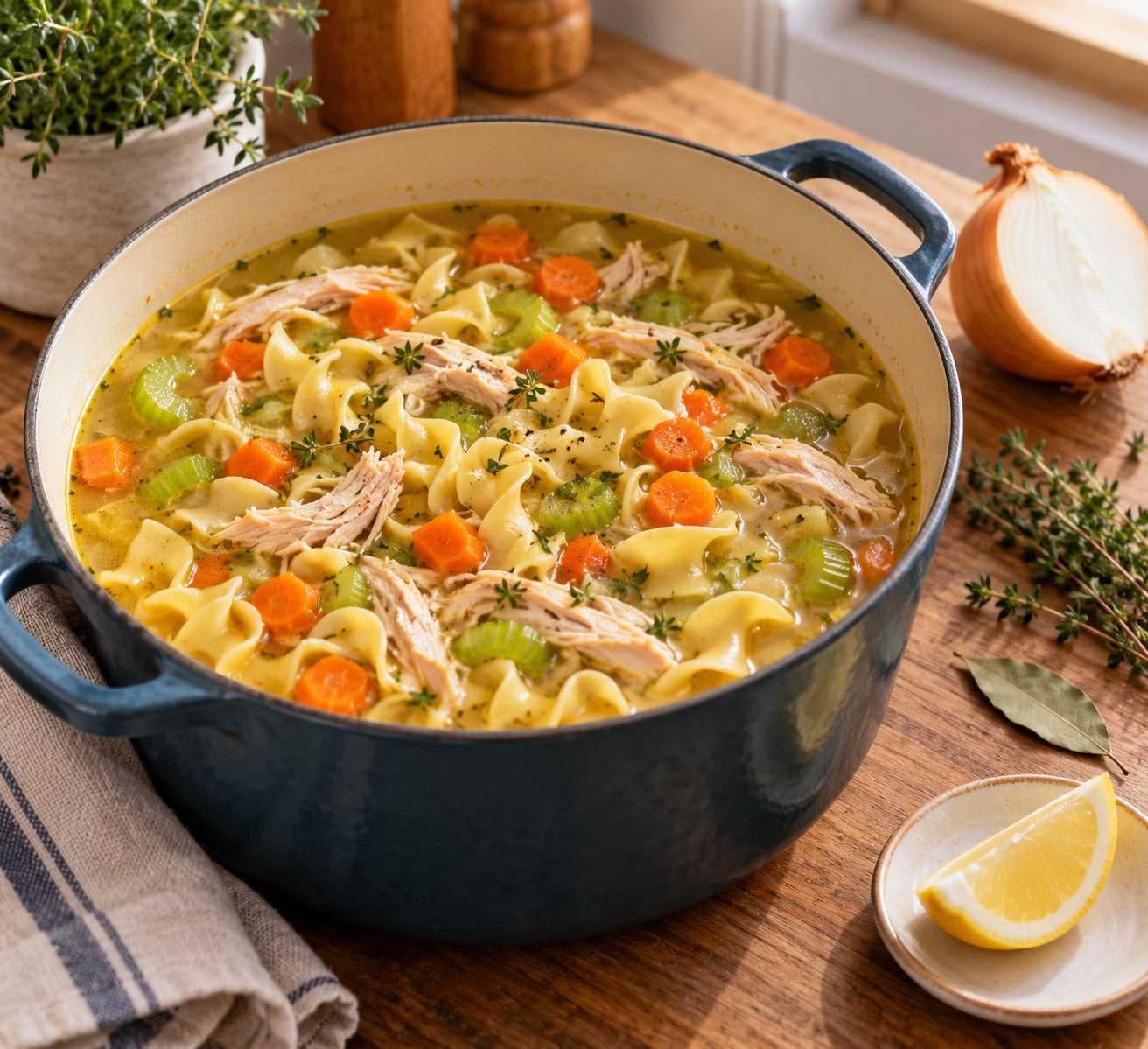
Homemade chicken noodle soup from scratch takes about two and a half hours, most of it hands-off, and gives you roughly eight bowls. You brown bone-in chicken in a hot pot, loosen the browned bits with water, then simmer everything low until the meat shreds and the broth turns deep gold.
Store-bought broth gets you a fast bowl. This method gets you the real thing: collagen pulled off the bones, fat emulsified into the liquid, and vegetables that still taste like vegetables. Below is the method I cook, including the noodle timing and the salt discipline that most recipe pages skip.
Prep: 20 minutes · Cook: 2 hours 15 minutes · Total: about 2 hours 35 minutes · Yield: 8 servings
Quick note on what “from scratch” means here: no canned broth, no bouillon granules, no rotisserie chicken. The only shortcut I allow myself is using a leftover roast chicken carcass, which turns the cook time down to about 40 minutes and still gives you a pot of broth worth drinking on its own.
Table of Contents
- What You Need
- For the broth
- For the soup
- For finishing
- Equipment
- Bone-in or boneless: which should you use?
- Step-by-Step: How to Make Chicken Noodle Soup From Scratch
- Build the Broth
- Add the Vegetables and Noodles
- Which noodles to use, and when
- Common Mistakes
- Why Homemade Chicken Noodle Soup Tastes Bland
- Storing, Freezing, and Reheating
- Frequently Asked Questions
- Can I make chicken noodle soup from scratch using boneless chicken?
- How long should I simmer chicken for chicken noodle soup?
- Can I use egg noodles or another noodle in this recipe?
- How do I keep the noodles from getting soggy?
- How long does homemade chicken noodle soup last in the refrigerator?
- Can I freeze chicken noodle soup with the noodles?
- Conclusion
What You Need
The ingredient list is short and every item earns its place. Quantities below are for about 8 servings, with metric in parentheses.
For the broth
- 2 to 3 pounds (900 g to 1.4 kg) bone-in, skin-on chicken pieces — thighs, drumsticks, wings, or a whole bird cut into pieces
- 1 tablespoon neutral oil such as canola or grapeseed
- 1 large yellow onion, halved
- 1 bay leaf
- 6 sprigs fresh thyme, or 1 teaspoon dried thyme
- 1 tablespoon kosher salt, plus more to taste
- 12 cups (2.8 L) cold water, plus extra as needed
For the soup
- 3 carrots, peeled and cut into half-inch pieces
- 3 celery stalks, cut into half-inch pieces
- 1 small yellow onion, finely diced
- 2 cloves garlic, minced
- 3 cups (255 g) dried wide egg noodles, or 340 g fresh
- 1 tablespoon unsalted butter
- Freshly ground black pepper
For finishing
- 1 tablespoon fresh lemon juice
- A handful of fresh dill, parsley, or scallions, chopped
- Grated Parmesan or a drizzle of heavy cream, optional
Equipment
You need a 6-quart stockpot with a lid, a fine-mesh strainer lined with cheesecloth, a Dutch oven or second pot for blanching the vegetables, and two forks for shredding. A heavy pot matters more than an expensive one, because searing and steady heat are doing the work.
Bone-in or boneless: which should you use?
| Chicken choice | Flavor | Cook time | Best use |
|---|---|---|---|
| Bone-in, skin-on thighs and drumsticks | Deepest and richest; bones and skin give up collagen and fat | 90 to 120 minutes | Soup you want to brag about |
| Whole chicken, cut up | Best of all; you use the frame for a second simmer | 2 to 3 hours | Sunday cooking, big batches |
| Boneless, skinless breast | Clean and mild; less body from the meat itself | 25 to 35 minutes | Quick weeknight version |
| Leftover roast chicken plus carcass | Very good, slightly less fresh | 40 minutes | Using what you already have |
Skin matters more than most people expect. That outer layer renders down into the broth and gives it a rounded, savory weight you cannot get from skinless pieces in the same time.
Step-by-Step: How to Make Chicken Noodle Soup From Scratch
Build the Broth
1. Salt the chicken in layers. Sprinkle the kosher salt over every surface of the pieces, a bit more on the thighs than the wings. Seasoning early seasons the meat itself, not just the water around it.
2. Sear the pieces hard. Heat the oil in the stockpot over medium-high heat until it shimmers. Lay the chicken in skin-side down in a single layer and leave it alone for 3 to 4 minutes. You want golden, deeply browned skin, and moving it too early is how you get pale, steamed skin instead.
3. Deglaze the pot. Turn the chicken, cook 2 more minutes, then lift it out onto a plate. Pour the cold water into the hot pot and scrape the bottom with a wooden spoon for about 30 seconds. Those stuck brown bits are fond, and they dissolve into the water and become the backbone of the broth.
4. Return the chicken and season the liquid. Put the pieces back in, add the halved onion, bay leaf, thyme, and the scraped-up fond. Add enough cold water to cover the chicken by about 2 inches (5 cm), which usually lands near 12 cups (2.8 L).
5. Skim the foam. Bring the pot to a bare tremble, then turn the heat down so you see one bubble every second or two. A rolling boil turns chicken protein into gritty particles and keeps the broth cloudy. In the first 15 minutes, skim off the grey foam and any lumps of protein with a spoon or a strainer held at the surface.
6. Simmer until the chicken gives way. Cover and simmer for 1 hour to 1 hour 30 minutes for bone-in pieces, or about 40 minutes if you started with a roast chicken carcass. The chicken is done when it hits 165°F (74°C) at the thickest part and pulls apart with almost no resistance. Pull it out, let it cool a few minutes, and shred it with two forks. Reserve the broth.
7. Strain the broth. Pour it through a fine-mesh strainer lined with cheesecloth into a clean pot. Do not press hard on the solids; let them drain. You should end up with roughly 10 cups (2.4 L) of clear, golden broth.
If you started with a whole bird, put the bones back in the strained pot with 4 cups (950 ml) of water and simmer another 45 to 60 minutes for a second, lighter broth. Home cooks do this constantly, and the second round is arguably the best stock in the whole pot.
Add the Vegetables and Noodles
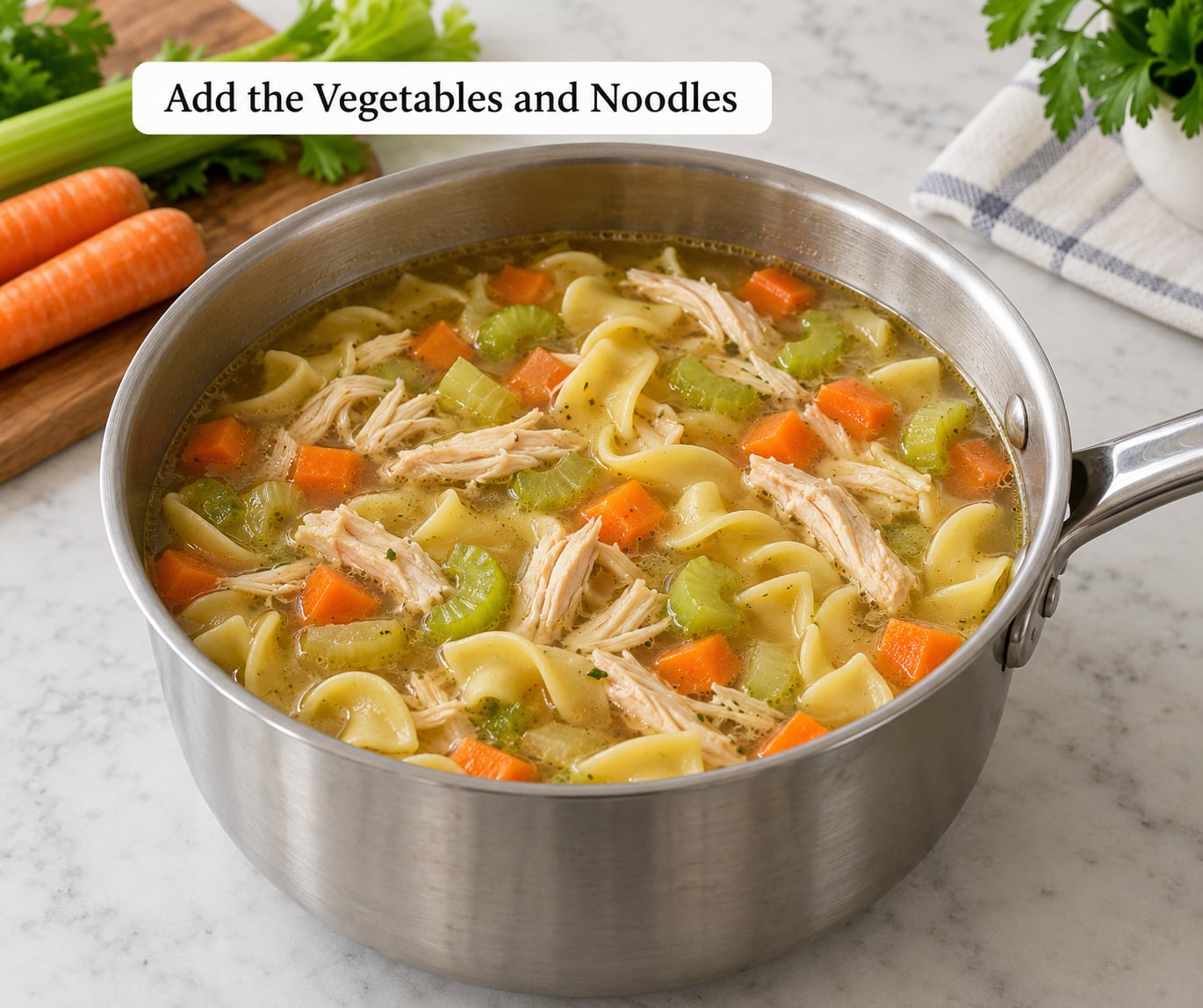
8. Blanch the firm vegetables. Bring a pot of salted water to a boil. Add the carrots and celery and cook for 3 to 4 minutes until they lose their raw edge but still have bite. Scoop them straight into the hot broth.
Why blanch at all? Because the broth is barely warm when the vegetables go in, and carrots that spend an hour in liquid that never quite boils turn soft and dull. Three minutes in boiling water gets them to the right texture in under a minute of gentle reheating.
9. Build the aromatics in the same pot. Melt the butter in the soup pot over medium heat. Cook the diced onion for 4 to 5 minutes until soft and just translucent, then add the garlic for 30 seconds. Add the shredded chicken and stir to warm it through.
10. Add the broth and season. Pour in the strained broth, add the blanched carrots and celery, and bring the whole thing back to a simmer. Taste it now, with a clean spoon, before anything else goes in. It should taste slightly under-seasoned, because the noodles and any garnish will add salt later. Add kosher salt and a few grinds of pepper.
11. Cook the noodles separately, or add them in. The cleanest result comes from boiling the noodles in a separate pot of salted water for the time on the package, then draining and adding them to the bowls. Same pot is faster and fine; it just means the noodles release starch into the broth, which thickens the bowl naturally. Both work.
12. Rest the pot off the heat. When the noodles go in, turn the burner down to low, or take the pot off the heat entirely. Let it stand for 5 minutes before serving. Noodles keep cooking from residual heat and from the steam trapped under the lid, and that extra cooking is exactly what turns tender noodles into mush. This single step fixes the most common complaint about homemade noodle soup.
13. Finish and serve. Take the pot off the heat and add the lemon juice, then taste again. Salt, pepper, and a last squeeze of lemon until the broth tastes complete. Ladle into bowls, scatter over the dill or parsley, and add Parmesan or a thread of cream if you want a richer bowl.
Which noodles to use, and when
| Noodle | Cook time | How much per 2 quarts (1.9 L) of broth | Notes |
|---|---|---|---|
| Wide egg noodles | 8 to 9 minutes | 2 cups (170 g) | The classic pick; holds up well in broth |
| Extra-wide egg noodles | 8 to 10 minutes | 1.5 cups (130 g) | Hearty; use less so the bowl is not all noodle |
| Thin or fine egg noodles | 4 to 5 minutes | 2 cups (150 g) | Cooks fast, so add late and watch it |
| Gluten-free rice or chickpea noodles | Package time, usually 4 to 6 minutes | 2 cups (140 g) | Less starch, so the broth stays thinner |
| Fresh refrigerated noodles | 3 to 4 minutes | 8 oz (225 g) | Softest texture; add right before serving |
| Egg noodles from a bag | Package time | 2 cups (170 g) | Any brand works; the recipe is not fussy here |
That ratio is the piece of math recipe pages usually leave out. One cup of dried noodles per two quarts of broth gives you a bowl that reads as soup. Two cups per two quarts gives you a bowl that reads as stew.
Common Mistakes
Almost every disappointing bowl of homemade chicken noodle soup comes down to one of six things. They are all fixable, and most are fixable the next time you make it.
The broth is bland. Seasoning every layer for the first time is the fix. See the next section for the full list of causes.
The broth is cloudy and greasy. Two habits prevent it: skim the foam in the first 15 minutes, and strain the finished liquid through cheesecloth. Never skim during a rolling boil, and do not press down on the solids while straining.
The chicken is tough and stringy. Usually it sat in boiling water for an hour. Keep the heat at a bare simmer, pull the pieces at 165°F (74°C), and shred them separately. Chicken simmered alongside the vegetables for the full hour will turn dry no matter how gentle the heat was.
The noodles are mushy. Take the pot off the heat after they go in, and hold the lid off while they cook. Starch keeps swelling as the broth cools, so a pot that sits for 20 minutes before everyone sits down will have soup-trapped noodles by the second bowl.
The soup turned into stew. Boneless breasts release a lot of water as they cook, and an uncovered pot loses another cup or two to evaporation. Start with more liquid than you think you need, keep the lid on, and if it still thickens, loosen each bowl with a splash of hot water at the table.
The soup is too salty. It usually happens when you keep adding bouillon or salt to a broth you have already reduced. Add water, not more salt. Start with unsalted water and season in layers, and you will not end up here.
Why Homemade Chicken Noodle Soup Tastes Bland
Five things cause bland homemade chicken noodle soup, and each has a direct fix.
- You never browned the chicken. Unbrowned chicken gives a thin, watery broth. Sear skin-side down until the skin is genuinely golden, then deglaze the pot and let those brown bits go back into the water. This is the single biggest upgrade over the shortcuts.
- You started with unsalted water and salted only at the end. Salt at the beginning of the simmer, not the finish. It seasons the meat and the broth instead of sitting on the surface.
- No aromatics went in. Onion, celery, garlic, a bay leaf, and thyme are not decoration. Cook the diced onion until translucent before the liquid goes in, and add garlic for the last 30 seconds of that step.
- No acid at the end. A tablespoon of lemon juice makes an under-seasoned broth taste twice as finished. Taste with a clean spoon, add lemon, then taste again.
- No fat in the bowl. A spoon of butter stirred in off the heat, or shredded chicken still carrying its skin, rounds out the flavor. Restaurant soups get this from fat emulsified into the broth, which is why they taste finished in a way a lean pot does not.
One more habit: taste at three points, not just at the end. After the broth is strained, after the vegetables go in, and after the lemon. Salt is layered, and the last layer hides what is missing.
Storing, Freezing, and Reheating
Chicken noodle soup keeps well, and it keeps better if you store the chicken and the noodles apart.
| What | Fridge | Freezer | Best method |
|---|---|---|---|
| Finished soup with noodles | 3 to 4 days | Not recommended; noodles go soft | Cool quickly, cover shallow containers |
| Broth without noodles | 4 days | 3 to 4 months | Portion into 1-quart containers or bags |
| Cooked shredded chicken | 3 to 4 days | 3 months | Freeze in broth or sauce, not dry |
Let the soup cool in shallow containers rather than one deep pot, then refrigerate within two hours. To freeze, cool the broth fully and leave the noodles out; cook fresh noodles when you reheat. Cooked chicken kept in liquid freezes far better than chicken kept dry, because it does not freeze into strands.
To reheat, bring the broth to a full rolling simmer and heat until the thickest pieces reach 165°F (74°C), stirring now and then. If the broth has thickened in the fridge, loosen it with a splash of hot water first, and add the noodles in the last 5 minutes.
Frequently Asked Questions
Can I make chicken noodle soup from scratch using boneless chicken?
Yes, and it is much faster. Sear boneless, skinless breasts for 3 to 4 minutes a side, then simmer them in the broth for about 25 minutes, until they reach 165 F (74 C). Pull them out, shred, and return them at the end. You trade some depth in the broth for about an hour of your afternoon, and the finished soup still beats anything from a can.
How long should I simmer chicken for chicken noodle soup?
Bone-in pieces need 90 minutes to 2 hours at a low simmer for the best broth. Boneless breasts only need 25 to 35 minutes, since they are just waiting to shred. The broth itself can simmer for hours; the chicken cannot. Check temperature, not time, and pull pieces the moment they hit 165 F (74 C).
Can I use egg noodles or another noodle in this recipe?
Egg noodles are the classic choice and need nothing special. Wide noodles give the most traditional bowl, while thin noodles cook in half the time and need closer watching. Rice noodles or gluten-free noodles work too, though they release less starch so the broth stays thinner. One cup of dried noodles per two quarts of broth is the right starting amount for any type.
How do I keep the noodles from getting soggy?
Three habits do most of the work. Cook the noodles in a separate pot and add them only at the table, add them to the hot broth only in the last few minutes rather than the last half hour, and take the pot off the heat once they are in. Noodles keep cooking in the residual heat and trapped steam, so a five-minute rest off the heat keeps them tender instead of soft.
How long does homemade chicken noodle soup last in the refrigerator?
Three to four days when stored properly, which means cooling it quickly in shallow containers and covering them before refrigerating. Keep the soup at or below 40 F (4 C) and reheat only the amount you plan to eat. If it smells off, looks cloudy from sitting uncovered, or has been out more than two hours, toss it rather than tasting it.
Can I freeze chicken noodle soup with the noodles?
You can, but the noodles go soft and bloated in the freezer and the broth turns cloudy and thick. Much better to freeze the broth without them and cook fresh noodles when you eat it, which takes four minutes. Frozen broth keeps three to four months, and frozen shredded chicken in broth keeps about three. Thaw overnight in the fridge rather than over the counter.
Conclusion
Start by browning the chicken properly, because that one step decides whether the bowl is good. Give it a hot pot, skin-side down, and let it develop real color before anything else goes in the stockpot.
Then give the broth a low simmer with the lid on and the spoon in your hand, and skim it while you have other things to do. Shred the chicken separately, salt in layers, add the vegetables just before they turn soft, and hold the noodles off the heat. That is how to make chicken noodle soup from scratch that tastes like the ones people claim they can only get from a diner.
Serve it hot with a lemon wedge on the side, fresh dill over the top, and a piece of crusty bread for the bottom of the bowl.