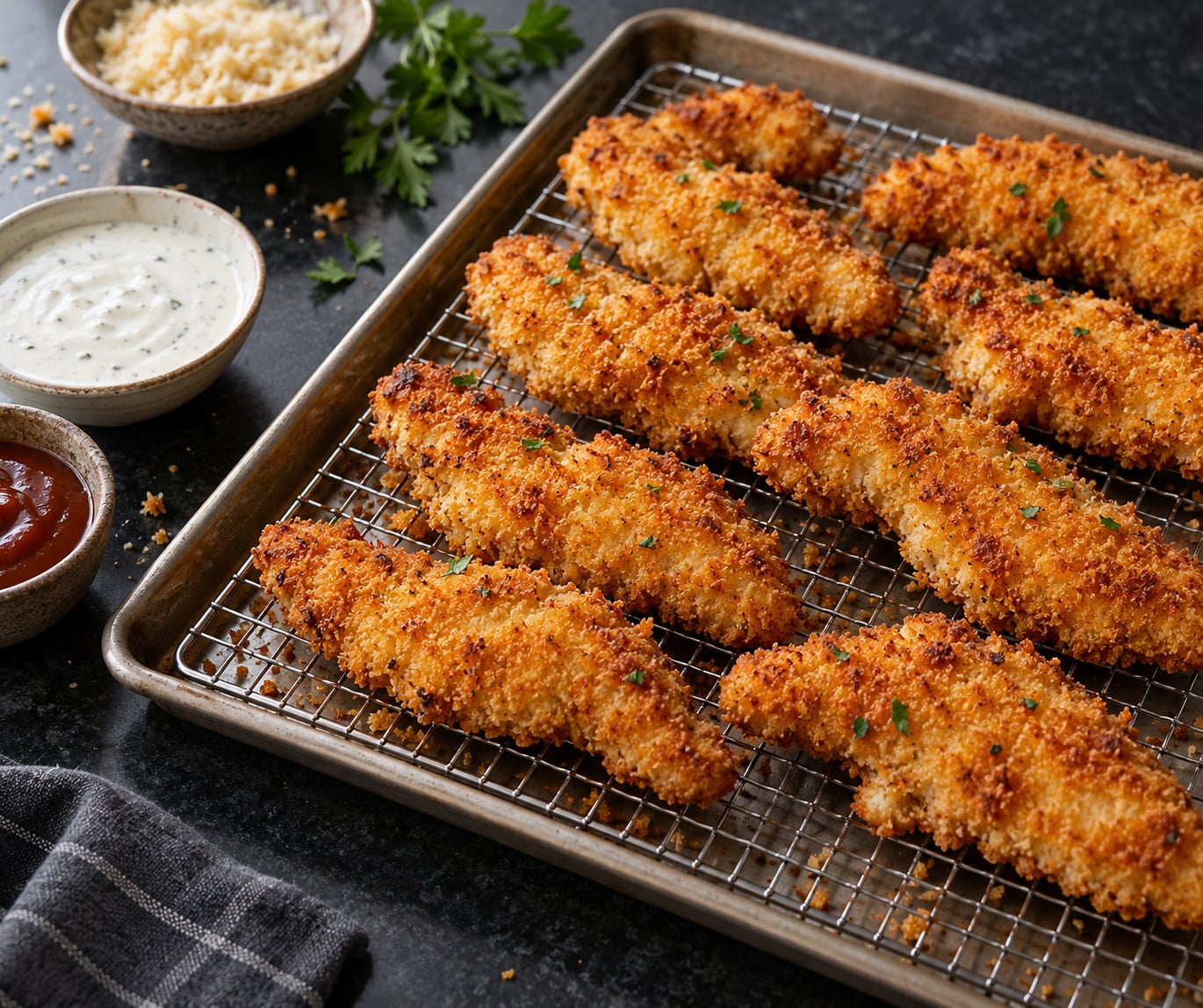
To make chicken tenders crispy in the oven, use pre-toasted panko breadcrumbs, a wire rack set over a rimmed baking sheet, a light spray of oil, and a fully preheated oven at 425°F (220°C). Bake 15 to 20 minutes, turning once at the halfway mark, until the crumb is deep gold and the thickest tender reads 165°F (74°C).
That gives you a shattering coating and a juicy center in about 35 minutes, with no fryer and almost no cleanup. A chicken tender is the strip of meat tucked directly under the breast bone. It is naturally tender, needs no trimming, and one whole breast yields five or six strips.
Table of Contents
- What You Need
- Ingredients
- Equipment
- Good sauces to serve alongside
- Step-by-Step: How to Make Chicken Tenders Crispy in the Oven
- Prepare the Chicken and Coating
- Coat the Chicken Evenly
- Bake Until Golden and Cooked Through
- Let Them Rest and Serve
- 350°F vs 400°F vs 425°F: Which Temperature Crisps Them Best
- Common Mistakes
- Why aren’t my chicken tenders crispy?
- Tips for even crispier results
- Frequently Asked Questions
- What temperature makes chicken tenders crispy in the oven?
- Should I bake chicken tenders on parchment paper or a bare sheet pan?
- Can I use frozen chicken tenders for this recipe?
- How do I keep baked chicken tenders crispy after serving?
- Can I make chicken tenders crispy without breadcrumbs?
- How long should I bake chicken tenders at 425°F?
- Conclusion
What You Need
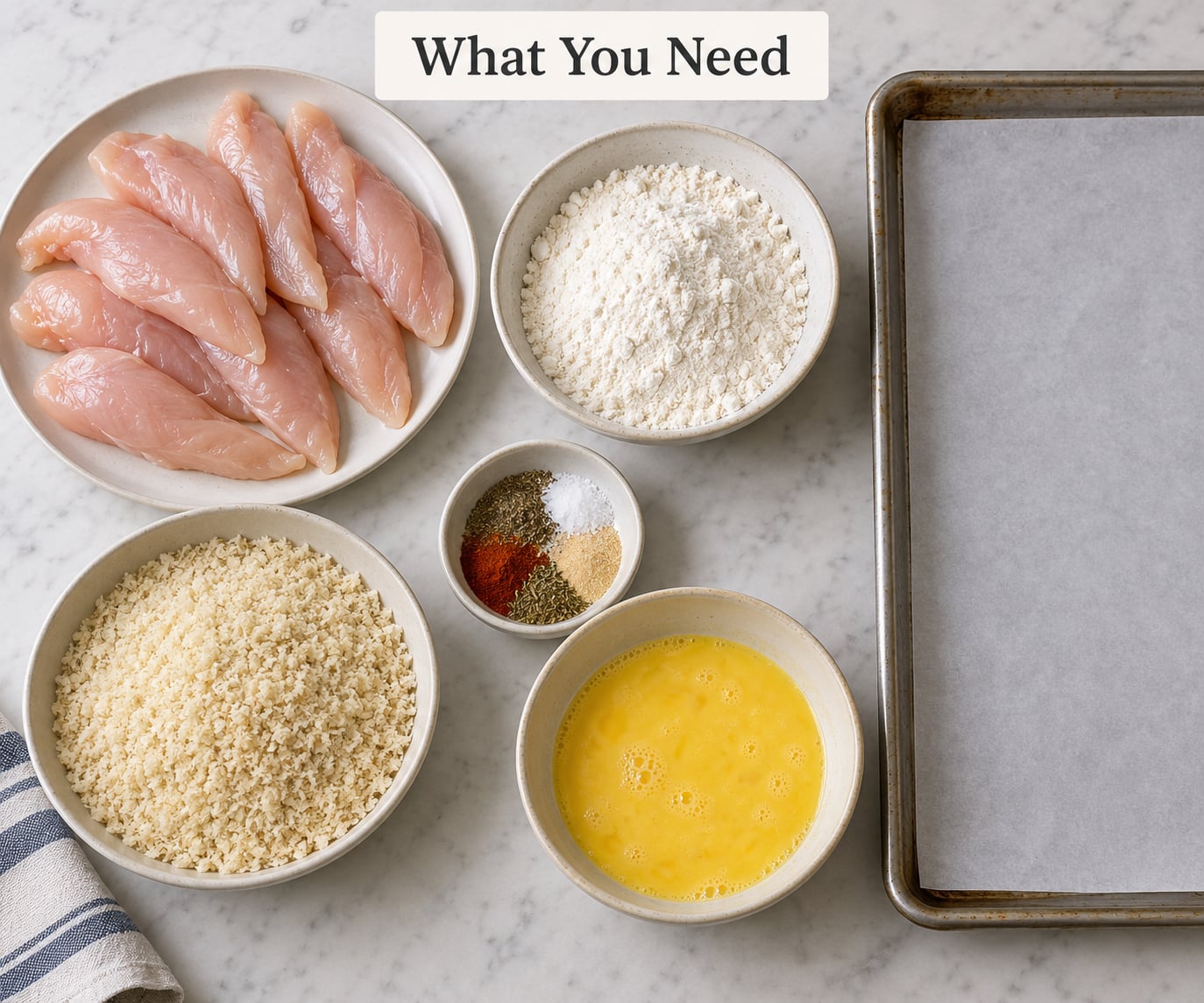
Ingredients
- 1.3 lb (600 g) chicken tenderloins, or 4 to 5 whole breasts sliced into strips
- 1 cup (125 g) all-purpose flour for the dredge
- 2 tsp baking powder or cornstarch (optional, for a louder crunch)
- 1 tsp salt, 1 tsp black pepper
- 1 tsp paprika, 1 tsp garlic powder, 1/2 tsp onion powder
- 2 large eggs, beaten with a splash of water
- 1 1/4 cups (90 g) panko breadcrumbs
- 1/2 cup (50 g) grated Parmesan cheese (optional but recommended)
- Cooking spray or neutral oil for the crumb and the rack
Equipment
- A rimmed baking sheet (half sheet, not a deep pan)
- A wire cooling rack that fits inside the sheet
- Three shallow bowls for the dredge station
- Instant-read thermometer
- Tongs or a fork to handle the raw chicken
Good sauces to serve alongside
Honey mustard, ranch, buffalo, barbecue, garlic aioli, or a quick lemon pepper. Set them out in small bowls and let people dip, so the coating stays dry.
Step-by-Step: How to Make Chicken Tenders Crispy in the Oven
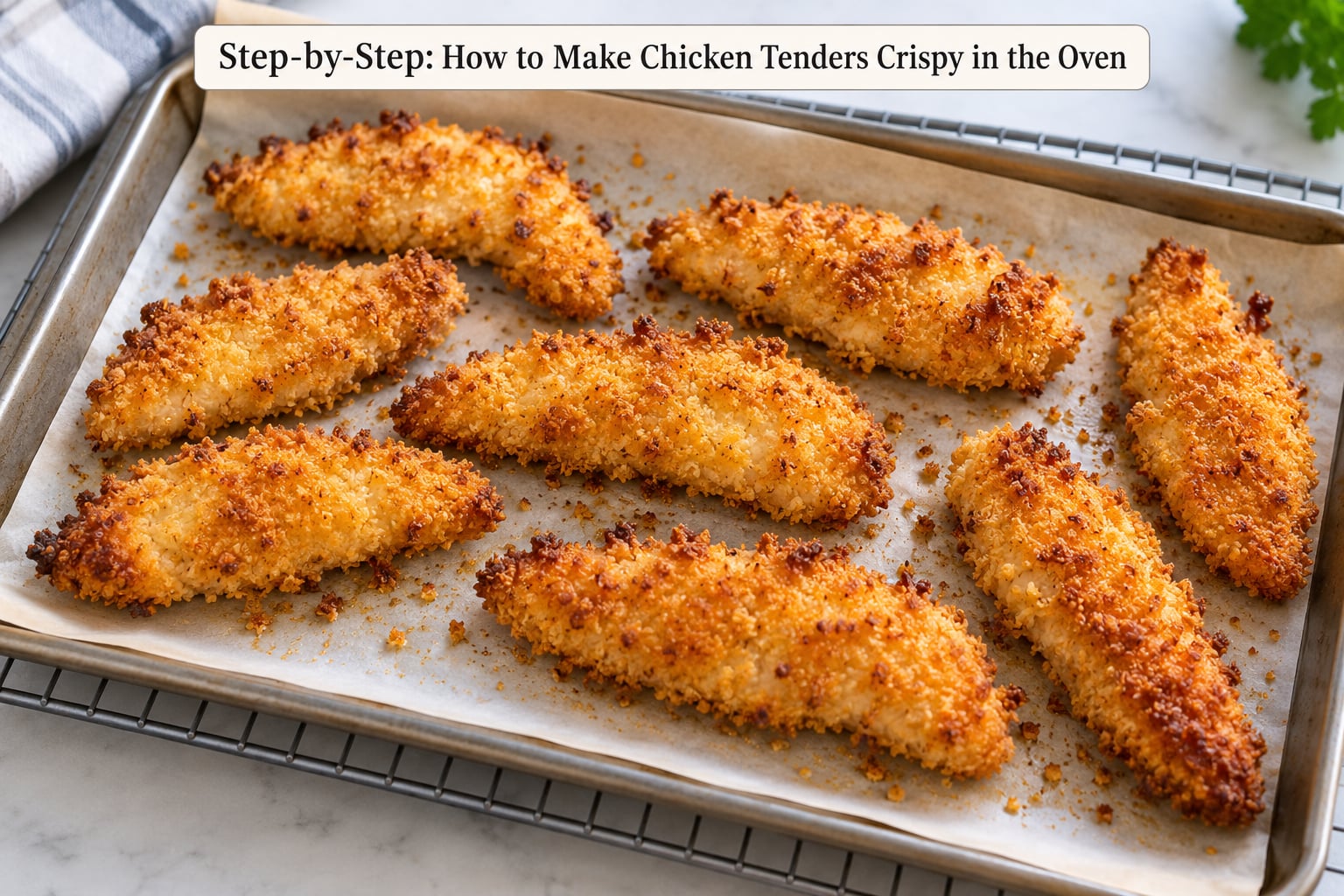
Before you touch the chicken, these five rules decide whether the batch turns out crunchy or pale and flabby.
- Fully preheat the oven. A cold oven plus 10 minutes of heating is not the same as a hot one.
- Toast the crumbs first, so they cannot drink up moisture from the egg.
- Lift the chicken off the pan on a wire rack, so hot air reaches the underside.
- Press the coating on firmly. Loose crumbs fall off before they brown.
- Spray the crumb lightly. Dry breadcrumbs brown slowly and can taste dusty.
Prepare the Chicken and Coating
Set the oven rack in the middle and preheat to 425°F (220°C). A fully preheated oven is the single biggest difference between crispy tenders and pale ones, so give it a full 15 minutes.
Pat the tenders dry with paper towels, all over and especially the edges. Surface moisture is what turns breading soft, and cold chicken straight from the fridge tightens and releases extra water as it cooks, so let the strips sit at room temperature for 15 to 20 minutes while the oven heats.
Toast the panko: spread it on a small sheet, spray lightly with oil, and bake for 4 to 6 minutes until it smells toasty and looks pale gold. Stir once at the 3-minute mark. Let it cool on the pan while you set up the dredge.
Build three bowls. Bowl one is the flour with the baking powder, salt, pepper, paprika, garlic powder, and onion powder mixed in. Bowl two is the beaten egg. Bowl three is the toasted panko blended with the Parmesan. Splitting the seasoning across the flour and the crumb, rather than piling it all in one bowl, seasons the chicken from the inside out.
Coat the Chicken Evenly
Work with one hand for the dry bowls and the other for the wet one, or use tongs, so your fingers stay out of the egg. Dredge each tender in the seasoned flour and tap off the excess, then dunk it in the egg, let the excess drip back into the bowl, and lay it into the panko.
Press the crumbs on with your fingertips. This is the step people rush, and it is where patches of bare chicken come from. Coat the top, the sides, and the tapered ends, then set the tender on the rack.
Keep about an inch of space between pieces. Touching tenders steam each other instead of browning, which is exactly the soggy pan most people complain about.
Bake Until Golden and Cooked Through
Heat a rimmed baking sheet in the oven for 5 minutes, spray it lightly, then set your wire rack on top. Hot chicken hitting a hot sheet starts the browning immediately instead of letting the tender warm through first. Spray the crumb tops with cooking spray before the sheet goes in.
Bake at 425°F (220°C) for 15 to 20 minutes, turning once at 10 minutes with tongs. Thick strips run closer to 20 minutes and thin ones closer to 15. Pull the pan when the crumb is deep golden brown and the thickest tender reaches 165°F (74°C) at its center, measured between two pieces.
If the crumb has browned but the chicken still feels underdone, tent the pieces loosely with foil and give them three or four more minutes. Browning and cooking at the same speed only happens when the pieces are thin and even, so uneven strips need this split finish more often than people expect.
Some cooks like a two-minute finish under the broiler for extra color. Watch it the whole time. High heat goes from golden to scorched in under a minute at that stage.
Let Them Rest and Serve
Move the tenders to a clean wire rack, not a plate. A plate traps steam under the coating and softens the bottom within a few minutes, and the rack lets the residual heat finish crisping for another 3 to 5 minutes. That carryover cooking also means the meat finishes tender instead of drying out.
Serve straight from the rack with the sauces above. For a game day platter, pile them on a sheet pan lined with parchment so nothing sits in its own juices, and keep the platter out of the oven’s residual heat.
350°F vs 400°F vs 425°F: Which Temperature Crisps Them Best
Higher is better for breaded tenders, because the crumb needs to brown before the moisture inside softens it. Lower temperatures cook more slowly and dry the coating first. Here is the honest trade-off at each setting.
| Oven temperature | Bake time | Result | Who should use it |
|---|---|---|---|
| 350°F (175°C) | 25 to 30 min | Cooks through, but the crumb stays pale and dries out | Reheating leftovers only |
| 375°F (190°C) | 22 to 26 min | Even browning, gentler color, tender meat | Thin, delicate strips or large-batch cooking |
| 400°F (205°C) | 18 to 22 min | Good crunch with a softer crumb texture | People who like a gentler bite |
| 425°F (220°C) | 15 to 20 min | Deep gold, shatters loud, juiciest center | The default for breaded tenders |
One adjustment to this table for unbreaded tenders. Without a crumb layer to protect the meat, drop to 400°F (205°C) and add five minutes so the outside does not scorch before the center cooks.
Common Mistakes
Why aren’t my chicken tenders crispy?
Nine times out of ten it is one of six things, and all six are fixable.
- The pan was overcrowded. Air needs to move around each piece. Bake in two batches rather than stacking, or the tenders steam and the breading softens.
- The chicken came straight from the fridge. Cold, damp surfaces release extra moisture mid-bake. Dry the tenders thoroughly and let them warm for 15 to 20 minutes.
- The oven was not fully preheated. Give it the full 15 minutes at temperature, and put the baking sheet in during that window so it heats with the oven.
- The crumbs were never toasted and never sprayed. Untoasted panko absorbs the egg and goes heavy; dry crumb browns slowly. Toast first, spray second.
- No rack was used. Chicken sitting on a sheet pan traps moisture underneath and softens the bottom. Elevate the pieces on a wire rack so hot air circulates.
- They baked too long. Once the crumb passes deep gold, it turns dry and the meat tightens. Pull at the color cue, then verify with a thermometer.
Tips for even crispier results
Stir a teaspoon or two of cornstarch or baking powder into the flour. It creates tiny gaps in the coating that stay crunchy. This trick circulates constantly in low-carb cooking circles, and it works on a conventional dredge too.
Season the crumb layer rather than the egg. Any salt or spice in the egg wash can make the coating bubble and loosen instead of setting into a shell.
Press twice. Dip the tender into the panko, press, then lift it and press again before it goes on the rack. Double pressing locks on the crumbs that a single pass would shed.
If you own an air fryer, the same breaded tenders come out excellent at 400°F (205°C) for 10 to 13 minutes, with no preheating of a sheet. Home cooks on Reddit cooking forums report the air fryer beating the oven for crumb texture, and it is the fastest route on a weeknight.
You can also skip the crumbs entirely. Toss plain tenders in the seasoned flour, spray with oil, and bake at 425°F (220°C) for 20 to 25 minutes. You get a noticeably lighter, thinner coating and a crisp golden shell. Cornflake crumbs or Rice Chex work as a gluten-free stand-in for panko if you need to avoid wheat.
To prep ahead, crumb the tenders up to 24 hours in advance and refrigerate them uncovered on a rack. Do not press extra flour on them to protect the coating, and skip the freezer. Cooks who freeze breaded chicken and report it working well are describing a softer result than most recipes promise, so treat freezing as a compromise rather than the plan.
To reheat, use a 350°F (175°C) oven or toaster oven for 8 to 10 minutes, or 6 to 8 minutes in an air fryer at 375°F (190°C). Never use the microwave. It heats the water in the coating faster than the coating itself and leaves you with a soft shell and hot middle. Store baked tenders in a single layer in the fridge and never stack them, since the weight crushes the crumb.
Frequently Asked Questions
What temperature makes chicken tenders crispy in the oven?
425°F (220°C) is the sweet spot for breaded tenders. The high heat browns the crumb before the moisture inside can soften it, so you get a fast, golden shell in 15 to 20 minutes. 400°F (205°C) gives a slightly gentler result and needs 18 to 22 minutes. Avoid 350°F (175°C) unless you are reheating, since the low heat dries the crumb before it colors.
Should I bake chicken tenders on parchment paper or a bare sheet pan?
Use a bare, preheated rimmed baking sheet, ideally with a wire rack on top. Parchment insulates the pan and slows browning on the underside, which is where tenders most often turn pale and soft. If you prefer parchment for easy cleanup, set it on top of the wire rack so the crumb still gets airflow underneath, and spray it lightly with oil before the chicken goes on.
Can I use frozen chicken tenders for this recipe?
You can bread frozen tenders, but thaw them first in the fridge if you want the best coating. Frozen chicken frosts over during thawing, and that frost keeps the flour from adhering, so patches of breading fall off in the oven. If you are working with frozen pre-breaded tenders from the freezer aisle, skip the dredge entirely and bake them straight from frozen at 425°F (220°C) for 25 to 30 minutes, turning once.
How do I keep baked chicken tenders crispy after serving?
Hold them on a wire rack rather than a plate, and keep them away from the heat of the oven. Steam from a pile of tenders softens the bottom pieces almost immediately, so a single layer on a rack or parchment-lined platter is worth the extra space. Serve within an hour, and save dips in small bowls so nobody pours sauce over the crust before the first bite.
Can I make chicken tenders crispy without breadcrumbs?
Yes, and the result is a lighter, crunchier shell than most breaded versions. Toss the tenders in seasoned flour with a teaspoon of cornstarch or baking powder, spray with oil, and bake at 425°F (220°C) for 20 to 25 minutes. A thin layer of Dijon or mayonnaise before the flour adds a savory backbone and helps the coating brown faster without any crumbs at all.
How long should I bake chicken tenders at 425°F?
Bake at 425°F (220°C) for 15 to 20 minutes, turning once at the 10-minute mark. Thick strips cut from the center of a breast take the full 20 minutes, while tapered tail pieces cook in about 15. Confirm with an instant-read thermometer rather than the clock: the thickest tender should reach 165°F (74°C) at its center.
Conclusion
Start with a fully preheated oven and a coating pressed on firmly, and most of the crunch problems disappear on their own. Toast the panko, set the tenders on a wire rack over a hot baking sheet, spray the crumb lightly, and bake at 425°F (220°C) for 15 to 20 minutes until deep gold and 165°F (74°C) inside.
Then get them off the pan and onto a rack so the last bit of steam escapes instead of soaking the coating. That is the whole method, and it takes about 35 minutes from counter to first dip.