Beer cheese soup is a cooked roux of butter and flour loosened with beer, chicken broth and cream, then finished off the heat with shredded sharp cheddar. That is the entire method, and it takes about 45 minutes to get four to six servings on the table. Three things decide whether it turns out smooth: cook the roux for a full minute, whisk the beer in a little at a time, and never add cheese to a boiling pot.
The version below is the plain one. No bacon in the base, no carrots, no broccoli. A lot of recipes reach for a heavy, loaded bowl, and that is fine, but the plain soup is what most people actually want when they search for how to make beer cheese soup, and it is much easier to get right.
Start with a block of sharp cheddar and grate it yourself. The bagged shredded stuff is treated with anti-caking cellulose, and that coating is exactly why your cheese turns grainy instead of melting.
Table of Contents
- What You Need
- The core ingredients
- Which beer should you use?
- Equipment
- How much cheese is enough?
- Simple substitutions
- Step-by-Step
- How Do You Keep Beer Cheese Soup Smooth?
- Can You Make Beer Cheese Soup Ahead of Time?
- Common Mistakes When Making Beer Cheese Soup
- Why is my beer cheese soup grainy?
- Why is my beer cheese soup greasy?
- Why is my beer cheese soup too thick?
- Why is my beer cheese soup too thin?
- Why does my beer cheese soup taste flat?
- Tips for serving it
- Frequently Asked Questions
- What kind of beer is best for beer cheese soup?
- Can I use any type of cheese in beer cheese soup?
- Why is my beer cheese soup runny?
- Can beer cheese soup be made without milk?
- How long does beer cheese soup keep in the refrigerator?
- Can I freeze beer cheese soup?
- Conclusion
What You Need

Everything here is supermarket-shelf except the beer, and the beer is the fun decision. For four to six servings you need about 6 to 8 ounces of sharp cheddar, one 12-ounce bottle or can of light beer, two cups of chicken broth, half a cup of heavy cream, and a small roux of butter and flour. Plan on 35 minutes of active cooking and 10 minutes of rest.
The core ingredients
- 6 to 8 oz sharp cheddar, aged about a year, grated by hand. Buy a block, not a bag.
- 12 oz light lager or amber ale (see the table below for other styles).
- 2 cups chicken broth, low-sodium works fine since Worcestershire and mustard bring plenty of salt.
- 1/2 cup heavy cream. Half-and-half works and is lighter, but you lose some body.
- 2 tbsp unsalted butter plus 2 tbsp all-purpose flour for the roux.
- 1 small yellow onion, diced, and 2 cloves garlic, minced.
- 1 tsp Worcestershire sauce, 1 tsp Dijon or yellow mustard, 1/2 tsp dry mustard, 1/2 tsp smoked paprika, and a few dashes of hot sauce.
- Salt and black pepper to taste at the end, not during.
Skip the bacon if you want the plain soup, but keep the bacon grease idea in reserve. Cooking aromatics in rendered bacon fat instead of butter is the fastest upgrade to a bowl that tastes like pub food rather than like a sauce.
Which beer should you use?
A light lager or amber ale is the safe default. It adds malt and a little bitterness without turning the soup bitter or sour on its own, and it disappears into the cheese rather than fighting it.
| Beer style | What it adds | Bitterness | Pick it if |
|---|---|---|---|
| Light lager (Bud Light, Michelob Ultra, Sam Adams Boston Lager) | Clean maltiness, nothing distracting | Very low | You want the cheese to lead and first-time cooks are making it |
| Amber or bock (Yuengling Lager, Shiner Bock) | Toasty malt and a touch of caramel | Low | You are going for a German pub or Oktoberfest feel |
| Pale ale | Grass and light fruit, more aroma than flavor | Low to medium | You want the beer noticeable without it getting sharp |
| Pilsner | Cracker-dry, very clean finish | Medium | You are pairing with pretzel bread or a heavy pretzel |
| IPA | Resin and citrus on the finish | High | You like bitterness and you will use a strong cheese to balance it |
| Stout or porter (Guinness) | Roast, coffee, dark chocolate | Medium | You are making a darker, deeper bowl with smoked cheddar |
| Blue Moon | Orange and coriander, faintly sweet | Low | You like the citrus note; it is not wrong, just noticeable |
| Non-alcoholic lager or ginger beer | Almost neutral liquid volume | Very low | The bowl is for kids or anyone avoiding alcohol |
One note on dark beers: roast flavors get more bitter as the soup cooks, so if you use a stout, keep the simmer short and taste before you salt. Yuengling and Guinness are the two most common choices in home kitchens, and both work, just with different personalities.
Equipment
A medium saucepan with a heavy bottom and a whisk is all you need. A second small saucepan lets you cook the roux separately and temper it in, which is the trick that kills lumps for good. An immersion blender is optional insurance if you add vegetables.
How much cheese is enough?
Six ounces of grated cheese feeds four comfortably. If you are serving six or more, go to 8 to 10 ounces. Recipes that call for six cups of cheese are making a dip, not a soup, and they thicken up differently.
Simple substitutions
- Vegetable broth instead of chicken, for a vegetarian bowl.
- Half-and-half or whole milk instead of heavy cream, with a slightly thinner result.
- Rice flour at a one-to-one ratio for the flour, if you need the soup gluten-free (and pick a gluten-free beer).
- Smoked cheddar, pepper jack, or a blend for a different profile. Avoid cream cheese as the only cheese; it melts differently and loosens the soup.
Step-by-Step
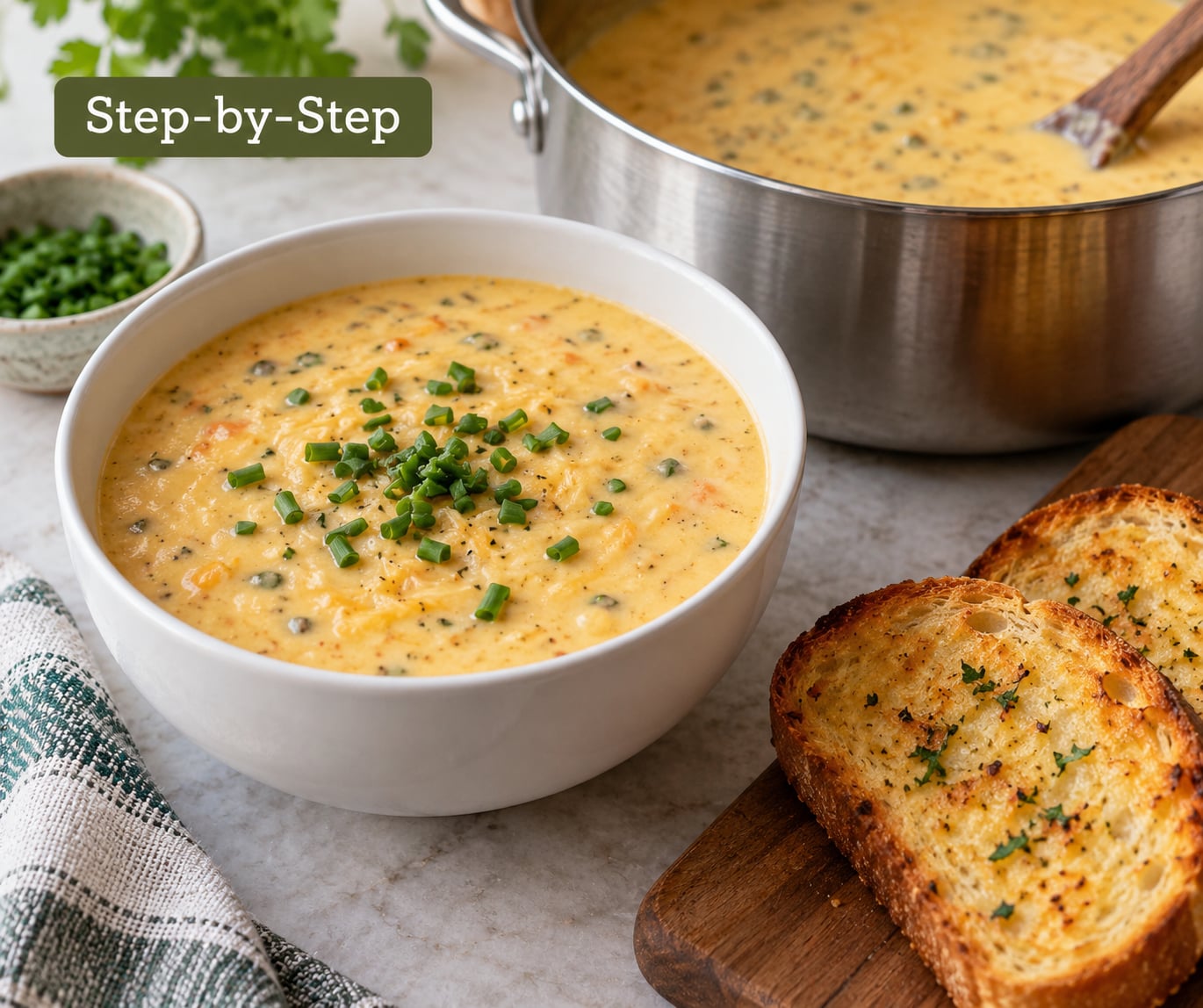
Read the whole method once before you start, because steps 4 through 7 happen fast and in order. The finished soup should fall off a spoon in a slow ribbon, not pour like milk and not stand up like glue.
1. Sweat the aromatics. Melt the butter in the saucepan over medium-low heat. Add the onion with a pinch of salt and cook 4 to 5 minutes until soft and translucent, not browned. Add the garlic and cook 30 seconds. You want the onion to lose its raw bite, not take on color.
2. Make the roux. Stir in the flour and keep stirring for a full 60 seconds. The mixture goes from pasty to slightly tan and smells like toast rather than flour. That minute is what cooks out the raw starch taste, and skipping it is the number one reason a homemade soup tastes starchy.
3. Temper in the beer. Turn the heat down a notch. Pour in about a third of the beer and whisk until it disappears, then add another third, then the rest. Whisking continuously here is what keeps the roux from breaking into little doughy bits.
4. Reduce the beer if you want it to taste like beer. Let the pot simmer for 3 to 5 minutes until the liquid drops by roughly half and smells malty. This is optional, but it is the fix for a bowl where the cheese swallowed the beer completely.
5. Add the broth and cream. Pour in the chicken broth and the heavy cream, then the Worcestershire, mustard, paprika, hot sauce, a bay leaf, and a few thyme leaves. Bring to a low simmer, not a rolling boil, and cook 5 to 7 minutes. The sauce should thicken enough to coat a spoon.
6. Take the pot off the heat. Let it sit for a minute. This is the step people skip, and it is the step that matters most. Cheese added to a boiling pot seizes into rubbery strings instead of melting.
7. Add the cheese a handful at a time. Stir in about a quarter of the grated cheddar, whisk until it melts completely, then add the next handful. The residual heat finishes the job. You will see the sauce turn glossy and slightly thinner as the cheese goes in, which is normal.
8. Season and rest. Remove the bay leaf, taste, and add salt and pepper now rather than earlier. Rest for 5 minutes off the heat, then ladle into bowls and finish with chopped chives or parsley and a dash of hot sauce.
How Do You Keep Beer Cheese Soup Smooth?
Smoothness comes down to four habits: medium-low heat, constant whisking, gradual cheese addition, and taking the pot off the heat before any dairy goes in. Break any one of them and the emulsion breaks.
- Shred it yourself. Pre-shredded cheese contains cellulose or flour to keep it from sticking in the bag, and that filler is what makes melted cheese grainy.
- Keep the heat moderate. Cheese proteins tighten and squeeze out fat above roughly 180°F, and that fat is the oil slick on top of your soup.
- Add cheese in four or five additions. Each handful melts in the residual heat before the next one lands, so the sauce never has to boil.
- Stir the whole time. Cheese that sits without moving for a minute clumps into ropes, especially in a thick roux base.
- Use a heavy pot and a real whisk. A wooden spoon leaves streaks and does not catch the flour at the bottom.
Can You Make Beer Cheese Soup Ahead of Time?
Yes, and for a party it is the better plan. Make it through step 6, refrigerate, and add the cheese when you are ready to serve so the texture stays clean.
Refrigerated in a covered container, beer cheese soup keeps about 3 to 4 days. Reheat it slowly over low heat with a splash of chicken broth, stirring often, and reheat to 165°F. Cream sauces tighten in the fridge, so a splash of broth is usually enough to bring it back.
If you want it to sit warm for a few hours, move the finished soup to a slow cooker on warm and stir it every 20 minutes or so. Holding it on a stovetop over low heat for more than an hour is where scorching starts.
For freezing, use the no-cream version, cool it fully, and freeze in a sealed container for up to 2 to 3 months. Reheat with broth and stir in fresh cheese after it warms.
Common Mistakes When Making Beer Cheese Soup
| Problem | Why it happens | Fix |
|---|---|---|
| Grainy or clumpy cheese | Boiling liquid, pre-shredded cheese, or adding too much at once | Off heat, handfuls at a time, grate your own block |
| Oily slick on the surface | Cheese proteins tightened from too much heat, pushing out fat | Keep it at a low simmer and stir often |
| Too thick and gluey | Roux cooked past the sauce stage, or broth added short | Warm broth a cup at a time and stir until it loosens |
| Too thin and runny | Not enough roux, or too much liquid | Whisk a slurry of 1 tbsp flour and 2 tbsp cold broth in and simmer 3 minutes |
| Sour or bitter finish | Dark or over-reduced beer, then heavy salting to compensate | Use a lighter beer, stop reducing early, taste before salting |
| Flat, one-note flavor | Seasoned before the liquid reduced | Season at the end with mustard, Worcestershire, and hot sauce |
Why is my beer cheese soup grainy?
Graininess is cheese that melted and then re-solidified into tiny crystals. It happens when the liquid was at a boil when the cheese went in, or when the cheese was pre-shredded. Shred a block of real cheddar, take the pot off the heat, and add it in small handfuls while whisking.
Why is my beer cheese soup greasy?
Fat separates out of cheese when the proteins cook too hard, which is what high heat does. A greasy top is a sign the soup got too hot, not that you used the wrong cheese. Lower the heat, stir more often, and skim nothing, because that fat is flavor.
Why is my beer cheese soup too thick?
Roux is the usual culprit, especially if you cooked it past a minute in a hot pot. It loosens easily: warm a cup of chicken broth, whisk it in off the heat, and wait a minute. Repeat until it falls off the spoon in a slow ribbon.
Why is my beer cheese soup too thin?
Too much liquid or too little flour. Do not dump in loose flour, which will taste raw. Whisk 1 tablespoon of flour with 2 tablespoons of cold broth into a slurry, pour it in while whisking, and simmer 3 minutes. Repeat if needed.
Why does my beer cheese soup taste flat?
Seasoning went in before the liquid reduced, so the flavor got diluted. Acid and mustard wake it up: a squeeze of lemon, a teaspoon more Dijon, or a few drops of hot sauce at the end. Salt last, after the soup reaches the thickness you want.
Tips for serving it
Serve beer cheese soup hot in shallow bowls so the thick texture reads as a soup and not a dip. The classic partners are a garlic cheese toast made in the same pan, warm pretzel bread or soft pretzels, and pumpernickel or rye with butter.
For a game-day spread, put the pot in the middle with a ladle and let people serve themselves, alongside a bowl of the same shredded cheese so guests can top their bowl. A bread bowl presentation looks dramatic, but a plain bowl with good toast on the side is easier to eat.
Feeding ten people, double the recipe and start it 20 minutes before guests arrive so it can rest. Two bottles of beer, 20 ounces of cheese, and the same butter and flour doubling gives you a pot that disappears by halftime.
Frequently Asked Questions
What kind of beer is best for beer cheese soup?
A light lager or amber ale is the best default. Both add malt and mild bitterness without turning the soup bitter or sour, and they blend into the cheese instead of fighting it. A pale ale gives you more aroma, a pilsner a drier finish, and a stout a darker, roasty bowl that pairs with smoked cheddar. If you are serving kids or anyone avoiding alcohol, use a non-alcoholic lager in the same amount.
Can I use any type of cheese in beer cheese soup?
Sharp cheddar is the classic choice, but Gruyere, Swiss, Monterey Jack, smoked cheddar, and pepper jack all melt well and change the profile. The rules are the same for any of them: buy a block and grate it yourself, skip the pre-shredded bags, add the cheese off the heat in handfuls, and avoid boiling. Very young, mild cheeses melt smoothly but give you a bland bowl, so sharp and aged is the better target.
Why is my beer cheese soup runny?
Runny beer cheese soup usually means too much liquid for too much roux. Warm a cup of chicken broth and whisk it in off the heat, a little at a time, until the sauce coats the back of a spoon. If adding liquid is not enough, thicken it with a slurry: whisk 1 tablespoon of flour with 2 tablespoons of cold broth, pour it in while whisking, and simmer for 3 minutes before tasting again.
Can beer cheese soup be made without milk?
Yes. Skip the cream entirely and use all chicken broth for a Wisconsin-style, roux-thickened bowl that is lighter but still creamy from the cheese and butter. The texture will be a little tighter and less rich, and this is the version many home cooks prefer. Just keep the heat low and add the cheese off the heat as usual, since without cream there is less fat available to keep the emulsion smooth.
How long does beer cheese soup keep in the refrigerator?
Refrigerated in a covered container, beer cheese soup keeps about 3 to 4 days. Cream-based soups tighten as they cool, so reheat slowly over low heat with a splash of chicken broth, stirring often, and bring it to 165°F before serving. For longer storage, freeze the no-cream version for up to 2 to 3 months and add fresh cheese after reheating.
Can I freeze beer cheese soup?
You can, but the cream version does not freeze as smoothly as the broth-only version. Cool the soup fully, leave out any final cheese, and freeze it in a sealed container for up to 2 to 3 months. Thaw overnight in the refrigerator rather than on the counter. Reheat gently with a splash of broth, then stir in a fresh handful of grated cheddar once it is warm enough to melt.
Conclusion
The first step that decides your batch is the roux, not the cheese. Give the butter and flour a full 60 seconds in the pan, add the beer slowly while whisking, and the rest of the recipe mostly takes care of itself. Add the cheddar off the heat in handfuls and it stays glossy instead of turning into strings.
Pour it into warm bowls, finish with chives and hot sauce, and serve it with garlic cheese toast or warm pretzel bread. Once you have the base down, the beer swap is where you start having fun with it.