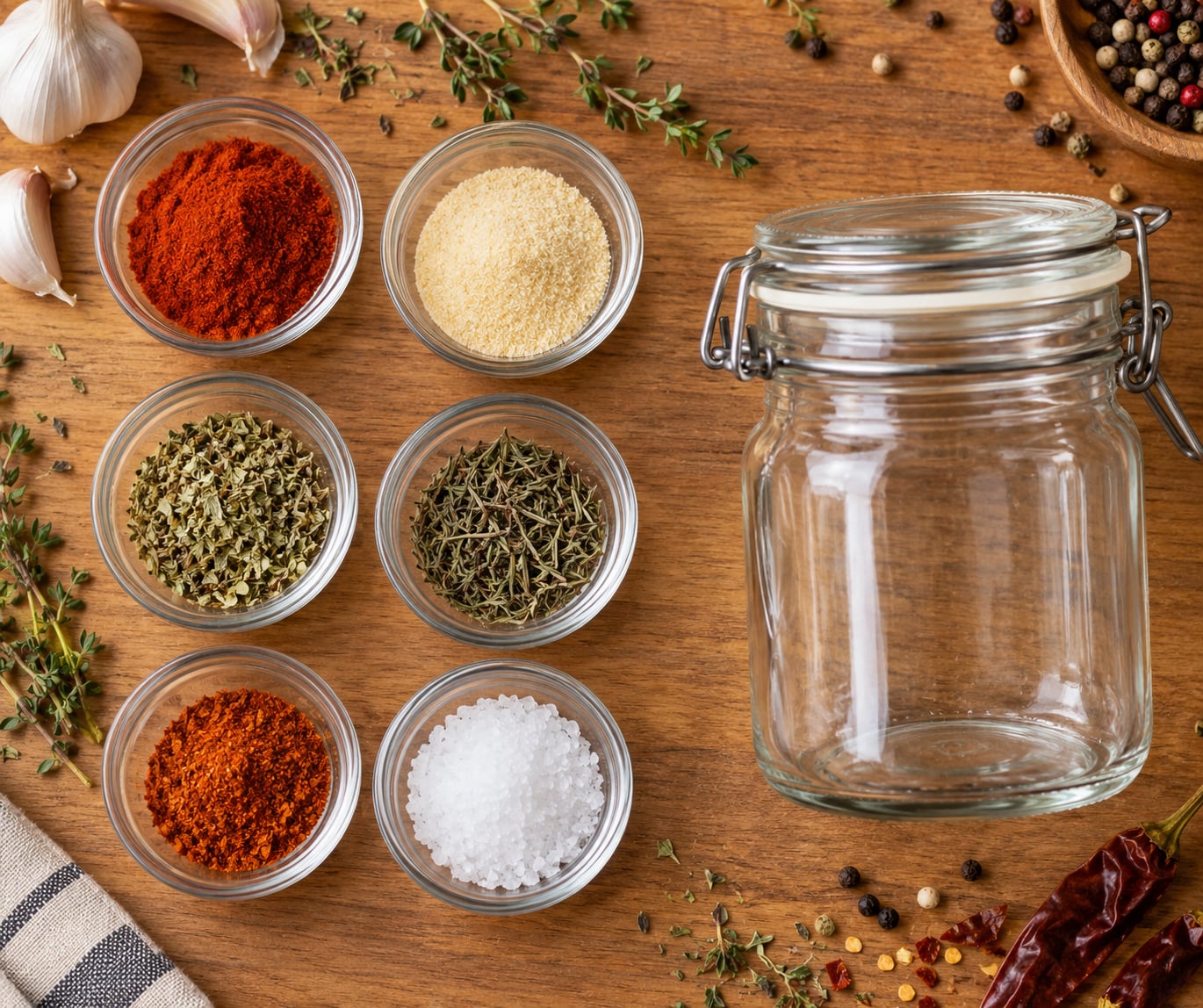
How to make cajun seasoning blend takes about five minutes and nine pantry spices: paprika, garlic powder, onion powder, kosher salt, dried oregano, dried thyme, cayenne, black pepper, and a smaller measure of white pepper. You measure everything into a jar, shake it, and you have roughly half a cup of dry rub that beats anything you can buy for flavor or cost.
A Cajun seasoning blend is a dry spice mix built to reproduce the peppery, smoky, herb-forward flavor of Louisiana Cajun cooking. It is not a marinade, and it is not the same thing as a Creole blend, though the two get mixed up constantly.
Here is the exact list, so you can start measuring right now:
- 2 tablespoons smoked paprika
- 2 tablespoons garlic powder
- 2 tablespoons kosher salt
- 1 tablespoon onion powder
- 1 tablespoon dried oregano
- 1 tablespoon dried thyme
- 1 tablespoon cayenne pepper
- 1 tablespoon black pepper
- 1 teaspoon white pepper
That list is a fixed tablespoon formula, which is convenient but hard to scale. Below it I give you the same blend as a parts ratio so you can make half a cup or a cup and a half without guessing. If heat is not your thing, drop the cayenne to 1 teaspoon. If you are feeding a football crowd, leave it at a full tablespoon and add red pepper flakes on the food itself, not in the jar.
Skip to the ingredients or jump to the mixing steps.
Table of Contents
- What You Need
- Step-by-Step: How to Make Cajun Seasoning Blend
- How to Make Cajun Seasoning Blend: Combine the Base Spices
- How to Make Cajun Seasoning Blend: Add Herbs and Heat
- How to Make Cajun Seasoning Blend: Taste and Store It
- Common Mistakes
- Overdoing the cayenne
- Not shaking long enough
- Grinding spices too fine
- Storing the blend somewhere damp or warm
- Forgetting to control the salt
- Seasoning too early or too late
- Reaching for Creole seasoning when you wanted Cajun
- How to Use Cajun Seasoning
- Turn the blend into a Cajun honey butter rub
- Cajun, Creole, or blackening: which one do you want?
- Frequently Asked Questions
- What is a Cajun seasoning blend?
- What is the ratio of each ingredient in a Cajun spice blend?
- Should homemade Cajun seasoning contain salt, and can I make it salt-free?
- What can I use as a substitute for Cajun seasoning mix?
- What is the difference between Creole and Cajun seasoning, and which is hotter?
- How long does homemade Cajun seasoning last and how should I store it?
What You Need
Everything in this blend sits in a normal pantry. Nothing needs to be fresh-frozen or hard to find, which is exactly why home cooks keep a jar of it going for months.
The useful thing about a parts ratio is that one number becomes your measuring unit. Treat the teaspoon as a part, and everything else follows:
| Ingredient | Parts | For the 9-spice batch | What it does |
|---|---|---|---|
| Smoked paprika | 2 | 2 tbsp | Color, mild smoke, the base note |
| Garlic powder | 2 | 2 tbsp | Sharp savory depth |
| Kosher salt | 2 | 2 tbsp | Flavor carrier and seasoning control |
| Onion powder | 1 | 1 tbsp | Sweetness, rounds out the garlic |
| Dried oregano | 1 | 1 tbsp | Earthy, slightly bitter backbone |
| Dried thyme | 1 | 1 tbsp | Woody, almost piney backbone |
| Cayenne pepper | 1 | 1 tbsp | Clean, lingering heat |
| Black pepper | 1 | 1 tbsp | Peppery bite and aroma |
| White pepper | 0.5 | 1 tsp | Floral warmth, a little heat of its own |
Paprika is the main ingredient and the largest single component after salt and garlic. Double it and the blend turns muddy; halve it and you lose the color that makes Cajun food look like Cajun food. Cooks on r/spices ask for the same thing every time they post a formula, and the answer is almost always: paprika leads, herbs follow, heat is the dial you turn last.
Two ingredient choices matter more than the rest. First, smoked paprika versus sweet: smoked is the traditional pick and gives you the background warmth that reads as “grilled” even when nothing was grilled. Sweet paprika works, but the blend tastes flatter and needs a pinch more smoke from another source.
Second, kosher salt versus table salt. Kosher salt is flaked, so roughly a tablespoon of Diamond Crystal measures about 1.5 times the volume of a tablespoon of table salt. If you only have table salt, cut every salt measurement by about a third or the blend will be punishing on wings and fries. You can also go straight to a salt-free version, which I cover below.
Every other spice on the list has a stand-in, which matters more than most recipes admit:
- Oregano takes Herbes de Provence or an Italian seasoning blend, though Italian blends already carry garlic and sometimes red pepper, so use less than you think.
- Thyme takes marjoram, which is sweeter and a little more floral, or simply more oregano.
- Garlic powder has no real swap. Granulated garlic works and is more intense, so use two-thirds of the volume.
- Onion powder can become a small amount of finely grated dried onion, or one tablespoon of onion flakes.
- Cayenne takes red pepper flakes for a slower, uneven burn, or ancho chile powder for a rounder heat with fruit underneath.
- White pepper is optional. Leave it out and the blend still works; you just lose a little floral lift.
One honest caveat before you start: there is no single canonical Cajun formula. Home cooks on r/Louisiana and r/cajunfood will happily argue about it for hours, and recipes disagree on everything from whether salt belongs in the jar to how much thyme is too much. Treat the list above as a well-balanced pub-style starting point, not as the only correct answer.
Step-by-Step: How to Make Cajun Seasoning Blend
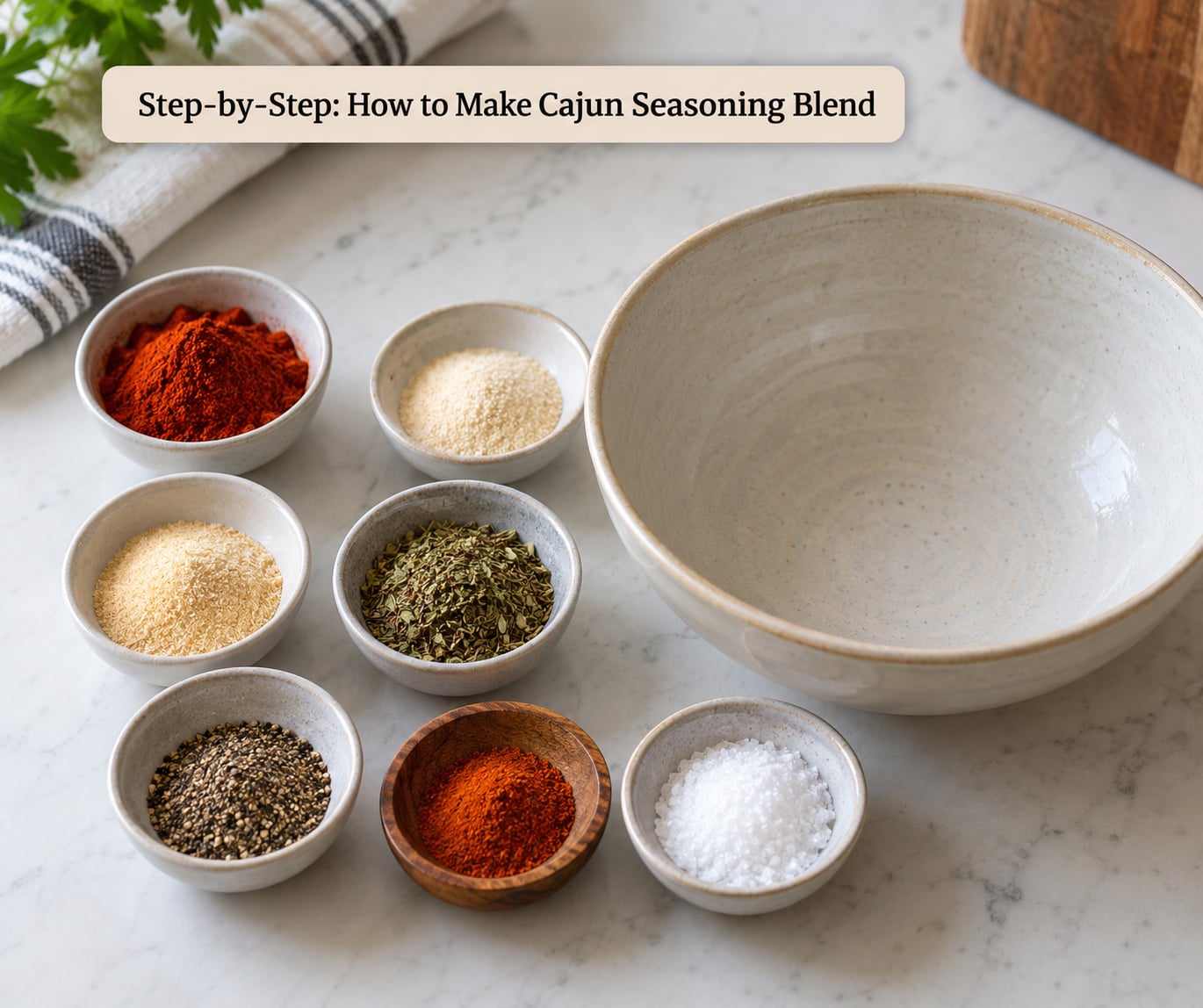
The whole process is measuring, shaking, and labeling. There is no cooking, no resting, and no technique that cannot be undone by a clumpy jar.
How to Make Cajun Seasoning Blend: Combine the Base Spices
Measure the paprika, garlic powder, kosher salt, and onion powder straight into a clean jar with a tight lid. A mason jar or a repurposed spice jar with a shaker top both work; the shaker top is genuinely useful later, which I get to below.
Pour the four base spices on top of each other rather than mixing as you go. You will see how even the layers look, and when you shake the jar that layering does most of the blending for you. Break up any clumps with the back of a spoon before the lid goes on, because compacted garlic powder will stay compacted no matter how long you shake.
How to Make Cajun Seasoning Blend: Add Herbs and Heat
Add the oregano, thyme, cayenne, black pepper, and white pepper on top of the base layer. Seal the jar and shake hard for 30 to 45 seconds. Rest your thumb over the shaker holes if you are using a shaker-top jar, or hold the lid tight and keep it pointed away from your face. Garlic powder dust travels.
How hard you shake matters less than how long you shake. Thirty seconds of genuine movement evens out the color, and you should see a uniform rust-orange with darker flecks rather than visible layers of white and red.
This is also the moment to decide your heat level, and there are three reasonable places to set it:
- Mild: 1 teaspoon cayenne instead of 1 tablespoon, and drop the white pepper. Good for large batches of food that will be shared.
- Medium: 2 teaspoons cayenne, keep the white pepper. This is the version most pub kitchens land on.
- Hot: full 1 tablespoon cayenne plus 1 to 2 teaspoons of red pepper flakes. The flakes sit in the jar and keep working, so add them to taste rather than by the spoonful.
For a salt-free blend, leave the kosher salt out entirely and add a quarter teaspoon of garlic powder to compensate for the flavor the salt was carrying. This is the version people gravitate to when the seasoning is going onto food that is already salted, like brined shrimp or salted fries.
How to Make Cajun Seasoning Blend: Taste and Store It
Dip a clean teaspoon into the blend before it goes anywhere near food. You are checking two things: whether the salt level suits you, and whether the heat reads as warmth or as fire. Blends that taste flat almost always need more salt; blends that taste harsh almost always need more paprika or a touch of sugar, not less seasoning overall.
Transfer the finished blend to an airtight container if your working jar was not sealed, label it with the date, and put it in a cool, dark, dry cupboard away from the stove. Not above the stove, not next to the coffee maker. Heat and steam are what flatten a dry blend, and a cabinet above a kettle is the most common way people lose the flavor they worked for.
To scale by the parts ratio, use the teaspoon as your part. Two parts means two of your measuring unit, and so on. One part equals roughly a quarter cup of finished blend, so a 24-part batch using the teaspoon as the unit gives you about six cups, which is a lot, but it is also a legitimate gift-jar batch for a housewarming.
For everyday use, keep a small shaker-top jar at the stove and the big batch in the cupboard. Cooks on r/cajunfood swear by exactly this, because a pinch of blend from a salt shaker at the grill is faster than measuring with a spoon and does not leave you with a wet spoon and a rusty canister.
Common Mistakes
Most disappointing homemade blends fail for boring, fixable reasons.
Overdoing the cayenne
One tablespoon sounds harmless in a jar. It is not, because the blend goes on food you then eat in quantity. Start with 2 teaspoons, taste the finished food, and only then decide whether the jar needs more. You cannot take heat out of a dish, but you can always add more seasoning next time.
Not shaking long enough
Thirty seconds of casual wrist movement is not mixing. Blends without cumin like this one are easier to blend than spiced rubs with fennel or coriander, but cayenne and paprika still separate fast. Shake until you no longer see streaks of white through the red.
Grinding spices too fine
Blending whole spices yourself gives you the best flavor and the longest life, but only if you keep the texture coarse. A blender pulverizes herbs and pepper into dust, and dust loses aroma within weeks. Pulse the grinder, stop often, and aim for the texture of coarse sand rather than flour.
Storing the blend somewhere damp or warm
Garlic powder and onion powder pull moisture out of the air and clump. Once clumps form they will not break apart cleanly and the flavor goes flat. Airtight container, cool cupboard, no dishwasher, no fridge, and use a dry spoon every time.
Forgetting to control the salt
Store-bought Cajun and Creole blends vary enormously in salt content, and that is the single biggest reason people decide homemade is not worth it. It is. You decide the ratio. Two tablespoons of kosher salt in a half-cup batch is a seasoned blend; it is not a salty one, until you put it on fries.
Seasoning too early or too late
Cajun seasoning added to a hot skillet burns quickly, because the paprika scorches and the garlic turns acrid. Add it to oil in the pan before the food, or add it in the last few minutes of cooking, or use it as a rub before heat ever touches it.
Reaching for Creole seasoning when you wanted Cajun
They are not interchangeable in a dish you are trying to make taste Cajun. Creole blends lean on black and red pepper, salt, and often thyme and rosemary. Cajun blends lead with paprika and cayenne. More on that below.
How to Use Cajun Seasoning
A half-cup jar goes a long way if you use it in layers rather than dumping it all into one pot.
- Chicken wings and drumettes: toss with 2 tablespoons of blend and 1 tablespoon neutral oil before baking at 425°F, flipping once. Season halfway through, not at the start, so the paprika does not scorch.
- Burger patties: 1 teaspoon per pound of beef, mixed into the meat before it hits the grill. A thin coating of mustard on the patty first gives the dry rub something to grab.
- Fries and skin-on chips: 1 teaspoon tossed with hot oil and salt right before serving, or dusted over the finished fries so the aroma is intact.
- Shrimp and grits: 1 teaspoon per serving, added to the pan with the butter before the cream goes in.
- Gumbo and jambalaya: 1 tablespoon at the roux stage, plus another teaspoon at the very end. Season at the end too, because stock saltiness varies wildly.
- Crawfish etouffee: 2 teaspoons in the roux, taste before serving.
- Roasted potatoes and sheet-pan vegetables: 1 tablespoon tossed with oil and salt at 425°F.
- Rice: 1 teaspoon per cup of cooked rice, folded in off the heat with a pat of butter.
- Yogurt or sour cream dip: 1 teaspoon per half cup, plus a squeeze of lime.
- Dry rub on pork shoulder or brisket: 2 tablespoons per pound, applied the night before for the penetration to work.
For any raw poultry, cook to 165°F internally, and for ground meat cook to 160°F. Whole cuts of beef, pork, and lamb go to 145°F with a rest, and fish is the same 145°F.
Turn the blend into a Cajun honey butter rub
This is the move that turns a jar of dry seasoning into the sticky glaze people remember from a good wing night.
- Melt 4 tablespoons of butter and let it cool to room temperature so it does not melt the honey.
- Stir in 2 tablespoons of your Cajun blend and 1 tablespoon of honey.
- Brush it on wings in the last 8 to 10 minutes of cooking, and again right before they leave the heat.
- For a hotter glaze, add 1 teaspoon of hot honey or a teaspoon of the hot version of your blend.
Cajun, Creole, or blackening: which one do you want?
This is where most home cooks go wrong, and it is a one-table fix.
| Blend | Leads with | Heat source | Best for |
|---|---|---|---|
| Cajun | Paprika, garlic, salt | Cayenne | Gumbo, jambalaya, etouffee, wings, burgers |
| Creole | Salt, garlic, black and red pepper | Black pepper, red pepper flakes | Shrimp, sausage, soups, anything you want savory rather than smoky |
| Blackening | Garlic and onion flakes, herbs | Cayenne, often heavier | Fish and shrimp seared hard in a screaming-hot cast iron pan |
A homemade Cajun blend is hotter than a typical Creole blend, because cayenne is a core component rather than an afterthought. Tony Chachere’s, the Creole blend most people reach for as a Cajun stand-in, leans on salt and black pepper and contains no cayenne, so swapping it into a gumbo changes both the heat and the character.
You can derive a blackening mix from what you already made. Take your Cajun blend, add 1 part each of garlic flakes or powder, onion flakes, extra dried thyme, and extra dried oregano, then increase the cayenne. That one-part-each formula is heavier on garlic and onion than anything you would want on a potato.
Frequently Asked Questions
What is a Cajun seasoning blend?
A Cajun seasoning blend is a dry spice mix, usually paprika, garlic powder, onion powder, salt, black and white pepper, dried oregano, thyme, and cayenne, combined in fixed proportions to reproduce the peppery, smoky, herb-forward flavor of Louisiana Cajun cooking. It works as a rub, a pot seasoning, or a finishing dust, and it is not a wet marinade. There is no single canonical formula, so treat any published ratio as a starting point rather than a rule.
What is the ratio of each ingredient in a Cajun spice blend?
A dependable pub-style ratio is 2 parts smoked paprika, 2 parts garlic powder, 2 parts kosher salt, 1 part each of onion powder, dried oregano, dried thyme, cayenne, and black pepper, plus 1/2 part white pepper. On a teaspoon-as-one-part system that works out to 2 tablespoons of paprika, garlic powder, and salt, 1 tablespoon of each of the middle spices, and 1 teaspoon of white pepper. One part yields roughly a quarter cup of finished blend.
Should homemade Cajun seasoning contain salt, and can I make it salt-free?
Salt belongs in most versions, because it seasons the food you are seasoning rather than relying on you to salt separately, and two tablespoons in a half-cup batch is not aggressive. For a salt-free version, leave the kosher salt out entirely and add a quarter teaspoon of extra garlic powder to stand in for the flavor salt was carrying. Use the salted version on wings, fries, and burgers, and the salt-free one on food that is already salted, like brined shrimp.
What can I use as a substitute for Cajun seasoning mix?
Creole seasoning is the closest swap for savory dishes, though it brings more salt and no cayenne, so add a pinch of cayenne if you want heat. Old Bay works, with a more celery-forward, briny edge. Adobo seasoning is saltier and more garlicky. For a quick DIY substitute, combine 2 parts chili powder, 1 part each of salt, garlic powder, black pepper, onion powder, and oregano, plus dried thyme, which lands close to the Cajun profile without any fuss.
What is the difference between Creole and Cajun seasoning, and which is hotter?
Cajun seasoning leads with paprika, garlic, and salt and gets its heat from cayenne, which is why it tastes smoky and slightly fiery. Creole seasoning leans on salt, garlic, black pepper, and red pepper flakes, with herbs like thyme and sometimes rosemary. A homemade Cajun blend is hotter, because cayenne is a core ingredient rather than a background note. You can use Creole in place of Cajun in most dishes, just not the reverse.
How long does homemade Cajun seasoning last and how should I store it?
A jar made from pre-ground spices keeps its punch for about six months in a cool, dark cupboard, and often longer if you keep it airtight and always use a dry spoon. Blends ground from whole spices at home stay fresher, usually a year or more, because the oils are still intact when you grind them. Store it away from the stove, not in the fridge, and discard it if it has gone clumpy, dull in color, or smells flat at the jar opening.
If you only do one thing this week, mix a single tablespoon batch, taste it on something plain like roasted potatoes, and adjust the salt before you commit to the full half cup. Learning where your own heat line sits takes one jar and one dinner, and every batch after that gets faster.