Guacamole turns brown because cutting the avocado exposes an enzyme called polyphenol oxidase to the air, and the moment oxygen reaches the flesh the reaction starts. To learn how to make guacamole that does not turn brown, you have to do one of two things: keep oxygen physically away from the surface, or make the surface inhospitable to the enzyme with acid. Fresh lime juice does both, and pressing plastic wrap straight onto the guac so there is no trapped air finishes the job. Ten minutes of prep buys you a bowl that stays bright green for two full days in the fridge.
I make a big batch for every game day we host, and the difference between the bowl that stays green and the one that goes grey by kickoff is about three decisions: how much lime goes in, how you mash, and what touches the surface afterwards. This is the process I use now.
Table of Contents
- What You Need
- Step-by-Step: How to Make Guacamole That Does Not Turn Brown
- Prepare the Avocados Without Browning Them
- Add the Ingredients That Slow Down Oxidation
- Mash, Taste, and Keep the Surface Protected
- Why Restaurants Keep Their Guacamole Green
- Common Mistakes
- How Long Does Homemade Guacamole Stay Green?
- Frequently Asked Questions
- Why does my guacamole turn brown so quickly?
- How do I keep guacamole from browning when serving it?
- Does lime juice really stop guacamole from turning brown?
- How long does guacamole stay green in the refrigerator?
- Can I make guacamole ahead of time without it turning brown?
- How can I tell if guacamole has gone bad?
- Conclusion
What You Need
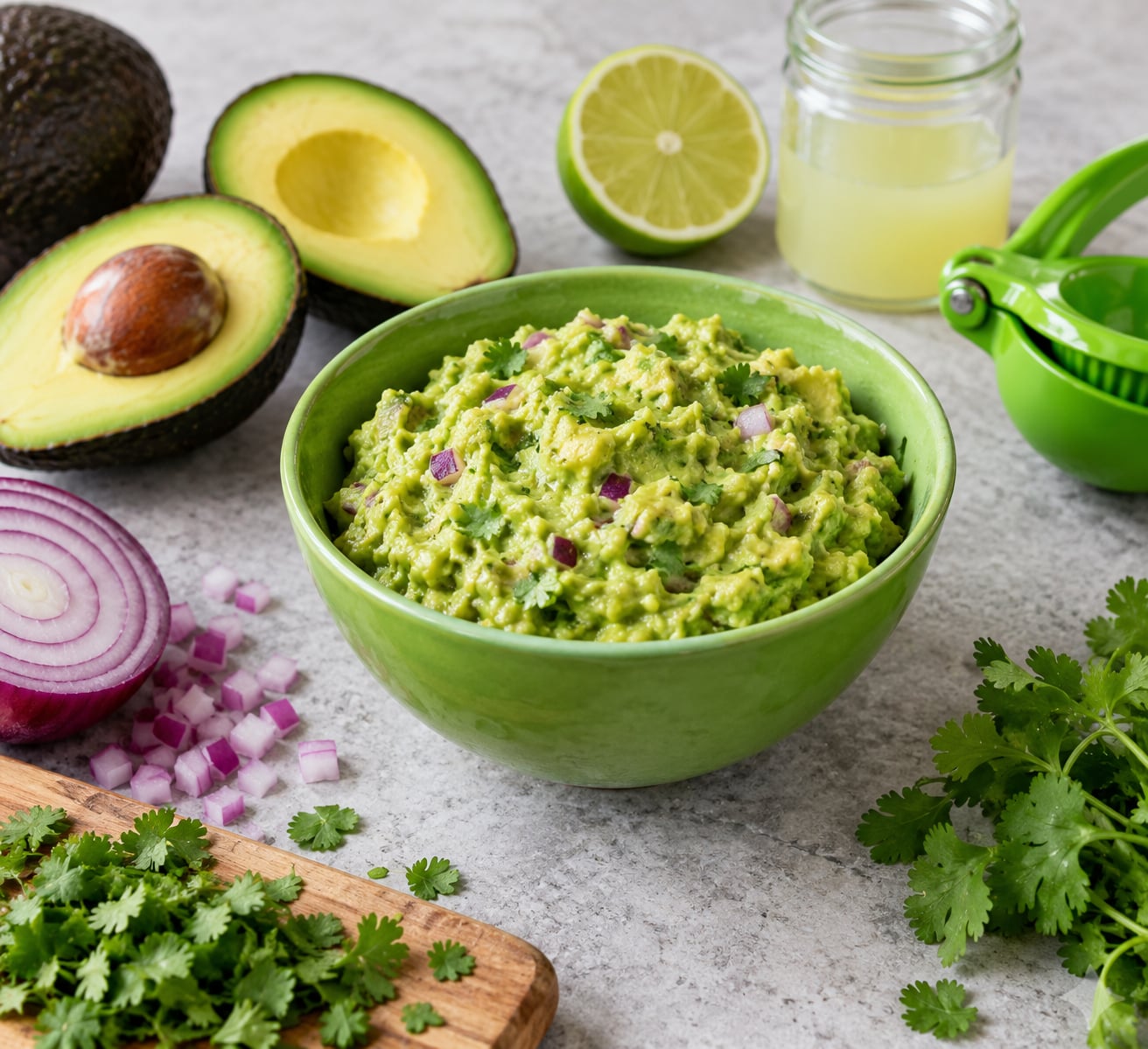
You need less than most people expect. The ingredient that does the real work is fresh lime, not the bottled stuff, so buy fruit with a heavy feel and bright green skin. Hard, pale limes have thick pith and little juice, and squeezing one of those into your guac is how you end up with a salty, barely acidic dip that browns anyway.
- Three to four ripe avocados that yield to gentle pressure at the neck. One hard, one soft and one in between gives you texture without needing salt to fix it.
- Two or three fresh limes, room temperature. Rolling each one hard on the counter under your palm before you cut it roughly doubles the juice you get.
- Kosher salt, which flakes instead of dissolving, so you can taste as you go.
- A quarter red onion, minced fine. Soak it in cold water for five minutes if you find raw onion sharp.
- A bunch of cilantro, roughly chopped, stems included.
- One or two serrano or jalapeno chiles, optional, deseeded and minced.
- Plastic wrap and a rubber band, or a bowl that takes a lid that seals right down on the rim.
That is the whole kit. No special equipment, and the plastic wrap and a lime are doing about ninety percent of the work here.
Step-by-Step: How to Make Guacamole That Does Not Turn Brown
Work in the order below and the colour problem basically disappears. The sequence matters: cutting and salting come before acid goes in, and covering happens last, within seconds of mashing.
Prepare the Avocados Without Browning Them
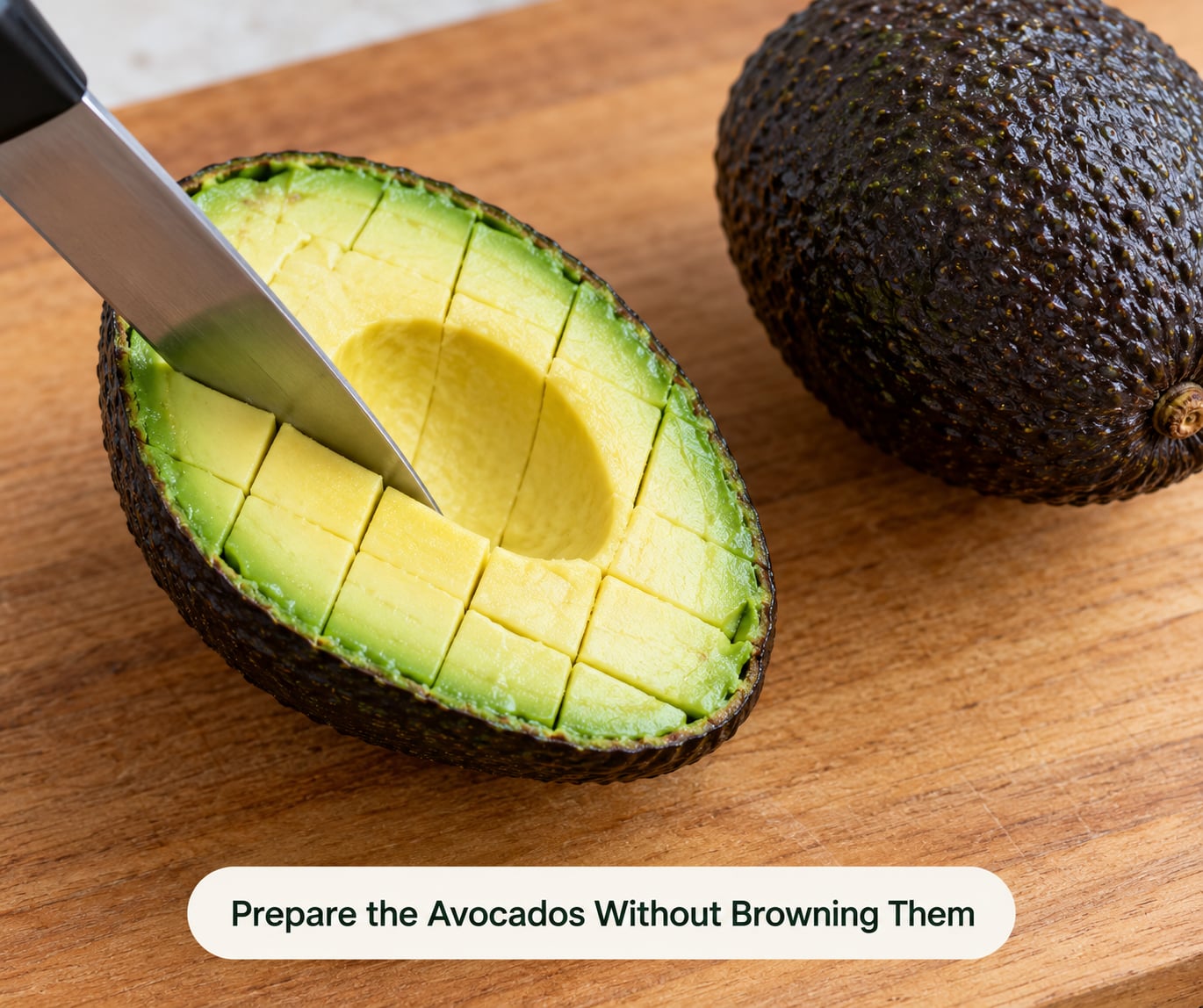
Cut each avocado in half, twist out the stone, and run a knife around the inside of the skin in long slices. Then score the flesh in a crosshatch pattern, cutting down to the skin but not through it, and scoop it out with a spoon. You get bigger pieces this way, which is the first defence against browning: less exposed surface area and less air touching the avocado at once.
Drop the scooped pieces into your bowl and keep moving. Every extra minute a cut surface sits in open air is a minute of reaction you cannot get back, so skip the step where you leave the scoops sitting on the board to photograph them.
How do you know the fruit is ready? Press the stem end. If it gives slightly, the flesh around the pit is soft enough to mash. If there is no give at all, the dip will end up lumpy and you will reach for more salt to compensate, which is how you get a salty guac.
Add the Ingredients That Slow Down Oxidation
Salt first, then lime. Salt on cut avocado draws out cell moisture and helps the pieces break down, and the lime that follows lands on already-broken-down flesh where it can do more work.
The rule I use is one tablespoon of lime juice per avocado, then taste. For three avocados that is three tablespoons, roughly the juice of one lime and a half. Squeeze it straight in, then add a teaspoon of salt per avocado and mash briefly before deciding whether you need more acid. Adding all the acid at the end is the mistake that makes guac taste sour and thin, because undiluted lime juice pools instead of dispersing.
Onion, chiles and cilantro go in at this stage too. Cilantro is worth adding late if you are fussy about the taste, since heat and time dull it.
Lime works because it carries ascorbic acid, the same antioxidant as vitamin C, plus citric acid that drops the pH. Oxygen reacts with the ascorbic acid first, which means it runs out before it reaches the flesh. That is a delay, not a permanent stop, which is why acid alone will not carry a bowl sitting on a warm counter through a party.
Mash, Taste, and Keep the Surface Protected
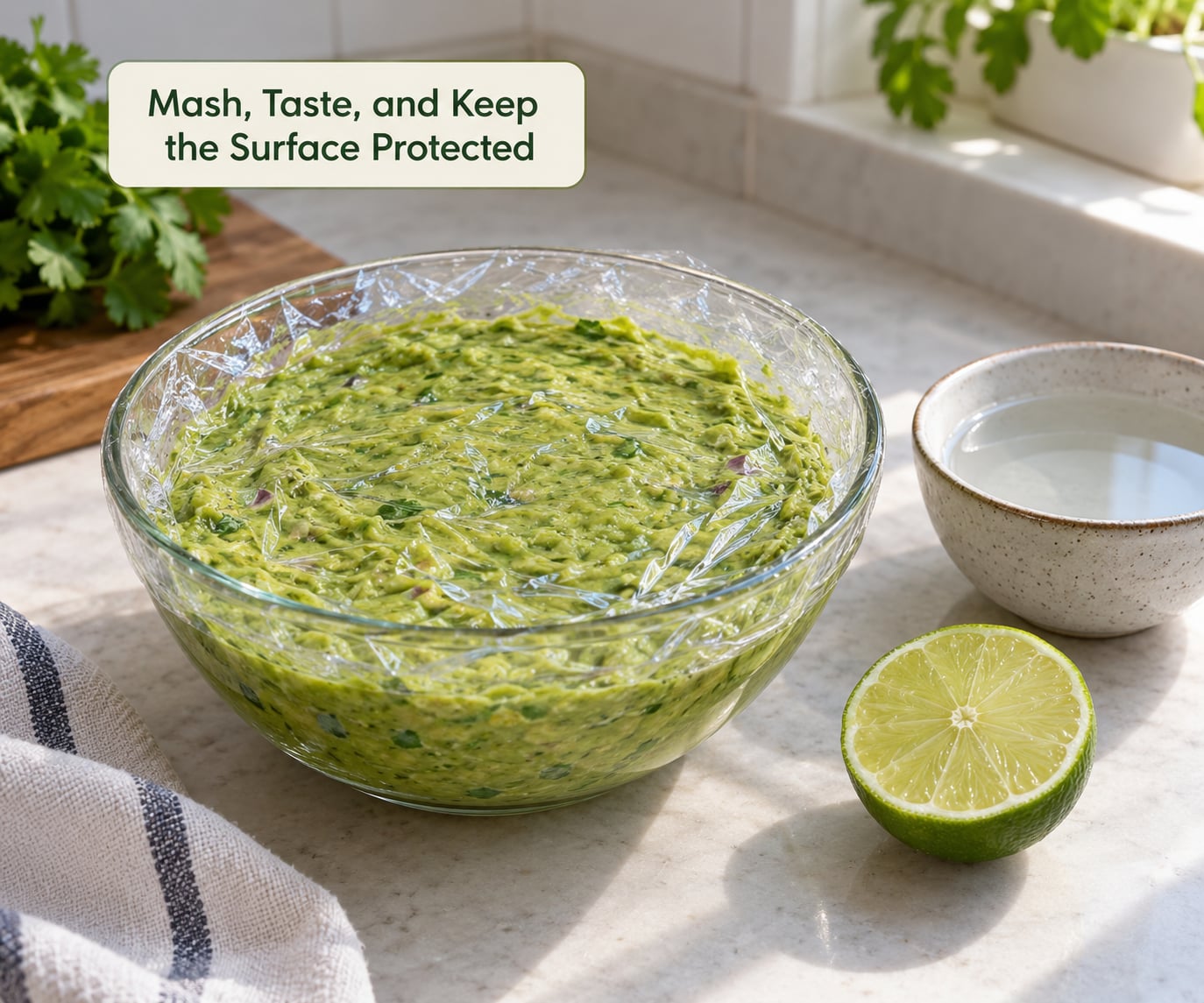
Mash with a fork and leave some texture. A fork gives you lumps of every size, which scoops better onto a chip than a uniform paste, and lumps have less wet surface area to discolor. A potato masher turns guac into something closer to baby food, and that paste browns faster than you would expect.
Taste before you serve it. It should be sharp enough to make you want another chip, with the salt sitting behind the lime rather than in front of it. Adjust one variable at a time: more lime if it tastes flat, more salt if it tastes thin.
Then the step that changes everything. Pull out a sheet of plastic wrap, lay it over the bowl, and press it down firmly against the surface of the guacamole with your palm until every bubble is gone. Wrap the bowl, then put a rubber band around it so nothing lifts. A lid that sits above the guac leaves a pocket of air, and that pocket is a free oxidation chamber.
Refrigerate within a few minutes. Cold slows the enzyme reaction on top of everything else the barrier is doing.
Here is the same thing in one comparison, because the right choice depends on how long you are storing and how much effort you want to spend.
| Method | How it works | Effort | Stays green for | Flavour impact | Best for |
|---|---|---|---|---|---|
| Plastic wrap pressed onto the surface | Excludes oxygen from the dip itself | One minute | 1 to 2 days | None | Overnight storage, game day |
| Thin lime juice layer brushed on top, then wrap | Acid plus a barrier | Two minutes | 2 days | Slightly sharper on top; stir before serving | Making it the night before |
| Half inch of water on top, refrigerated | Water blocks oxygen, acid slows the enzyme | Two minutes plus pouring it off | 2 to 3 days | None if poured off fully | Longest hold, big batches |
| Airtight jar, dip pushed to the top | Minimal headspace air | One minute | About 1 day | None | Meal prep portions |
| Olive oil poured over the top | Blocks air, no acid effect | One minute | Under 1 day | Oily surface, strange on chips | Nothing, honestly |
The water method is the most repeated community favourite, and it works: pour about half an inch of cold water over the surface until the guac is submerged, refrigerate, then pour the water off in the morning and give the dip a gentle stir. Squeezing half a lime over the top first is the belt-and-braces version, and it is the one I use when the party is more than a day out.
Why Restaurants Keep Their Guacamole Green
Restaurants and chains solve the same problem at a larger scale, and their answer is not one clever trick. It is a system, and you can borrow any part of it for your own bowl.
- Batch size stays small. A big chain service line does not hold a bowl of guac for three days. They make small batches, sell through them, and start fresh, which is why restaurant guac never gets the chance to turn.
- Fresh lime in the mix, always. Acid goes into every batch, not just on top. It costs almost nothing and it is the single biggest factor in the colour.
- Sealed service containers. Guac travels in lidded tubs packed in ice, with the lid sitting flush so there is no headspace.
- Cold chain, end to end. Continuous refrigeration keeps the enzyme reaction slow the whole time the dip is in service, not just during the first hour.
The takeaway for home cooks is the first two points. Keep your batch modest, mix in lime, and you have already done what a kitchen does.
Common Mistakes
Most brown guac is not a failed recipe. It is one of these six things, and every one of them has a straight fix.
Leaving the avocado pit in the bowl. This is the most repeated myth in cooking forums, and it is straightforwardly false. The pit does not release anything into the surrounding dip. All it does is occupy the middle of the bowl, which is exactly where the guac is exposed anyway. People keep it out of habit and then blame the pit when the edges go brown.
Sticking toothpicks into the avocado. Same problem, plus punctures. There is nothing to gain here.
Pouring olive oil over the surface. Oil blocks air, but it adds nothing chemically and it leaves a slick film on the dip and on every chip that touches it. Skip it.
Wrapping loosely and letting the film float. This is the most common failure with an otherwise correct method. Plastic wrap has to be in contact with the guac, not hovering above it. Press it down with your palm, push out the bubbles, and secure it with a rubber band.
Using bottled lime juice. Bottled juice is often weaker and more bitter, so you end up adding more of it and losing the fresh taste. Fresh limes give you about double the juice per fruit.
Leaving the bowl on the counter during a party. A covered bowl holds for hours. An uncovered one starts changing within twenty minutes. If you are serving for more than a couple of hours, put the bowl into a larger bowl of ice, keep it in the fridge between waves of guests, or serve small batches and refill.
How Long Does Homemade Guacamole Stay Green?
With the plastic wrap contact seal and lime mixed in, expect bright green colour for roughly 24 hours in the fridge and a slightly duller top for up to two days. Add the water barrier and you are looking at two to three days before the flavour starts to suffer.
Brown guacamole is not the same as bad guacamole. Browning is a cosmetic oxidation reaction, and it does not by itself create a safety risk. Smell it and look at it: an off or sour smell, visible moisture or fizziness, or a slimy texture means it goes in the bin regardless of colour. Standard leftover guidance from USDA is three to four days refrigerated at or below 40F, and guac is usually at its best well before that.
If a batch has gone brown but still smells fine, scrape off the top layer and there is usually bright green underneath. Then work fresh lime into it, stir, and use it in nachos or on a burger where a little colour shows less.
Frequently Asked Questions
Why does my guacamole turn brown so quickly?
Cutting the avocado damages cells and releases polyphenol oxidase, an enzyme that reacts with oxygen to produce brown pigment. The more cut surface you leave exposed, the faster it happens. Acid slows the reaction, and a barrier such as plastic wrap pressed onto the surface stops oxygen reaching the guac at all. A bowl left uncovered on a warm counter will brown in under half an hour.
How do I keep guacamole from browning when serving it?
Mash it right before guests arrive, not an hour before. Use fresh lime juice in the mix, then press plastic wrap directly onto the surface and hold it down with a rubber band. If the bowl will sit out longer than about two hours, set it inside a larger bowl packed with ice, or bring small batches out and refill them. Covered and cold is the whole game.
Does lime juice really stop guacamole from turning brown?
It slows it substantially rather than stopping it completely. Lime contains ascorbic acid and citric acid. The oxygen reacts with the ascorbic acid first, and the lower pH slows the enzyme, so you buy hours rather than days. On its own it is not enough for overnight storage, which is why it works best combined with plastic wrap or a water layer on top.
How long does guacamole stay green in the refrigerator?
About 24 hours with the plastic wrap contact seal, up to two or three days if you add a half inch of water on top and refrigerate. Colour is not the safety question, though. Smell for anything off, check for slime, and follow the standard three to four day leftover window. You can also freeze it in portions for up to two or three months, though the texture softens once thawed.
Can I make guacamole ahead of time without it turning brown?
Yes, and a night ahead is comfortable. Mix in a tablespoon of lime juice per avocado, mash with a fork, then press plastic wrap flat against the surface with no air pockets and refrigerate. For two days or more, pour half an inch of water over the top and pour it off before serving. Stir gently once you uncover it, since the surface will have set slightly.
How can I tell if guacamole has gone bad?
Use your nose first. Fresh guacamole smells fresh and grassy, while spoiled guac smells sour, fermented or faintly ammonia-like. Then check the texture for sliminess or fizzing when poured, and look for separation or discoloration beyond the surface layer. If any of those show up, discard the whole bowl even if the colour still looks fine.
Conclusion
Do this first: squeeze a tablespoon of fresh lime juice per avocado straight into the bowl, mash with a fork instead of a masher, and press plastic wrap flat against the surface so no air is trapped, then refrigerate it. That combination covers oxygen with a barrier and slows the enzyme with acid, and it keeps guacamole bright green through a whole party and into the next day. Add a half inch of water on top when you are storing it longer than that.