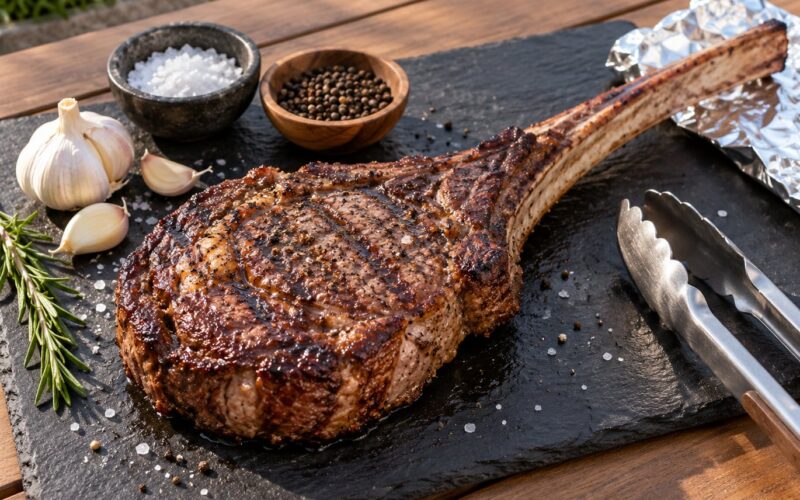
The short answer is a hot cast-iron skillet and a hot oven. Sear the steak 2 to 4 minutes a side until a deep brown crust forms, then move anything thicker than 1.5 inches into a 400F oven until it hits your target internal temperature. Rest it 5 to 7 minutes before slicing.
That method is how to cook steak without a grill better than most people expect. A dry steak against a very hot pan browns harder and faster than the same steak over indirect grill heat, and the oven finish solves the one problem a skillet creates, which is cooking the middle without scorching the outside.
Total time is about 25 minutes, plus however long you let the steak sit before cooking. No grill, no patio, no charcoal. Just a burner and ten minutes of attention.
Table of Contents
- What You Need
- Step-by-Step: How to Cook Steak Without a Grill
- 1. Choose and Prepare the Steak
- 2. Heat the Skillet Until Very Hot
- 3. Sear the First Side Without Moving It
- 4. Flip and Cook the Second Side
- 5. Finish Thick Steaks in the Oven
- 6. Rest, Slice, and Serve
- How Do You Know When Steak Is Done?
- Common Mistakes When Cooking Steak in a Skillet
- Can You Cook Steak in the Oven Without a Skillet?
- How Should You Season Steak Without a Grill?
- Frequently Asked Questions
- Can I cook steak without a cast-iron pan?
- How long does steak take to cook in a skillet?
- Do I have to bring steak to room temperature before cooking?
- What temperature should steak reach when cooked without a grill?
- Can I cook steak in a nonstick pan?
- How do I keep my kitchen from filling with smoke when searing steak?
- Conclusion
What You Need
Most home kitchens already have everything on this list, which is good news, because steak is one of the cheapest things to cook well. The short version: a heavy pan, a thermometer, and coarse salt.
- A heavy skillet. Cast iron is the classic choice, and a 10 or 12 inch pan gives you room for one good-sized steak without crowding. A thick-bottomed stainless steel pan is a genuinely capable substitute.
- An instant-read thermometer. This one tool does more for your results than any pan upgrade. Probe steaks in the thickest part, not through the side.
- Tongs. A pair of metal tongs, ideally with scalloped tips, so you can grip the steak without puncturing it.
- A neutral, high smoke point oil. Avocado, canola, grapeseed, or refined (not extra virgin) olive oil. Beef tallow is the highest smoke point option of all and gives the most beefy flavor.
- Coarse kosher salt and cracked black pepper. Regular table salt dissolves into the crust and tastes flat. Diamond Crystal or Morton kosher salt season properly.
- Butter, garlic, and a woody herb. Thyme or rosemary for the basting step, which is where the restaurant flavor comes from.
- Ventilation. A range hood on high, or a window and a fan. More on this below, because it is the number one indoor complaint.
- A wooden board. Resting on a board keeps the juices on your plate instead of running down the drain.
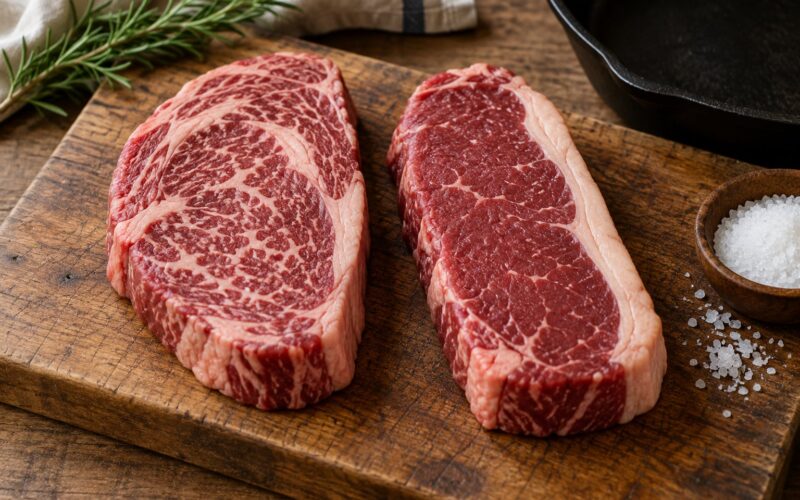
On cut choice, aim for a steak between 1 and 1.5 inches thick. Ribeye and New York strip are the forgiving ones, sirloin is leaner but still reliable, flat iron is great value and very tender, and filet mignon is the easiest of all but the most expensive. Chuck eye, sometimes sold as a Boston steak, is what gets called the poor man’s ribeye, and for a pan sear it behaves just like one.
Step-by-Step: How to Cook Steak Without a Grill
1. Choose and Prepare the Steak
Take the steak out of the fridge 20 to 30 minutes before cooking if you can. A cold steak hits the hot pan and sears unevenly at the edges while the center stays cold. Room temperature just means room temperature, not warm.
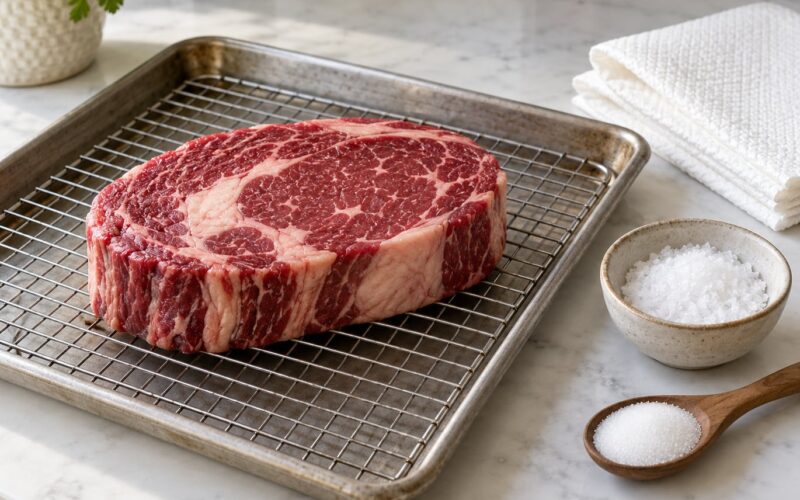
Then dry it. Take paper towels and blot every surface of the beef until it looks slightly tacky rather than wet. Surface moisture has to evaporate before browning can start, and a damp steak will steam in the pan instead of searing, which is why the crust turns patchy and pale.
Season both sides generously with coarse salt, working it into the edges and the fat cap if there is one, then grind black pepper over the top. Salt early, because the crust you are about to build needs it to taste like something. If you like, salt up to 24 hours ahead and leave the steak uncovered in the fridge for a deeper seasoning all the way through.
2. Heat the Skillet Until Very Hot
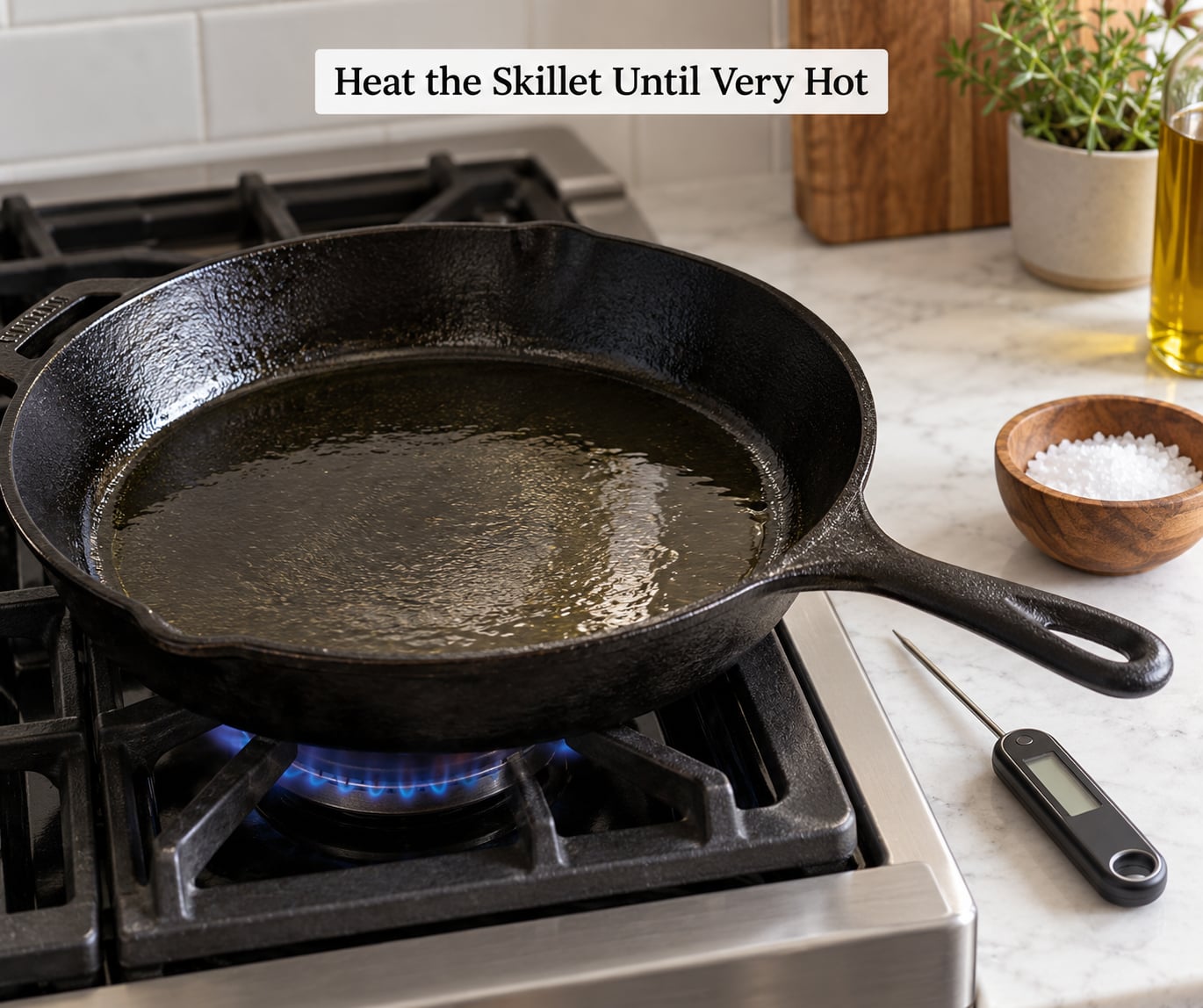
Put the skillet on a burner set to high and give it three full minutes. Cast iron announces itself with a faint shimmer and a smoke trace from the seasoning, and by then the metal is genuinely hot enough to brown a steak on contact. Stainless steel looks similar once the oil starts to move.
Add a thin layer of oil that coats the bottom of the pan and no more. Olive oil extra virgin turns bitter and smokes at searing temperatures, which is the most common reason home steaks taste acrid, so use a refined oil or tallow instead.
You do not need a thermometer in the oil. Wait until the oil is fluid and just beginning to shimmer across the surface, which is the signal that it is hot enough for the steak to hit without sticking.
3. Sear the First Side Without Moving It
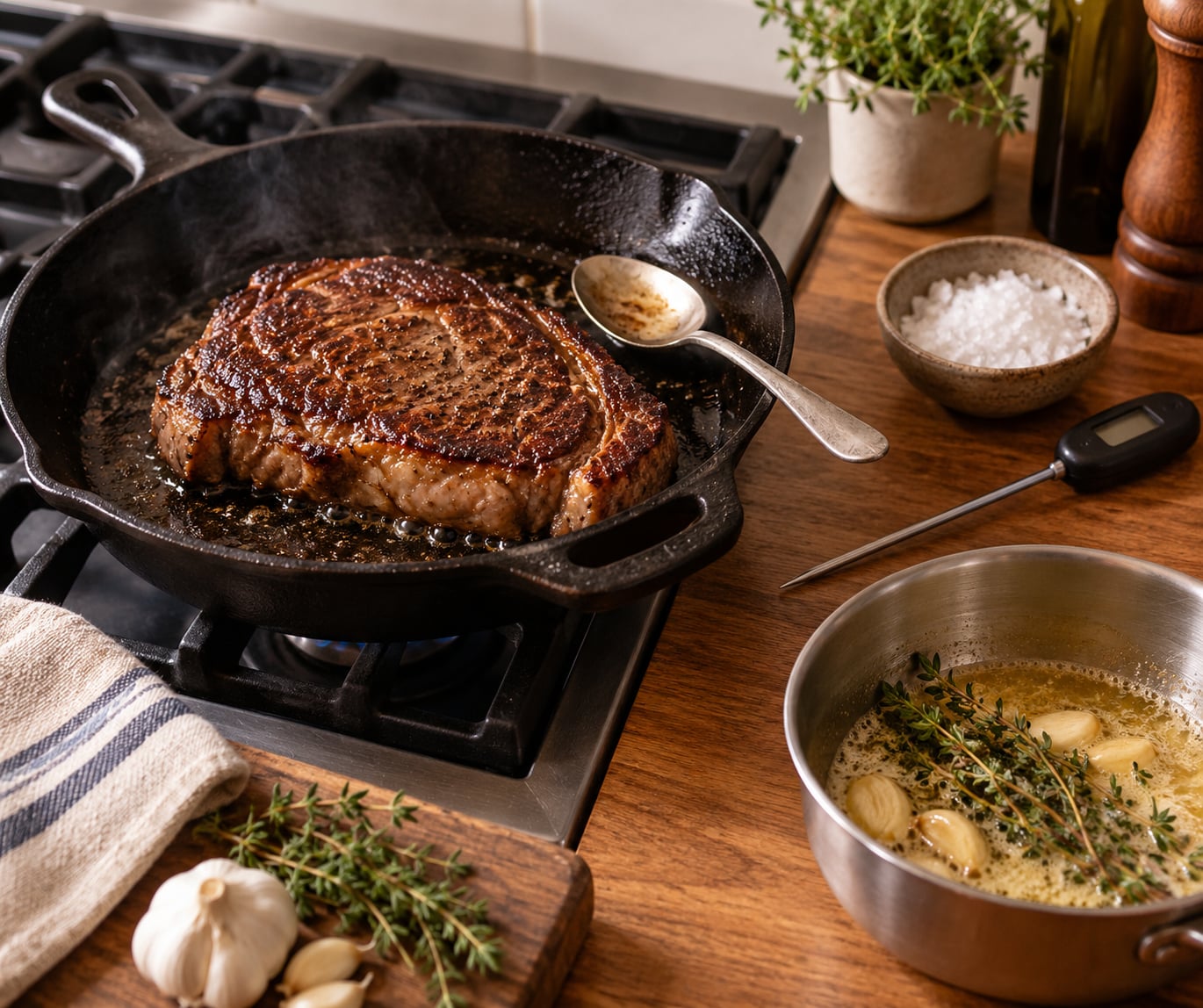
Pick up the steak with your tongs and lay it into the pan away from you so any spatter moves away from your arm. It should hiss loudly and immediately. If it does not hiss, the pan was not ready, and you should start over with a fresh steak rather than cook a grey one.
Now leave it alone. Resist the urge to flip, press, or slide it. The crust forming under the steak needs roughly 3 uninterrupted minutes for a 1 inch cut, and every time you move the meat you tear that crust off and expose raw surface to the pan.
You will know the first side is close when the surface turns deep brown rather than tan, the edges look cooked and darkened, and the steak releases from the pan with no resistance at all. If it sticks hard, it needs another 30 seconds and a little more heat.
4. Flip and Cook the Second Side
Flip once with your tongs. Cook the second side for a similar stretch, a little shorter if the steak is under an inch thick, because the residual heat in a thick pan keeps working after the burner does.
Start checking temperature during this second side if the steak is 1 inch or thinner. For anything thicker, push the probe into the side and read the center; a thin steak can pass through medium rare to medium well in under a minute at this stage.
Adjust your heat as you go. If the bottom of the crust is darkening much faster than the steak is cooking through, turn the burner down to medium rather than letting the outside win.
5. Finish Thick Steaks in the Oven
Anything past 1.5 inches needs the oven. Preheat it to 400F while the steak sears, which is roughly the same as a moderately hot domestic oven, and move the whole pan onto a middle rack for 4 to 9 minutes depending on thickness and how done you want it.
Check the temperature every minute from the third minute onward. A reverse sear works here too, and it is the method I prefer for thick ribeyes: cook the steak in a 225F oven to about 10 to 15F below your target, then sear it hard in a screaming hot skillet for 90 seconds a side. It gives you the deepest crust of any indoor method because the center never had to survive direct heat.
6. Rest, Slice, and Serve
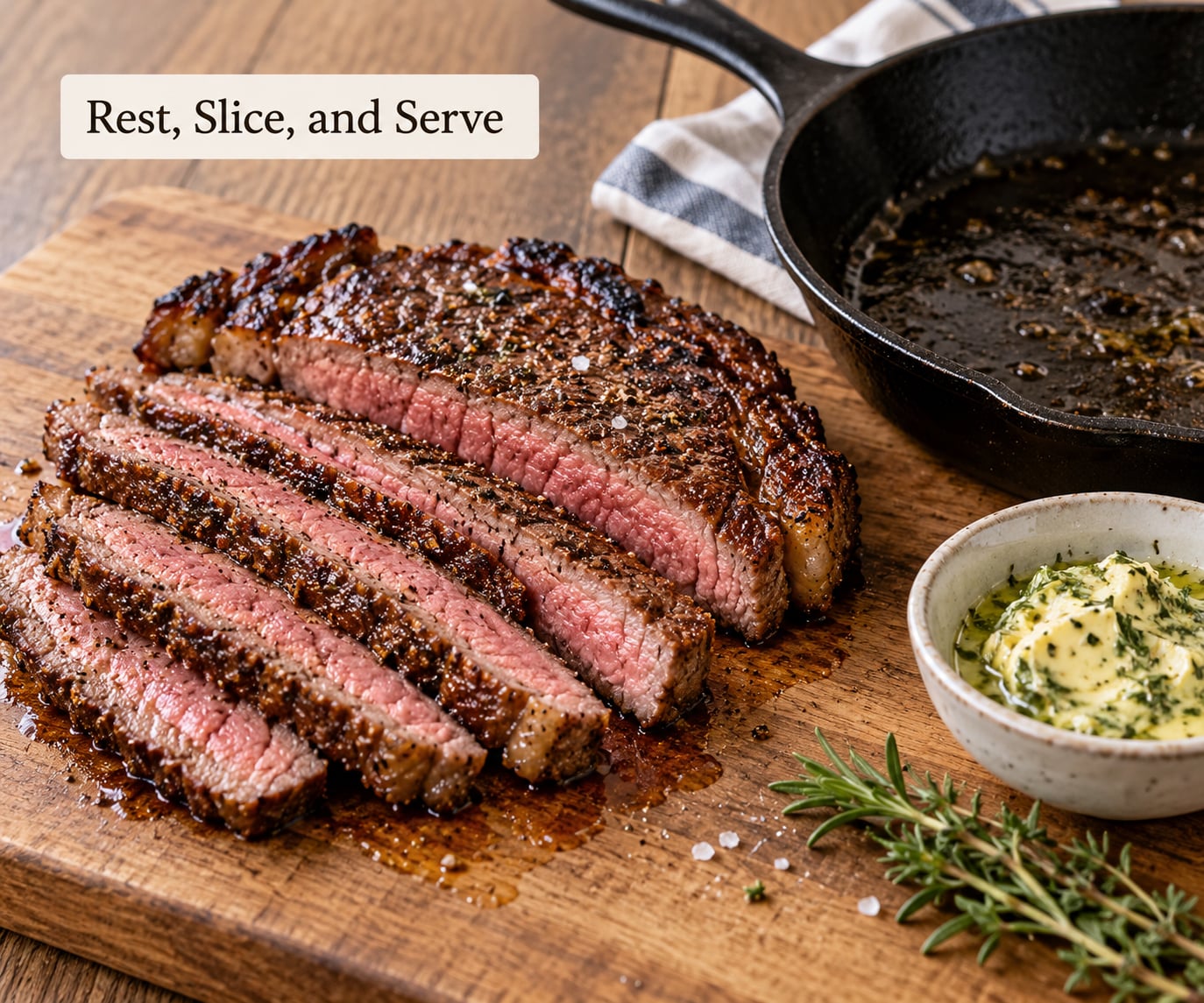
Take the steak off the heat and let it sit on a board for 5 to 7 minutes. Thinner cuts need about 5, thick cuts closer to 10. Resting lets the muscle fibers relax and reabsorb the juice that got pushed toward the center, which is the difference between a steak that is wet when you cut it and one that stays tender.
Then slice against the grain. Find the direction the fibers run, usually obvious on the fat and the long lines of the cut, and cut across them at a slight angle for more surface area on the plate.
Finish with flaky salt, a knob of the basting butter if you have any left, and a pinch of flaky salt or pepper. Serve right away while the crust is still crackling.
How Do You Know When Steak Is Done?
Use an instant-read thermometer every time. For food safety, USDA guidance for whole cuts of beef is an internal temperature of at least 145F, followed by a three minute rest. Most home cooks stop well short of that on purpose, and that is a preference choice rather than a safety one.
| Doneness | Pull at | After resting | What you feel |
|---|---|---|---|
| Rare | 120 to 125F | 125 to 130F | Soft, very red center |
| Medium rare | 125 to 130F | 130 to 135F | Warm, red, springy center |
| Medium | 135 to 140F | 140 to 145F | Firm, pink center |
| Medium well | 145 to 150F | 150 to 155F | Little pink, noticeably firm |
| Well done | 155 to 160F | 160F and up | Firm throughout, grey |
Two things explain the gap between the pull column and the resting column. First, carryover cooking: a hot steak keeps cooking after it leaves the pan, adding roughly 5 to 10F as the interior equalizes out. Pulling 10 to 15F below your target is the single best habit a beginner can pick up.
If you have no thermometer, touch is a rough fallback. Rare feels like nothing, medium rare gives slightly more resistance, medium takes a light press, and medium well bounces back like the back of your hand. Check by pressing the steak itself, not the tongs, and expect to overshoot.
| Steak thickness | First side | Second side | Oven finish at 400F |
|---|---|---|---|
| 3/4 inch or thinner | 90 to 120 seconds | 90 to 120 seconds | Not needed |
| 1 inch | 2 to 3 minutes | 2 to 3 minutes | Optional, 3 to 5 minutes |
| 1.5 inch | 3 to 4 minutes | 3 to 4 minutes | 4 to 7 minutes |
| 2 inch or thicker | 3 to 4 minutes | 3 to 4 minutes | 7 to 12 minutes, or reverse sear |
These times assume a hot pan and a steak at room temperature. A thicker steak, a colder steak, or a weak burner all push the numbers longer, which is another argument for the thermometer.
Common Mistakes When Cooking Steak in a Skillet
Putting two steaks in a hot pan. The pan temperature crashes when you add cold, wet meat, and two pieces of beef need more surface area than most home skillets have. Sear one at a time. Every serious cook I know owns more pans than they planned on for exactly this reason.
Skipping the drying step. Wet meat steams. Blot with paper towels until the surface looks dry.
Not waiting for the pan. Three minutes on high for cast iron, until the oil shimmers. A lukewarm pan gives you a grey, sad exterior and a raw middle.
Flipping constantly. Some cooks flip every 30 seconds on purpose, and the result is more evenly cooked but a thinner crust. Decide which one you want. For a restaurant-style sear, leave it alone.
Using a nonstick pan over very high heat. Nonstick coatings are rated well below the temperatures needed for a hard sear. You can cook steak in one at medium heat, but you are trading the crust for the pan, and the classic skillet method will not transfer.
Cooking a 2 inch steak entirely in the skillet. You will get a burnt outside and a raw center. Move it to the oven, or better yet, use the reverse sear.
Slicing straight off the burner. The juices come out on the board instead of staying in the meat. Rest it.
Ignoring smoke. It happens to everyone, and it is a sign that the pan is hot enough to work, not that you have failed. Turn the range hood to high before you start, open a window, and stand a fan at an open door pointed outward. Beef tallow and avocado oil smoke later than olive oil, which buys you margin. Smoke is a nuisance, not a safety emergency, but if a plug-in alarm sounds, get the pan off the heat and ventilate rather than cooking through it.
Can You Cook Steak in the Oven Without a Skillet?
Yes, and the oven is genuinely better than a skillet for thick cuts. Set it to 400F, put the seasoned steak on a wire rack over a baking sheet so air circulates underneath, and cook until a thermometer reads your target. This gives you an evenly cooked steak with a browned exterior and no crust as aggressive as a seared one.
The broiler is the shortcut for a browned top. Move the steak as close to the broiler element as your oven allows, cook on one side until browned, flip, and start checking temperature immediately. Broilers run hot and unevenly, so stand there and watch it, and pull it the moment the top browns.
The cleanest version of all is the reverse sear I mentioned earlier, and it is the method to use when you have time. Low and slow in a 225F oven until the steak is 10 to 15F below your target, then a fast hard sear in a ripping hot pan for 90 seconds a side. Consistent edge to center, no gray band, and a crust that tastes like the Maillard reaction, which is just the chemical browning that needs a dry surface and real heat.
How Should You Season Steak Without a Grill?
Start with coarse salt and cracked pepper, applied generously to both sides before the steak ever sees heat. That is what a steakhouse does, and it is harder to improve on than cooks think. The salt should feel like too much when you apply it, because a lot of it falls off with the crust.
For a different direction, add a butter baste in the last minute of searing. Put a couple of tablespoons of butter, two smashed garlic cloves, and a few thyme sprigs into the pan and tilt it so the foam rolls over the steak. That butter turns nutty and brown from the pan’s heat and becomes an instant sauce.
A spice rub works well on thicker, leaner cuts. Coat the raw steak with a coarse salt, garlic powder, smoked paprika, and a little cayenne, and let it sit for 30 minutes before cooking. Keep the rub thin; a heavy layer burns long before the steak is done.
Whatever you use, keep the surface dry until the moment it hits the pan. Marinades and glazes with sugar or acid in them need the oven method, because they burn on a stovetop before the beef cooks.
Frequently Asked Questions
Can I cook steak without a cast-iron pan?
Yes. A heavy stainless steel skillet works nearly as well, because what matters is mass and heat retention, not the material. A ridged grill pan, carbon steel, or a flat cast iron griddle all behave similarly. Nonstick will cook the steak but caps the heat below what a proper sear needs, and it struggles to build a crust. Whatever you use, give it three minutes to preheat before the steak goes in.
How long does steak take to cook in a skillet?
About 2 to 4 minutes per side for a 1 inch steak gives you a browned exterior. Cooking time changes with thickness, cut, starting temperature, and how much heat your pan is holding, so treat those numbers as a guide. Check early and often with an instant-read thermometer, and pull 10 to 15F below your target because the steak keeps cooking after it leaves the pan.
Do I have to bring steak to room temperature before cooking?
No, and food safety does not require it. Letting a thick steak sit out for 20 to 30 minutes helps thin cuts cook more evenly, because a cold steak hits a hot pan and sears unevenly at the edges. Shorter cuts can go straight from the fridge to the pan without much loss. Do not leave beef sitting out past two hours, or one hour in a hot kitchen.
What temperature should steak reach when cooked without a grill?
USDA guidance for whole cuts of beef is at least 145F internally, followed by a three minute rest. Many home cooks prefer medium rare at 130 to 135F, medium at 140 to 145F, or medium well at 150 to 155F. Pull the steak 10 to 15F below your target, since carryover cooking adds several more degrees during the rest.
Can I cook steak in a nonstick pan?
You can, but you give up the hard sear that makes skillet steak worth cooking. Nonstick coatings are rated below the high heat needed to brown a steak quickly, so use medium heat and expect a paler, thinner crust. A stainless steel or cast iron skillet lets you work at full burner heat and gives you the browning you are after.
How do I keep my kitchen from filling with smoke when searing steak?
Start the range hood on high before the steak goes in, and open a window if you have one. Use a neutral high smoke point oil such as avocado, canola, or beef tallow instead of extra virgin olive oil, which smokes early and turns bitter. Keep a fan pointed at an open door to pull air out of the room, and stand upwind of the burner while the steak sears.
Conclusion
Start by taking a steak that is an inch or a bit thicker, patting it completely dry, and salting both sides well. Give the pan three minutes on high, sear without touching it for 3 to 4 minutes, move anything thick into a 400F oven, and stop pulling at 10 to 15F below your target temperature.
Let it rest five minutes before you slice. That single habit, more than the pan you own, is what separates a good indoor steak from a disappointing one.