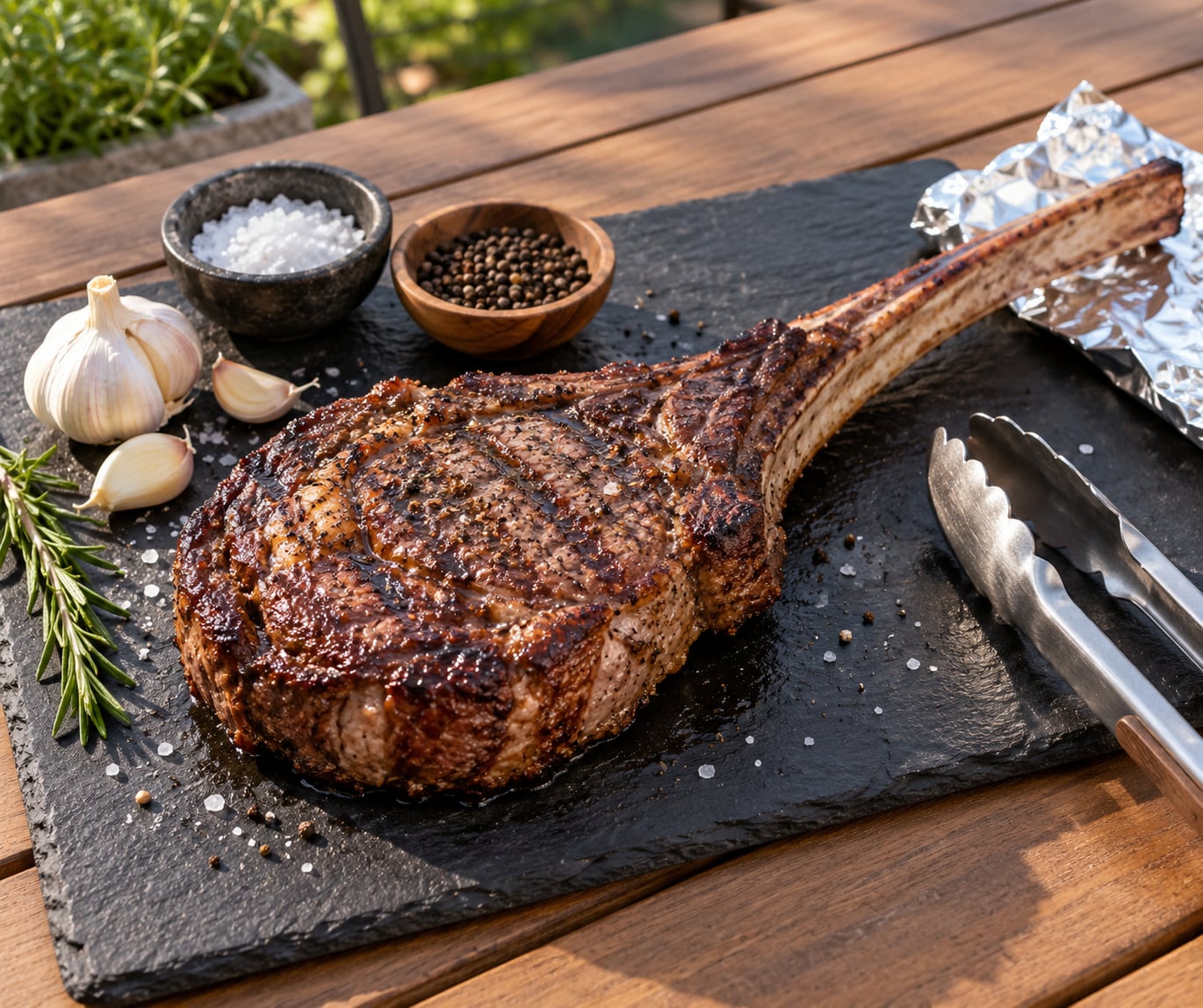
To grill a tomahawk steak, use the reverse sear: cook it gently over indirect heat until the inside reaches about 115 to 120 F (46 to 49 C), then sear hard over direct heat for 60 to 90 seconds a side to build a crust. A tomahawk is too thick for a straight sear, and this two-stage method is what keeps the middle pink. Allow 45 to 60 minutes, most of it hands-off, and it’s beginner-friendly as long as you have a probe thermometer.
The failure mode everyone hits first is the same: a blackened outside wrapped around a raw center. That happens because a forward sear gives the crust a five-minute head start and the middle nowhere to catch up.
Here is what a tomahawk actually is, what you need on hand, and the method that works on a gas grill, a charcoal grill or a pellet grill.
Table of Contents
- What You Need
- Step-by-Step: How to Grill a Tomahawk Steak
- Step 1: Prepare the Tomahawk Steak
- Step 2: Season the Steak Just Before Grilling
- Step 3: Build a Two-Zone Fire
- How to Grill a Tomahawk Steak on Gas, Charcoal or Pellet
- Step 4: Cook Over Indirect Heat Until 115-120 F
- Step 5: Sear the Tomahawk Steak Hard
- How Long to Grill a Tomahawk Steak, by Weight
- Tomahawk Steak Internal Temperature for Every Doneness
- Step 6: Rest, Slice and Serve
- Common Mistakes
- Frequently Asked Questions
- How long does it take to cook a tomahawk steak on the barbecue?
- Is reverse searing the best method for a tomahawk steak?
- How long do you smoke a 3 lb tomahawk steak at 225 degrees?
- Should I wrap the bone in foil?
- How many people will a 3 lb tomahawk steak feed?
- What is the 3-3-3 rule for steak?
What You Need
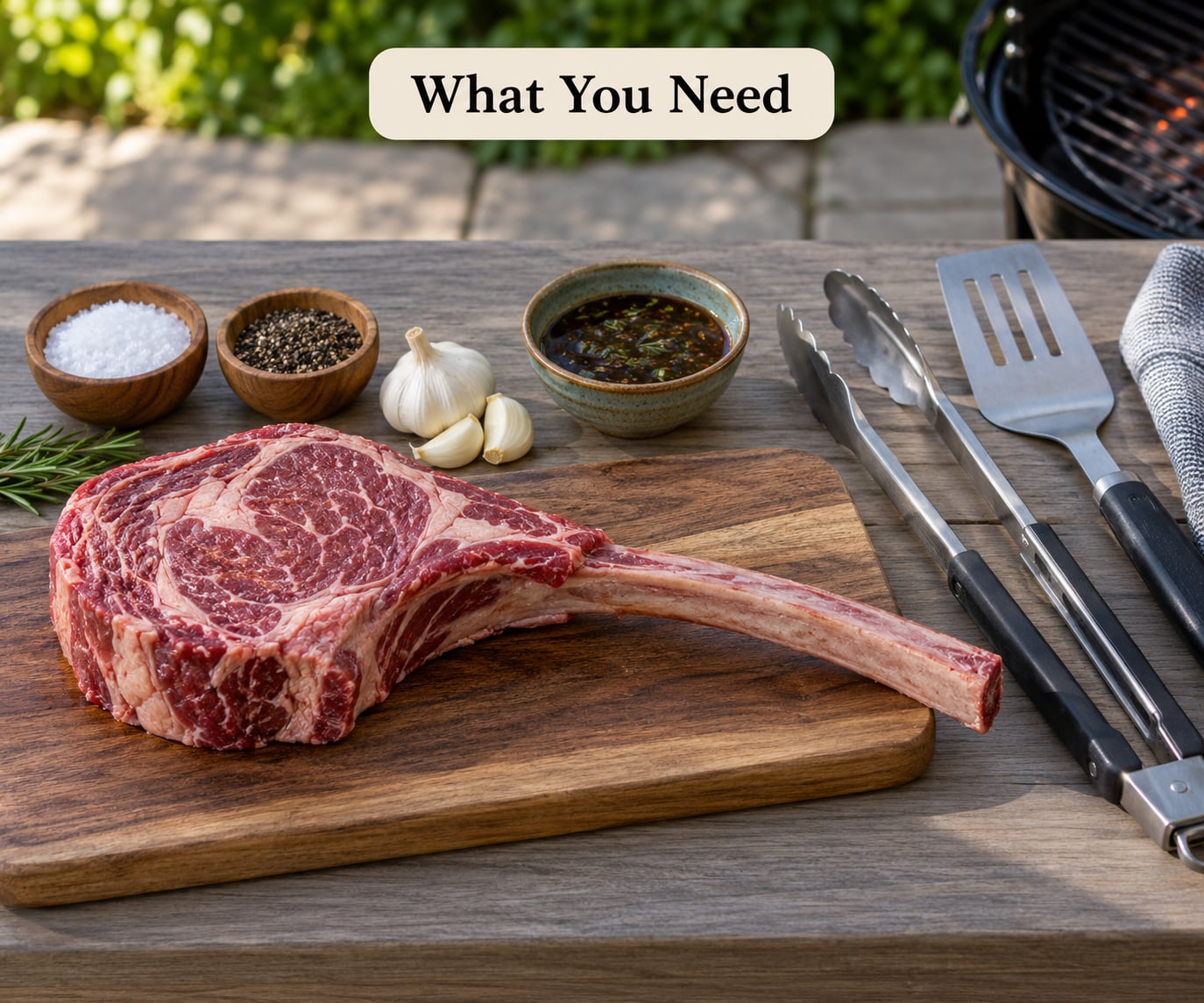
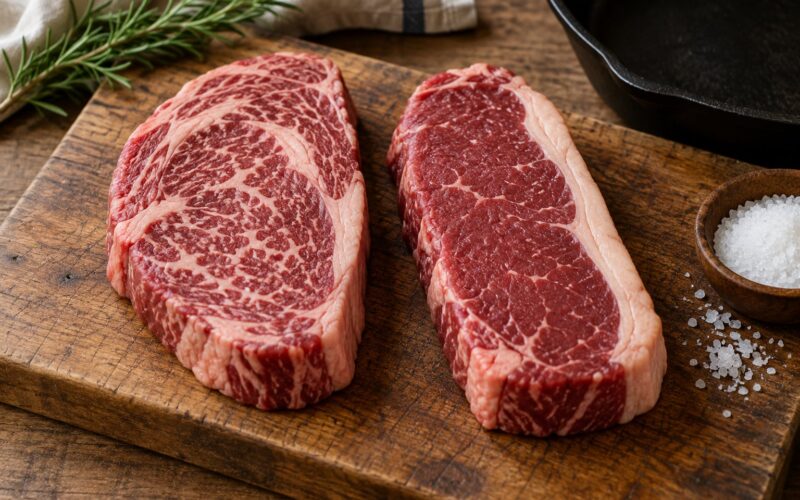
A tomahawk steak is a bone-in ribeye with the rib bone left long and French-trimmed so it looks like an axe head. The meat runs 2.5 to 5 inches thick and usually weighs 1 to 7 lb (450 g to 3.5 kg), which is why it needs a plan rather than a guess. One of these feeds two to four people, depending on the sides.
You’ll need a steak large enough to cover the grates, so nothing falls through. A cast iron grate or a heavy stainless grate handles a 3 lb tomahawk; a thin porcelain grate on a small kettle grill is a gamble.
The other must-have is an instant-read probe thermometer. Time is a rough guide here, and the community consensus on r/BBQ and r/grilling is blunt about that: probe temperature decides when the steak comes off, the clock only tells you when to start checking.
Then, the supporting kit:
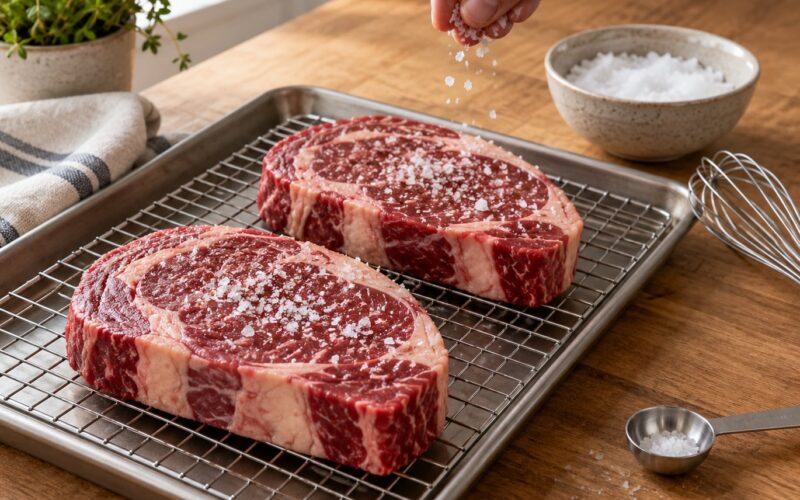
- Coarse kosher salt and a grinder of black pepper. Fine table salt dissolves into the crust; kosher salt gives you a visible season.
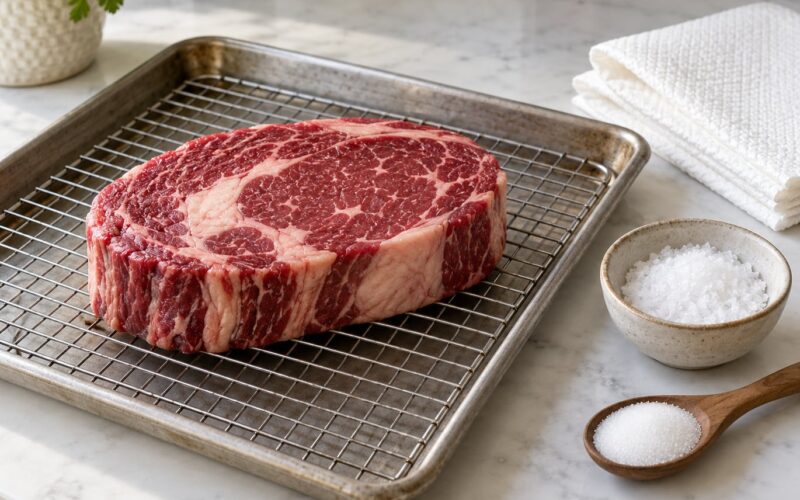
- A wire rack set over a tray, for salting ahead and for letting the surface air-dry.
- A small sheet of aluminum foil to wrap the exposed end of the bone.
- Neutral oil, or a compound butter for the end.
- Long tongs and a sharp carving knife, plus a board big enough for the steak.
Optional but useful: a charcoal chimney for a fast two-zone bed, wood chunks if you’re on charcoal or pellet, and a second steak if you’re feeding more than four. Cook a spare and slice it for sandwiches, because nobody in the history of this cut has regretted having leftovers.
Step-by-Step: How to Grill a Tomahawk Steak
Step 1: Prepare the Tomahawk Steak
Take the steak out of its packaging and pat the surface properly dry. Moisture is the enemy of crust, and a wet steak steams before it browns.
Trim any loose surface fat hanging past the edge, but leave the fat cap on top. That cap is flavor, and it’s what gives you the sizzle and drip during the sear.
Season it and leave it uncovered in the fridge on the rack for anywhere from one hour to overnight. People on r/BBQ swear by the overnight dry brine; the surface loses moisture and the seasoning penetrates further. A couple of hours is plenty if you’re in a hurry, but don’t skip it.
Before it goes on the grill, leave it out for 30 to 60 minutes so it isn’t refrigerator-cold. Straight-cold meat tightens up and cooks unevenly. Don’t leave it out longer than that, though. Above 40 F the outside starts drying out and seasoning into the crust before you ever light the fire.
Step 2: Season the Steak Just Before Grilling
If you dry brined it earlier, a light coat of pepper is enough. The salt has already done its work, and adding more right before grilling is how you oversalt.
If you’re seasoning on the spot, coat the whole surface generously with kosher salt about 10 to 15 minutes before the steak hits the grate. That rest gives the salt time to dissolve and work inward instead of just sitting on the surface as crystals.
Coarse ground black pepper goes on after the salt. Garlic powder, smoked paprika or a little cayenne all work well on the fat cap. Keep it simple on the first attempt, though. You want to taste the beef.
Step 3: Build a Two-Zone Fire
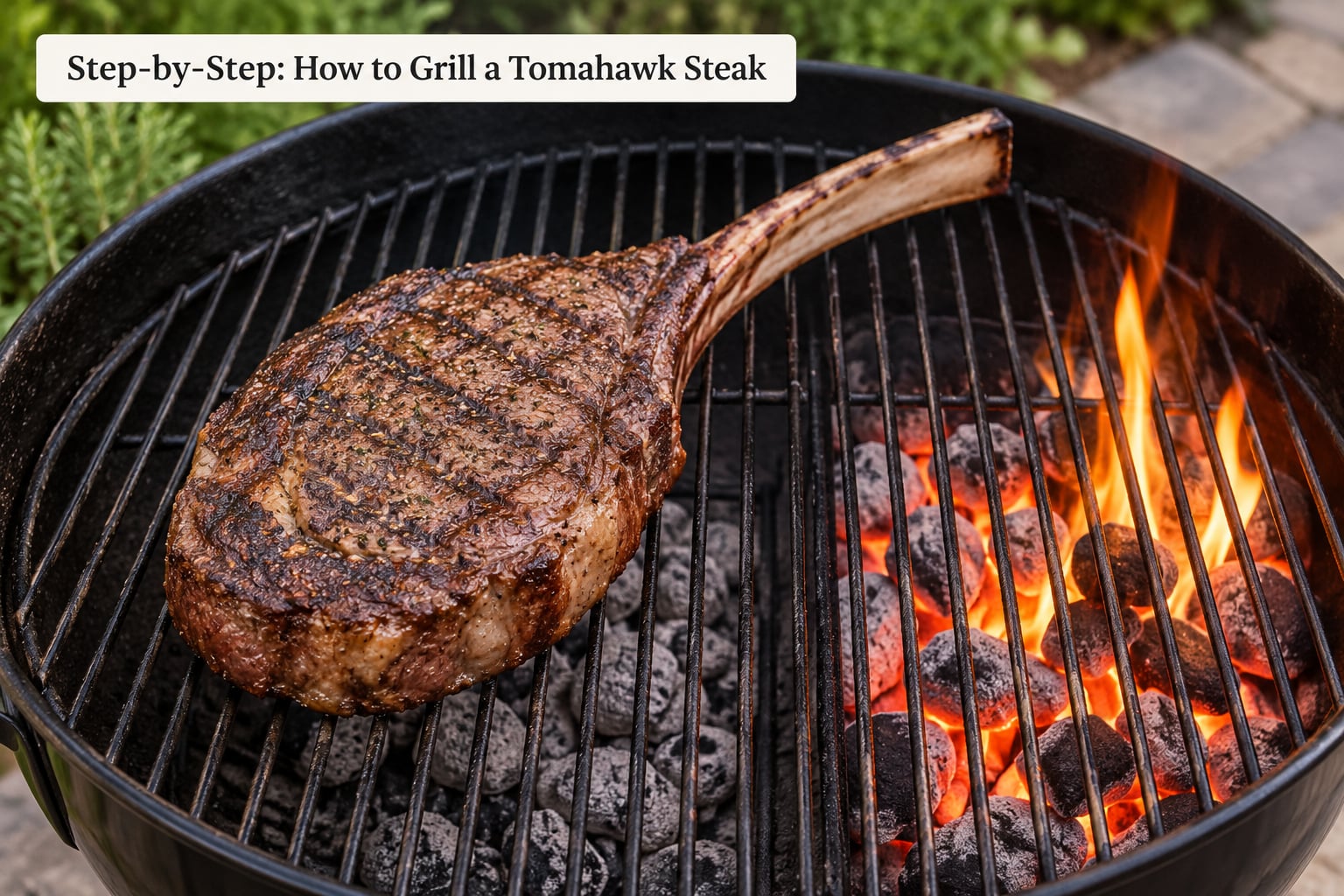
A two-zone fire is the whole trick: one side hot enough to sear, one side gentle enough to cook the middle. It is the single change that turns a straight sear into a reverse sear.
How to Grill a Tomahawk Steak on Gas, Charcoal or Pellet
Gas grill. Light all the burners, let the grill preheat a full 10 minutes with the lid closed, then shut off the burners on one half. That dead zone is your indirect side. The live side is your sear zone, and a gas grill gets hot fast, so start searing in 90 seconds and adjust down.
Charcoal grill. Fill a chimney and light it. When the coals ash over, dump half to the far side of the grill and push it into a single tight bank on the other. Let it burn another five to ten minutes so the sear bank is properly glowing, not just grey. This is the setup experienced grillers on r/BBQ converge on, and it works on a 14-inch kettle. One user there notes a small charcoal grill is genuinely enough for a single tomahawk, which counters the idea you need a big rig.
Pellet grill. Run it at 225 to 250 F (107 to 121 C) for the whole cook and treat the reverse sear as a bonus step. When the probe hits 120 F, crank the grill to high, sear 60 to 90 seconds a side, then turn it back down for the rest.
Kamado or offset smoker. Follow the pellet method, then finish over the charcoal grate. The Dutch oven method is the one exception: put the bone-in steak in a cast iron pot, sear it on all sides in butter, then braise at 250 F until a probe reads your target. It is a different dish, and a very good one.
Whatever the fuel, wrap the exposed blade of the bone in a small strip of foil, snugly and covering the bare white bone. It’s a five-second job that saves you a bitter, blackened bone at the table.
Step 4: Cook Over Indirect Heat Until 115-120 F
Put the steak on the cool side of the grate with the thicker end toward the hotter zone, insert the probe into the thickest part, and close the lid.
Now leave it alone. Every time you flip, you dump the heat that has built up. On a 2.5 to 3 inch steak, the low phase usually takes 20 to 35 minutes, but the probe is the only thing that counts.
You’re watching for 115 to 120 F. This is below your final target on purpose, and it’s the single most useful number in the whole method: it means the center is nearly where you want it, the outside is still pale, and the sear has a clean job to do.
That gap is carryover cooking. The steak keeps cooking after it leaves the heat, and a thick cut gains 5 to 10 F while it rests. Pull at 115 to 120 F and you land on medium rare. Pull at 130 F and you’ll overshoot to medium while the crust is still forming.
Step 5: Sear the Tomahawk Steak Hard
Move the steak to the hot zone and put the lid back up. You want the sound of aggressive sizzling and faint smoke, not a gentle hiss.
Press the steak down for the first 10 seconds to get good grate contact, then leave it. Cook 60 to 90 seconds on the first side, turn with tongs, and repeat. A 3 lb steak is thicker than your palm, so check the crust at 45 seconds and be ready to pull at 60. Thin tail sections brown fast, so watch the edges rather than the middle.
You’re looking for deep brown to mahogany, with the pepper forming a dark crust. If you see grey bands and no browning, the grill isn’t hot enough. If the fat cap catches fire, move the steak back to the cool side for 30 seconds, let the flare die down, and finish it there. You can still get crust on a gas grill, it just takes patience.
How Long to Grill a Tomahawk Steak, by Weight
These are grill times, from the moment the steak hits the indirect side to the moment you pull it at 115 to 120 F. Times assume a preheated two-zone fire with the lid closed.
| Steak weight | Indirect cook | Total with sear and rest |
|---|---|---|
| 1 lb (450 g), thin tomahawk | 10 to 15 min | 25 to 30 min |
| 1.5 lb (700 g) | 15 to 20 min | 30 to 35 min |
| 2 lb (900 g) | 20 to 25 min | 35 to 40 min |
| 3 lb (1.4 kg) | 30 to 40 min | 50 to 60 min |
| 3.5 kg (7.7 lb), extra thick | 40 to 50 min | 60 to 70 min |
Small tomahawks around 1 lb are barely thicker than a New York strip. Beginners routinely apply 3 lb timings to them and then wonder why the steak is dry, because an hour of indirect heat on a thin cut dries it out. Judge by thickness, not by the label on the tray.
For the biggest ones, give yourself room. A 3 lb steak needs grate space and a thermometer you can leave in for an hour. If you’re cooking six for a party, split them across a two-zone setup, stagger the starts by 10 minutes, and keep the thinnest on the cool side so it isn’t overcooked while the others finish.
Tomahawk Steak Internal Temperature for Every Doneness
Pull temperatures are measured off the grill. Finished temperatures include carryover cooking during the rest.
| Doneness | Pull off the grill | Finished after resting |
|---|---|---|
| Rare | 115 to 120 F (46 to 49 C) | 125 F (51 C) |
| Medium rare | 125 to 130 F (52 to 54 C) | 130 to 135 F (54 to 57 C) |
| Medium | 135 to 140 F (57 to 60 C) | 140 to 145 F (60 to 63 C) |
| Medium well | 145 to 150 F (63 to 66 C) | 150 to 155 F (66 to 68 C) |
| Well done | 155 F (68 C) | 160 F (71 C) or higher |
For food safety, whole cuts of beef should reach at least 145 F (63 C) internal. Most people pull a tomahawk far earlier than that on purpose, which is a matter of taste, not safety. The probe goes into the thickest part of the eye, never touching bone or the foil-wrapped handle.
If you have no thermometer, use the 3-3-3 rule as a fallback: 3 minutes per side seared, 3 minutes in a 325 F (163 C) oven, another 3 minutes seared. It’s an approximation, and for a 3 lb tomahawk I’d buy a probe instead of gambling.
Step 6: Rest, Slice and Serve
Rest the steak 10 to 15 minutes. Tent it loosely with foil. This isn’t politeness, it’s physics: the muscle fibers relax and reabsorb the juice that got pushed out during cooking, which is why a steak sliced straight off the grill runs watery across the board.
Rest it on a board, not on the foil. Tight foil softens the crust you just worked for.
Slice across the grain, not with it. On a tomahawk the grain runs along the length of the eye, so cut perpendicular to it in 1/2 to 3/4 inch slices. Serve the bone end first, standing up, so people can see the pink center before they cut into it.
A compound butter with garlic and thyme, melted over the top after slicing, adds the one thing the reverse sear doesn’t: richness on the surface. A red wine reduction or a sharp salsa verde cuts through the fat. For sides, something acidic and bitter beats something heavy, because the marbling is already doing plenty.
Common Mistakes
Cooking a thick steak the whole way on direct heat. The classic mistake. The crust sets long before the center moves and you end up with a grey band around a raw core. Fix: two zones, always, and the majority of the cook on the cool side.
Moving the steak every thirty seconds. You keep resetting the surface temperature and the Maillard browning never gets going. Set it down, press once, and leave it for a full minute and a half.
Salting hours ahead of grilling on the grill. Salt on the surface draws out moisture, which steams. Season just before, or dry brine in the fridge where airflow dries it back off.
Cooking by time alone. A 3 lb steak and a 1.5 lb steak get the same “about 30 minutes” and finish worlds apart. Probe it. The numbers on the board mean nothing without a thermometer in the meat.
Cutting straight off the heat. The juices hit the board immediately and you eat them from the floor of the plate. Ten minutes of rest fixes it.
Parking the bone on the hottest coals. It will char, turn bitter, and blacken. Wrap it in foil, and keep it on the far side of the grate during the sear.
Ignoring the fat cap flare-ups. That’s rendered fat doing its job, but a big flare can drop grill temperature 50 F or more mid-sear. Move the steak to the cool side until the flame dies, then come back to finish.
Overcooking the thin tail. The strip of meat beside the eye cooks faster than the eye and turns to leather while you’re still chasing the center. Fold it under or pull the steak when the thin parts hit 130 F.
Forgetting carryover cooking. Pulling at your target instead of 5 to 10 F below it is the quiet way to overshoot. Take the steak off early, let it finish on the board, and only then check again.
Frequently Asked Questions
How long does it take to cook a tomahawk steak on the barbecue?
On a two-zone grill, a 2 to 3 lb tomahawk needs roughly 20 to 30 minutes over indirect heat, then 60 to 90 seconds a side over direct heat, plus 10 to 15 minutes resting. Small tomahawks around 1 lb finish in 10 to 15 minutes of indirect cooking, while a 3.5 kg steak needs 40 to 50 minutes. Treat these as ranges and pull the steak based on probe temperature, not the clock.
Is reverse searing the best method for a tomahawk steak?
For a steak this thick, yes. The gentle first phase cooks the center evenly without drying out the edges, and the short hot sear only has to brown the outside. Grilling on r/grilling is broadly agreed that a straight sear overcooks the outer edge long before a tomahawk’s center reaches temperature. A forward sear still works on a small cut, just not on 3 inches of beef.
How long do you smoke a 3 lb tomahawk steak at 225 degrees?
At 225 F (107 C), plan on about 60 to 75 minutes to reach a probe reading of 120 F (49 C). Hold the temperature steady rather than peaking above it, and wrap the exposed bone in foil if you want to keep it from darkening. When the probe hits 120, move it to a grill or hot pan for 60 to 90 seconds a side, then rest 10 to 15 minutes. Expect the finished steak to land near medium rare.
Should I wrap the bone in foil?
Yes, and it takes about five seconds. Wrap the exposed white bone in a snug strip of aluminum foil before the steak goes on the grill, especially during the hard sear. Bare bone blackens quickly over direct heat and can taste bitter at the table, which is a shame when the bone is the reason you bought a tomahawk in the first place. Loosely tented foil is fine too, just don’t wrap the meat.
How many people will a 3 lb tomahawk steak feed?
A 3 lb tomahawk comfortably serves two people as the centerpiece with substantial sides, or three to four with lighter accompaniments. Because the cut is bone-in ribeye, a good share of the weight is bone, so portion math runs smaller than the package suggests. Cooking a second steak and slicing it thin for sandwiches covers leftovers and takes almost no extra grill time while the fire is hot.
What is the 3-3-3 rule for steak?
The 3-3-3 rule is a doneness shortcut: 3 minutes seared per side, 3 minutes in a 325 F (163 C) oven, then a final short sear on each side. It was built for thinner steaks and is unreliable for a tomahawk, where the middle is 3 inches from the surface. Use it only if you have no thermometer. If you buy one tool for this cut, make it a probe thermometer.
Start with the steak, not the fire. Salt it, put it on a rack in the fridge for a few hours, and buy a probe thermometer if you don’t own one. Then set up two zones, pull the steak off the cool side at 115 to 120 F, sear it 60 to 90 seconds a side, and rest it a full 15 minutes. Those four numbers do the work for you every single time.