Knowing how to cook flank steak so it is not chewy comes down to five things: take it off the heat early, slice it thin across the grain, let it rest before you cut it, and give it some acid or a quick tenderizing treatment beforehand. Most chewy flank steak is one of two failures — cooked too long, or cut with the grain. Fix those and you can turn a lean, fibrous cut into fajita-grade meat in about 20 minutes.
I have ruined more flank steaks than I care to admit, and it was almost always the same two mistakes. Once I started pulling the steak off the heat at 130°F and slicing it thin across the fibers, the difference was night and day. This guide covers the whole method, including the parts most guides skip.
Table of Contents
- What You Need
- Step-by-Step: How to Cook Flank Steak So It Is Not Chewy
- 1. Choose the Cut and Trim the Silver Skin
- 2. Season or Marinate for Tenderness
- 3. Bring the Steak to Room Temperature
- 4. Sear the First Side Over High Heat
- 5. Cook the Steak to the Right Temperature
- 6. Rest, Slice Against the Grain, and Serve
- Common Mistakes That Make Flank Steak Chewy
- Frequently Asked Questions
- Should I marinate flank steak to make it less chewy?
- How long should flank steak rest before slicing?
- Can I cook flank steak in the oven instead of a pan?
- What temperature should flank steak reach?
- How do I know which way the grain runs in flank steak?
- Is flank steak better grilled or pan-seared?
- Start Here
What You Need
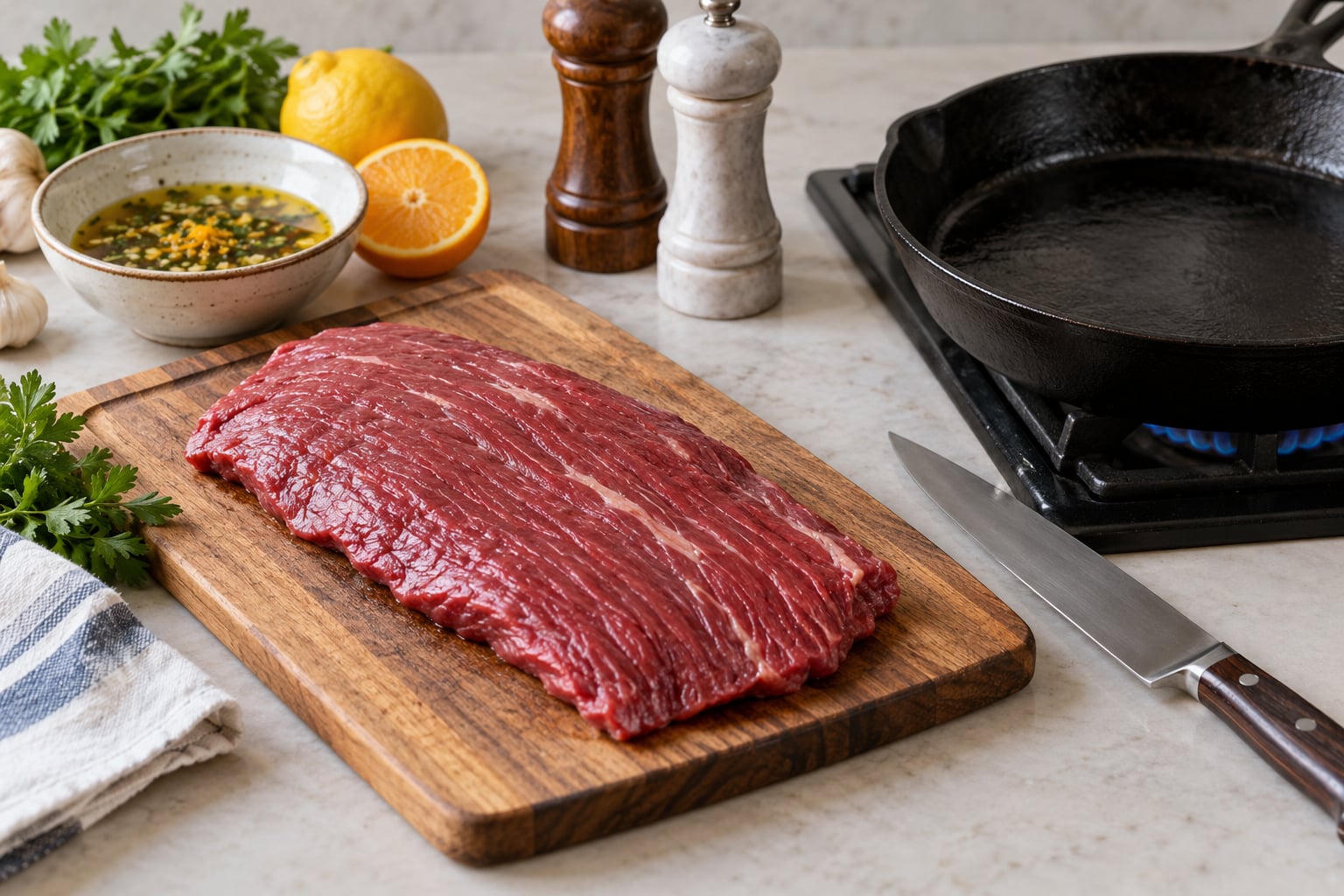
Flank steak is a thin, lean cut from the abdominal muscle, so it cooks fast and has almost no fat of its own to keep it moist. You want very little equipment, but a thermometer is not optional.
- Flank steak, roughly 1 to 1.5 pounds
- Kosher salt and coarse ground black pepper
- High smoke point oil, such as avocado, canola, or grapeseed
- An instant-read thermometer
- A sharp carving or chef’s knife
- A large cutting board with a groove or damp towel underneath so it does not slip
- Tongs and a cast iron skillet or a grill
Optional but helpful: a small bowl for marinade (olive oil, lime or lemon juice, a splash of Worcestershire or soy sauce, garlic powder, cumin, and salt), a meat tenderizer, and a small amount of baking soda for a dry brine.
Step-by-Step: How to Cook Flank Steak So It Is Not Chewy
1. Choose the Cut and Trim the Silver Skin
Pick a flank steak that is roughly even in thickness. Some pieces come in a wedge shape, and that is the single biggest reason a flank cooks unevenly — the thin tail overcooks while the thick section is still cold in the middle. If the piece is badly wedge-shaped, pound the thick end gently with the flat side of a meat tenderizer until the thickness matches. You are aiming for an even slab, roughly a half inch at the thickest point.
Trim loose fat and any silvery membrane you can grab with the knife. Leave a thin edge of the seasoned outer fat cap if it is there — that fat is what keeps the steak from tasting dry. Then pat the surface dry with paper towels. A damp surface steams instead of browning, and browning is where the flavor comes from.
2. Season or Marinate for Tenderness
Salt and pepper alone is a perfectly good finish. Generously salt both sides at least 15 minutes before cooking so the seasoning penetrates, then add black pepper just before it hits the heat so it does not scorch.
If you want more tenderness, use an acidic marinade. Mix 1/3 cup olive oil, the juice of one lime or half a lemon, 1 tablespoon Worcestershire sauce or soy sauce, a minced garlic clove, and a pinch of cumin and salt. Marinate in the refrigerator for 2 to 4 hours. That window softens the outer fibers; going overnight or for 24 hours tends to make the surface mushy and chalky, which is worse than doing nothing at all.
Keep in mind what a marinade can and cannot do. The acid works on the surface, and it helps because flank steak is so lean — the oil replaces some of the missing fat while the acid softens the top layer of fibers. It will not rescue a badly overcooked steak, so don’t skip the temperature work below.
There is a second option that forum cooks like for this specific problem: a dry brine with baking soda. Coat the raw steak lightly with baking soda, about 1 teaspoon per pound, and let it sit for 30 to 45 minutes. Rinse the surface and dry it thoroughly before seasoning and cooking. The window is narrow — cook the steak within about an hour of rinsing, or the alkaline surface starts tasting soapy or funky.
3. Bring the Steak to Room Temperature
A steak straight from the fridge cooks unevenly: the outside overcooks before the center catches up. Take the flank out 20 to 30 minutes before you start. It does not need to sit out for an hour, and leaving it out longer than about two hours is a food safety risk.
4. Sear the First Side Over High Heat
Heat a cast iron skillet until it is nearly smoking, or preheat a grill to high with one zone over direct heat and one side off. Add a thin layer of high smoke point oil. The oil should shimmer and run quickly across the pan, which means it is hot enough.
Lay the steak down away from the hottest part of the pan and leave it alone for 2 to 3 minutes. Flanking the steak repeatedly is what turns it grey and chewy. You are waiting for a dark brown crust that releases from the surface when you lift an edge with tongs. If the fat is browning black or the oil is smoking hard, move the steak to a cooler zone rather than lowering the heat.
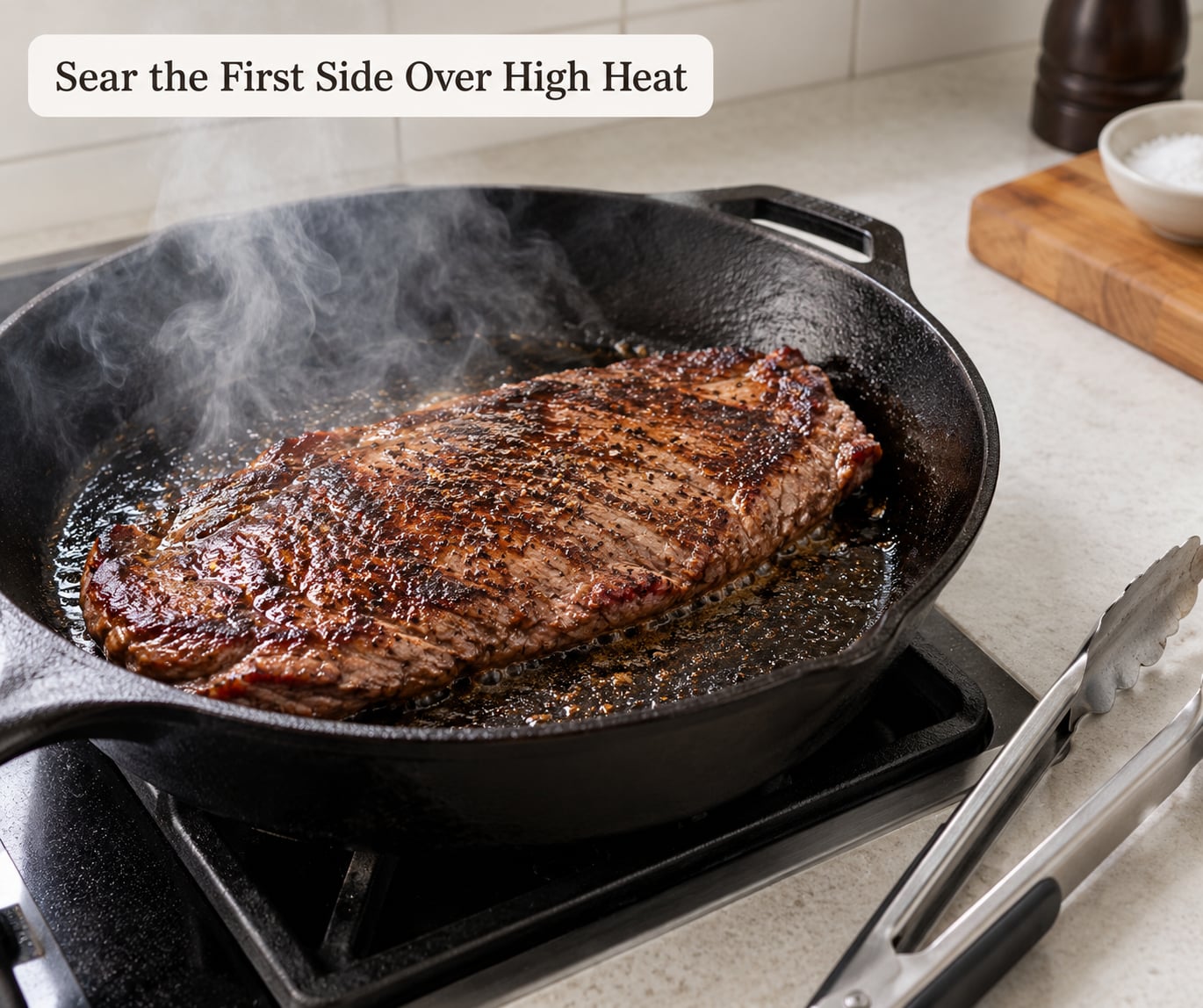
The reason high heat matters here is speed. Flank steak has no fat to render slowly through, and a long cook at low heat drives out moisture and tightens the proteins.
5. Cook the Steak to the Right Temperature
Flip the steak and cook the second side for another 2 to 4 minutes, depending on thickness. Start checking temperature early with your instant-read thermometer, inserted into the thickest part without touching bone or the pan.
Because the steak keeps cooking after you pull it, account for carryover cooking. Here is the target range:
| Doneness | Pull temperature | Final temperature after resting | Result |
|---|---|---|---|
| Rare | 120°F | 125°F | Very pink, still chewy because of the fibers |
| Medium-rare | 128 to 130°F | 132 to 135°F | The sweet spot for flank steak |
| Medium | 135°F | 138 to 140°F | Safe, firmer texture, still workable |
| Medium-well | 145°F | 148°F | At the edge of chewy |
| Well-done | 160°F and up | 160°F and up | Leather |
This is the answer to why flank steak is so chewy even when it is not overcooked. The temperature sets the ceiling, and past medium the muscle proteins contract and squeeze out moisture, which reads as chew. There is no slow-cook rescue on this cut, and it does not get more tender the longer you cook it, the way a pot roast does. The USDA minimum safe internal temperature for whole cuts of beef is 145°F, so serve a medium-rare flank steak only if everyone eating it is comfortable with that, and let the rested temperature finish the job for those who prefer it firmer.
For a thicker piece, a reverse sear works nicely: heat the oven to 250°F, sear the steak 2 minutes a side in a hot skillet, then finish it in the oven until the thermometer reads 125 to 130°F, and sear 60 seconds a side to brown the outside.
6. Rest, Slice Against the Grain, and Serve
Move the steak to a warm plate and let it rest for 8 to 10 minutes. Loosely tent it with foil if you like. Resting lets the muscle fibers relax and hold onto their juice instead of squeezing it out onto the board, which is what makes an undercooked flank feel dry and tight when you cut into it too soon.
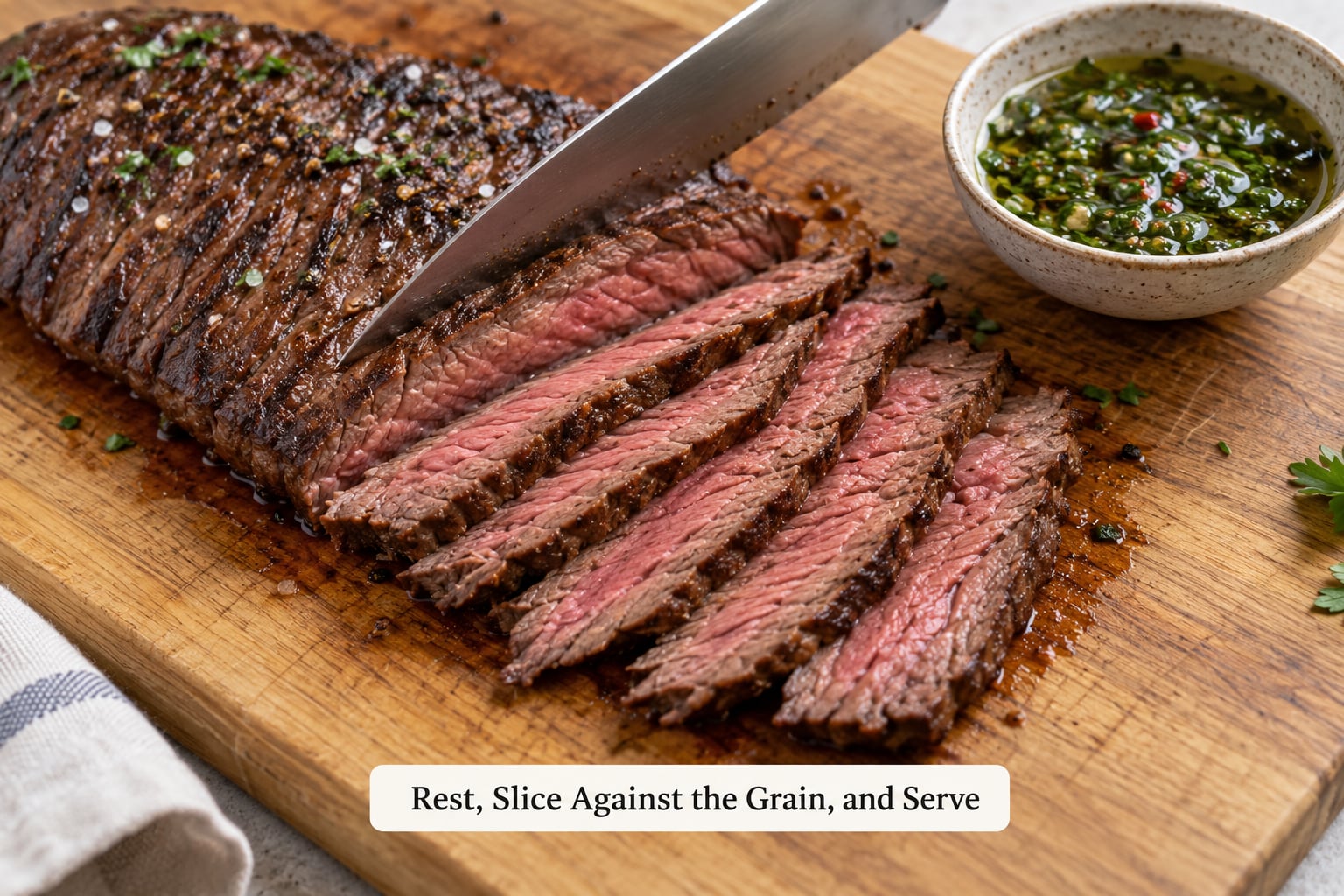
Now find the grain. On flank steak the fibers run lengthwise down the long direction of the muscle, usually straight from one tapered end to the other. Tip the steak on its side and look at the cut face: the grain shows as fine parallel lines running one way and nothing the other way. Those lines are your target.
Set the knife at about a 45-degree angle to the board and slice straight across those lines, cutting each piece around an eighth of an inch thick. Thinner is better here — you are reducing the length of fiber the tooth has to chew through, which is the whole point. A long, thin steak turned ninety degrees to the grain in your fork can feel tender even when the same meat sliced with the grain is genuinely tough.
Serve it fajita style with peppers and onions, in tacos with salsa and lime, on a salad, or with a chimichurri or sliced pepper sauce on the side. For leftovers, slice from both ends of the steak toward the middle so the pieces reheat evenly rather than turning rubbery.
Common Mistakes That Make Flank Steak Chewy
- Cooking it past medium. This is the number one cause. Pull at 128 to 130°F and trust the carryover.
- Slicing with the grain. A perfectly cooked steak cut the wrong direction is still chewy. Look for the fiber lines first.
- Skipping the rest. Cutting immediately locks in a dry, tight texture. Give it 8 to 10 minutes.
- Moving the steak constantly in the pan. Every flip interrupts the crust and starts the steam cycle again. Leave it alone for 2 to 3 minutes a side.
- Low heat for the whole cook. A slow cook on a lean cut dries it out. High heat and a short cook is the way.
- Over-marinating. More than about 4 hours in an acidic marinade makes the surface mushy and chalky.
- Salting right before searing on a wet surface. Salt pulls moisture to the surface and it steams. Pat dry first.
- A wedge-shaped piece cooked as-is. Pound the thick end level so both halves finish together.
One last note on storage: keep raw flank steak in the refrigerator for 3 to 5 days and cooked meat for 3 to 4 days, and freeze it for up to 6 months. Reheat slices in a hot skillet for a minute per side rather than in the microwave, which is what makes leftover steak rubbery.
Frequently Asked Questions
Should I marinate flank steak to make it less chewy?
Yes, but only for a couple of hours. A marinade with lime or lemon juice and olive oil softens the outer fibers and adds back some of the fat flank steak lacks. Two to four hours in the refrigerator is the useful window. Leave it overnight or for 24 hours and the acid turns the surface mealy and chalky, which is harder to eat than the chewiness you were trying to fix.
How long should flank steak rest before slicing?
Between 8 and 10 minutes. That is long enough for the muscle fibers to relax and stop squeezing out juice, but short enough that the steak is still warm when you slice it. Tent it loosely with foil if you want to hold it. Cutting into a flank steak the moment it leaves the heat is one of the top reasons it feels dry and tight.
Can I cook flank steak in the oven instead of a pan?
Yes, and it works well for thicker pieces. Sear in a hot cast-iron skillet for 2 minutes a side first, then finish in a 250°F oven until an instant-read thermometer reads 125 to 130°F, then return to the pan for 60 seconds a side. A reverse sear like this gives you an even cook with a browned crust. You can also broil it, but watch it closely, since a thin flank burns before it browns.
What temperature should flank steak reach?
Pull it off the heat at 128 to 130°F and let carryover cooking bring it to 132 to 135°F during the rest. That is medium-rare and the best result for this cut. Rare is too tight to be pleasant, and anything past medium gets noticeably chewier as the muscle proteins contract. The USDA minimum safe internal temperature for whole cuts of beef is 145°F, so cook it further if anyone at the table needs it well done.
How do I know which way the grain runs in flank steak?
Look at the cut face with the meat tipped on its side. The grain shows as fine parallel lines running the length of the muscle, usually from one tapered end to the other. Slice perpendicular to those lines, holding the knife at about a 45-degree angle to the board, cutting pieces roughly an eighth of an inch thick. If you are not sure, look at the cooked steak in the light and follow the longest visible strands.
Is flank steak better grilled or pan-seared?
A very hot cast iron skillet gives you more control, which matters on a thin cut that is easy to overshoot, and it is the easiest method for a weeknight. A grill with a two-zone fire setup works just as well: start over direct heat for the crust, then move the steak to the side with no direct heat to finish. Either way the numbers are the same, 2 to 3 minutes a side and pull it at 128 to 130°F.
Start Here
Do this first: pull the steak at 130°F rather than when it looks done, let it rest 8 to 10 minutes, then find the grain and slice thin across it at a 45-degree angle. Those three steps fix most of the chewiness people run into. Everything else on this page, the marinade, the thermometer, the tenderizer, is a bonus.