You can estimate a steak’s doneness without a thermometer by pressing its surface and comparing the firmness to the fleshy pad at the base of your thumb when you touch each finger to that thumb. Soft and loose is raw, firmer is rare, springy is medium-rare, and firm with no give is well done. Touch gets you close. A thermometer confirms it. Updated for October 2026.
I learned this the slow way. Years of slicing into steaks to check, then serving them drier than they should have been. The hand test has a real limit, so I will show you where it works and where it lies to you.
Table of Contents
- What You Need
- Step-by-Step: How to Tell Steak Doneness by Touch
- Step 1: Choose and Prepare the Steak
- Step 2: Use the Finger-Press Test
- Step 3: Match the Feel to a Doneness Level
- Step 4: Confirm the Doneness
- Common Mistakes
- Frequently Asked Questions
- Is the hand test for steak accurate?
- Should I use a meat thermometer or the touch test?
- What happens if you overcook a steak?
- Is it okay if steak is a little pink?
- Do chefs prefer rare or medium-rare?
- How long should a steak rest before cutting?
- Conclusion
What You Need
The list is short, and most of it is optional. What you actually need is a steak and the willingness to touch it every 30 seconds.
- Clean, dry hands. Wet fingers read soft and give you a false rare. Dry them on a towel before every check.
- The pad of your fingertip. Not your whole palm pressing down. The fleshy pad below the thumb is the reference point every method depends on.
- An instant-read probe thermometer. This is the confirmation step, not the main event. It is the only way to be certain.
- A small plate or board. Resting the steak on something that catches juices keeps the juices with the meat instead of on the counter.
- A steak at a consistent thickness. A 1.5 inch ribeye and a 0.5 inch sirloin do not read the same, and thickness skews everything.
Step-by-Step: How to Tell Steak Doneness by Touch
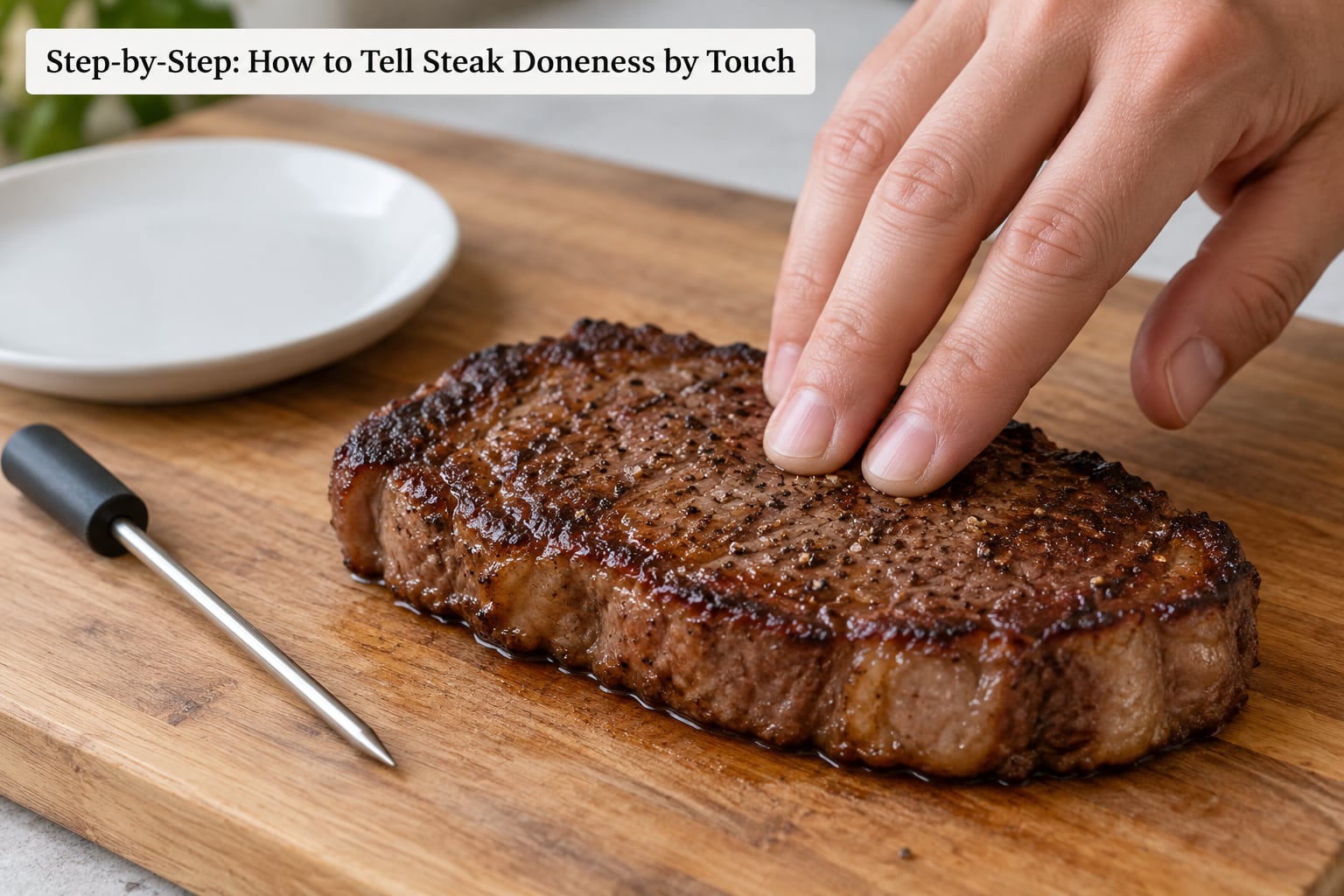
Step 1: Choose and Prepare the Steak
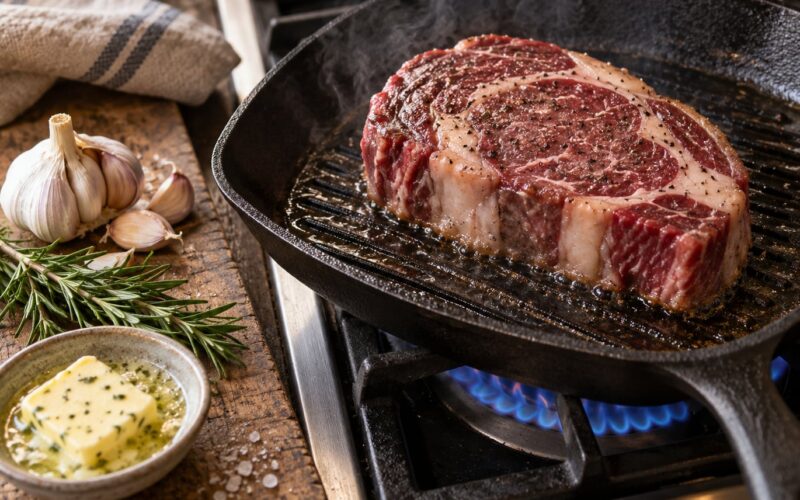
Thickness matters more than anything else before you touch it. A 2 inch thick ribeye has a rare center long before the edges firm up, so a press near the edge will always read donelier than the middle. Judge the steak at its thickest point, not its thinnest.
Marbling changes the reading too. Fat is softer than muscle, so a heavily marbled steak feels springier at the same temperature than a lean sirloin. When in doubt, press the eye of the meat rather than a seam of fat.
Starting temperature is the third variable. A steak pulled straight from the fridge cooks unevenly, with a cold raw patch in the center that makes it feel softer than it is. Letting it sit at room temperature for 20 to 30 minutes before it hits the pan evens things out.
Bone-in versus boneless barely matters for touch. What changes is where you can press. On a bone-in rib chop, the meat right next to the bone cooks faster and feels firmer, so sample a few inches away from it.
Step 2: Use the Finger-Press Test
Build the reference first. Press your thumb against the fleshy pad at the base of your palm and feel how it changes as your thumb touches the index finger, middle finger, ring finger, then pinky. That pad is the cheapest doneness gauge in any kitchen, and it changes firmness noticeably at each step.
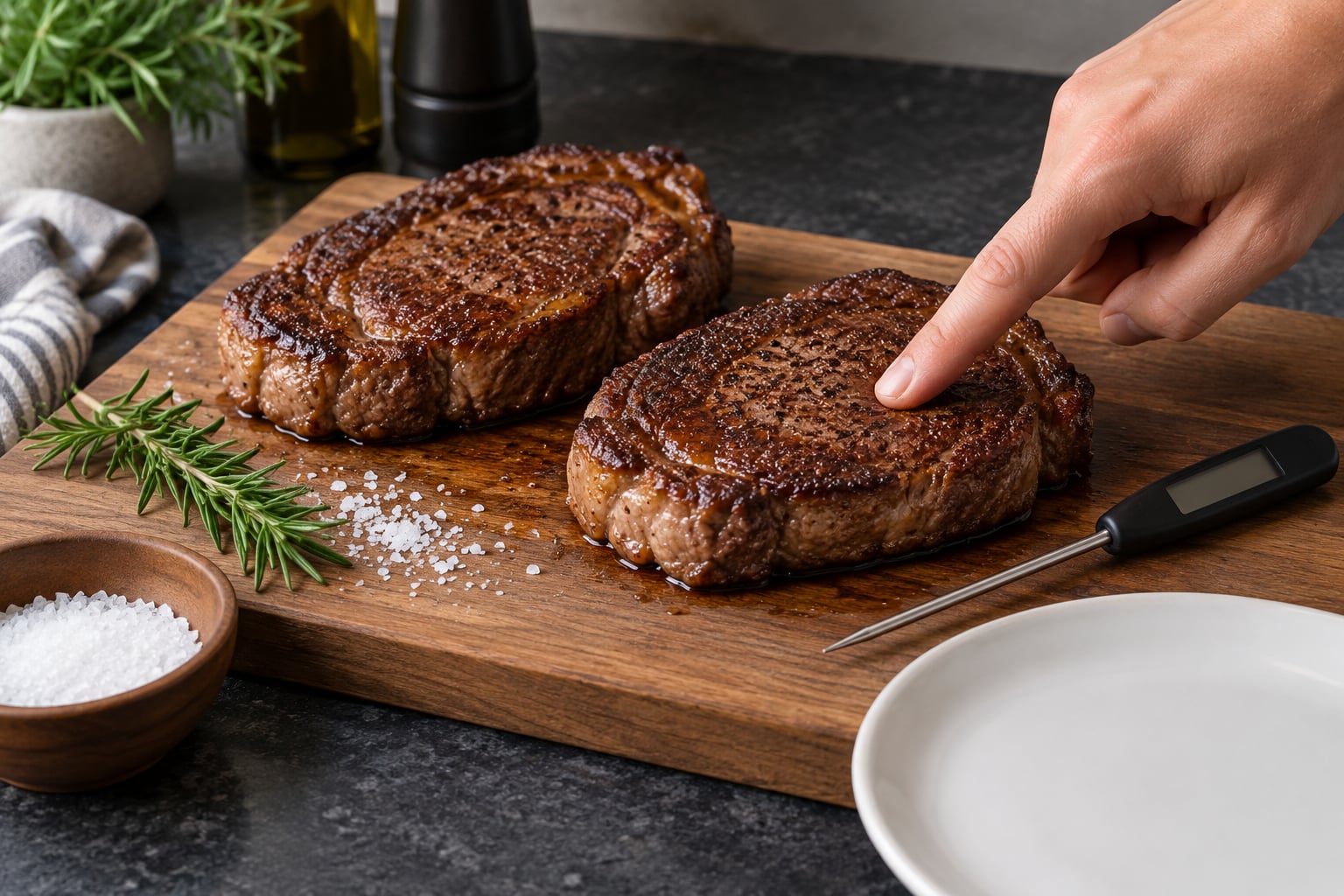
Now press the steak. Lay your fingertip pad flat on the top surface and press gently, about as much as you would press your own forearm. Note two things: how much the surface gives, and whether it snaps back to shape when you lift off.
Where you press matters, and this is the part almost every guide skips. The center of the steak, at the thickest point, is the honest reading. The edges dry out faster and read firmer. The fat cap gives almost nothing because fat is not muscle. The browned crust on top is already cooked protein, so pressing through it tells you about the crust, not the inside. Press the center, once, gently.
Step 3: Match the Feel to a Doneness Level
Match what you feel under your fingertip to one of the five hand positions. Use one word per level and trust the first impression.
- Raw: Touch the fleshy pad with your hand open and relaxed. The steak feels soft and squishy, almost liquid under the crust.
- Rare: Thumb to index finger. The steak feels slightly firmer and springs back instantly, but still yields easily.
- Medium-rare: Thumb to middle finger. More tense and springy than rare, with a little resistance to your fingertip and a fast rebound.
- Medium: Thumb to ring finger. Noticeably firmer, like pressing a rubber ball, and it dents briefly under your finger before returning.
- Medium-well: Between the ring finger and pinky positions. Firm all the way through with a slow spring-back and much less give.
- Well done: Thumb to pinky. Very firm and tight with no give, the surface feels like a dense rubber eraser, and juices run clear when you press.
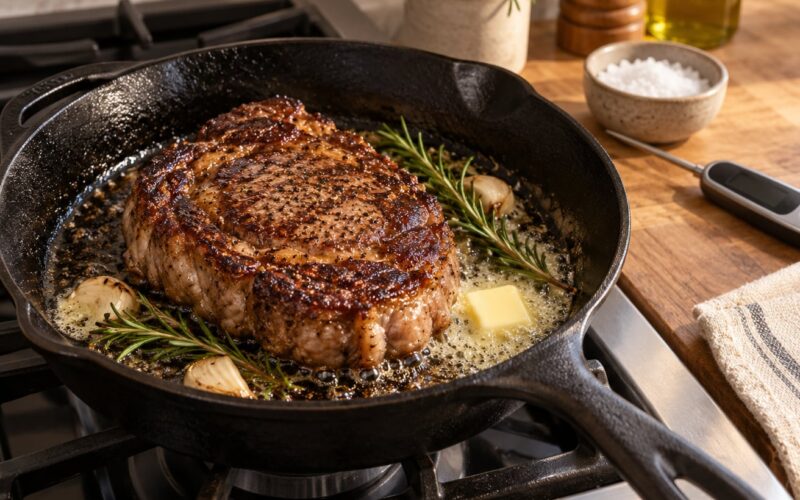
Color and juices support the read but never replace it. A medium-rare steak is deep red with a pink center. Medium turns brownish-pink throughout with a slightly grey cast. Well done is uniformly brown with a grey ring near the crust. One steak can run dark on the outside and barely warm in the middle, which is exactly why color alone sends people astray.
Here is the whole mapping in one place, with the temperatures you are trying to hit and the rest each level needs.
| Doneness | Finger position | Internal temp | Center color | Feel | Rest |
|---|---|---|---|---|---|
| Rare | Thumb to index finger | 120-125 F / 49-52 C | Deep red | Slightly firmer, instant spring-back | 3-5 min |
| Medium-rare | Thumb to middle finger | 125-130 F / 52-54 C | Red with pink center | Tense and springy, slight resistance | 5-8 min |
| Medium | Thumb to ring finger | 130-135 F / 54-57 C | Pink to brownish-pink | Noticeably firmer, like a rubber ball | 5-8 min |
| Medium-well | Between ring and pinky | 135-145 F / 57-63 C | Light pink at center | Firm, slow spring-back | 8 min |
| Well done | Thumb to pinky | 160 F / 71 C and up | Brown with grey ring | Very firm and tight with no give | 10 min |
Another reference point worth knowing: plenty of restaurant cooks press the steak to their own face, treating the cheek as rare, the chin as medium, and the forehead as well done. Same principle, same reason. The skin and muscle under it feel different at different degrees of cooking, whether it is a steak or a chin.
Why does this work at all? Heat denatures the muscle proteins, and they tighten up as they cook. That contraction is exactly what your fingertip is measuring. The same reaction makes meat shrink and squeeze out moisture as it goes past medium, which is why a well done steak feels dense instead of springy.
Step 4: Confirm the Doneness
Push the probe into the thickest part of the steak, away from the bone and away from the fat cap, and read it fast. The USDA minimum internal temperature for whole cuts of beef is 145 F or 63 C. For the juicier results most cooks want, aim lower and understand where the number goes next.
Carryover cooking is the part that catches beginners. The steak keeps rising after it leaves the heat, often by 5 to 10 degrees during a rest. Pull a steak you want at 130 F around 125 F and let it rest, and it lands where you aimed.
Aim slightly under your target. A thick steak taken off the heat at medium-rare will land near medium after five minutes of resting, which is the most common way an expensive ribeye gets wasted.
Common Mistakes
Pressing too hard. A hard poke always reads well done, no matter what the steak is actually doing. Press with the pad of one fingertip, gently, the way you would test the surface of a cake before icing it.
Testing the fat, the crust, or the bone. Fat gives like butter, bone gives like a rock, and a seared crust is already cooked. All three send you in the wrong direction. Press the eye of the meat at the center.
Judging by color. Color is affected by the cut, the pH, how long it sat in the cooler, and how much juice ran out during the rest. Use color as a sanity check against your finger reading, not as the decision.
Forgetting that thick steaks cook from the outside in. A 2 inch ribeye and a thin top sirloin are not on the same clock. When in doubt, probe rather than guess, and pull early if you are cooking a thick cut.
Skipping the rest. Cutting straight off the heat dumps the juices on the board. Resting lets the muscle relax and hold moisture, and it gives carryover cooking time to finish the job.
Cutting into the steak to check. Every slice you take out of the center is juice you will never get back. Touch and probe instead.
Never calibrating your hand. The best way to learn the mapping is to cook the same cut to several doneness levels in one session and press each one right after it comes off the heat. Four steaks, four temperatures, one afternoon, and your palm finally has a memory. People on cooking forums tend to say the same thing: the touch test only works once you have calibrated it against a steak whose temperature you already know.
Frequently Asked Questions
Is the hand test for steak accurate?
The hand test gets you in the ballpark, and it is not precise. It can reliably separate rare from well done, but it struggles to tell medium-rare from medium with any confidence. Experienced cooks use it to get close and then confirm with an instant-read thermometer. The value of touch is speed and no puncture, not accuracy.
Should I use a meat thermometer or the touch test?
Use both. Touch tells you roughly where the steak is while it cooks, which lets you pull it at the right moment. The thermometer tells you the actual internal temperature and removes all guesswork. If you only keep one tool in the kitchen, keep the thermometer. The touch test works beautifully as a backup and for cooking several steaks at once.
What happens if you overcook a steak?
Above about 140 F the muscle proteins keep contracting and squeeze out moisture, so the steak shrinks, dries out, and turns rubbery. That dense, chewy feel is the same firmness you feel under your fingertip, which is why well done steak no longer springs back. To soften one that went too far, slice it thin against the grain and let it sit in its own juices for a few minutes.
Is it okay if steak is a little pink?
For whole cuts of beef, the USDA recommends an internal temperature of 145 F or 63 C. That recommendation exists because color is an unreliable safety test. A properly seared steak served pink in the middle is what most cooks order and eat regularly, but if safety is your priority, verify with a thermometer rather than with the color of the juices.
Do chefs prefer rare or medium-rare?
Most professional cooks land on medium-rare as the sweet spot, and the reasoning is moisture rather than fashion. Before about 140 F the muscle has not fully contracted, so the steak keeps its juices. The same cooks who judge doneness against their own faces generally steer people toward medium-rare for exactly that reason.
How long should a steak rest before cutting?
Rest it half as long as you cooked it, with a floor of 5 minutes for anything under medium-rare and 10 minutes for well done. Resting is not just about juice retention. The muscle fibers relax and reabsorb liquid during the rest, which is why a steak rested properly seems to melt and one cut straight off the fire seems tight and dry.
Conclusion
Start with touch. Press the thickest part of the steak with the pad of one fingertip, compare it to the base of your thumb at each finger position, and read the level in a word. Pull the steak 5 degrees under your target so carryover cooking finishes the job, rest it properly, then confirm with a probe in the center. Touch gets you close fast. The thermometer decides.