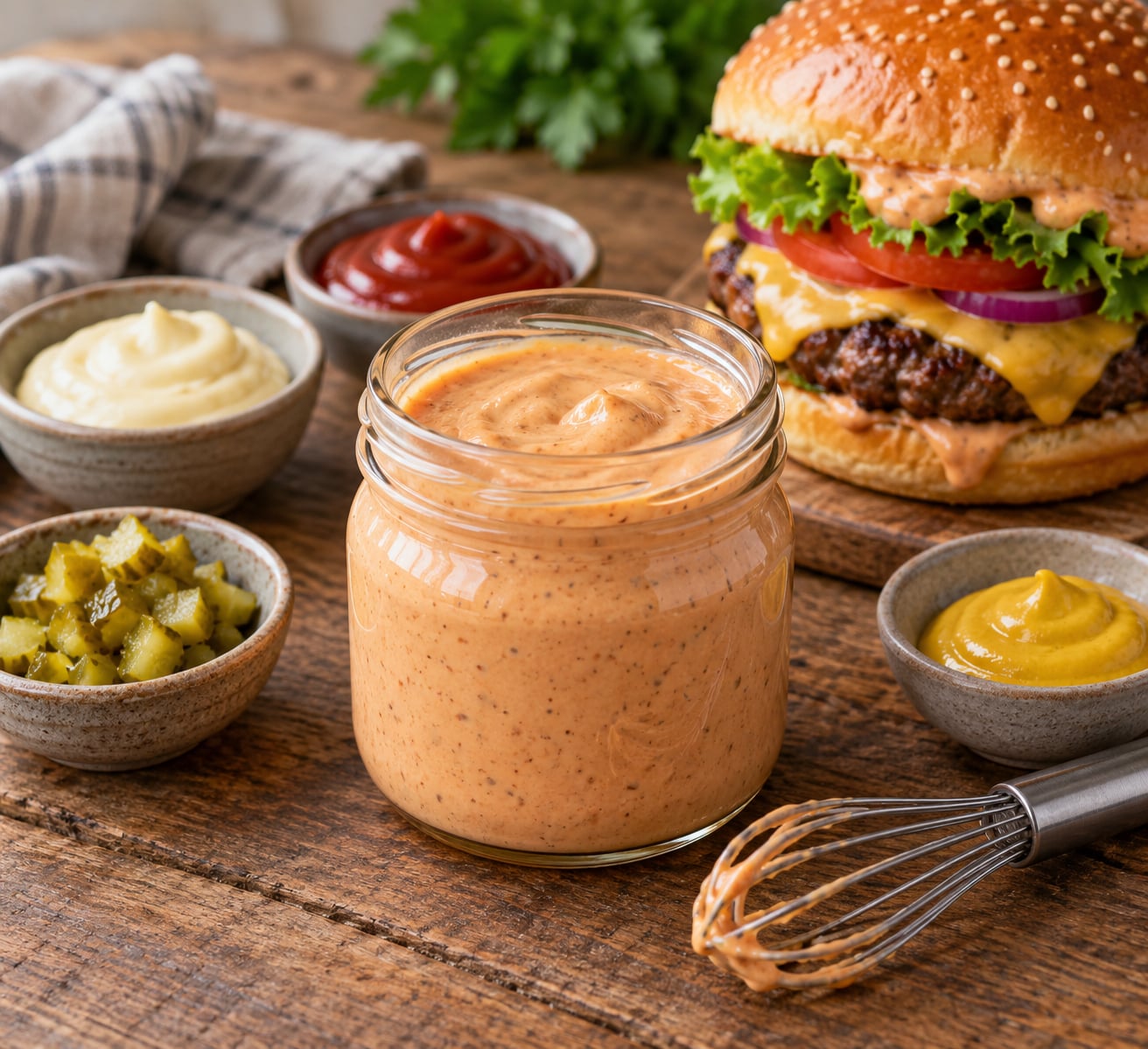
Burger sauce is a no-cook mayonnaise emulsion loosened with ketchup, yellow mustard and a splash of vinegar, then sharpened with pickle relish and a few spices. Learning how to make burger sauce at home takes about five minutes of stirring plus a short rest in the fridge, and it gives you control over the sweetness that makes shop-bought sauce taste flat.
Store-bought burger sauce is heavy on sugar and packed with acidity regulators and stabilisers, so it slaps on a burger but rarely tastes like much. A homemade batch costs almost nothing, keeps for about a week, and lets you make a double-bitter version for smash burgers or a mild one that kids will actually eat.
Table of Contents
- What You Need
- Ingredient amounts in US, metric and grams
- The ratio cheat sheet for any batch size
- How to Make Burger Sauce at Home: Step-by-Step
- Whisk the creamy base
- Add the seasonings
- Fold in optional pickles
- Chill and adjust the consistency
- Copycat versions: which burger sauce are you chasing?
- Adjusting for sweet, tangy or spicy
- Common Mistakes
- Tips that make the batch better
- Frequently Asked Questions
- What is the best substitute for mayonnaise in burger sauce?
- How can I make burger sauce thicker without adding more mayonnaise?
- How long does homemade burger sauce last in the refrigerator?
- Can I make burger sauce without mustard or ketchup?
- What can I add to burger sauce for more crunch?
- Conclusion
What You Need
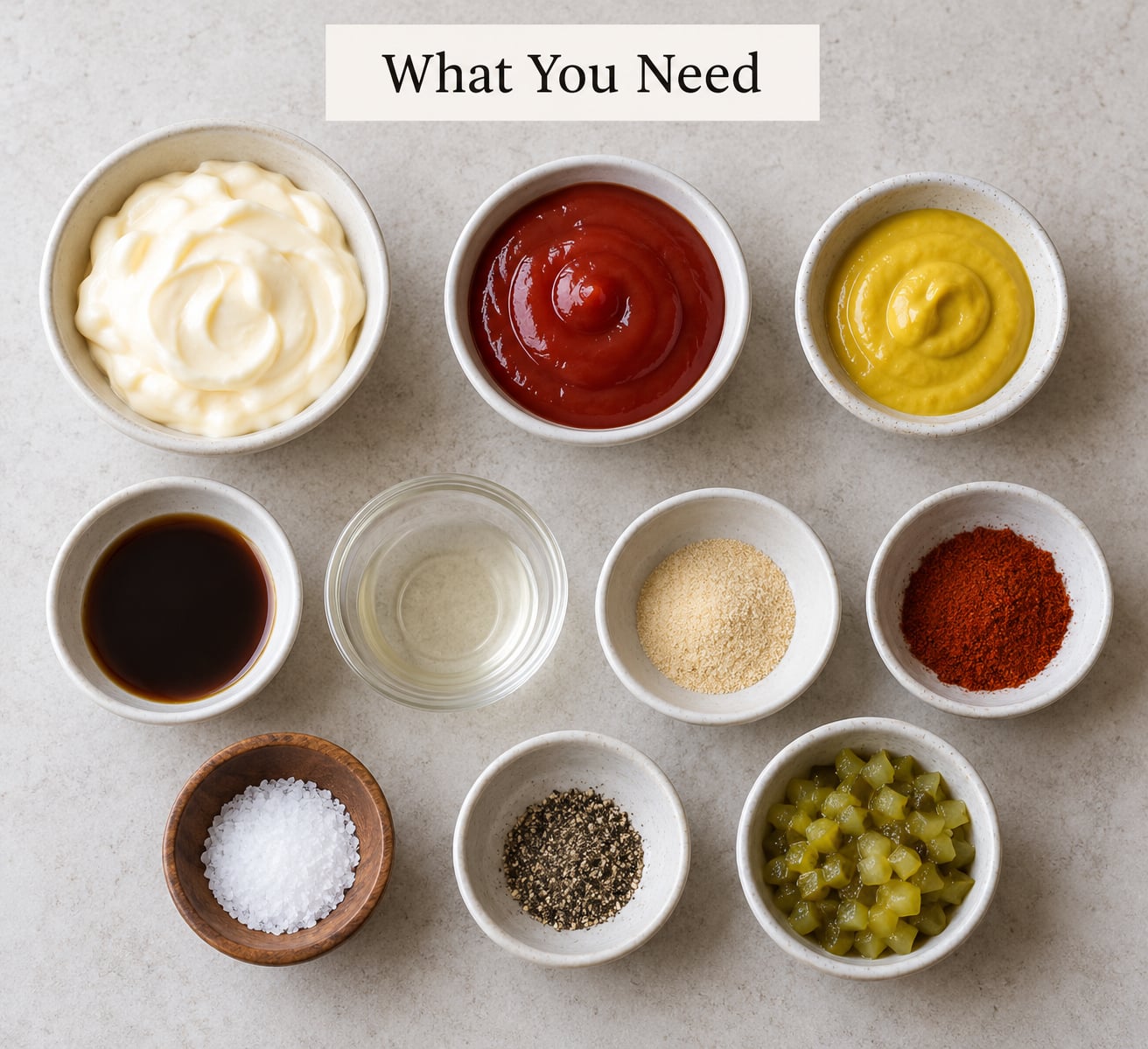
The standard batch makes about three-quarters of a cup, which is enough for four or five burgers. Every core ingredient has a job, so measure them all before you start.
- Mayonnaise, 1/2 cup (120 ml, 112 g) — the creamy base. Use whole egg mayonnaise if you want the closest match to chain sauce; regular mayo works fine.
- Ketchup, 1/4 cup (60 ml, 65 g) — sweetness and body. This is the number one variable in the recipe, so start here and adjust after tasting.
- Yellow mustard, 2 tablespoons (30 ml, 20 g) — sharpness that survives the sugar. American yellow mustard, not Dijon and not hot English mustard.
- Worcestershire sauce, 1 teaspoon (5 ml) — a savoury, slightly fermented depth you would miss if it were gone.
- White vinegar, 1 teaspoon (5 ml) or the juice from a jar of gherkins, which does the same job with a pickle note.
- Sweet pickle relish, 2 tablespoons (30 ml) — crunch and pickle flavour. Dill relish works too; see the swaps below.
- Granulated sugar, 1 teaspoon — optional. Most people using supermarket ketchup skip it.
- Garlic powder, 1/2 teaspoon, and smoked paprika, 1/2 teaspoon — background seasoning, not a flavour you can pick out on its own.
- Salt and black pepper to taste — the final catch-all, added after everything else is in.
Ingredient amounts in US, metric and grams
| Ingredient | US volume | Metric volume | Grams (approx.) |
|---|---|---|---|
| Mayonnaise | 1/2 cup | 120 ml | 112 g |
| Ketchup | 1/4 cup | 60 ml | 65 g |
| Yellow mustard | 2 tbsp | 30 ml | 20 g |
| Sweet pickle relish | 2 tbsp | 30 ml | 35 g |
| Worcestershire sauce | 1 tsp | 5 ml | 6 g |
| White vinegar | 1 tsp | 5 ml | 5 g |
| Granulated sugar | 1 tsp | 5 ml | 4 g |
| Garlic powder | 1/2 tsp | 2.5 ml | 1.5 g |
| Smoked paprika | 1/2 tsp | 2.5 ml | 1.3 g |
The ratio cheat sheet for any batch size
Keep the mayo as the anchor and scale the rest around it. A batch of 4 parts mayonnaise to 1 part ketchup to 1/2 part mustard is the ratio most home cooks land on, and it scales cleanly.
| Batch | Mayonnaise | Ketchup | Mustard | Relish | Yield |
|---|---|---|---|---|---|
| Small (2 burgers) | 1/4 cup | 2 tbsp | 1 tbsp | 1 tbsp | 1/2 cup |
| Standard (4-5 burgers) | 1/2 cup | 1/4 cup | 2 tbsp | 2 tbsp | 3/4 cup |
| Double (8-10 burgers) | 1 cup | 1/2 cup | 1/4 cup | 1/4 cup | 1 1/2 cups |
| Party (20+ burgers) | 2 1/2 cups | 1 1/4 cups | 1/2 cup | 1/2 cup | 4 cups |
For a party, mix it the morning of and keep it in one covered tub rather than several small bowls. A quarter cup per person is plenty if you are also serving fries and other dips.
How to Make Burger Sauce at Home: Step-by-Step
Whisk the creamy base
Put the mayonnaise, ketchup, mustard, Worcestershire sauce and vinegar in a medium bowl. Whisk until the streaks of ketchup disappear and the colour settles into one even, pale orange.
Scrape the sides twice. What you are looking for is a smooth, uniform cream with no darker ribbons of ketchup sitting on the surface; that takes about 30 seconds of steady wrist work.
Add the seasonings
Stir in the garlic powder, paprika and the optional teaspoon of sugar, then season with salt and pepper. Taste with a clean spoon before adding more — the sauce should read savoury first, sweet second.
If it tastes flat, the fix is almost always acid rather than salt. A splash more vinegar or mustard fixes a dull sauce in a way that more sugar never will.
Fold in optional pickles
Dice two or three gherkins into small pieces and fold them through, or add the sweet pickle relish. Fold rather than whisk, and stop while the pieces still hold their shape.
Overmixing turns the pickle into pulp and dulls the crunch. If you only have a jar of dill pickles, mash them roughly with a fork instead of dicing — the uneven texture is the point.
Chill and adjust the consistency
Spoon the sauce into a jar or tub, press the lid down, and refrigerate for at least 30 minutes. It thickens as it chills, so judge the consistency cold rather than warm.
If it is stiff for spreading, loosen it with a teaspoon of water or milk. If it is loose for dipping, stir in another spoonful of mayonnaise. Then leave it at room temperature for about 10 to 15 minutes before serving so the flavours meld rather than tasting like separate condiments.
Copycat versions: which burger sauce are you chasing?
Chain sauces are not the same thing. On r/burgers people argue about this constantly, and the confusion is fair: In-N-Out Spread is mild and silky, while Big Mac sauce is sweeter and more heavily pickled. Pick your target before you start.
| Version | Key move | Flavour profile |
|---|---|---|
| Big Mac style | Whole egg mayo, ketchup, sweet relish, sugar, white vinegar, black pepper | Sweet, heavy on pickle, closest to shop-bought special sauce |
| In-N-Out Spread | Mayo, ketchup, small amount of mustard, plenty of finely diced pickles, vinegar | Mild, silky, noticeably more pickle than sweet |
| Comeback sauce (griddle cooks) | Mayo, chili sauce, ketchup, spicy mustard, no sweet relish | Hot, tangy, no sweetness — a favourite on Blackstone griddles |
| Thousand island style | Mayo, ketchup, sweet relish, plus a spoonful of thousand island dressing | Sweeter and looser, closer to a salad dressing |
One community favourite from r/burgers skips ketchup almost entirely: roughly a third mayonnaise, a third horseradish sauce and a third chopped sweet pickle. That version is properly savoury, and it is worth making once just to taste the difference.
If you are chasing the McDonald’s sauce specifically, the answer is the Big Mac row above with a tablespoon of finely minced onion folded in at the end. Popular versions sometimes claim French dressing as an ingredient; it is not in the classic sauce, though a teaspoon of it will not hurt.
Adjusting for sweet, tangy or spicy
Now that the base is mixed, steer it rather than remake it.
- Sweeter: a teaspoon of sugar or an extra tablespoon of ketchup.
- Tangier: another teaspoon of vinegar, pickle juice or mustard, added a quarter teaspoon at a time.
- Sweeter and tangier together: keep adding equal small amounts of ketchup and vinegar until the balance lands.
- Spicier: 1/2 teaspoon sriracha or chipotle in adobo, or a teaspoon of a vinegar-based hot sauce such as Tabasco.
- Lower in fat and sugar: swap the mayonnaise for plain nonfat Greek yoghurt and use a no-added-sugar ketchup. It will be lighter and slightly tangier, so hold back the vinegar.
- Ketchup-free: lean on relish or chopped pickles plus pickle juice and mustard for all the sweetness and tang at once.
Whisk everything again after the last addition, then chill for another 10 minutes so the heat and acidity settle into the fat.
Common Mistakes
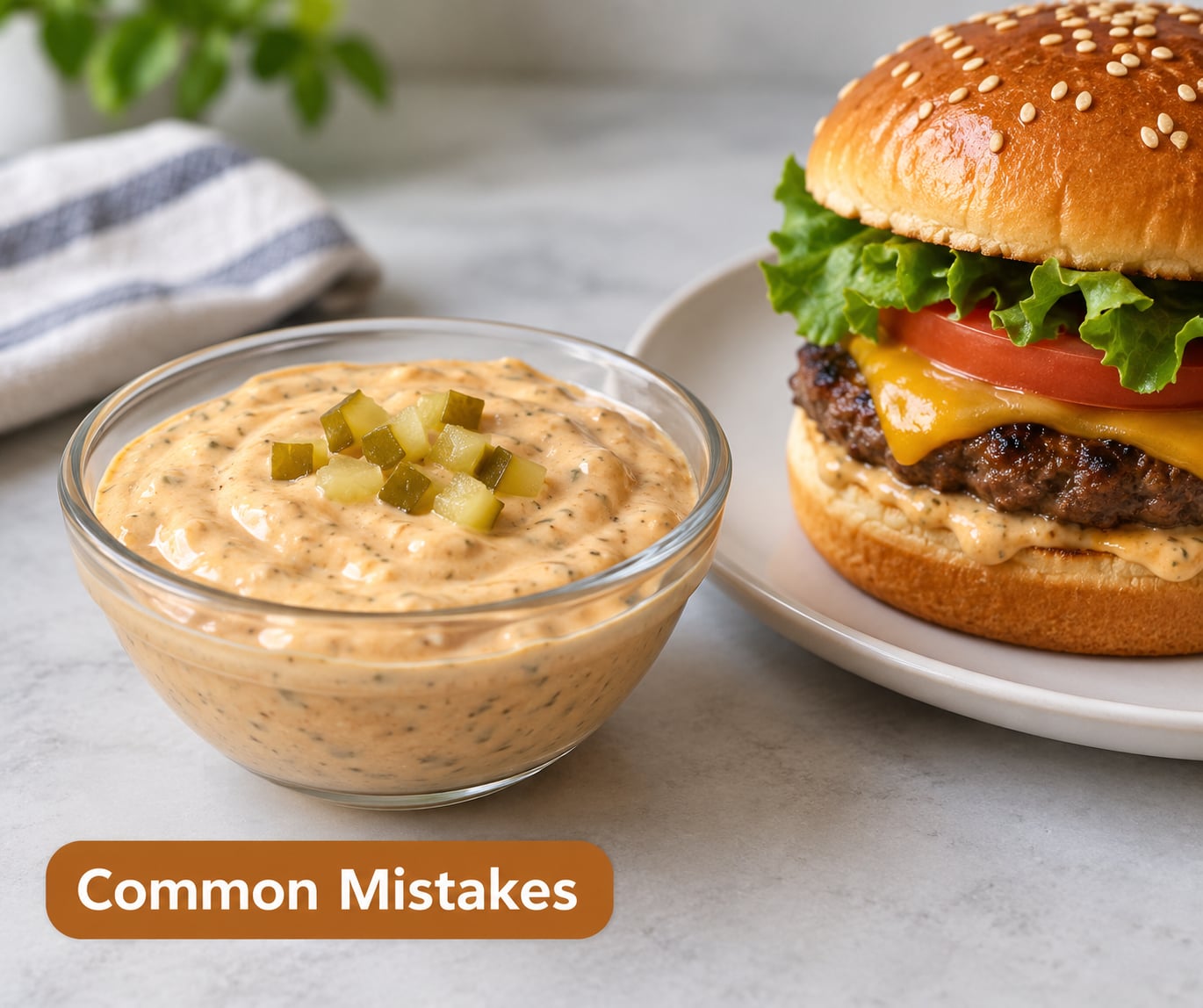
The sauce is watery. You judged it before it chilled. Mayonnaise thickens noticeably in the fridge, so give it 30 minutes before adding liquid. If it is still thin, fold in mayonnaise a tablespoon at a time.
It tastes too sweet. This is the most common complaint, and it almost always traces back to ketchup quantity rather than the added sugar. Cut the ketchup by a third and add a splash of vinegar to fill the gap.
It tastes flat. Boredom in a sauce reads as salt first, then acid. Try a pinch of salt before anything else, then a quarter teaspoon of vinegar.
It is too hot. Heat cannot be removed once it is in. The fix is dairy and sugar: stir in a tablespoon of mayonnaise or a half teaspoon of sugar, then dilute with another spoonful of mayo.
It tastes bitter or harsh. You have leaned on vinegar or hot English mustard. Neither belongs in this recipe. Scrape the batch and start again with American yellow mustard and one teaspoon of white vinegar.
The sauce split. Whisking too hard or adding liquid in one go can break the emulsion. Whisk the mayo smooth first on its own, then loosen the ketchup into it gradually with a spoon.
Tips that make the batch better
Choose condiments you would happily eat on their own. Ketchup straight from the fridge tastes duller than the same ketchup at room temperature, so warm the bottle in a mug of hot water for two minutes before you measure.
Dice pickles no larger than a corn kernel. Bigger pieces taste separate from the sauce instead of part of it.
Label the jar with the date. Homemade burger sauce with fresh onion or pickle pieces keeps about 5 days in the fridge; a version made only from jarred condiments keeps closer to 7 days. Either way, keep it airtight and below 40°F, and toss anything that smells off or looks grey.
At a cookout, a covered tub of sauce should not sit out longer than two hours, or one hour if it is above 90°F outside. Set out small portions on ice and refill them from the fridge tub rather than putting the whole batch on the table.
Use it on both buns, not just the bottom. Double-scooping is what chain burgers do, and it is the single cheapest upgrade to a homemade burger.
Frequently Asked Questions
What is the best substitute for mayonnaise in burger sauce?
Plain Greek yoghurt is the cleanest swap: use the same 1/2 cup, and hold back the added vinegar by half a teaspoon because yoghurt is already sharp. It makes a thinner, tangier sauce, so chill it longer before serving. Sour cream works too and is closer in texture, while a spoon of tahini mixed with water gives you a nuttier version that leans away from the classic profile.
How can I make burger sauce thicker without adding more mayonnaise?
Reduce it the way a cook would reduce a sauce: cover the bowl and refrigerate it until the fat firms up, which takes 30 to 45 minutes. For a permanent thickening, stir in a teaspoon of finely grated pickle, a small spoon of breadcrumbs, or a tablespoon of cream cheese. Mashed potato is the odd one out that works well, but it changes the flavour of the sauce noticeably.
How long does homemade burger sauce last in the refrigerator?
Plan on 5 days for a batch containing fresh onion or freshly diced pickles, and about 7 days for a batch built entirely from jarred condiments. Store it in an airtight container in the coldest part of the fridge, not the door, and always use a clean spoon. If the sauce separates after a week, whisk it hard for 15 seconds and refrigerate it again.
Can I make burger sauce without mustard or ketchup?
Yes, and the result is a different but legitimate sauce. Drop the ketchup and use 3 tablespoons of sweet pickle relish plus 1 tablespoon of horseradish sauce in its place. Drop the mustard and lean on pickle juice and vinegar for the acidity, bumping both slightly. This is the savoury version regulars on r/burgers describe, and many of them prefer it to the sugary original.
What can I add to burger sauce for more crunch?
Finely diced pickles or gherkins are the classic answer and need no prep beyond a sharp knife and a five-minute chopping session. Beyond that, try minced dill pickles for sharper crunch, celery seed for a rye-bread note, or crispy fried onion for texture that survives a few hours in the fridge. Toasted breadcrumbs mixed in at the last moment stay crunchy for about an hour.
Conclusion
Start by measuring everything out: half a cup of mayonnaise, a quarter cup of ketchup, two tablespoons of yellow mustard, Worcestershire, a teaspoon of vinegar and the spices. Whisk the base smooth, taste it, then add diced pickles if you want crunch and refrigerate for half an hour before slathering it on both buns.