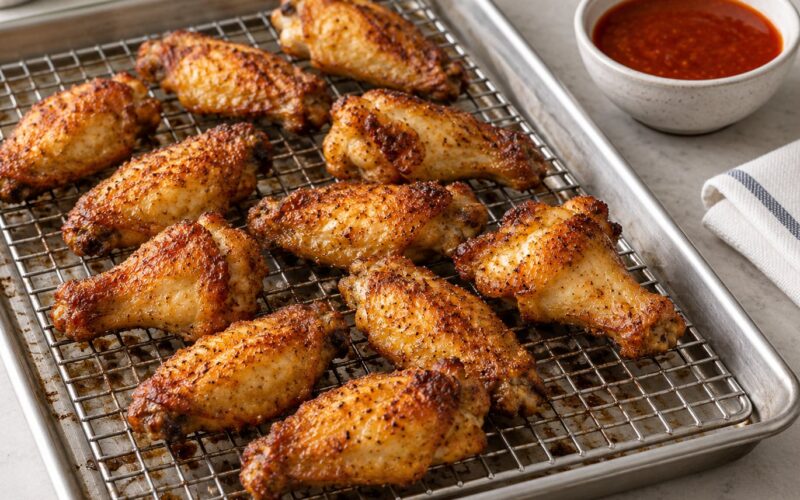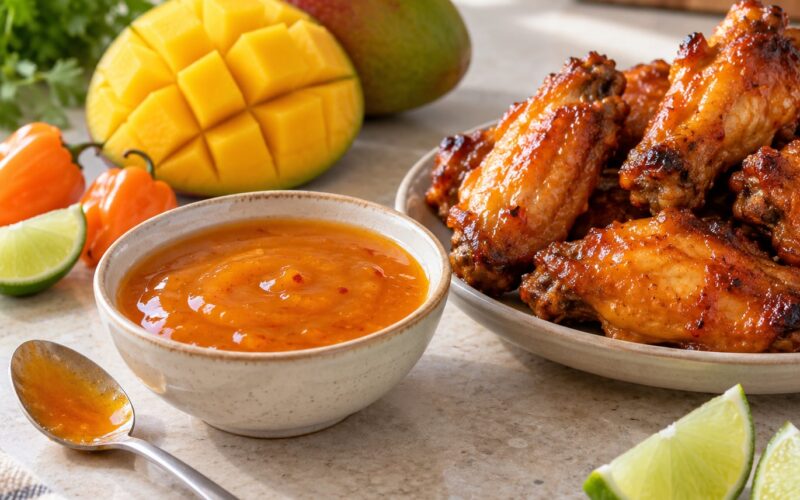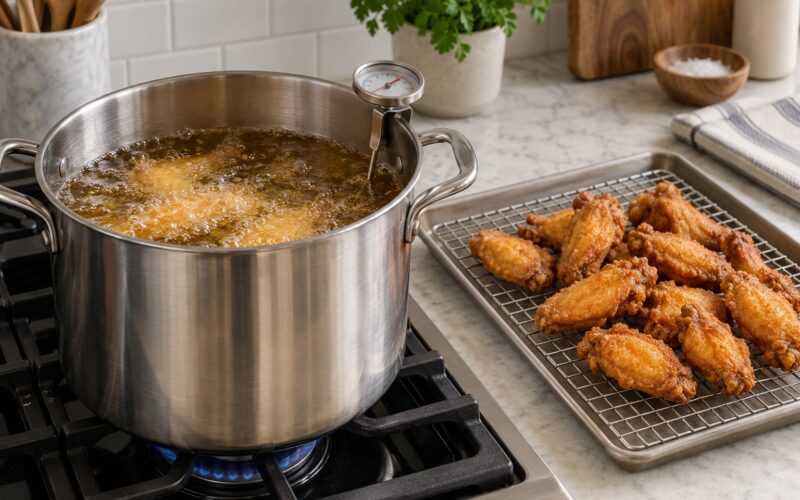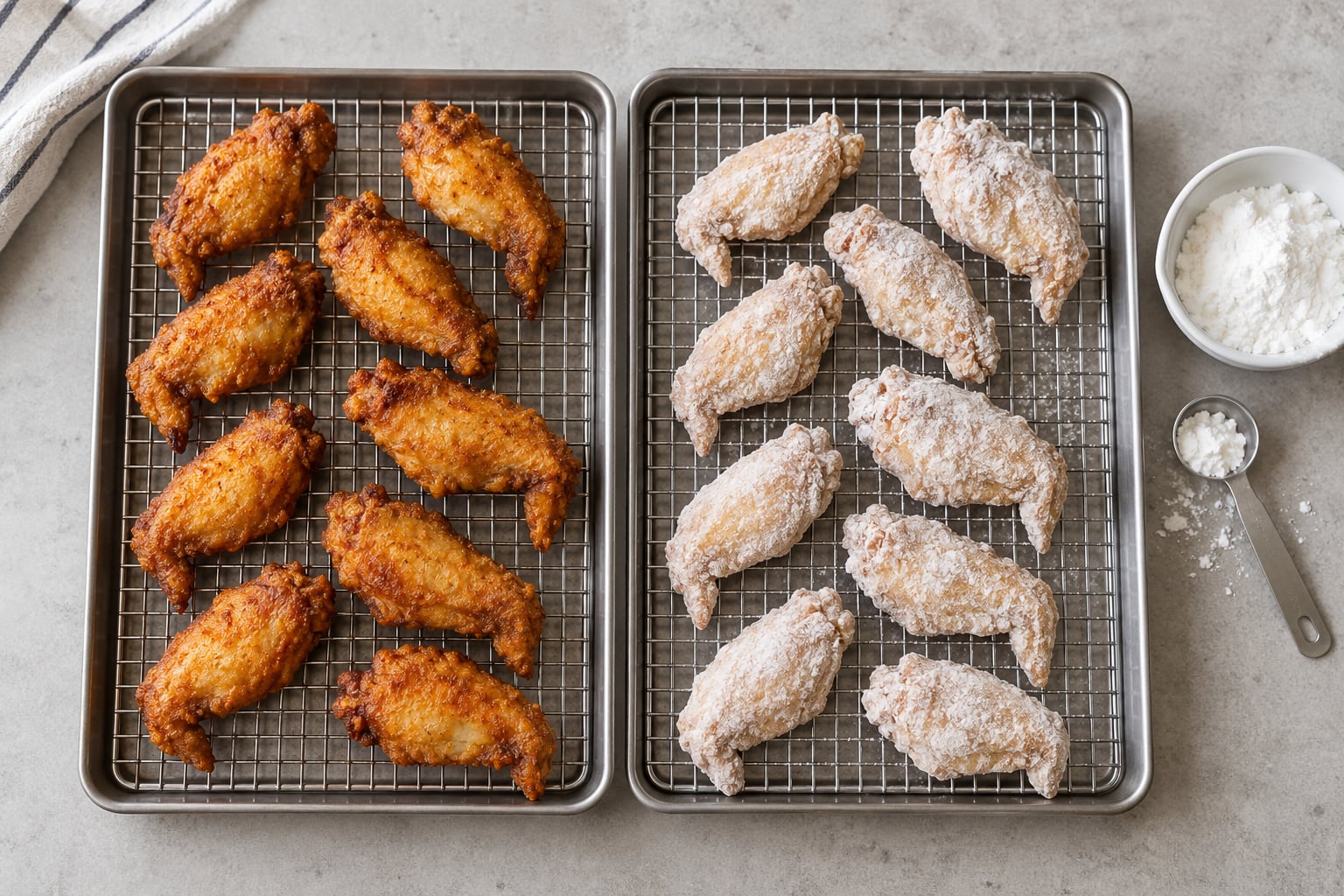
Cornstarch gives you the crispest, driest coating; baking powder gives you a lighter, tender-crisp skin that browns faster. Most home cooks land on the best result by using both together, about 1 teaspoon of aluminum-free baking powder plus 1 to 2 tablespoons of cornstarch per pound of wings. If you only want one, pick cornstarch.
The reason the advice sounds contradictory is that the two ingredients work on completely different principles, and most recipes quietly use both. Here is what each one does, how much to use, and which one wins for baked, air-fried, fried and grilled wings.
Table of Contents
- Cornstarch vs Baking Powder for Crispy Wings at a Glance
- How Cornstarch and Baking Powder Make Wings Crispy
- Why baking soda is not the same as baking powder
- Cornstarch vs Baking Powder: Texture and Moisture Control
- Cornstarch
- Baking Powder
- Flavor, Color, and Coating Behavior
- How to Use Each Ingredient on Chicken Wings
- Cornstarch vs Baking Powder for Crispy Wings: Which Should You Choose?
- Which Wings Stay Crispy the Longest?
- Frequently Asked Questions
- Is cornstarch necessary for crispy chicken wings?
- Can I use baking powder instead of cornstarch on wings?
- Can baking powder or cornstarch make chicken wings explosive?
- Should I add baking soda to cornstarch-coated wings?
- Do I have to deep-fry wings for a crispy coating?
- What internal temperature should fully cooked chicken wings reach?
- Conclusion
Cornstarch vs Baking Powder for Crispy Wings at a Glance
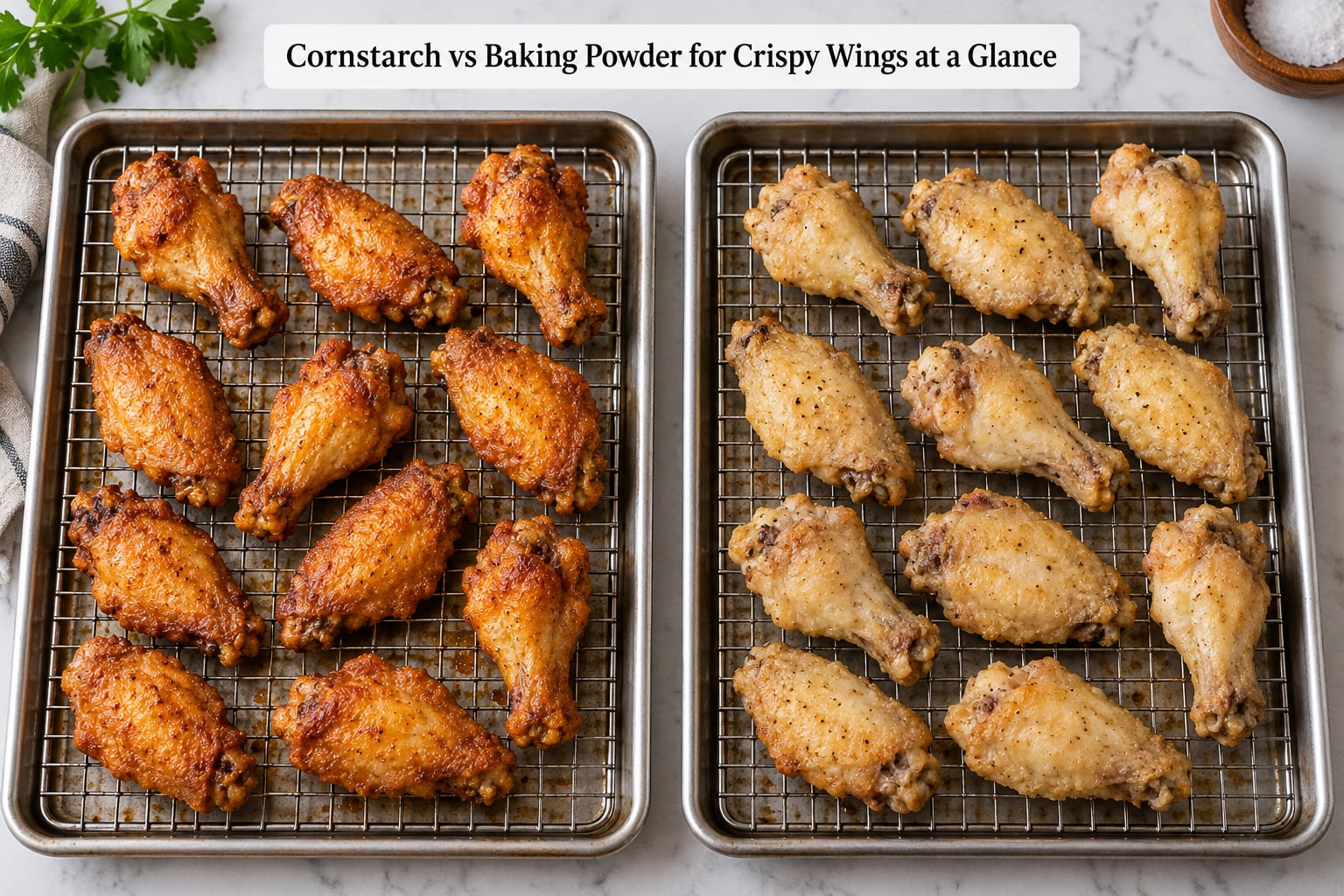
| Criterion | Cornstarch | Baking Powder | Winner |
|---|---|---|---|
| Type of crisp | Fine, glassy, brittle crunch | Lighter, tender-crisp crunch | Cornstarch for maximum crunch |
| Moisture control | Absorbs surface moisture physically | Raises surface pH so skin dries faster | Cornstarch |
| Coating color | Translucent, browns light gold | Deeper brown, more color at lower heat | Baking powder |
| Flavor neutrality | Completely neutral | Neutral in small doses, metallic if overdone | Cornstarch |
| Coating stability | Crackly, shatters onto a plate | Tougher, holds together better | Depends on the dish |
| Best wing styles | Drumettes, whole flats, fried or baked | Whole flats, saucy and glazed wings | Baking powder for heavy sauces |
| Ease of use | Very forgiving | Sensitive to quantity and brand | Cornstarch |
| Amount per pound | 1 to 2 tablespoons (8 to 16 g) | 1 teaspoon (about 5 g) | Use both |
| Worst failure | Powdery if used heavily | Metallic or soapy aftertaste | Cornstarch |
That last row is the honest reason cornstarch wins a head-to-head test. Baking powder is easy to overshoot, and once it tastes metallic there is no way to hide it under sauce.
How Cornstarch and Baking Powder Make Wings Crispy
Uncoated wings steam in their own moisture. The skin gives up water, that water sits on the surface, and the skin never gets hot enough to dry out.
Cornstarch attacks that problem physically. The starch granules drink up moisture on the skin and, once they absorb enough heat, gelatinize into a thin glassy film. That film sets hard, and it does two useful things at once: it holds moisture in the meat and it forms a barrier the skin cannot soften through.
Baking powder works chemically instead. Standard baking powder is sodium bicarbonate mixed with a mild acid, usually cream of tartar, and often cornstarch as a carrier. Heat and moisture release carbon dioxide, but the more important effect happens before any gas forms: the bicarbonate raises the pH of the surface. Alkaline skin breaks peptide bonds faster, loses water faster and browns more readily.
That browning is the Maillard reaction, and it is what turns pale skin into the deep color people associate with restaurant wings.
Why baking soda is not the same as baking powder
Baking soda is pure sodium bicarbonate with nothing to buffer it. Used alone on wings it raises the pH so aggressively that the surface turns soapy and bitter, and it darkens in patches. Baking powder dilutes that punch and adds an acid to control it, which is why almost every wing recipe that reaches for an alkaline agent uses the powder and not the soda.
Cornstarch vs Baking Powder: Texture and Moisture Control
Cornstarch-coated wings finish noticeably lighter. The coating is thin, it shatters when you bite it, and it flakes onto the board when the wings rest. If you want the crunch loud enough to hear across the table, cornstarch is the ingredient doing the work.
Baking powder wings come out slightly thicker and springier. The higher surface pH pulls water out of the skin itself rather than just off it, which produces a coating that survives a heavy buffalo or teriyaki glaze better than pure starch does. The trade is that the crunch is gentler and the color arrives sooner.
Coating thickness matters more than most people expect. Too much cornstarch reads as floury and slightly dusty once the sauce goes on. Too much baking powder reads as bitter. Both problems come from measuring by eye instead of by spoonful.
Reheating favors cornstarch too, though both recover well in a hot oven or air fryer. A coated wing reheated at 400F for 6 to 8 minutes dries out again before the coating has time to turn chewy.
Cornstarch
Cornstarch is a pure starch extracted from corn, with no flavor and no leavening. On wings it acts as a desiccant first and a setting agent second. That ordering matters, because the moisture it pulls off the skin is what allows the surface to reach browning temperature at all.
Cornstarch suits drumettes and whole flats, fried or baked. It is also the safe pick for gluten-free cooking, since plain cornstarch carries no wheat protein.
For a pound of wings, use 1 tablespoon for a light coating and 2 tablespoons for a heavy one. Toss the cornstarch with the seasoning first so it distributes evenly, then add the wings and shake. Coating right before cooking is enough; there is no benefit to letting it sit for hours, which only lets the starch pull moisture out before the heat arrives.
One useful detail from the reader comments on baking powder wing posts: regular salt mixes into cornstarch more evenly than coarse kosher salt. If your coating is blotchy, that is usually the reason.
Baking Powder
Baking powder is a dry leavening agent. Double-acting varieties release carbon dioxide once the liquid and heat arrive and a second time in the oven, which is why a small amount can produce an even lift across a whole wing.
That lift is the part people overlook. The gas bubbles that form in the coating create tiny blisters, and those blisters are extra surface area. More surface area means faster browning and faster drying.
Use 1 teaspoon, roughly 5 grams, per pound of wings. Any more and the aftertaste turns metallic, especially if the powder contains aluminum sulfate, which is what gives older brands their soapy, tinny note. Aluminum-free baking powder exists at every major grocer and removes the problem at the source.
Baking powder earns its place on whole flats that are about to get drenched in sauce. It also pairs well with a dry rub, because the higher surface pH helps the rub adhere instead of sliding off.
Flavor, Color, and Coating Behavior
Cornstarch is invisible until it browns, and it browns to a light gold. Baking powder browns darker at the same temperature, which means wings can hit a deep color sooner in the oven. On a grill, where browning comes from the Maillard reaction rather than radiant heat, that difference shows up most clearly.
Coating opacity runs the same way. A starch-heavy coat is translucent, so you still see the skin underneath. A baking-powder-heavy coat turns the wing pale and matte before it colors, which is why many cooks dust paprika into the mix to check coverage.
Clumping is mostly a cornstarch problem, and it comes from adding it to wet wings instead of dry. Dust the wings, then the starch, then shake. Wings packed too close together steam each other and the coating never sets, so a wire rack over a sheet pan beats a crowded sheet pan every time.
Fried wings change the calculus a little. Cornstarch in the dredge survives the fryer well because the oil handles browning, while baking powder adds little. Deep-fried wings need starch more than they need leavening.
How to Use Each Ingredient on Chicken Wings
Preparation does more for crispness than either ingredient. Pat the wings dry with paper towels, then let them sit uncovered in the refrigerator for 2 to 24 hours. Skin that starts cold and dry finishes crisp.
| Method | Coating per pound | Temperature and timing |
|---|---|---|
| Oven, two stage | 1 tsp baking powder plus 1 tbsp cornstarch | 250F (125C) for 25 to 30 min, then 425F (220C) for 35 to 45 min |
| Oven, convection | 1 tsp baking powder plus 1 tbsp cornstarch | 450F (230C) convection, flip at 30 min, 10 min more |
| Air fryer | 1 tsp baking powder plus 1 to 2 tsp cornstarch | 400F (205C) for 22 to 28 min, flip at 15 min, no overlap |
| Deep fryer | 1 to 2 tbsp cornstarch, no baking powder | 350F (175C) for 8 to 10 min in batches |
| Grill or smoker | 1 tbsp cornstarch plus 1 tsp baking powder | Cold grill cranked to 400F (205C), sear skin side down first |
The seasoning order that works best is dry ingredients first, then oil, then wings. Salt pulls moisture out of the skin, so it goes on before the coating to avoid wet spots underneath the starch.
The one-pound combination most readers land on is a simple 1:1:1:1 ratio: one pound of wings, one teaspoon each of kosher salt, cornstarch and baking powder. It is memorable, and it works. For air fryers specifically, starch has less time to set, so keep the cornstarch lighter and let the baking powder do more of the drying.
Whisk any baking powder you use into the other dry ingredients first. Blending it into the cornstarch breaks up clumps and spreads it thin, which is exactly what you want from an ingredient that goes metallic when concentrated.
Cornstarch vs Baking Powder for Crispy Wings: Which Should You Choose?
Cornstarch wins on crunch and on forgiveness. Use it alone when you want the loudest possible crackle, when the wings are going into a fryer, or when you are cooking for someone who reacts to the taste of baking powder.
Baking powder wins on color and on speed. Use it when you want deep browning in a short cook, when you are grilling, or when the wings are about to be covered in a thick, sticky sauce that would soften a pure starch shell.
Use both when the wings have to hold up through a rest, a drive or a party tray. The baking powder drives the browning, the cornstarch builds the shell, and the two problems cancel out most of each other’s weaknesses.
And skip the baking soda entirely. It is not a substitute for baking powder here. If you only have baking soda, cornstarch alone on wings will still be an excellent result.
Which Wings Stay Crispy the Longest?
A starch-coated wing holds its crunch better than a baking-powder wing because the glassy shell does not reabsorb water as quickly. Baking-powder wings soften at roughly the same pace, but they tolerate a heavier sauce on the way.
For holding, the enemy is trapped steam. A pile of wings in a covered bowl goes soft in about 20 minutes. Spread them in a single layer on a rack set over a sheet pan, keep them uncovered, and hold them in a 200F (95C) oven. That way the moisture keeps leaving instead of coming back.
Buffalo wings are the hardest case, because the sauce has to touch the skin. Toss the wings in sauce only once they are on the serving tray, and serve in smaller batches than you think you need.
For reheating, spread the wings out rather than stacking them, and use dry heat. A few minutes at 400F (205C) in the oven or air fryer brings back the crunch without adding oil.
Frequently Asked Questions
Is cornstarch necessary for crispy chicken wings?
No. Cornstarch is not required, it is just the most reliable way to get there. Wings baked hot and dry on a rack will crisp reasonably well with no coating at all, but the skin will be softer and less uniform. Cornstarch adds a brittle shell, keeps the meat moist and gives you the shattering crunch people mean when they say restaurant wings.
Can I use baking powder instead of cornstarch on wings?
Yes, with a smaller quantity. Baking powder alone produces a lighter, tender-crisp wing with deeper color, mostly because the raised surface pH dries the skin faster and browns sooner. Use about 1 teaspoon per pound of wings, choose an aluminum-free brand, and expect a softer crunch than cornstarch gives you. For heavy sauces, powder alone is often the better choice.
Can baking powder or cornstarch make chicken wings explosive?
No. Neither ingredient is a leavener in the way that makes bread or biscuits rise, so wings will not burst or go off. Baking powder releases a small amount of carbon dioxide, but at wing quantities that gas escapes through the coating instead of expanding the meat. You can ignore the warnings you may have seen about exploding chicken wings.
Should I add baking soda to cornstarch-coated wings?
Skip it. Cornstarch already handles moisture on its own, and baking soda raises the surface pH so sharply that the skin turns soapy and patches of dark color appear. It also leaves a bitter aftertaste that no sauce hides well. Baking powder is the controlled version of the same idea, so use that if you want faster browning.
Do I have to deep-fry wings for a crispy coating?
No, and coated wings are exactly how you skip the fryer. An oven at 425F (220C), an air fryer at 400F (205C) and a grill cranked hot all produce crisp skin with no frying oil involved. The one thing you cannot skip is air circulation, so use a wire rack over a sheet pan and leave space between the wings.
What internal temperature should fully cooked chicken wings reach?
Chicken wings must reach an internal temperature of 165F (74C) measured at the thickest part, away from the bone, per USDA guidance. Take them off the heat at 160F (71C) and let residual heat carry them the rest of the way. Pushing past that point dries the meat out, and wings that are overcooked never recover their crunch no matter how good the coating was.
Conclusion
Cornstarch vs baking powder for crispy wings comes down to what failure you would rather risk. Cornstarch gives you the crispest, driest coating and the least chance of a bad flavor. Baking powder gives you a lighter tender-crisp result and faster, deeper browning. Combine the two only when you want a balanced all-purpose coating that holds up through a sauce and a rest.
Do this first: pat the wings dry, salt them, and let them sit uncovered in the refrigerator for at least a couple of hours. Then mix one teaspoon of aluminum-free baking powder with one to two tablespoons of cornstarch per pound, toss, and cook hot on a rack with space between every wing. That combination fixes more failed batches of wings than any single ingredient ever will.