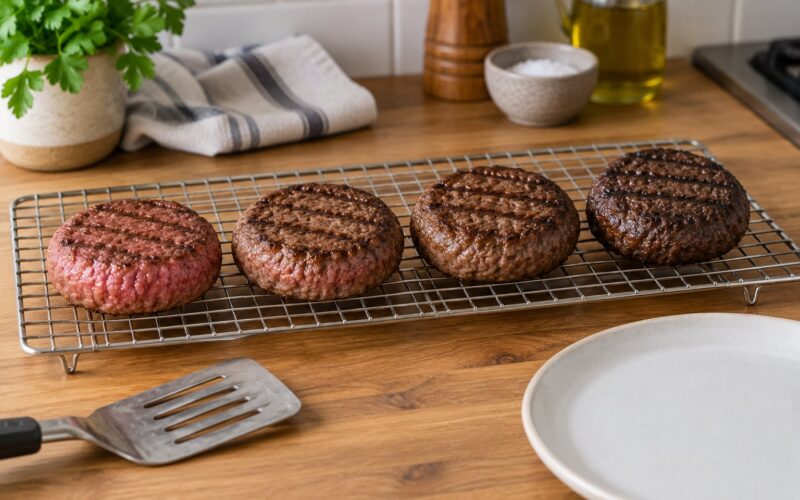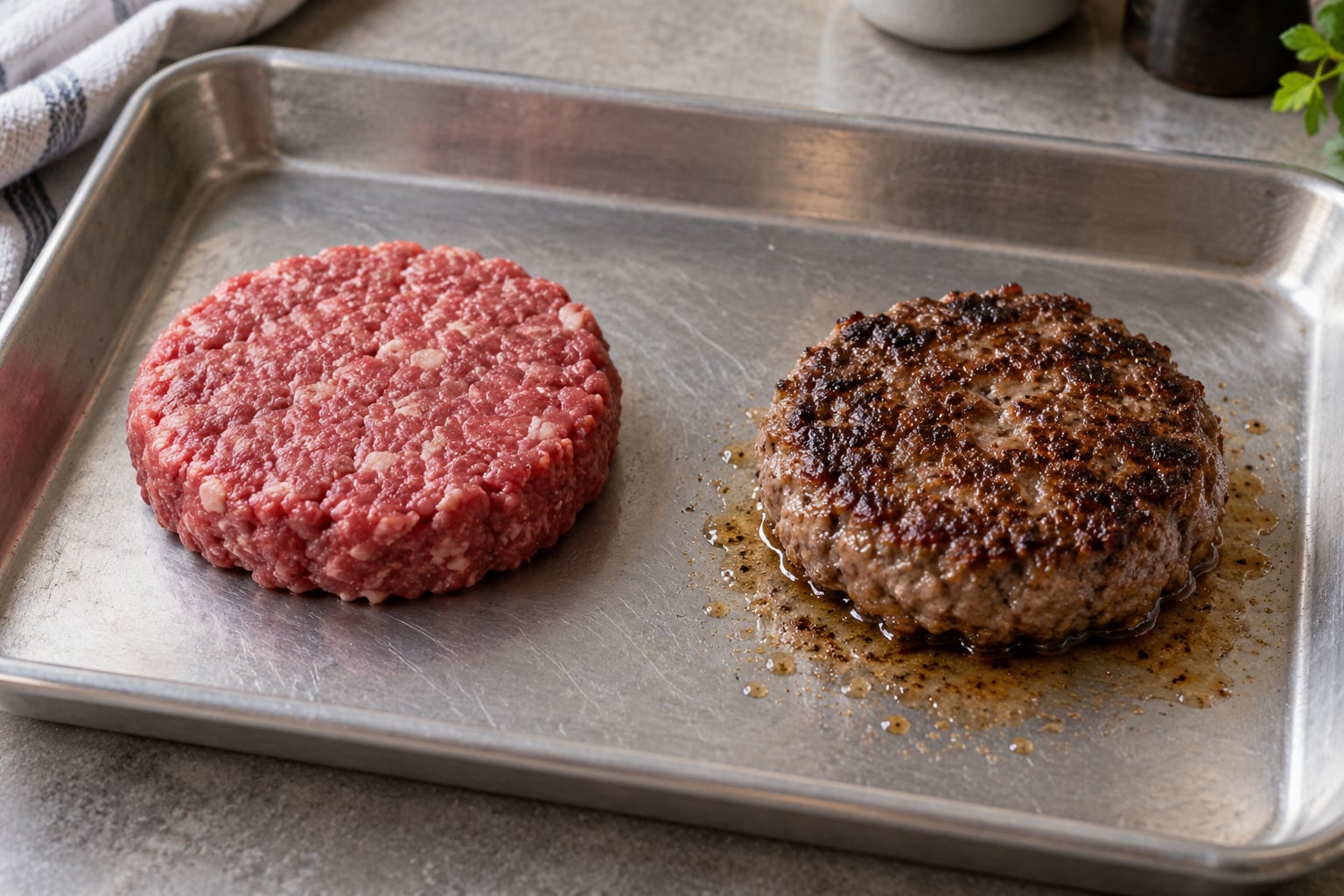
If you are wondering why do my burger patties shrink so much, the honest answer is that most of it is physics, not a mistake on your part. Heat makes the muscle proteins in ground beef contract, the marbled fat melts and drips away, and surface water leaves as steam. A patty that starts 4 inches wide and weighs 6 ounces will usually come off the grill closer to 3.5 inches and about 4.5 ounces, and the degree of fat in your grind decides how dramatic that change looks.
You can slow it down. You cannot stop it. This guide covers what is actually happening inside the meat, how much shrinkage a healthy patty should show, why patties pull inward from the edges, and the shaping and cooking choices that keep a burger juicy instead of turning it into a dry puck.
Table of Contents
- Why Do Burger Patties Shrink So Much During Cooking?
- The main causes of patty shrinkage, in plain terms
- How Much Should a Burger Patty Shrink?
- What Actually Happens Inside the Meat
- Protein contraction
- Rendering
- Cupping
- Overworking
- Why Does the Patty Shrink From the Edges Inward on the Grill?
- Why Do My Burger Patties Shrink When I Fry Them in a Pan?
- Why Do Homemade Burger Patties Shrink More Than Store-Bought Ones?
- How to Keep Burger Patties From Shrinking Too Much
- Cause, symptom, fix
- Grill, pan, griddle and air fryer compared
- A low-shrink method, start to finish
- Fixes that do not work
- When shrinkage is the whole point
- How to Tell Whether a Burger Patty Is Underdone
- Frequently Asked Questions
- How do I stop my hamburger patties from shrinking?
- How much do burger patties shrink when cooked?
- Why do my burger patties keep shrinking after they are cooked?
- Why do my burgers shrink from the edges inward instead of the middle?
- Does adding egg or breadcrumbs to ground beef stop shrinkage?
- Do burgers shrink more on a grill or in a pan?
- Conclusion
Why Do Burger Patties Shrink So Much During Cooking?
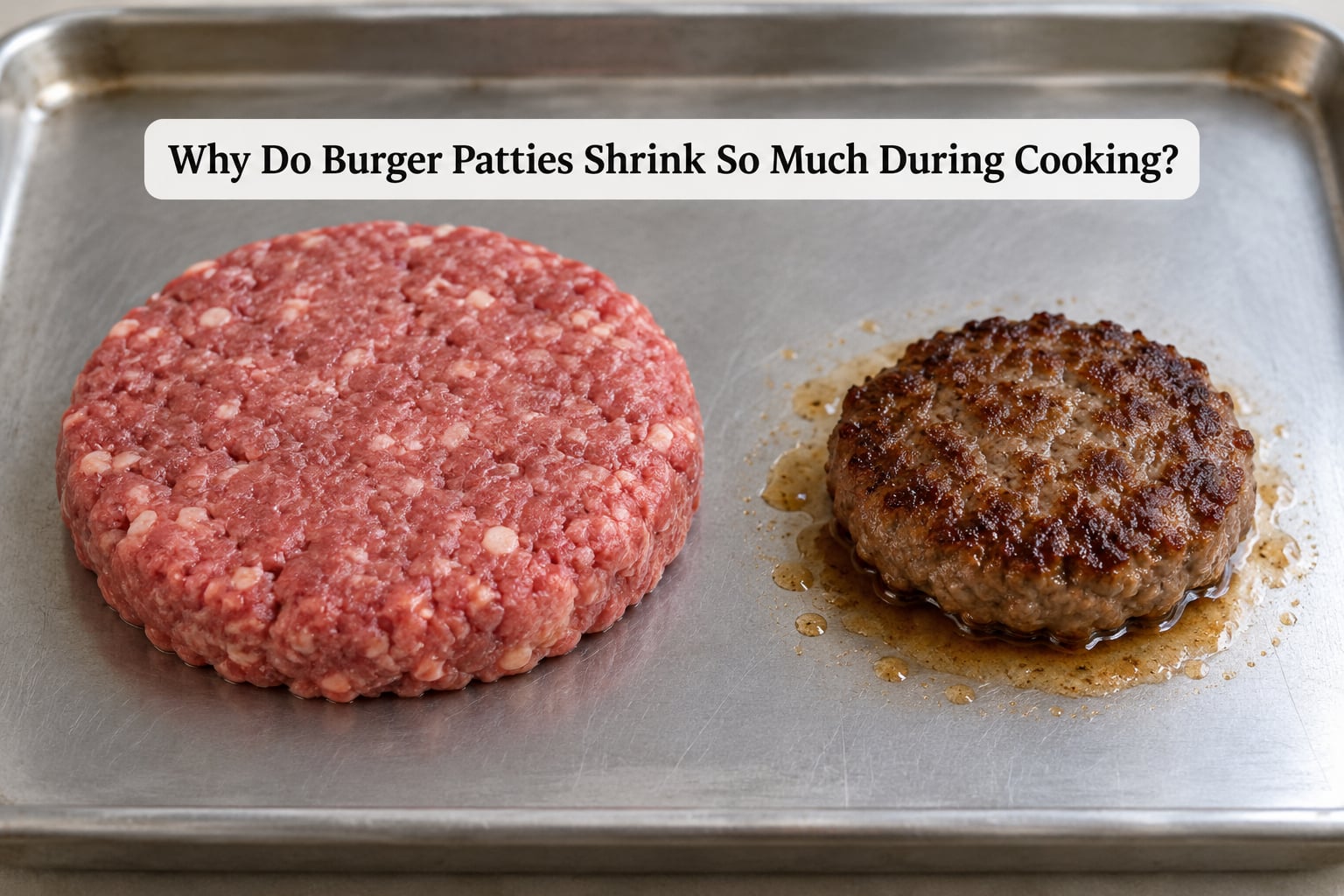
Three things happen at once when ground beef hits heat: the muscle proteins contract and pull inward, the fat between the fibres melts and renders out, and water on and inside the patty evaporates as steam. Add aggressive heat, a loose shape, or a lot of handling and the loss becomes obvious, because volume is dropping everywhere at once. You can slow all three down, but you cannot switch any of them off.
The word to keep in mind is rendering. Fat inside the meat melts at a much lower temperature than the proteins that hold the patty together, so it leaves early and the structure that remains is denser and tighter than what you started with.
The main causes of patty shrinkage, in plain terms
- Muscle proteins denature and tighten, physically squeezing the patty smaller from every direction at once.
- Marbled and interstitial fat melts, renders out and drips into the pan, taking volume with it.
- Surface and trapped water turns to steam and escapes, which is the juice you notice in the pan.
- Working the meat too hard binds the proteins into a tight paste that contracts hard when heated.
- Searing at very high heat drives off fat and moisture faster than the patty can hold them.
- Pressing with a spatula pushes out juice that was still inside the meat a second ago.
- A patty shaped to the exact bun size has nowhere to go but smaller once it cooks.
- Lean grinds carry less fat to lose but less fat to keep them moist, so they shrink and dry together.
How Much Should a Burger Patty Shrink?
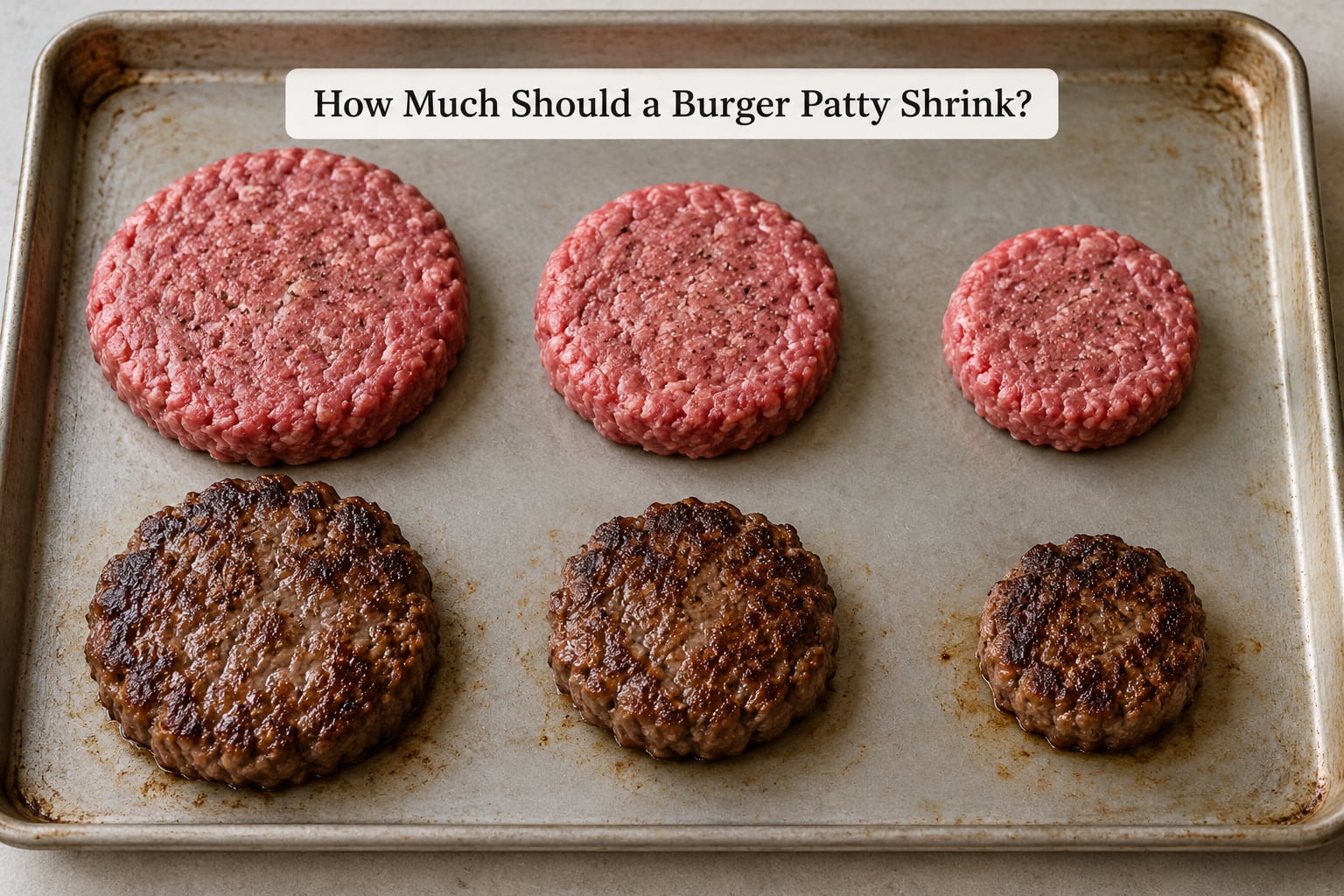
Here is the honest expectation for a 4-inch patty cooked to 160°F internal temperature. Anything far outside these ranges tells you something specific about what happened on the heat.
| Raw patty | Raw thickness | Typical cooked diameter | Expected weight loss | Usual cause if you see more |
|---|---|---|---|---|
| 80/20, 6 oz | 1/2 inch | 3.4 to 3.6 inches | 20 to 25% | Very high heat, or pressed early |
| 85/15, 6 oz | 1/2 inch | 3.5 to 3.7 inches | 18 to 22% | Long cook time, thin griddle |
| 90/10, 6 oz | 1/2 inch | 3.5 to 3.6 inches | 15 to 20% | Ground too fine, overworked |
| 95/5 lean, 6 oz | 1/2 inch | 3.4 to 3.6 inches | 15 to 18% | Long cook, uncovered pan |
| Store-bought 4 oz | 1/4 inch | 3.0 to 3.2 inches | 20 to 25% | Preformed and pressed thin |
| Smash patty, 8 oz | 3/16 inch | 4.5 to 5 inches | 30 to 40% | Deliberate, that is the style |
Diameter loss usually runs a little smaller than weight loss because the patty also loses thickness and gets taller as it cooks. The thick puck most people complain about is not so much a diameter problem as a thickness problem, and it usually means the patty was underworked on the heat until late in the cook.
Weighing before and after is the only honest way to know what your own patties are doing. Most home kitchens see closer to the low end of these ranges, and the difference between a 6 ounce raw patty and a 4.5 ounce cooked one is normal rather than a failure.
What Actually Happens Inside the Meat
Ground beef is not a solid block. It is a loose web of muscle fibres, collagen, and fat marbled through the whole thing, held together by proteins that have not yet been cooked. That structure is why shrinkage is three-dimensional instead of a simple pull inward.
Protein contraction
Heat changes the shape of proteins like myosin and actomyosin. Instead of sitting loose, they tighten and bond to each other, and connective collagen shrinks as it does. The whole network draws in on itself, which is why a raw patty relaxes slightly when you press it and a cooked one springs back hard.
Rendering
Rendering is fat melting and leaving the meat. It starts well before the patty is cooked through and continues the whole time. The grease in the pan at the end of your cook is not seasoning, it is volume you no longer have.
Cupping
Cupping is the patty curling into a bowl while the centre domes upward. The edges are thinner, so they lose heat and moisture faster, and they pull inward and up. The thick middle stays flat, so the patty no longer sits evenly in the bun.
Overworking
Kneading ground beef squeezes out air and brings the surface proteins into contact so they bond. Those bonded proteins tighten aggressively on the grill and squeeze out whatever juice is still inside. Butchers work meat into mixes for sausage and meatball texture, and those patties are meant to shrink into one piece.
Why Does the Patty Shrink From the Edges Inward on the Grill?
What readers describe as patties pulling in from the rim first is really an edge problem, and the centre holds on longer than you would expect. Every point on the surface of the patty is losing fat and water at the same time, and the edge has two extra problems on top of that: it is thinner, so it cooks through faster, and it has two exposed sides instead of one, so it loses moisture twice as fast.
Grill temperature sets the pace. A very hot grate deposits a hard sear on the outside while the centre is still cold, so fat under that crust traps heat and renders hard, and moisture has nowhere to go but out. A moderate grill lets the patty cook more evenly, which is why thinner patties suffer most on an over-hot grill.
Three habits make it worse on a grill. Pressing with a spatula to make grill marks pushes juice out of the meat and adds to the shrink you were trying to avoid. Flipping repeatedly restarts the cooking process on a new surface, so the patty renders twice. And cooking on a spot far from the coals gives you raw middle and over-rendered edges at the same time.
Resting matters more than most cooks expect. Let the patty sit a few minutes after it comes off the heat and the loose juice has somewhere to go instead of running out the bottom. A patty flipped straight onto a bun is a patty that has just had its last chance to hold anything in.
Why Do My Burger Patties Shrink When I Fry Them in a Pan?
A pan concentrates the problem. A grill sheds fat downward onto open coals, but a pan surrounds the patty on two sides with a metal surface that reflects heat back into it. The patty cooks from below, from above and around the edge all at once, so rendering happens faster and more evenly than it does over a grill.
The common pan mistakes are specific. A screaming hot pan sears the surface hard before the centre warms, so the same high-heat problem appears at the stovetop. A crowded pan drops the temperature of the whole pan, then a restless cook cranks the heat up to compensate, which is the worst of both worlds. Pressing the patty flat with a spatula for crust, or flipping it six times while it cooks, pushes out juice every time.
There is one more pan-specific habit worth naming. Greasing the pan and the patty heavily before it goes in adds fat that you then cook off, and the extra oil in the pan collects under the patty and steams the bottom instead of searing it.
Why Do Homemade Burger Patties Shrink More Than Store-Bought Ones?
A commercial patty is formed under pressure by a machine, so it goes on the grill already dense and uniform. When you shape a patty by hand, the looser you handle the meat the more air and connective tissue you leave in it, and that structure has to go somewhere during cooking.
Three habits do most of the damage. Mixing the ground beef thoroughly before shaping, for no reason other than habit, works the proteins into a paste. Squeezing each patty hard between your palms to make it look neat compresses the meat and pushes fat toward the surface, where it renders off in the first minute. And using a food processor or pulse blender gets the texture of a sausage mix rather than a steakburger.
Fat ratio does the rest of the work. The rule that shows up again and again on grilling forums is simple: the higher the fat content, the more weight cooks off and the smaller the finished patty. That is not a flaw, it is a fat choice, and it is why a lean burger shrinks and then tastes dry at the same time.
How to Keep Burger Patties From Shrinking Too Much
Eight adjustments, ordered by how much difference each one makes in my kitchen. You do not need all of them, but the first three do most of the work.
- Choose the grind on purpose. 80/20 gives you the most shrinkage and the most flavour, while a lean 90/10 or 93/7 gives you a smaller patty that is drier on the plate. Pick based on whether you want juice or size.
- Shape the patty wider than the bun. Experienced cooks size up deliberately because they know the burger will meet the bun after cooking. A 4-inch patty on a 4-inch bun ends up as a small burger with a bun overhang.
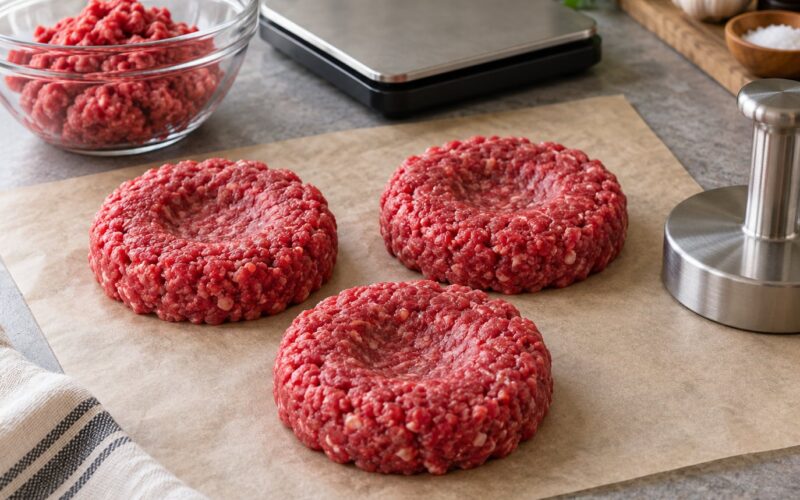
- Press a shallow dimple in the centre. It gives the thick middle room to expand instead of doming, so the patty stays flat and the edges stop curling up.
- Handle the meat gently. Lift and pat with a light touch, keep the shape loose, and never knead or compact it. Loose meat holds more water when cooked.
- Chill before cooking. A firm patty keeps its shape on a hot grate far better than a soft one, and 20 to 30 minutes in the fridge is enough.
- Cook at moderate heat. Get colour without scorching the fat. You want the sear to take time, not to be instant.
- Stop pressing. Every touch with a spatula presses juice out of the meat and shrinks the patty further.
- Rest before serving. A few minutes off the heat keeps more of what is left inside the patty instead of on the board.
Cause, symptom, fix
| Cause | Symptom you see | Fix |
|---|---|---|
| Heat far too high | Edges dark and crisp, centre chewy, big drop | Move to a medium zone, give each side more time |
| Fat renders out fast | Puck shape, dry crumbly texture, grease in the pan | Use 80/20 and moderate heat |
| Overworking the meat | Fine dense texture, tough and dry, shrinks hard | Shape with a light touch, do not mix the beef |
| Pressing or flipping a lot | Puck, no crust, juice on the board | One flip, no spatula pressure |
| No dimple | Centre domes, edges curl into a bowl | Press a shallow thumbprint before cooking |
| Patty matched to the bun | Small finished burger, overhang on the bun | Shape 20 to 25% wider than the bun |
| Air fryer running hot | Very dry edges, heavy overall loss | Lower the temperature, cook a little less long |
Grill, pan, griddle and air fryer compared
The same patty shrinks differently on each surface because heat transfer is different. Grill and griddle behave most similarly, the pan is harsher, and an air fryer is fastest of all.
| Method | How heat reaches the patty | Shrinkage tendency | Adjust this |
|---|---|---|---|
| Gas or charcoal grill | Radiation and conduction from below | Moderate, edges dry out fastest | Keep the patty in the cooler zone for the first minute |
| Cast iron skillet | Conduction from below plus reflected heat | Higher loss, fat renders fast | Medium heat, do not press, move the pan off the flame |
| Flat top griddle | Even conduction with little radiant heat | Closest to a normal expectation | Give it room so it is not steaming in its own moisture |
| Air fryer | Fast hot air from above and around | Highest loss for the same thickness | Drop the temperature by about 25°F and check early |
A low-shrink method, start to finish
For a thick pub-style patty that stays close to its raw size, do it in this order. Weigh out 6 ounces of 80/20 beef per burger and shape it loosely to 4.5 inches wide and a little under half an inch thick, leaving visible texture at the edge rather than a smooth packed surface. Press one shallow dimple in the centre of each patty with your thumb, then chill them for 20 to 30 minutes so the fat firms up. Heat a griddle or skillet to medium and give the beef enough room that it is not sitting in its own steam. Put the patty down and leave it alone until the edges have darkened and released from the surface, flip once, cook the second side to 160°F (71°C), and rest it two minutes before serving.
That sequence keeps the heat steady enough not to render the fat in the first thirty seconds, and gives the juice somewhere to go when you let it rest. You should still expect a smaller patty at the end. You just should not expect a dry one.
Fixes that do not work
- Breadcrumbs in the mix. They absorb juice, then that juice is gone for good. The patty stays larger on the plate but drier in the mouth, and the bread adds its own raw flavour.
- Egg in the mix. Egg binds and adds water, which helps a patty hold together when it breaks apart. It does nothing about shrinkage, which happens inside the meat.
- Oil mixed into the raw beef. Ground beef already carries 10 to 20% fat. Adding oil gives you more volume to lose.
- Tempering the beef first. Room-temperature meat cooks unevenly and burns before the centre warms. Cold meat on a hot grate is not the cause of shrinkage either.
- Salting very early. Salt draws moisture to the surface, but most of that moisture stays in the patty and cooks in. It is a question people ask constantly and the effect on size is small.
When shrinkage is the whole point
A smash patty is pressed thin on a very hot flat top on purpose, and it loses 30 to 40% of its weight while cooking. That is the style, not a mistake. If your goal is a burger with a crisp lacy edge and a bun-sized footprint, the aggressive technique works. If you want a thick pub-style patty that stays juicy, the same approach ruins it.
How to Tell Whether a Burger Patty Is Underdone
Colour is a weak signal. Pink inside can mean anything from raw to perfectly done, and browned outside can hide a raw middle just as easily. The one reliable test is a thermometer, and ground beef should reach 160°F (71°C) internal temperature.
If you have no thermometer, push a finger into the centre and compare it with the meat of your own palm at the base of the thumb. The texture of rare steak is roughly the same as a very lightly cooked patty, medium is a bit firmer, and well done feels firm and springy in both cases. The squeeze test is a backup, not a safety measure.
To keep a patty juicy through that cook, take it off the heat a little before you think you need to. Carryover heat finishes the job, the resting time lets the juice redistribute, and a burger rested two minutes loses less than one flipped straight onto the bun.
Frequently Asked Questions
How do I stop my hamburger patties from shrinking?
You cannot stop it, but you can slow it. Pick an 80/20 grind, shape the patty 20 to 25% wider than your bun, press a shallow dimple in the centre, and handle the beef gently rather than packing it. Cook at moderate heat, keep the spatula away from the patty, and let it rest two minutes before serving. Fat ratio and shaping do most of the work.
How much do burger patties shrink when cooked?
A 6 ounce, half-inch 80/20 patty usually lands around 4.5 to 5 ounces cooked, losing 20 to 25% of its raw weight and about half an inch of diameter. Lean grinds lose 15 to 18% and lose more moisture with it, while a smash patty pressed thin can lose 30 to 40% by design. Weighing your own patties before and after is the only accurate answer for your grind.
Why do my burger patties keep shrinking after they are cooked?
That is mostly carryover loss, not more cooking. Hot fat and loose juice keep moving out of the patty for a few minutes after it leaves the heat, and if you move it straight to a plate or a bun, that juice goes on the floor. Rest the patty on a warm surface for two to three minutes before slicing or serving and most of it stays where you want it.
Why do my burgers shrink from the edges inward instead of the middle?
The edge is the thinnest part and has two exposed sides, so it cooks faster and loses moisture twice as fast as the centre. The centre is thick and shielded, so it holds its size longer. That edge pull is what creates cupping, where the edges curl up and the middle domes. A shallow dimple in the centre before cooking stops the dome and makes the patty sit flat in the bun.
Does adding egg or breadcrumbs to ground beef stop shrinkage?
Neither one does. Egg binds and adds water so a patty holds together rather than falling apart, and breadcrumbs absorb juice so the patty keeps its shape, but both trade dryness for size. Shrinkage happens inside the muscle proteins and the fat, so a binder cannot reach it. Choose the fat ratio and the shaping instead, and dry binders make the burger worse, not better.
Do burgers shrink more on a grill or in a pan?
In a pan. A grill cooks a patty mostly from below, while a skillet surrounds it on two sides with metal that reflects heat back in, so fat renders faster. An air fryer shrinks patties more than either, because hot air moves quickly on every surface. If shrinkage is your main complaint, move the patty to the cooler side of the grill and keep the skillet at medium heat.
Conclusion
Start with three things. Weigh your beef so every patty is the same, shape each one 20 to 25% wider than your bun and press a shallow dimple in the centre, then handle the meat lightly enough that you can still see loose texture in the edge. Pick a grind that matches the burger you want: 80/20 for flavour and juice, leaner if you would rather have less rendered fat on the plate. Cook at moderate heat, flip once without pressing, and let it rest two minutes before it goes anywhere near a bun. Every patty will still be smaller than it started, and a 20 to 25% weight loss on an 80/20 blend is a good burger, not a mistake.