A smash burger is a ball of loosely packed 80/20 ground beef, pressed flat on a very hot griddle for about 10 seconds until it sears into a thin patty with crisp edges and a juicy middle. Learning how to make smash burgers on a griddle comes down to four numbers: a surface around 425°F, 2.5 to 3 ounces of beef per ball, a 5-second window before you smash, and a 10-second press. Start to plate, it takes about 15 minutes.
The whole method is short, which is exactly why it goes wrong so often. A griddle that isn’t hot enough gives you a gray, rubbery patty. Meat that sits too long before the flip turns dry. And a ball packed tight refuses to spread, so you get a thick puck instead of those lacy edges that make the burger worth eating.
Table of Contents
- What You Need
- Equipment
- Ingredients
- Step-by-Step
- 1. Preheat the Griddle and Prepare the Buns
- 2. Form the Burger Portions
- 3. Place and Smash the Patties
- 4. Cook Until the Edges Are Crisp
- 5. Flip, Cheese, and Toast
- 6. Assemble and Serve Immediately
- Common Mistakes
- Frequently Asked Questions
- What temperature should a griddle be for smash burgers?
- Can I use lean ground beef for smash burgers on a griddle?
- How long should I cook each side of a smash burger patty?
- Should I cover smash burgers while the cheese melts?
- Can I cook smash burgers from frozen ground beef?
- How many smash burgers can I make on one griddle at a time?
- Conclusion
What You Need
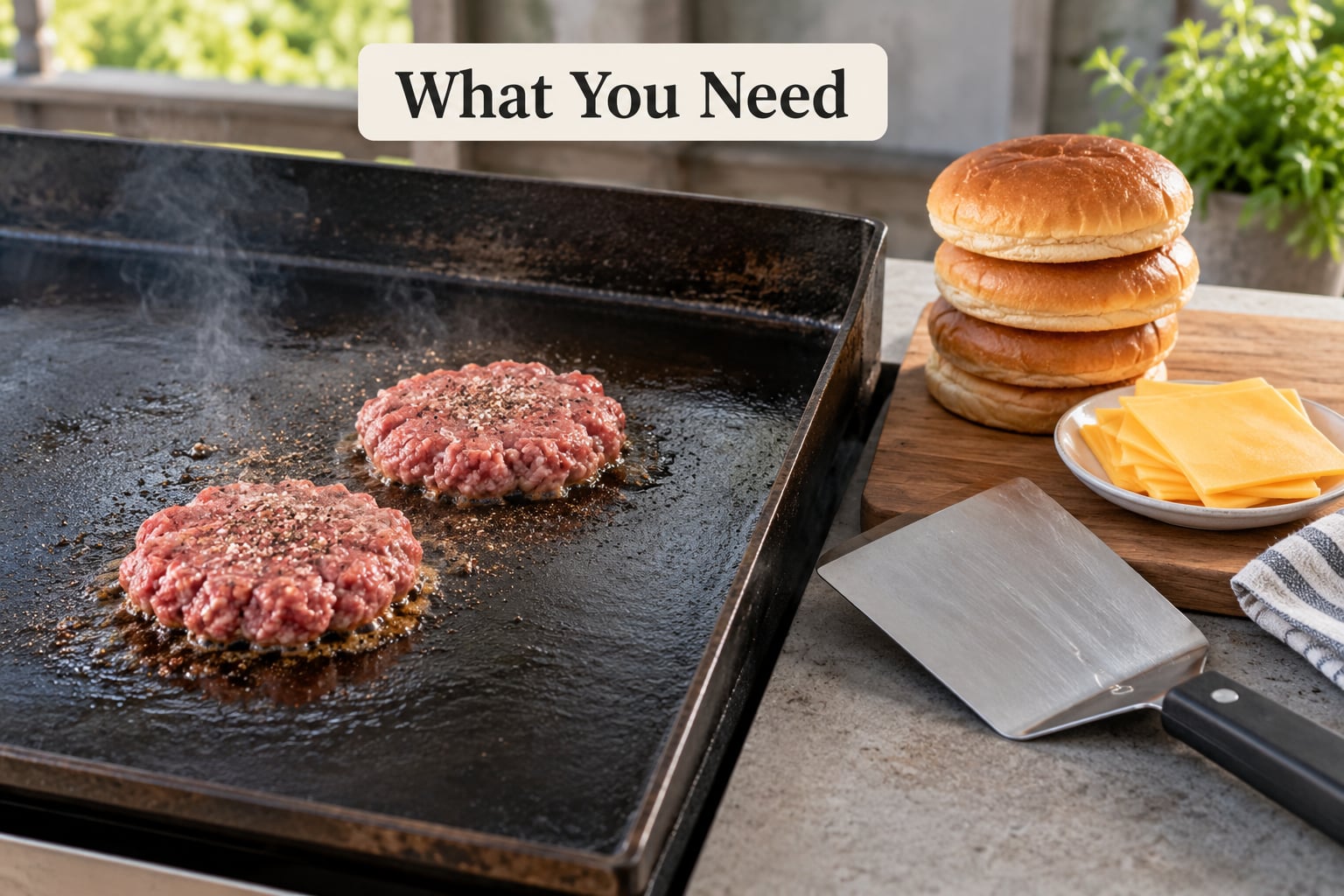
The setup is short. A flat or cast iron griddle, 80/20 ground beef, thin-sliced American cheese, buns, salt, and a sturdy spatula cover everything you need.
Equipment
- A flat top or cast iron griddle. A cast iron skillet or carbon steel pan works too, just in smaller batches.
- A sturdy, wide spatula with a sharp leading edge. A thin, floppy turner will fold the patty instead of lifting it.
- A second spatula or a heavy skillet. Two spatulas crossed in an X do the job of a burger press.
- Parchment rounds or wax paper. Optional, but they release the meat cleanly from the press and the griddle.
- A 1/3 cup measure. Packs consistent balls faster than eyeballing.
- An instant-read thermometer. Optional, useful for confirming doneness on a thick double stack.
Ingredients
- Ground chuck or an 80/20 ground beef blend. Fat is what keeps the center juicy. Lean beef dries out before it crusts.
- Thin-sliced American cheese. It melts smooth over the hot patty and gives you the classic pub-style pull. Provolone and Swiss also work well.
- Buns sized to the patty. The patty should match the bun or overhang it by a few millimeters on each side.
- Salt and black pepper. Finely ground salt goes on before the press, heavier seasoning after.
- Garlic powder, onion powder, or a burger rub. Optional, but a light hand. You want the beef to taste like beef.
- A high smoke point oil or butter. For the griddle and the buns.
Step-by-Step
1. Preheat the Griddle and Prepare the Buns
Heat a flat top or cast iron griddle to about 425°F on medium-high and let it sit there for several minutes before the first ball goes down. Preheat is the single step that decides whether you get a crust, so give it more time than feels necessary.
Wipe the surface with a thin film of high smoke point oil, then toast the buns cut side down in that grease for 30 to 60 seconds and set them aside. Toasting now keeps the buns from stealing heat from the patties later.
2. Form the Burger Portions
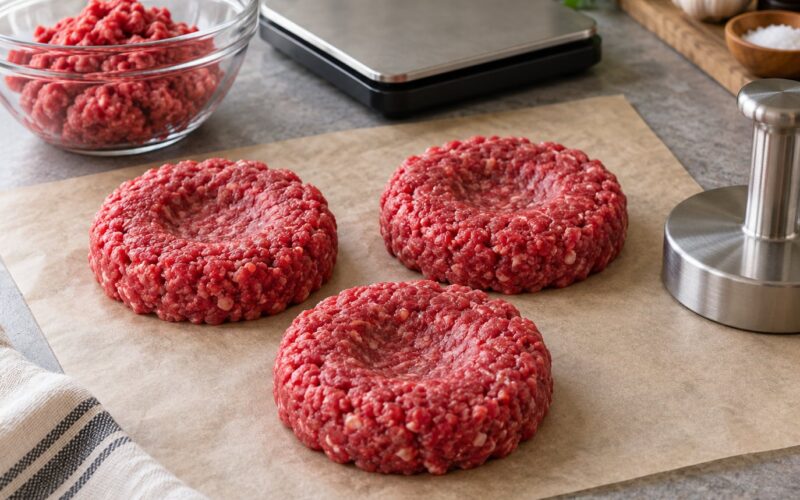
Divide the beef into 2.5 to 3 ounce portions, roughly a golf ball and about a packed 1/3 cup each. Handle the meat as little as possible and pack it loosely, almost too loosely. A tightly packed ball won’t spread, and a compact meatball is the fastest way to end up with a burger that never got thin enough to sear.
A pound of beef gives you about five balls. Make them all before you start cooking, because once the first patty is down your hands are busy.
3. Place and Smash the Patties
Set the beef balls on the hottest part of the griddle, leaving about 4 inches between them. You have roughly 5 seconds before the surface starts to cook and the ball tightens up, so work one at a time: ball down, smash, move to the next.
Press firmly and hold for about 10 seconds. If you have a press or a heavy skillet, weight does the work for you. If you don’t, cross two spatulas in an X and press straight down. Sliding the patty around while you press drags the meat instead of flattening it.
Drop a parchment round between the beef and the press if you keep running into sticking. It costs nothing and it doesn’t hurt the crust.
4. Cook Until the Edges Are Crisp
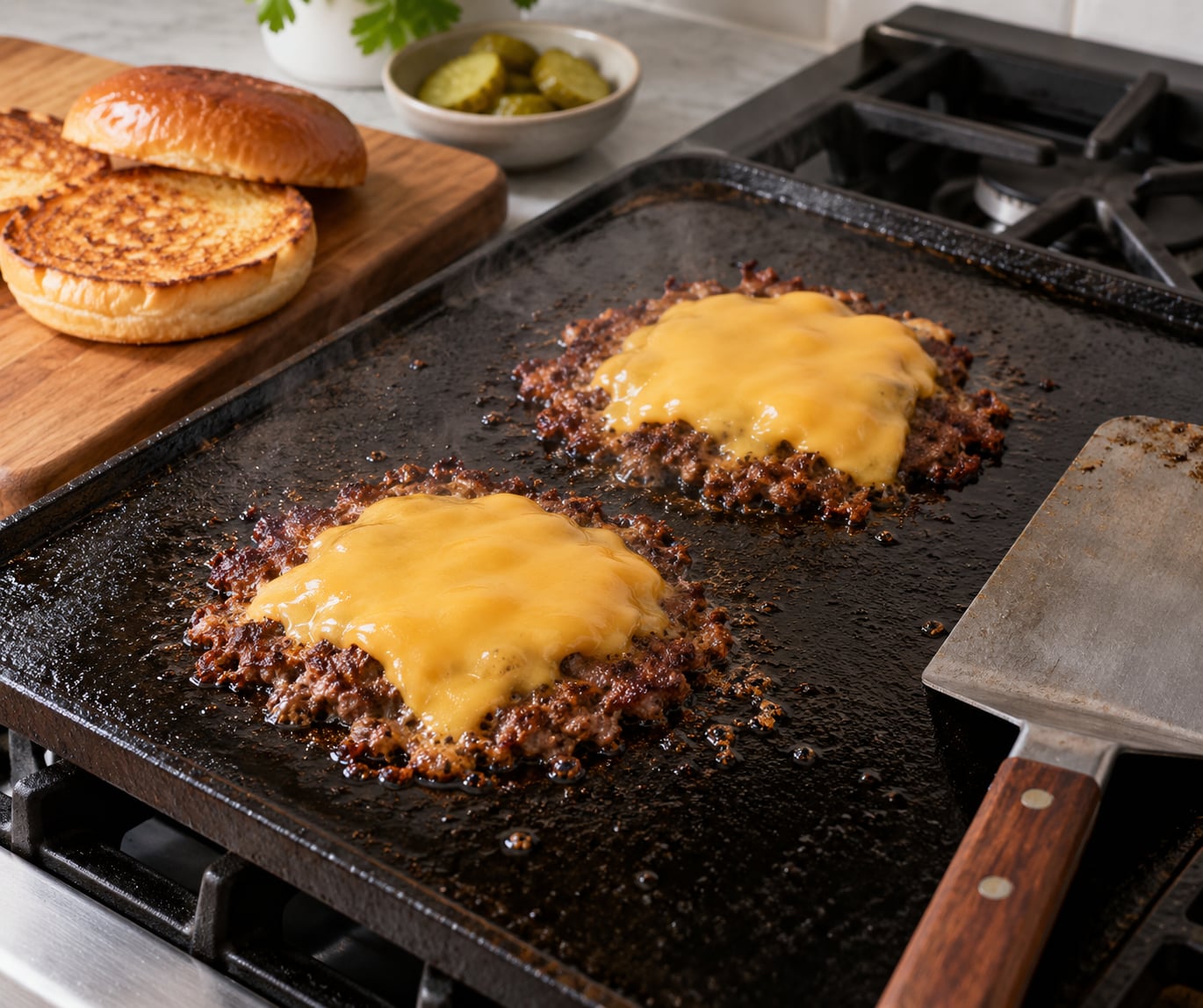
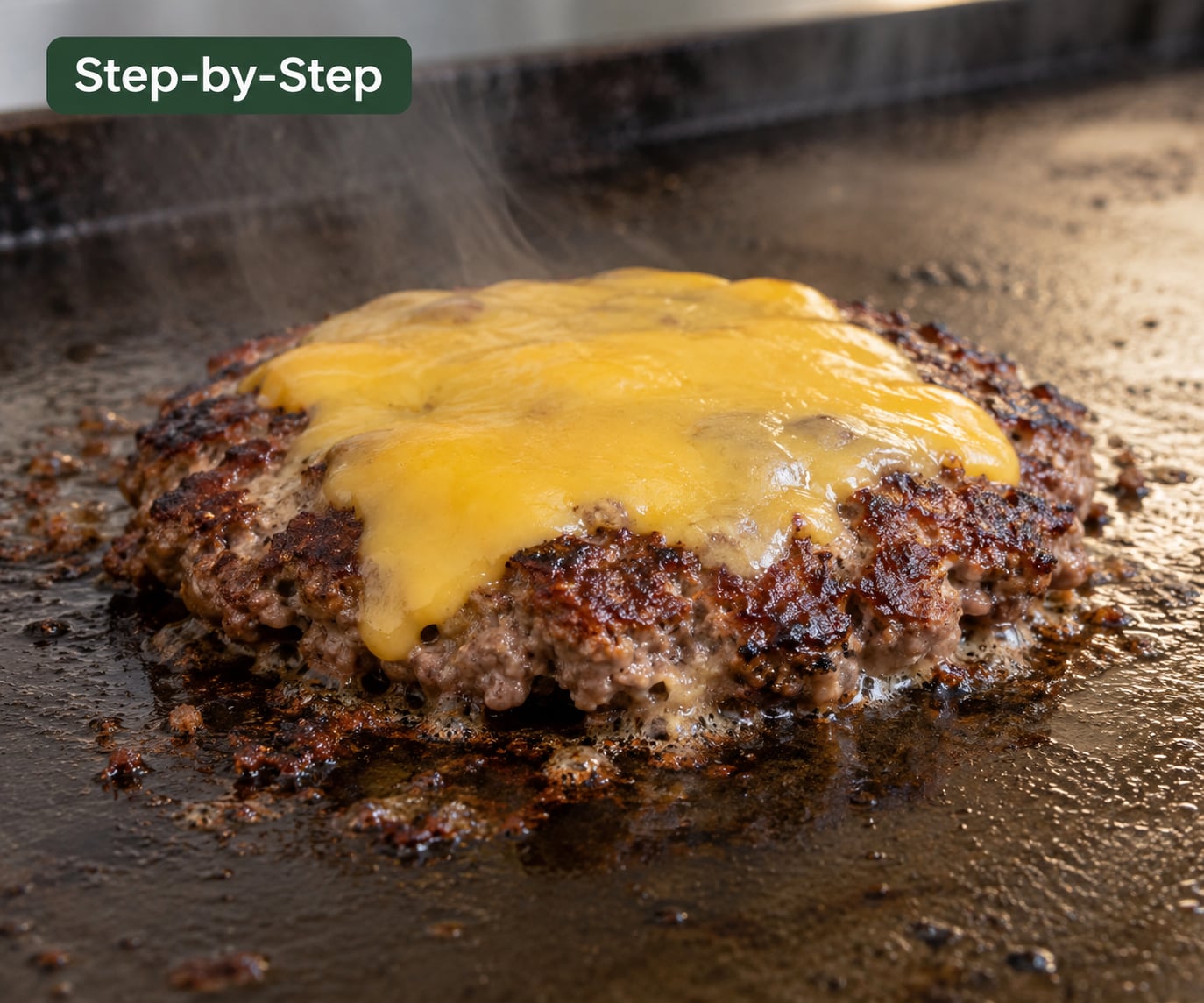
Leave the smashed patty alone for 3 to 5 minutes. It should look set and cooked on the surface with the edges darkening, and a properly smashed patty shows small lacy holes where you can almost see through the meat. That lace is your sign the crust is forming.
Salt and season the top side now if you didn’t season before the smash. Don’t move the patty before the edges release on their own.
5. Flip, Cheese, and Toast
Slide your spatula under the patty at about a 45-degree angle, scraping toward the hot side so the browned edge stays attached, and flip while the top is still slightly pink. That’s the moment most people wait too long on, and it’s what turns a juicy burger into a dry one.
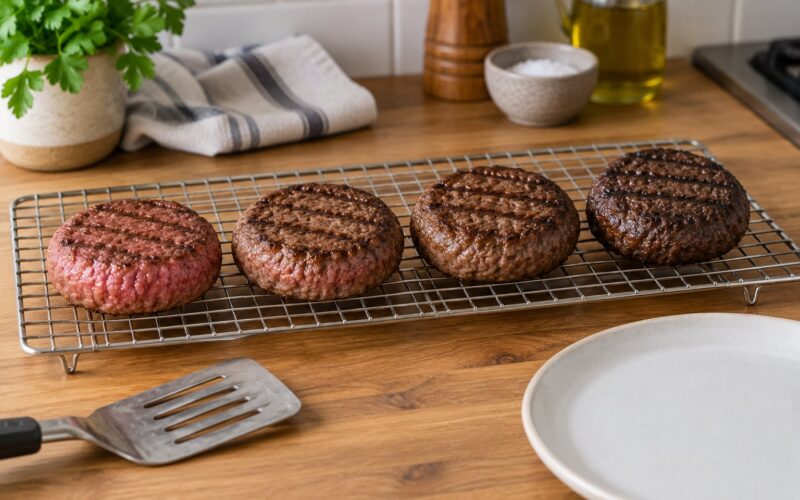
Cook the second side for 30 to 60 seconds, add a slice of cheese, and cover with a dome or an inverted metal bowl for 15 to 20 seconds. Ground beef should hit 160°F internally, though a thin single patty that’s browned on both sides will usually be well past that already.
6. Assemble and Serve Immediately
Build in this order: bottom bun, sauce, first patty, second patty if you’re doubling, cheese, then toppings. Lettuce and tomato go on last, right before the top bun, so they don’t steam the bread.
Serve these right away. Steam softens a bun fast, and a smash burger left sitting for five minutes goes soggy at the bottom. Two thin patties stack and eat better than one thick one, which is the other thing this method is really about.
Common Mistakes
Using lean beef. Anything below 80/20 loses the fat that keeps the inside juicy during that short, high heat sear. Buy chuck and let the store grind it if you can.
Crowding the griddle. Six balls at once drops the surface temperature and leaves the last ones cooking in the steam off the first ones. Cook 2 to 4 at a time and batch your way through.
Pressing patties that have already started to cook. The 5-second window is real. A ball that has set on the surface resists the press and tears when you flip it.
Moving the patty too early. If the spatula slides under without resistance, the crust is not ready. Wait until the edges release on their own.
Low heat. A lukewarm griddle steams the beef instead of searing it. Wait until a drop of water sizzles and evaporates almost instantly, or until a flick of your wrist over the surface feels like heat coming back at you.
Skipping bun prep. Untoasted buns soak up grease and go soft under the sauce. Thirty seconds cut side down in the residual fat fixes that.
A couple of extras worth knowing. A nonstick pan can’t get hot enough for a real sear, so use cast iron or carbon steel. And for a crowd, plan the batches ahead: 2 to 4 patties every 5 to 6 minutes means 12 patties in about 20 minutes of actual cooking, while you toast buns and stage toppings in between.
Frequently Asked Questions
What temperature should a griddle be for smash burgers?
Aim for about 425°F on the cooking surface, which usually means medium-high on a gas griddle or medium on a stovetop burner. Hold that heat for several minutes before the first ball goes down. To test without a thermometer, flick a few drops of water onto the surface: they should hiss and disappear in under a second. Any cooler and the beef steams instead of searing, which is what causes gray, rubbery patties.
Can I use lean ground beef for smash burgers on a griddle?
You can, but the burgers will be drier. Smash burgers cook fast at very high heat, so the fat in an 80/20 blend is what stays in the patty as moisture. Lean beef or a 90/10 blend has less to hold onto and tends to come out of the press looking grey and dry at the edges. Ground chuck is the better buy, and many stores will grind fresh chuck for you at the counter.
How long should I cook each side of a smash burger patty?
Give the first side 3 to 5 minutes, until the edges darken and the surface looks set, then flip and give the second side only 30 to 60 seconds. Smash patties are thin, so the second side finishes almost immediately. Flip while the top still looks slightly pink. Waiting until there is no pink left on top is the single biggest reason home smash burgers come out dry.
Should I cover smash burgers while the cheese melts?
Yes, briefly. Once the patty is flipped and seasoned, lay on a slice of thin American cheese and cover with a heat safe bowl or a dome for 15 to 20 seconds. The trapped heat melts the cheese evenly without overcooking the patty underneath. Hold the cover any longer and you will start drying out the thin beef. Many cooks also add a splash of water to the griddle under the cover, which steams and loosens the cheese nicely.
Can I cook smash burgers from frozen ground beef?
Don’t smash straight from the freezer. Freezing and thawing changes the texture of ground beef, and a frozen ball will smear on the griddle instead of spreading. Portion the meat into 2.5 to 3 ounce balls and freeze them on a tray, then move the balls to the fridge overnight. They thaw firm rather than mushy, which is exactly the texture you want to press flat. Thawing sealed at room temperature for an hour or so also works.
How many smash burgers can I make on one griddle at a time?
Cook 2 to 4 patties per batch on a full size flat top, leaving about 4 inches between each ball so the spatula has room to get underneath. A home cast iron skillet fits one to two. Bigger crowds mean more batches: at 5 to 6 minutes per round, you turn out about 12 patties in 20 minutes of actual cooking, which is plenty if you are serving hard and working in parallel on buns and toppings.
Conclusion
Four things decide whether a smash burger works: a very hot clean griddle, loosely packed 80/20 beef portioned at 2.5 to 3 ounces, one firm 10-second press within 5 seconds of the beef hitting the surface, and a flip while the top is still pink. Do those four things and the crust takes care of itself.
After that it’s all adjustment. Larger buns want wider patties, a home skillet means smaller batches, and cheese types vary in how long they take to melt. Once you’ve cooked a few rounds you’ll be reading the griddle by sight and sound instead of the clock, which is the real sign you know how to make smash burgers on a griddle.