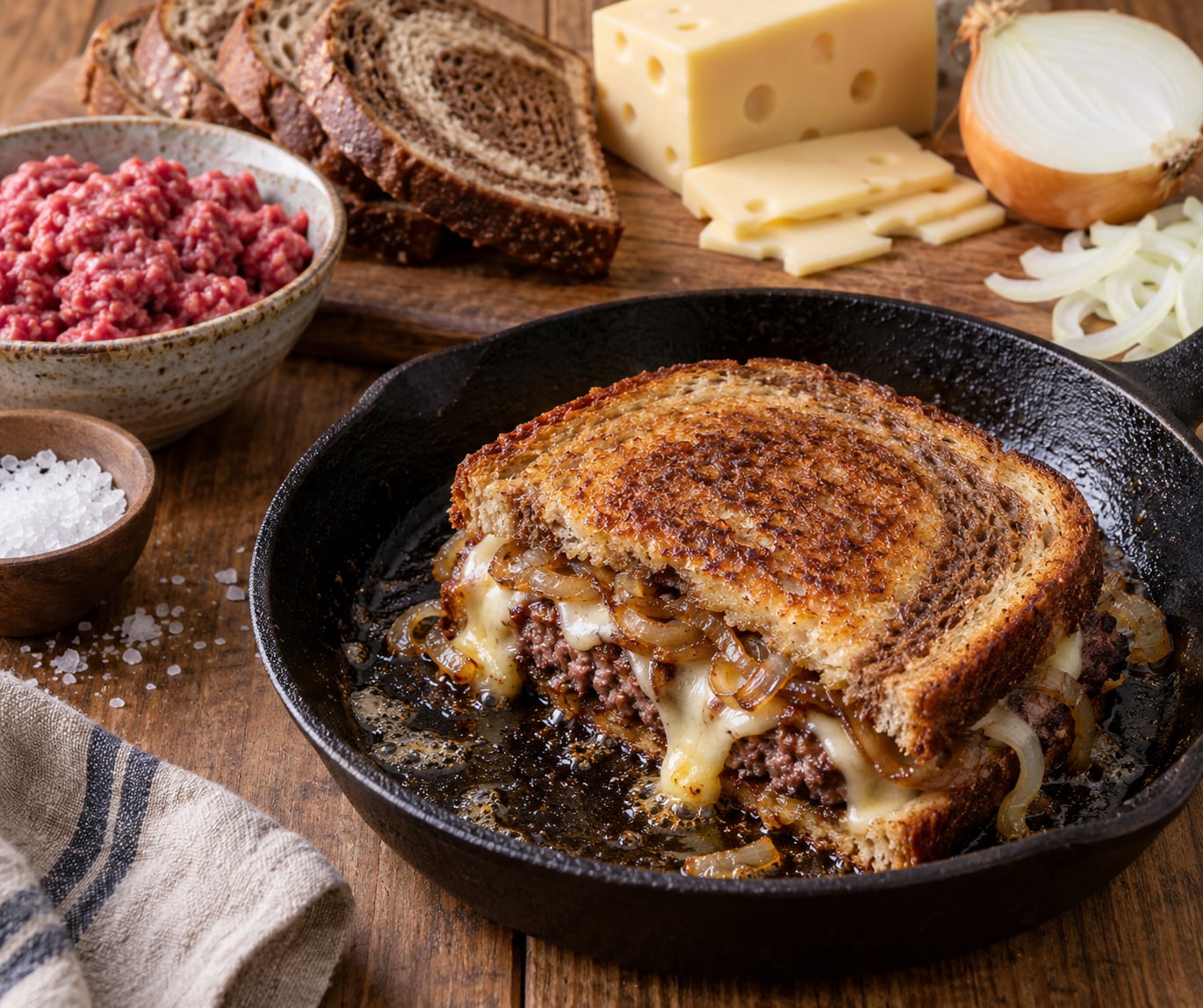
A patty melt is a thin beef patty covered with deeply caramelized onions and melted Swiss cheese, squeezed between two slices of buttered, griddled bread. Learning how to make a patty melt at home takes about an hour, and most of that hour belongs to the onions. The sandwich itself is beginner work: one skillet, four stages, and a couple of minutes on the griddle at the end.
The whole thing tastes better than it has any right to. It is also the sandwich I want when there are six people in the kitchen and nobody wants to run a burger bar.
Here is the method, phase by phase, with the timings that actually matter.
Table of Contents
- What You Need
- Core ingredients
- Optional additions
- Tools that help
- Step-by-Step: How to Make a Patty Melt at Home
- 1. Caramelize the onions (25 to 40 minutes)
- 2. Form and sear the patties (6 to 8 minutes)
- 3. Assemble with cheese on both sides
- 4. Griddle until deep golden brown (4 to 6 minutes)
- How Do You Keep a Patty Melt From Falling Apart?
- Common Mistakes
- The patty crumbles when you flip it
- Why does the bread go soggy in a patty melt at home?
- Cheese leaks everywhere
- The onions taste raw or burnt
- The sandwich is too thick to eat
- You cut it too early
- How Should You Store and Reheat a Patty Melt?
- Frequently Asked Questions
- What is the best bread for a patty melt at home?
- Can I use turkey or chicken sausage for a patty melt?
- Should I cook the onions before putting them in the sandwich?
- How do I get the bread crispy without burning it?
- Can I make patty melts ahead of time for game day?
- What internal temperature should ground beef reach?
- Conclusion
What You Need
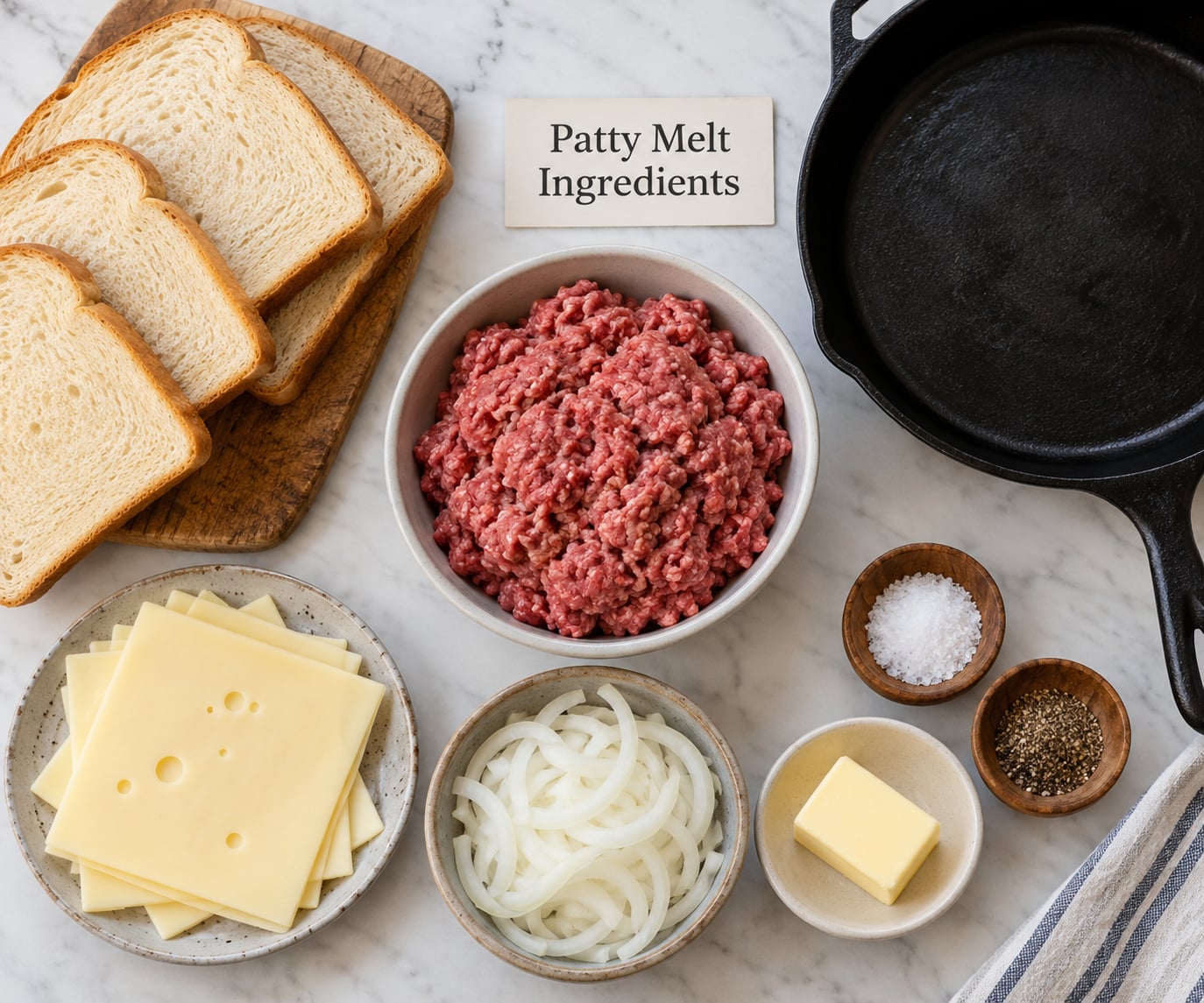
For one sandwich you want half a pound of ground beef, one large onion, four slices of bread, and about three slices of Swiss cheese. A cast-iron skillet or a flat-top griddle handles all four stages without anything being washed in between.
Core ingredients
- 8 ounces ground beef, 80/20 or 73/27 fat content
- 1 large yellow onion, sliced thin
- 4 slices rye, sourdough, or plain white sandwich bread
- 2 to 3 slices Swiss cheese (Emmental and Gruyere both work)
- Butter for the bread, plus a tablespoon for the skillet
- Coarse salt and cracked black pepper
Optional additions
A tangy sauce is what turns this from a good sandwich into a pub order. Thousand Island dressing is the classic, and a squeeze of ketchup and a smear of mayo gets you most of the way there. Some people add a teaspoon of yellow mustard to the beef itself, which is not traditional but is very good.
Tools that help
A wide, thin spatula is the one tool worth caring about. A narrow one is why patties tear. A second piece of parchment or a small plate also helps while you work through each stage.
Step-by-Step: How to Make a Patty Melt at Home
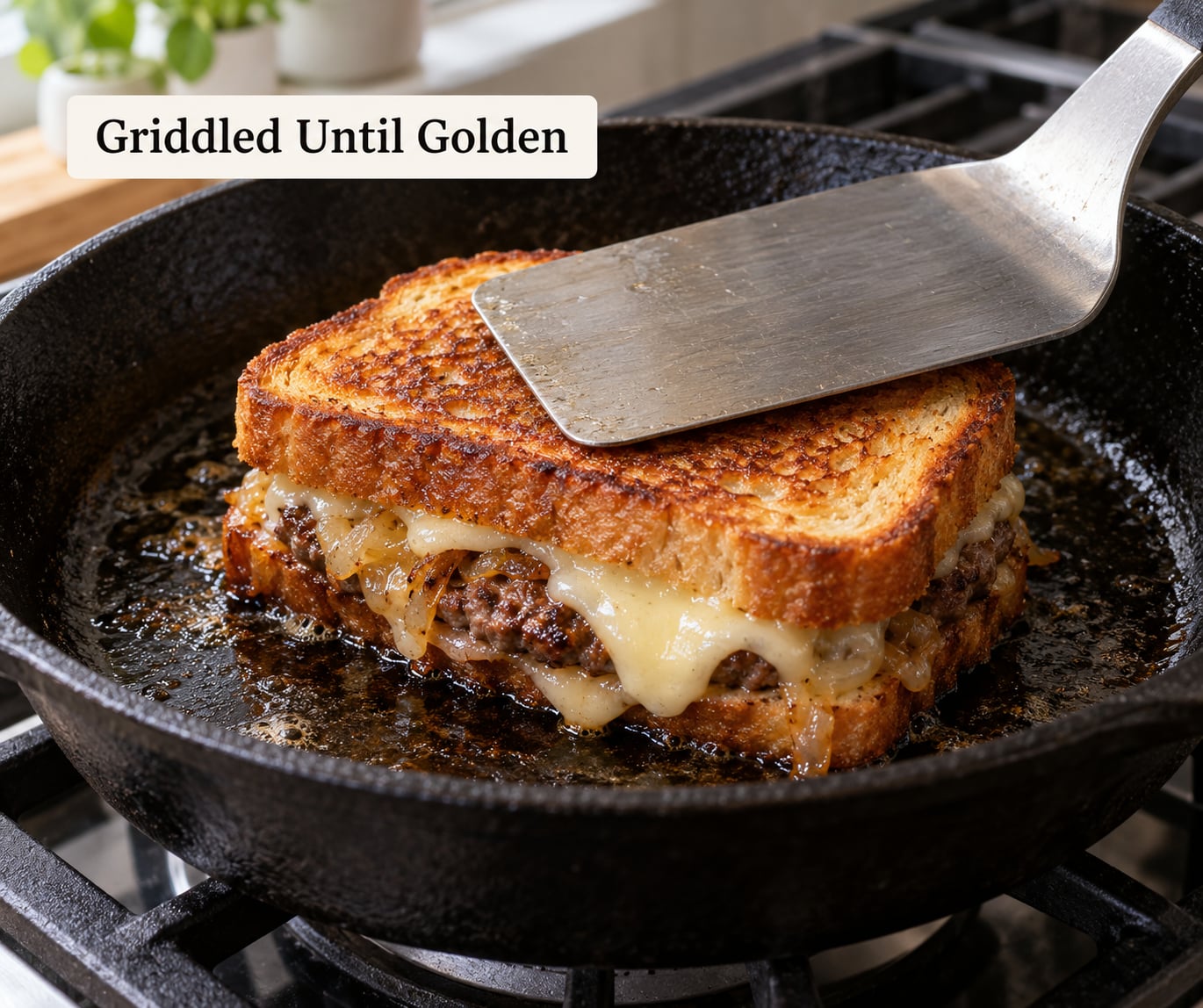
Everything happens in one skillet, in layers. Do not wipe it out between stages. The fond from the beef and the onion sugar left behind is what seasons the bread.
1. Caramelize the onions (25 to 40 minutes)
Melt a tablespoon of butter in the skillet over medium-low heat. Add the sliced onion with a pinch of salt and spread it into an even layer, then leave it alone for the first five minutes. Stirring constantly releases water and slows everything down.
After that, stir every three to four minutes, scraping the bottom loose. You want the onions to go from translucent to soft, then from soft to straw-colored, then slowly to deep brown. Thirty-five minutes is normal. When they look done, add a tablespoon of apple cider vinegar and let it bubble out. That takes the edge off the sweetness.
2. Form and sear the patties (6 to 8 minutes)
Push the onions to one side of the pan and scrape out most of the grease, keeping a thin film behind. Divide the beef into two loose portions and shape each into a patty roughly a quarter inch thick, slightly wider than your bread. Handle each one as little as possible. That is the whole trick to a patty that stays intact.
Do not season inside the patty. Salt it on the outside, right as it hits the pan, along with the pepper. Cook over medium-high for two to three minutes without moving it, until the underside is a deep brown crust. Flip once and give it another two to three minutes, depending on how thick you rolled it.
3. Assemble with cheese on both sides
Butter the outside of each slice of bread. Lay two slices butter-side down in the skillet, buttered side still touching the pan. Put a slice of cheese on each, then a patty on one and the caramelized onions on top of that patty, then a second slice of cheese on the onions. Top each sandwich with the remaining bread slice, buttered side facing up.
Two slices of cheese, not one. The bottom layer melts against the bread and makes a seal, and the top layer melts over the onions and gives you something stretchy when you cut in.
4. Griddle until deep golden brown (4 to 6 minutes)
Press each sandwich down gently with the flat of your spatula, then walk away for three minutes. Resist flipping it early. When the underside is golden and the cheese has visibly leaked at the seam, flip and give it another two to three minutes.
If your cheese is going nowhere, drop a square of foil over the sandwich and press again. The trapped steam forces a faster melt without driving the bread to burn.
How Do You Keep a Patty Melt From Falling Apart?
Four habits fix almost every collapse. Shape the patty loosely and press it with one flat palm instead of kneading it. Cook the first side long enough to build a crust that grips the pan before you even think about a spatula. Use the widest thin tool you own and slide it fully under the patty before tipping it. And let the sandwich sit on the board for a minute after griddling, because cheese that is still molten will drag everything with it.
Common Mistakes
Six things go wrong with home patty melts, and all six have a straight fix.
The patty crumbles when you flip it
Usually one of two causes: you worked the beef too much while shaping, or you flipped too early. Form the patty with two or three gentle presses and give the first side a full two to three minutes of undisturbed heat. A crust is structural glue.
Why does the bread go soggy in a patty melt at home?
Two causes, one fix. If the bread is thin or soft, it steams before it toasts. Use sturdy bread that is at least three-quarter inch thick, and do not assemble until the patties are fully cooked and drained. Pressing the sandwich also squeezes out trapped air.
Cheese leaks everywhere
Too much cheese, too much heat, or a sandwich stacked too high. Three slices is plenty. Cheese that runs out and browns on the pan is not a disaster, but it burns. Medium heat with a foil press beats high heat and patience.
The onions taste raw or burnt
Raw means the pan was too hot or too crowded, so the onions seared instead of softened. Burnt means you walked away during the last ten minutes, when the sugars turn fast. Stir every few minutes and pull them off the heat when they are deep brown, not when they are dark.
The sandwich is too thick to eat
Your patty is probably too thick. A quarter inch is the target, and it should be slightly wider than the bread so the edges stay tidy. A patty that bulges out is a patty you cannot bite through.
You cut it too early
The middle is still molten. Give the sandwich a full minute on the board, then cut with a serrated knife in one firm motion rather than a sawing one. Straight down, in half.
How Should You Store and Reheat a Patty Melt?
A patty melt keeps for three to four days in the fridge, which is honestly one of the nicer things about it. Let the sandwich cool until it stops steaming, then wrap it in foil or seal it in a container. Cool first, wrap second. Wrapping a warm sandwich traps condensation and softens the crust.
For reheating, the skillet wins again. Melt a little butter, set the sandwich in butter-side down, cover it, and give it two to three minutes per side over medium-low heat. The oven works too: 350 degrees for about eight to ten minutes, wrapped in foil. Either way the bread re-crisps while the cheese goes soft again.
Two food-safety notes worth repeating. Ground beef needs to reach 160 degrees Fahrenheit, or 71 degrees Celsius, before it is eaten, and cooked beef should be refrigerated within two hours. When you reheat, push it past 165 degrees Fahrenheit to be safe.
Frequently Asked Questions
What is the best bread for a patty melt at home?
Rye is the traditional choice, seeded or seedless, and it holds up to the butter and heat better than anything else. Sourdough is the modern favorite because the tang cuts the richness of the beef. Plain white sandwich bread works fine as long as it is sturdy. Avoid anything thin, like French bread or a baguette, since it steams before it toasts.
Can I use turkey or chicken sausage for a patty melt?
You can, but expect a different sandwich. Turkey and chicken sausage are leaner, so they need a little more fat added and they take roughly the same two to three minutes per side. Skip the seasoning on the outside since sausage is already seasoned. Turkey sausage reaches 165 degrees Fahrenheit internally, a step higher than beef.
Should I cook the onions before putting them in the sandwich?
Always. Raw onions in the hot fat of a griddled sandwich turn sharp and turn the bread to leather. Slowly caramelized onions take 25 to 40 minutes, and that slow cooking is the single thing that separates a real patty melt from a cheeseburger on toast. If you are short on time, cook a big batch and freeze the extras in ice cube trays.
How do I get the bread crispy without burning it?
Butter the outside, place it butter-side down in a preheated pan, and use medium heat rather than high. High heat browns the surface before the center gets crisp. Press the sandwich flat with a spatula to squeeze out steam, and resist flipping it for the first three minutes. If the cheese needs help, cover with foil to trap heat without adding browning.
Can I make patty melts ahead of time for game day?
Yes, up to a point. You can cook the onions a day ahead and keep them sealed in the fridge, and you can even form the raw patties the night before on a tray in the fridge. Do not assemble and griddle ahead, since the sandwich goes soft in a sealed container. For a crowd, cook the patties in batches and stack them on a sheet pan under low heat, keeping the whole batch hot until service.
What internal temperature should ground beef reach?
Ground beef should reach 160 degrees Fahrenheit, which is 71 degrees Celsius, to be safe to eat. Because a patty melt patty is thin, that internal reading comes fast, so check early with an instant-read thermometer in the thickest part. Some cooks cook patties to medium and eat them straight off the grill, but the safe recommendation is to hit 160 degrees for ground meat.
Conclusion
Four things decide whether a home patty melt works: onions cooked slowly past the point of patience, patties pressed thin and seasoned only on the outside, cheese on both sides of the meat, and bread left on the griddle long enough to turn deep gold. Get those right and the rest is timing.
Start with the onions. They take the longest, and everything else in this how to make a patty melt at home method waits on them anyway.