What holds black bean burgers together? Three things: drained beans that have been dried, a binder that soaks up what moisture is left and gives the patty an internal scaffold, and a short chill so that scaffold firms before the patty hits a hot pan. Nail those and the burger flips, stacks and survives the bun. Learn how to make black bean burgers that hold together and every other flavor decision in the recipe stops being wasted.
This takes about 20 minutes of prep and 10 to 15 minutes of cooking. The technique part is not hard, it is just easy to skip. Home cooks drain a can of beans, mash them into a paste, and wonder why the patty cracks in half the moment a spatula goes under it.
The reason is simple. Canned black beans arrive sitting in water, and that water is still in there when you mash. A wet mixture has no friction and no structure, so it smears instead of holding an edge. The fix is not more mash. It is less water, plus a dry or gelled binder, plus a short rest.
Table of Contents
- What You Need
- Step-by-Step: How to Make Black Bean Burgers That Hold Together
- 1. Drain the Beans and Dry Them Properly
- 2. Mash Only Half the Beans
- 3. Add Binder and Seasoning
- 4. Shape Patties That Hold Together
- 5. Sear Until Firm, Then Flip
- How to Keep the Patties From Cracking
- How to Tell When the Burgers Are Cooked
- Common Mistakes
- Frequently Asked Questions
- What is the best binder for black bean burgers that hold together?
- How long should I chill black bean burger patties before cooking?
- Can I make black bean burgers ahead of time?
- Why do my black bean burgers fall apart when I flip them?
- Can I cook black bean burgers in an air fryer?
- How long do cooked black bean burgers last in the refrigerator?
What You Need
For four burgers, this is the setup I use. It scales cleanly if you are cooking for a crowd, just keep the ratio of beans to binder the same.
- Two 15-ounce cans black beans, drained and rinsed
- 3/4 cup rolled oats or oat flour, pulsed in a food processor or blitzed
- 1/3 cup panko or plain breadcrumbs for extra structure and a better crust
- 1 small yellow onion, finely diced
- 2 garlic cloves, minced
- 1/4 cup salsa or 2 chopped chipotles in adobo, drained
- 1 tablespoon chili powder, 2 teaspoons cumin, 1 teaspoon smoked paprika, salt and pepper
- 1 tablespoon olive oil or avocado oil for the pan
For a vegan patty, add one flax egg: 1 tablespoon ground flaxseed mixed with 3 tablespoons water, left to thicken for 10 minutes. It gels into a glue that does the same job an egg does.
Equipment is short: a large bowl, a potato masher or the back of a fork, a rimmed sheet pan, a cast iron skillet or grill, a wide spatula, and two forks for flipping. A 3.5-inch ring mold is useful but not required.
Step-by-Step: How to Make Black Bean Burgers That Hold Together
1. Drain the Beans and Dry Them Properly
Drain, rinse, then spread the beans on a towel-lined sheet pan and blot them dry. Skipping the towel is the single most common reason a bean burger turns to paste in the pan.
For a heavier dry-out, roast them: 350°F for 15 to 20 minutes until the skins look dull and the beans have lost their wet shine. That is the technique behind the most-praised bean burger recipes, and it is the step that separates a patty that holds from one that does not.
2. Mash Only Half the Beans
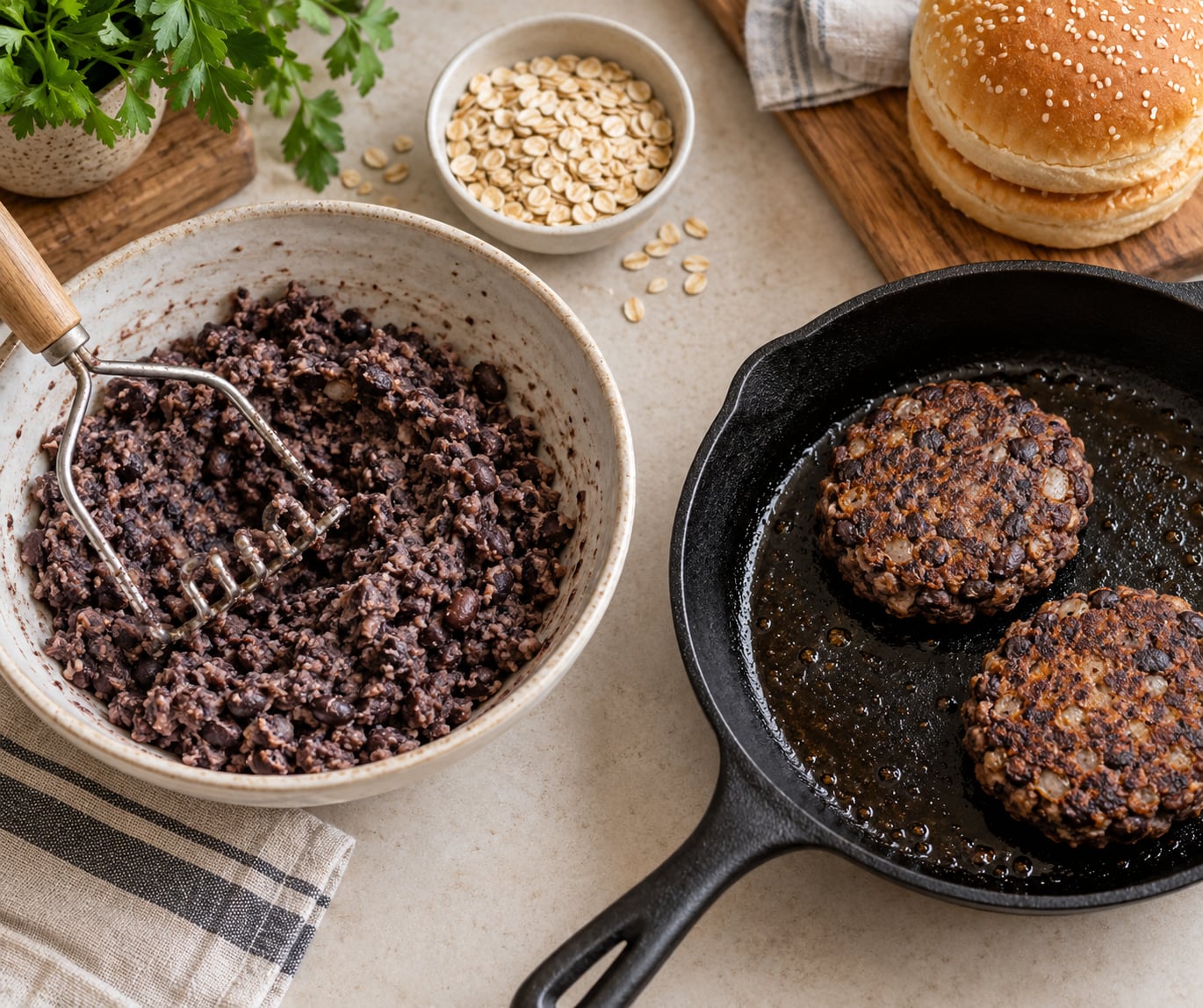
Put the beans in a bowl and mash roughly half of them with a potato masher. You are not making hummus. Leave plenty of whole beans, because those whole pieces are what gives the patty texture and something to grip when heat hits.
If you use a food processor, pulse in short bursts and stop early. Over-processing is the most common self-inflicted wound here, and it is very hard to undo.
3. Add Binder and Seasoning
Mix in the oats, panko, onion, garlic, salsa and spices. Fold with your hands until no dry pockets remain and the mixture clumps when you squeeze it. Then rest the bowl in the fridge for 20 to 30 minutes.
That rest is where the oats drink up moisture and the flax gel firms. Breadcrumbs and oats are the two fixes most home cooks land on first, and they work because they absorb rather than add water.
4. Shape Patties That Hold Together
Chill the mixture, not the formed patties. Portion about 1/3 cup per patty and press firmly with the heel of your hand, compacting from the outside in until the disc is dense and about 3/4 inch thick. A quick thumb press in the center keeps the middle from ballooning.
Free-hand patties are fine if you press hard. A ring mold gives you a uniform edge and even thickness, which is what stops the thin spots from tearing first. Thinner patties are always more fragile, so resist the urge to make them restaurant-flat.
5. Sear Until Firm, Then Flip
Heat a tablespoon of oil in a cast iron skillet over medium-high heat. Lay the patties down and press each one flat for a few seconds so the crust anchors. Leave them alone for 3 to 4 minutes.
When the edges look set and the patty resists a gentle nudge, slide two forks under the far edge, get underneath with the spatula, and turn it in one confident move. Wiggle test, then flip. Repeated testing is what breaks patties.
How to Keep the Patties From Cracking
Cracking comes from structure, not from heat. A patty holds together when there are whole bean pieces to bridge gaps, enough binder to fill the spaces between them, and just enough moisture for the starches to gelatinize into a soft gel. Dry out the beans, use the full 3/4 cup of oats, and the patty will feel like dough when you press it.
The opposite mistake is just as common. Push the binder too far and you get a patty that is pale, dry and crumbly, and it will shed crumbs onto the grill rather than break cleanly. Judge by feel: a squeezed handful should hold its shape and leave a slight dent in your palm, not crumble and not squish.
Finally, let the patty firm before it meets heat. The chill firms the mixture so it survives heat shock, and heat is when the structure is tested. A patty that is fragile cold rarely survives a searing hot skillet.
How to Tell When the Burgers Are Cooked
Look at the outside and cut one open. You want a browned, crisp crust, set edges, and an interior that is hot all the way through with no cold center and no raw bean taste at the core. Press the thickest part gently; a finished patty springs back slightly rather than feeling doughy.
Because there is no meat to check, cook the patties through rather than to a specific temperature, and follow current local guidance for plant-based patties. Most home cooks land on 3 to 4 minutes per side in a skillet, or 20 to 25 minutes in a 425°F oven with one flip halfway.
For the grill, go medium-high over indirect heat and keep the lid closed until the last flip, so the patty cooks through instead of only coloring.
Common Mistakes
- No binder at all. Beans alone cannot bridge into a patty. Add 3/4 cup of oats or oat flour per two cans.
- Beans not dried. Rinsed beans still hold water. Blot them on a towel or roast them for 20 minutes at 350°F.
- Over-mashing. Puree turns the mix into paste that spreads in the pan. Leave half the beans whole.
- Loose shaping. A patty that compresses when you set it down cannot hold on a spatula. Press firmly and compact the edges.
- High heat before the patty firms. Very hot pan plus a soft patty equals a torn burger. Medium-high gives the binder time to set.
- Flipping too early. If the edges are pale and soft, the patty is not ready. Wait for a set edge and a browned top.
- Wiggling with a spatula. Test once, then turn in a single motion with forks and a spatula working together.
- Chilling formed patties. Condensation on the surface adds moisture back. Chill the mixture in the bowl, then shape.
Home cooks often report the same pattern: the patty holds together fine cold and falls apart the moment it heats up. That is heat shock, not a bad recipe. Press the patty denser than feels right, make them three-quarters of an inch thick instead of a quarter inch, and give the pan a minute to warm up rather than screaming hot.
Frequently Asked Questions
What is the best binder for black bean burgers that hold together?
Oats or oat flour are the best all-round binder: about 3/4 cup per two 15-ounce cans. They absorb moisture without changing the flavor and they do not go gummy. Panko or plain breadcrumbs add more structure and a crisper crust. For a vegan patty, use a flax egg (1 tablespoon ground flaxseed plus 3 tablespoons water, rested 10 minutes). Cornstarch works but needs more of it, and egg alone often leaves a patty that is rich but fragile.
How long should I chill black bean burger patties before cooking?
Chill the mixture in the bowl for 20 to 30 minutes, then shape and cook straight away. Most home cooks were told to chill formed patties for 30 minutes, and that advice is backwards: condensation on the surface puts moisture right back onto the patty. If you must refrigerate formed patties, pat them dry with a paper towel before cooking and give them a longer sear.
Can I make black bean burgers ahead of time?
Yes, and the make-ahead mix is the better version. Mix everything except the oil, cover the bowl, and refrigerate for up to three days. Shape from the chilled mixture right before cooking. Formed raw patties keep about two days refrigerated, separated on parchment. For longer storage, freeze them in a single layer until firm, then move to a bag or container and cook from frozen with a few extra minutes.
Why do my black bean burgers fall apart when I flip them?
Three things cause it: the mixture was too wet, it was too loose to begin with, or you flipped before a crust formed. Wet beans are the most common cause, so dry them properly first. Pack the patty firmly so it holds together in your hand. Then wait until the edges set and the top browns before turning it, and flip in one motion with two forks under a wide spatula.
Can I cook black bean burgers in an air fryer?
Yes, and air frying is the gentlest way to cook them. Set the air fryer to 400u0026deg;F, place the patties in a single layer with a light spray of oil, and cook for 6 to 7 minutes. Flip with a spatula, then cook another 5 to 6 minutes until the edges are crisp and the center is hot. Check the thickest one by cutting it open before serving.
How long do cooked black bean burgers last in the refrigerator?
Cooked patties keep for three to four days in the fridge, stored in a sealed container on a plate. Cool them fully before closing the container so no condensation forms on the crust. Reheat in a dry skillet over medium heat for two minutes per side, or in the oven at 350u0026deg;F for about 10 minutes, which keeps the crust from going soft.
If you only change one thing this time, dry the beans. It takes five minutes, it costs nothing, and it is behind more failed bean burgers than any other step. Once they are dry, mash halfway, add the full measure of oats, rest the mixture 20 minutes and press the patties firmly.
Then leave them alone in the pan. A burger that holds together starts with dry beans and ends with the patience not to flip it until the crust says so.