To cook a great steak in a cast iron skillet, take the meat out of the fridge 30 to 45 minutes early, pat it completely dry, season it heavily with kosher salt and pepper, and lay it into a preheated cast iron pan with a high-smoke-point oil. Sear without touching it, butter baste the second side, then rest the steak 5 to 10 minutes before slicing.
That whole method takes about 45 minutes of active work for a single 1 to 1.5 inch steak, and it is far more forgiving than it looks. The cast iron does the hard part: it holds and radiates heat like nothing else on a home stovetop, so the entire face of the pan is searing hot the moment the meat lands on it. Your job is mostly prep, restraint, and a thermometer.
Table of Contents
- What You Need
- Equipment
- Ingredients
- Step-by-Step: How to Cook Steak in a Cast Iron Skillet
- 1. Choose and Prepare the Steak
- 2. Heat the Cast Iron Skillet
- 3. Sear the First Side
- 4. Flip and Cook to the Right Doneness
- 5. Rest and Slice the Steak
- Cast Iron Steak at a Glance
- Common Mistakes and Tips
- Frequently Asked Questions
- How long do you cook a 2 inch thick steak in cast iron?
- Do you use butter or oil for cast iron steak?
- Is 400 degrees hot enough to sear a steak?
- What is the minimum internal cooking temperature for a sirloin steak?
- What is the 3-3-3 rule for steaks?
- Why does my steak stick to a seasoned cast iron pan?
- Conclusion
What You Need
You need very little. A cast iron skillet, a decent instant-read thermometer, coarse salt, and the steak.
Equipment
- A cast iron skillet, ideally 10 to 12 inches, heavy enough that you can lift it with one hand and use the same pan for searing and the butter baste. Any well-seasoned pan works, even a thin one, though sear times run shorter.
- An instant-read thermometer. This is the single tool that turns guesswork into control. Insert it from the side into the thickest part, never through the top where the read can be skewed by the crust.
- Paper towels and a plate for the rested steak. A wire rack set over a baking sheet is better if you have one; it lets air circulate under the meat so the bottom crust does not steam.
- Tongs or a spatula with a broad, thin edge for a clean flip, plus a spoon for basting and a pair of dry oven mitts.
Ingredients
- The steak. Ribeye, New York strip, sirloin, and filet all work. A ribeye has more fat and more forgiveness; a filet cooks in a fraction of the time and has no fat of its own to protect it.
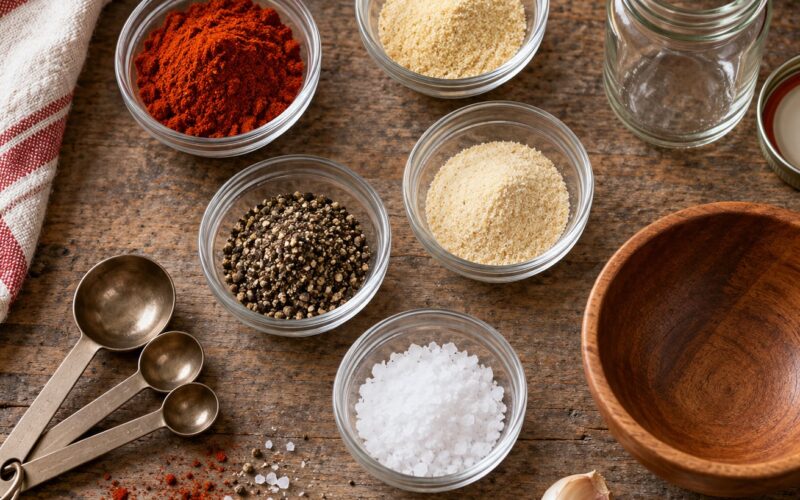
- Kosher salt, roughly 1 teaspoon per pound of beef, applied on both sides. Regular table salt is about half as dense, so you would need roughly double.
- Coarse ground black pepper. Fine pepper burns in a hot pan. Grind it just before seasoning if you can.
- A high-smoke-point oil for the sear: 1 to 2 tablespoons of avocado, canola, grapeseed, or vegetable oil, or 1 tablespoon of ghee.
- Unsalted butter, 2 to 3 tablespoons, plus 2 or 3 smashed garlic cloves and 2 or 4 sprigs of fresh rosemary for the baste. The butter is optional, but it is where the flavor lands.
On the oil, the only real requirement is that it does not burn before the steak hits. Avocado and canola both smoke around 400F, which is above the temperature a good sear needs. Ghee handles heat better than butter because the milk solids are already gone. Regular extra virgin olive oil smokes closer to 375F, so if that is your only oil, use less of it, keep the heat a notch under high, and accept a slightly gentler crust.
Substitutions are easy here. A stainless skillet cooks a thinner steak fine if you shorten each side by a minute. Any oven-safe skillet does double duty, which is exactly what you want for a thick ribeye. And if your steak is not dry brined, seasoning it 15 to 20 minutes before the pan goes on is enough for the salt to work into the surface.
Step-by-Step: How to Cook Steak in a Cast Iron Skillet
Set the pan on the burner and let it heat while you prep the meat, not after. That order is the whole trick: by the time you are ready to season, the pan has been heating for several minutes already.
1. Choose and Prepare the Steak
Pull the steak out 30 to 45 minutes before you plan to cook. A steak straight from the fridge hits a hot pan with a cold center, so the outside overcooks before the inside catches up, which is the single biggest cause of the gray band people complain about.
Thickness matters more than weight. Anything 1 to 1.5 inches thick is the sweet spot for a straight skillet cook, searing on one side and finishing on the other. Past 1.5 inches, a skillet alone will burn the crust long before the center is done, so plan on an oven finish or a reverse sear. That is the one real fork in how to cook steak in a cast iron skillet: the pan replaces both the grill and the oven below 1.5 inches, and you hand the last stretch to a hot oven above it.
Pat the steak dry with paper towels until the surface feels tacky, not wet. Surface moisture has to boil off before browning can start, and while it boils, the temperature at that spot stays under 300F, so you get gray meat instead of a crust. Season both sides immediately afterward, so the dry surface picks up the salt and pepper.
2. Heat the Cast Iron Skillet
Set the skillet over medium-high to high heat and leave it alone for 5 to 10 minutes. Cast iron needs the slow ramp. A quick blast of flame heats the outside of the pan and leaves the center lagging behind, which is how you get a dark streak on one side of the steak and a pale one on the other.
You know it is ready when a drop of water skitters and evaporates on contact, or when a flick of flour browns in a second. Then add 1 to 2 tablespoons of oil and let it shimmer, run, and just stop smoking. A faint haze is fine; a black plume means you are heating in an enclosed kitchen and need the window open and a fan behind you before you continue.
Seasoning the pan again is not necessary for a nonstick result. A well-seasoned cast iron does not need oil to release a steak. It needs oil for flavor and for browning, which is a different job entirely.
3. Sear the First Side
Lay the steak in away from you, away from any steam, and do not touch it. The sound on contact is your confirmation: a loud, immediate hiss means the pan is hot enough. A lazy sizzle means the pan or the steak was not ready.
Leave it for 2 to 3 minutes depending on thickness, and do not move it, do not flip it early, and do not press it. Every lift breaks the crust forming on the surface, and that is how browning ends up stuck to the pan instead of on the meat. You want the edges to look set and slightly darker, and the flat face of the steak to lift on its own when you slide a spatula under it. If it resists, give it another 30 seconds.
The browning happening here is the Maillard reaction, an amino acid and sugar reaction that needs a dry surface and roughly 300F or higher. That is why a dry steak and a hot pan are the same requirement stated twice.
4. Flip and Cook to the Right Doneness
Flip once with tongs or a thin spatula and sear the second side for about 1 to 2 minutes, then start checking temperature. A rule of thumb: thin steaks get roughly 2 minutes per side total, 1.5 inch steaks about 4 to 5 minutes per side, and anything 2 inches thick or more needs help from the oven.
For a steak thicker than 1.5 inches, move the skillet into a 400F oven after the first sear. An insertable thermometer left in the thickest part lets you pull it the moment it hits your target. Thin steaks do not need the oven at all, and putting them in will just dry them out.
Remember that the steak keeps cooking after it leaves the heat. Pull a 1 inch steak about 5F below your target and a 2 inch steak about 10F below, and the carryover will carry it the rest of the way while it rests.
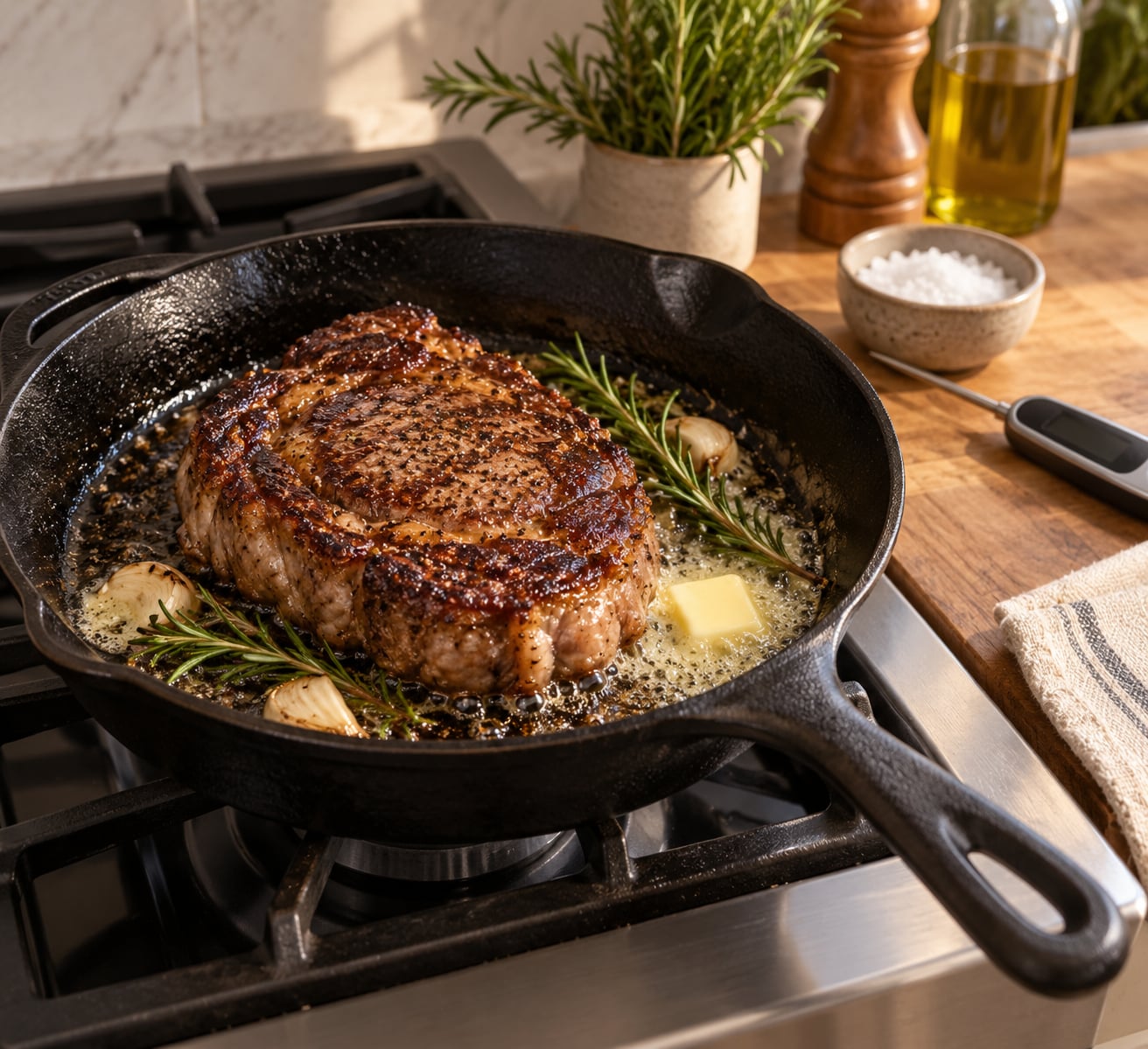
Baste the second side in the last 60 to 90 seconds. Drop in 2 to 3 tablespoons of unsalted butter, 2 or 3 smashed garlic cloves, and a couple of rosemary sprigs, then tilt the pan and spoon the foaming butter over the top as it melts. The butter should foam and brown, not blacken; if it is browning too fast, pull the pan off the heat for a few seconds and keep going.
Food safety note for anyone cooking for other people: USDA guidance for whole cuts of beef is an internal temperature of at least 145F with a rest of 3 minutes. Most cooks pull well before that for taste, and the temperatures in the table below reflect preference, not safety.
5. Rest and Slice the Steak
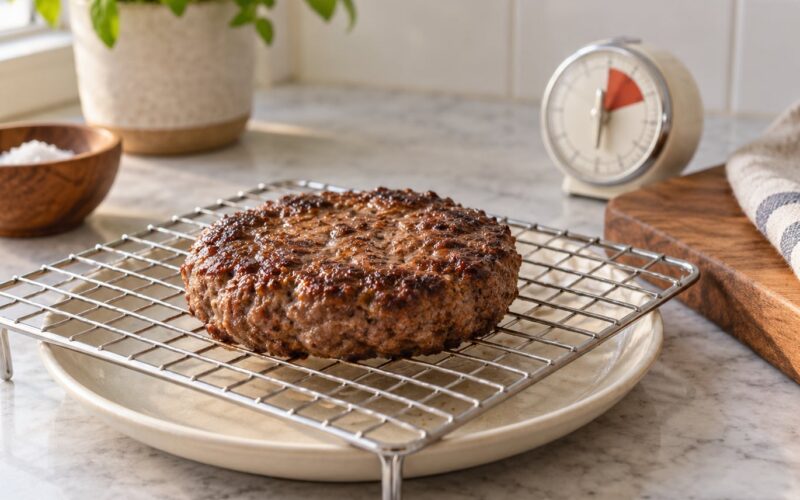
Move the steak to a warm plate or wire rack and wait 5 to 10 minutes. A 1 inch steak needs about 5 minutes; a 2 inch steak needs closer to 10. Resting lets the muscle fibers relax, and a steak sliced too early dumps its juice onto the cutting board instead of staying in the meat.
Cut against the grain. Look at the side of the raw steak or the cooked one and find the direction the fibers run, which is usually the direction the steak is stretched lengthwise. Slice perpendicular to that and the meat is noticeably more tender.
Slice with a sharp knife in a single motion rather than sawing back and forth, which juices out the steak. A pinch of flaky salt on top after resting is the last thing it needs.
Cast Iron Steak at a Glance
The table below pairs the thickness of the steak with the sear time, the temperature to pull at, and the doneness that lands. These are skillet sear times only, and the pull temperatures are already adjusted for carryover cooking.
| Steak thickness | First side | Second side | Pull at | Finishes at | Doneness |
|---|---|---|---|---|---|
| 3/4 inch | 2 minutes | 1 to 2 minutes | 120F | 125F | Medium rare |
| 1 inch | 2 to 3 minutes | 2 to 3 minutes | 125F | 130F | Medium rare |
| 1 inch | 3 minutes | 3 minutes | 130F | 135F | Medium rare to medium |
| 1.5 inch | 3 minutes, then 400F oven | 2 to 3 more minutes, checking temperature | 130F | 135F | Medium |
| 2 inch | 3 minutes, then 400F oven | Until temperature is reached | 135F | 140F | Medium |
| 2 inch | 3 minutes, then 400F oven | Until temperature is reached | 150F | 155F | Well done |
Internal temperature targets, for reference: rare ends around 120 to 125F, medium rare at 130F, medium at 135 to 140F, medium well at 145F, and well done at 155F or above. For a reverse sear, bring the steak to 95 to 100F in a 450F oven, sear 60 to 90 seconds per side in the pan, and pull at 110 to 112F so it coasts up to 118 to 120F.
Common Mistakes and Tips
The crust is gray and the meat is boiled-looking. The steak was wet, or the pan was not hot enough, or both. Pat it dry again, preheat the pan longer, and wait for the oil to shimmer before laying the meat down.
The steak sticks and tears. Almost always the steak moves too early, not that the pan needs more seasoning. Cookers on cast iron forums argue about seasoning constantly, but the honest answer is that a properly heated pan and a dry piece of meat release on their own. If it sticks now, scrape the pieces into the pan sauce later rather than fighting it.
There is a gray band between the crust and the pink center. That is steam: the surface moisture boiled instead of browning. Dry the steak properly, and if you keep seeing it, give the meat a 30 to 40 minute salt pre-treatment in the fridge, which draws surface moisture out ahead of time.
Smoke is pouring off the pan before the steak goes in. The oil is past its smoke point, or you are searing in a hot enclosed kitchen. Use avocado or canola oil rather than butter or extra virgin olive oil for the sear, move the burner down a notch, and open a window before you light the stove.
The outside is charred while the middle is still cold. You went too far with the heat for the thickness. Use the oven finish for anything over 1.5 inches, and if you prefer, do a reverse sear: oven to 95 to 100F at 450F, then a short, hard skillet sear at the end.
The steak is dry inside despite a good crust. You cooked it too long or cut it too soon. Watch the thermometer rather than the clock, pull early to account for carryover, and give it the full rest.
The crust is browning unevenly, dark on one side. The burner is hotter on one side, or the pan was not level. Give the handle a quarter turn at the halfway point of the sear, and cook on a burner matched to the pan diameter so heat spreads rather than pooling.
Two more tips worth having. The 3-3-3 rule cooks a one inch steak for 3 minutes per side to roughly medium, then rests it 3 minutes, which lands close to medium rare for most people. And after cooking, let the skillet cool on the burner for a few minutes, wipe out the fond with a paper towel, and wipe a very thin film of oil over the cooking surface while it is still warm. Cooking a well-seasoned steak will not ruin your seasoning.
Frequently Asked Questions
How long do you cook a 2 inch thick steak in cast iron?
Sear a 2 inch steak 3 minutes per side in the preheated pan, then move the skillet to a 400F oven and cook until an instant-read thermometer hits your target. Pull at 135F for medium and let carryover bring it to 140F. A straight skillet cook on a 2 inch steak burns the crust long before the center cooks, so the oven finish is not optional at that thickness. Rest it 10 minutes before slicing.
Do you use butter or oil for cast iron steak?
Use a high-smoke-point oil for the sear and butter only for the baste at the end. Butter contains milk solids that burn at searing temperature, so it goes in after the crust is already formed, during the final 60 to 90 seconds on the second side. Avocado, canola and grapeseed oil all hold up fine in a ripping hot cast iron pan. Ghee works too, since the milk solids are already removed.
Is 400 degrees hot enough to sear a steak?
For a cast iron skillet sear, yes, 400F is plenty hot, and cast iron actually needs a 5 to 10 minute preheat to get there. A searing pan browns steak at roughly 350F to 450F at the surface, so a hot oven at 400F is in the right range for a reverse sear or an oven finish on a thick cut. What is not enough is a lukewarm pan, which gives you a gray band instead of a crust.
What is the minimum internal cooking temperature for a sirloin steak?
USDA guidance for whole cuts of beef, sirloin included, is 145F internal with a 3 minute rest. Most home cooks pull sirloin much earlier for taste, around 125F to 130F for medium rare, and rest it 5 to 10 minutes. When you cook for someone who wants it well done, the difference is 20 to 25F and a few extra minutes, not a different technique.
What is the 3-3-3 rule for steaks?
It is a timing shortcut for a 1 inch steak: 3 minutes per side in a very hot cast iron skillet, then a 3 minute rest. That combination lands close to medium, or around 130F, which most people describe as medium rare once the carryover finishes during the rest. It is a useful starting point, not a rule, since burner output and pan weight change the sear time considerably. A thermometer still wins.
Why does my steak stick to a seasoned cast iron pan?
Heat and moisture, not seasoning, cause sticking. If the pan was not hot enough, or the steak surface was wet, the meat sears to itself instead of the pan and tears when you flip it. Preheat the skillet 5 to 10 minutes, pat the steak dry, and wait until the oil shimmers. Also leave the steak alone for the full sear time, since lifting it early breaks the crust that is forming underneath.
Conclusion
How to cook steak in a cast iron skillet comes down to three things: a hot pan, a dry steak, and a thermometer. Start with the pan, not the meat. Put the cast iron over medium-high to high heat and give it a full 5 to 10 minutes, then take the steak out, dry it thoroughly, and season both sides while the skillet is still heating. Everything after that is timing: 2 to 3 minutes a side without touching it, butter baste at the end, and a 5 to 10 minute rest. Pull the steak 5 to 10F below your target and let carryover cooking finish the job.