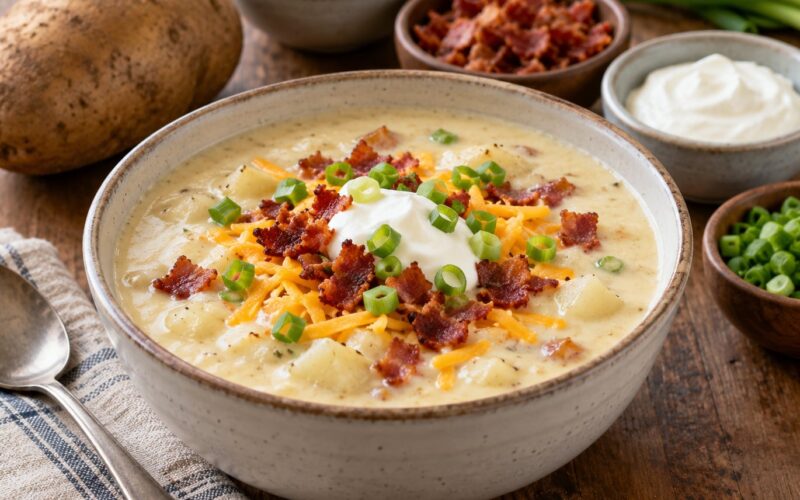
If you want a bowl thick enough to stand a spoon in, learn how to make broccoli cheddar soup by browning the broccoli first, building the base with a butter-and-flour roux, and stirring in a large amount of grated cheddar with the pot off the heat. From cold cutting board to first ladle it takes about 35 minutes, all in one pot.
The reason most home attempts come up short is thickness and texture, not flavor. Soup that simmered without a roux tastes thin no matter how much cheese you add, and bagged pre-shredded cheese leaves a sandy grit that no amount of simmering fixes.
Last updated October 2026.
Table of Contents
- What You Need
- Equipment and substitutions
- Step-by-Step
- How to Make Broccoli Cheddar Soup
- Common Mistakes
- Frequently Asked Questions
- How can I make broccoli cheddar soup thicker without adding more cheese?
- Can broccoli cheddar soup be made ahead?
- Can broccoli cheddar soup be frozen?
- What cheese works best for broccoli cheddar soup?
- What can I serve with broccoli cheddar soup?
- Conclusion
What You Need
This makes about 6 servings. Everything comes from a standard grocery run, and the only equipment you truly need is a pot with a lid and a box grater or microplane.
- 12 oz broccoli florets, cut into bite-size pieces (about 4 cups)
- 1 large sweet yellow onion, diced small
- 2 carrots, peeled and diced small
- 2 celery stalks, diced small
- 3 tablespoons unsalted butter, divided
- 3 cloves garlic, minced
- 1/4 cup all-purpose flour (about 30 grams)
- 2 cups low-sodium chicken stock, plus more if you like it thinner
- 2 cups whole milk or half-and-half
- 4 oz extra-sharp cheddar cheese, freshly grated (about 1 1/2 cups)
- 1 teaspoon Dijon mustard
- 1/2 teaspoon smoked paprika
- 1/2 teaspoon dry mustard powder
- Salt and white pepper to taste
- Pinch of cayenne and grated nutmeg (optional)
For serving: homemade croutons, an extra handful of grated cheddar, black pepper, and a drizzle of olive oil. The Dijon and the croutons are what push this from a decent bowl toward the restaurant version, and both take five minutes.
Equipment and substitutions
A 4-quart stock pot or Dutch oven is the right size. A lid matters more than people expect, because the soup needs to hold a gentle simmer for the last stretch, and an uncovered pot keeps trying to boil.
An immersion blender is genuinely useful here. It lets you purée right in the pot and leaves some texture, so the soup reads as blended vegetable soup rather than a bowl of loose florets. A regular blender works fine, just work in batches and vent the lid, because hot soup expands fast.
Pre-shredded cheese is the one substitution to skip. Bagged cheese carries anti-caking agents, usually cellulose, that keep the shreds from sticking together in the bag, and that same coating is what makes your soup gritty. Four ounces of block cheddar grated by hand melts smooth and costs less per cup.
Frozen broccoli works fine. Thaw it first or add it straight from the freezer and cut about 5 minutes off the simmer. Vegetable broth instead of chicken stock makes it vegetarian, and a Russet potato or cauliflower blended into the base thickens without any flour at all.
Step-by-Step
Read through the whole thing once before you start. The order matters: the broccoli browns first, the roux cooks in the same pot, and the cheese goes in at the very end.
- Cut everything to the same size. Dice the onion, carrot and celery to about the same 1/4-inch piece as the broccoli florets. Uniform cuts mean everything finishes cooking together instead of leaving carrot chunks in a bowl of mushy broccoli.
- Sizzle the broccoli in a dry pot. Set your 1 tablespoon of butter in the pot over medium-high heat, add the broccoli, and leave it alone for 3 to 4 minutes until the edges take on brown spots. Crowding steams instead of browns, so use a 4-quart pot and do this in two batches if your broccoli is shy on space.
- Pull the broccoli out. Transfer it to a plate. You are leaving the browned bits in the pot, which is where the flavor ends up.
- Cook the aromatics in the remaining 2 tablespoons of butter. Drop the onion, carrot and celery into the same pot with the fond and cook 5 to 6 minutes until soft and starting to color. Add the garlic for the last 30 seconds and stir, so it does not scorch.
- Make the roux. Sprinkle the flour over the vegetables and whisk constantly for 1 minute until everything looks dry and slightly pasty, about the color of sand. Cook it another minute. That extra minute is what removes the raw flour taste, and skipping it is the reason homemade soup tastes dusty.
- Add liquid slowly. Pour in the chicken stock a little at a time, whisking after each pour to keep the roux loose. Once the broth is in, add the half-and-half or milk, then stir in the Dijon, smoked paprika and dry mustard. Bring the pot up to a low simmer, where you see occasional small bubbles and never a rolling boil.
- Simmer and thicken. Cook uncovered at a steady simmer for 15 to 20 minutes, stirring every few minutes so the bottom does not catch. The soup thickens noticeably in the last 5 minutes as water cooks off. Return the broccoli for the final 3 minutes so it stays bright green and just tender.
- Blend part of it. Immerse the blender and pulse a few times in the middle of the pot, leaving plenty of whole florets behind. For a fully silky bowl, puree the whole thing and return it to a low heat.
- Add the cheese off the heat. Kill the burner, wait 30 seconds, then stir in the grated cheddar a cup at a time, letting each addition melt before the next. Season with salt, white pepper and a pinch of cayenne or nutmeg.
- Ladle and finish. Ladle into bowls, scatter with croutons, extra cheddar and black pepper, and drizzle a little olive oil over the top.
How to Make Broccoli Cheddar Soup
Three numbers do most of the work here. The first is the roux ratio: 1/4 cup of flour for every 2 cups of liquid. That gives you a body you can loosen at the end with a splash of stock, which is far easier than trying to rescue thin soup later. The second is the 15 to 20 minute simmer, long enough for the starches in the roux to swell and for the broth to concentrate, short enough that you still taste the individual vegetables.
The third is temperature. Milk proteins begin to tighten and squeeze together somewhere around 180°F, which is what turns smooth cheese sauce into grainy curds. You do not need a thermometer. If you see a rolling boil or big breaking bubbles after the dairy goes in, it is too hot, and no amount of whisking will bring the texture back.
For a thinner, brighter soup, blend only a third of the pot. For the Panera-style bowl, blend most of it and leave a few florets for texture. That version also leans harder on a sharp-forward cheese blend, white pepper, mustard and croutons on top.
One more detail: the broccoli stalks. Peel the tough outside, slice the pale core thin, and add it with the carrots. It sweetens as it simmers and costs you nothing.
Common Mistakes
Six things go wrong with broccoli cheddar soup, and every one of them has a fix.
The soup is watery. There was no roux, or not enough of one. You cannot thicken a finished bowl by adding more cheese, because cheese adds flavor and fat but barely any body. Fix thin soup with a slurry instead: whisk 1 tablespoon of cornstarch with 2 tablespoons of cold water or cold milk, pour it in, and simmer 3 to 5 minutes. One tablespoon of cornstarch per cup of thin soup gets you to a spoon-coating consistency.
It tastes like weak cheese. Usually two causes: the cheese went in too early and lost its punch, or the soup is over-salted by the stock and your palate reads that as flat. Use low-sodium stock, season with the salt and pepper at the end rather than the start, and add the cheese after you have tasted the base on its own.
The texture is gritty or grainy. That is bagged pre-shredded cheese, whose anti-caking agents refuse to melt into the liquid. Shred your own from a block, or melt the cheese in a bowl with a splash of hot broth first and stir that in.
Cheese clumps into strings. The soup was too hot when the cheese went in. Pull the pot off the heat, wait 30 seconds, and add the cheese in smaller batches, stirring fully between each one.
The broccoli is mushy and dull green. It cooked too long, or it went in before the liquid and simmered for the full 20 minutes. Add it back for the last 3 to 5 minutes, and keep the simmer gentle. Broccoli that is just tender still snaps.
It reduced too far. Twenty minutes of uncovered simmering at a hard boil turns the soup into something you cannot ladle. Whisk in warm stock or half-and-half a quarter cup at a time until it pours and still holds a little shape on the spoon.
A note on leftovers: cooked soups keep in the fridge for 3 to 4 days in a sealed container, not the five to seven days that circulates online. Reheat on the stove over low heat with a splash of stock, stirring until the cheese comes back together. The microwave reheats unevenly and pushes the soup past the point where the cheese stays smooth.
Frequently Asked Questions
How can I make broccoli cheddar soup thicker without adding more cheese?
Cheese adds flavor and fat but very little body, so thickening comes from starch. Whisk 1 tablespoon of cornstarch with 2 tablespoons of cold water or milk, stir it into the simmering soup, and cook 3 to 5 minutes until it coats the back of a spoon. You can also simmer the soup uncovered for another 5 to 10 minutes to cook off water, or purée more of the vegetables to release their starch.
Can broccoli cheddar soup be made ahead?
Yes, and it reheats well. Make it up to 2 days ahead, cool it quickly, and refrigerate it in a sealed container. Broccoli keeps its color and texture better than most vegetables in a make-ahead soup, so this is an easy dish to cook for a crowd. Reheat slowly on the stove with a splash of stock, and add fresh croutons at the table so they stay crunchy.
Can broccoli cheddar soup be frozen?
You can freeze it for up to 3 months in an airtight container with a little headroom. Thaw it overnight in the fridge rather than in the microwave, then warm it on the stove with extra stock, stirring often. The cheese sauce smooths back out and the texture is close to fresh, though the broccoli softens more than it does on the stove, so freeze it slightly under-cooked if you can.
What cheese works best for broccoli cheddar soup?
Extra-sharp cheddar grated from a block is the standard. Sharp blocks have less moisture and more flavor than mild, so you need less of them and they melt without turning the soup greasy. Gruyere or Swiss adds nuttiness, and a small amount of Parmesan sharpens the flavor further. Avoid pre-shredded bagged cheese, since the anti-caking agents leave a gritty texture in hot liquid.
What can I serve with broccoli cheddar soup?
Croutons are the classic choice, and homemade ones beat store-bought because you control the butter and the salt. A hunk of crusty sourdough or a warm dinner roll works just as well for scooping. A side salad with a sharp vinaigrette cuts the richness, and a hard-boiled egg or crisp bacon on top turns the bowl into a full meal on its own.
Conclusion
The whole recipe comes down to two decisions: brown the broccoli and cook a proper roux for enough time, then keep the dairy off the heat so the cheddar melts instead of seizing. Start there and the rest is seasoning.
Do the first two things next time you make it. Get the florets browned in a dry pot before anything wet goes in, cook the flour and butter for a full minute, and add the cheese in two batches with the burner off. If the soup still feels thin at the end, a cornstarch slurry fixed in cold water will get you to the thickness you want without another ounce of cheese.