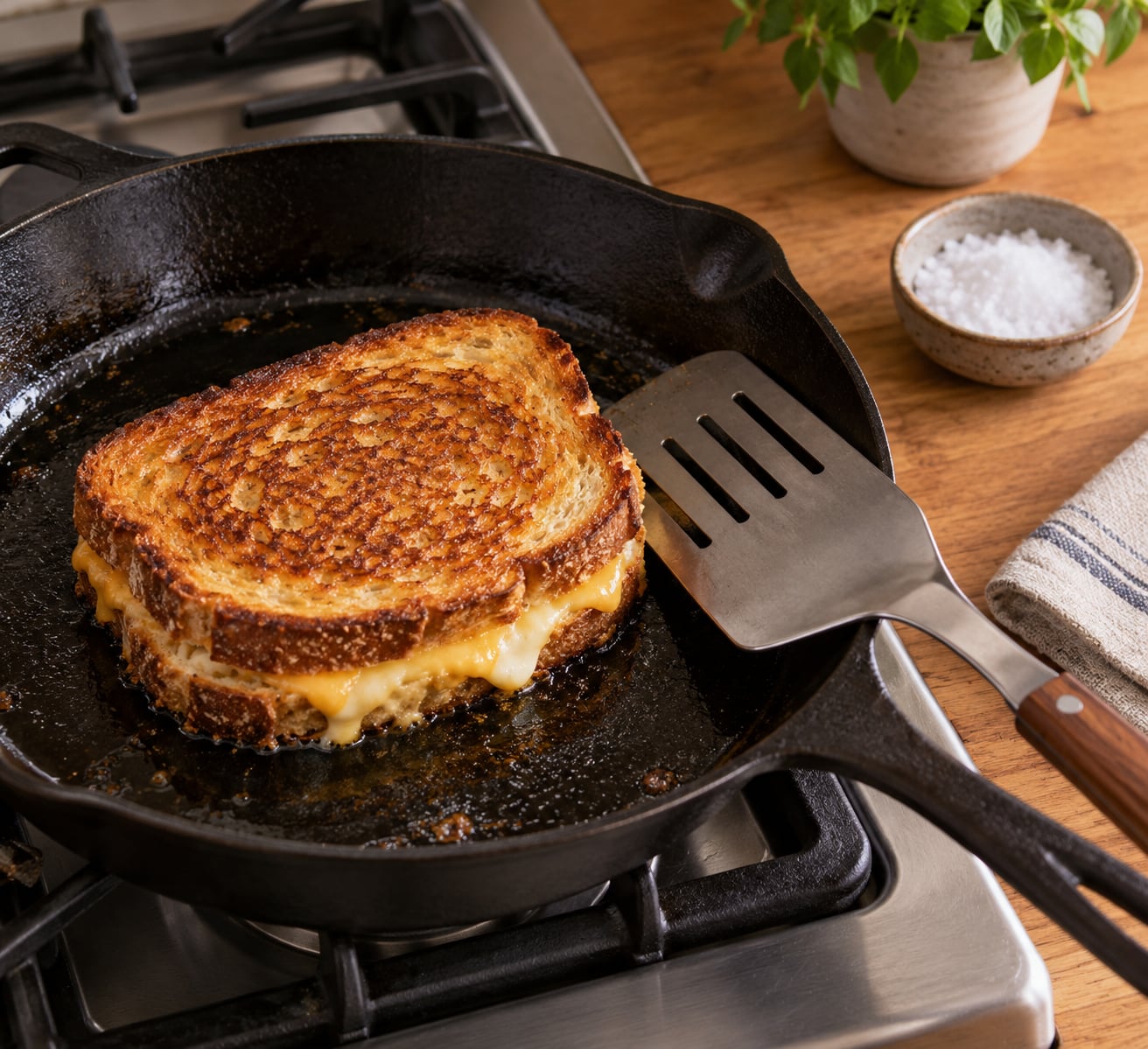
How to make a grilled cheese with crispy edges comes down to three things: fat on the outside faces of the bread, medium-low heat, and a firm press at the seam. Do all three and you get a sandwich that shatters when you bite it, with cheese that has melted all the way to the middle. Ten minutes start to finish.
The reason most home grilled cheeses disappoint isn’t ingredients, it’s heat. A hot pan browns the bread in about a minute and leaves the cheese in a cold slab in the middle. Slower heat browns the crumb at the same pace the cheese softens, which is why the good ones come off the heat looking evenly golden rather than dark outside and raw inside.
Table of Contents
- What You Need
- Step-by-Step: How to Make a Grilled Cheese with Crispy Edges
- Choose the Bread and Cheese
- Butter the Outside, Not the Inside
- Start at Low-to-Medium Heat
- Press and Flip for a Golden Crust
- Common Mistakes
- Frequently Asked Questions
- What type of cheese melts best for a grilled cheese?
- Why are the edges of my grilled cheese not getting crispy?
- Should I butter the outside or inside of a grilled cheese?
- What heat setting makes grilled cheese edges crispy?
- Can I make a grilled cheese in a sandwich press?
- How do I keep a grilled cheese from getting soggy?
- Conclusion
What You Need
The ingredient list is short. Everything that matters is in the pan and the bread.
- Bread: two slices per sandwich. Thick-cut sourdough, Texas Toast, or a sturdy white loaf. Anything thin and floppy tears when you flip it.
- Cheese: two to four slices, or about 60 to 90 grams grated. Sharp cheddar, Gruyere, Monterey Jack, mozzarella, or provolone all melt reliably.
- Fat: butter, mayonnaise, or a neutral oil for the outer faces. Butter gives flavour, mayonnaise gives colour.
- A pan: nonstick or cast iron skillet, a griddle, or a grill plate. A lid is genuinely useful.
- A spatula: wide enough to slide fully under the sandwich without tearing the crust.
- Coarse salt: a small pinch for the pan, which does more for edge crispness than anything else on this list.
A stand mixer isn’t required. A salt shaker is. If you’re making more than one sandwich, a wire rack in the oven at 200°F keeps them crisp while the rest cook, which a plate never will.
Step-by-Step: How to Make a Grilled Cheese with Crispy Edges
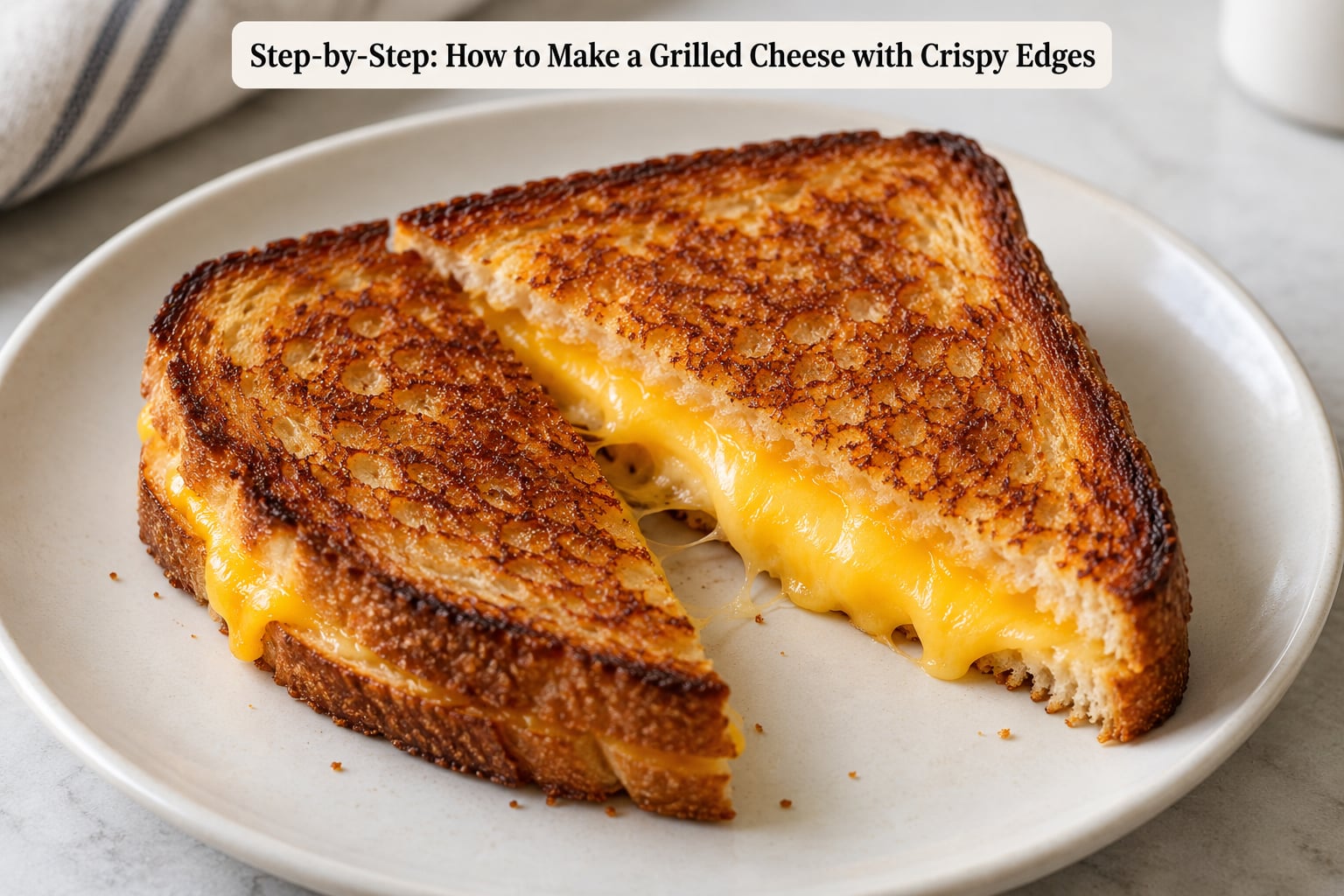
Read all six steps before you turn on the burner. The order matters more than the timing.
- Coat the outside faces. Butter or mayo the two sides of bread that will touch the pan. Do this before the pan heats. Fat on a cold slice spreads evenly; fat slid on in a hot pan tears the crumb.
- Build the sandwich. Put one slice butter-side down, add the cheese, then the second slice butter-side up. Cheese reaching the very edge is fine. It will shrink as it melts and pull in from the seam.
- Heat the pan gently. Medium-low for a normal skillet. You want a lazy sizzle, not a hiss. Cast iron and a griddle run hotter, so go a notch lower there.
- Salt the pan, then lay the sandwich in. A pinch of coarse salt scattered on the dry surface before the bread goes down seasons the crust and draws a little moisture out of the surface starch.
- Cook the first side 3 to 4 minutes. Press lightly with the spatula every minute. When the bottom is deep gold and you can smell butter rather than smoke, put a lid on for 60 to 90 seconds to finish the melt.
- Flip, press, repeat. Another 2 to 3 minutes on the second side. Rest one minute before cutting, then slice on the diagonal.
How do you know it’s done without a thermometer? The crust is a solid golden brown, the cheese has slumped flat rather than sitting in a mound, and a nudge with the spatula makes the whole sandwich move as one piece. If the cheese still has shape, give it another 30 seconds under the lid.
Choose the Bread and Cheese
Bread thickness decides your cook time. Standard sandwich bread finishes in about 2 minutes a side. Sourdough or Texas Toast need 3 to 4, and they’re the better pick for crispy edges because the open crumb browns faster and holds up under the press.
For cheese, the useful question is melt behaviour, not flavour. Aged and hard cheeses such as cheddar and Gruyere melt, but slowly, and they need the lid. Provolone, mozzarella, and Monterey Jack melt fast and smooth. If your cheese is pre-shredded, expect a weak melt and a greasier sandwich; the anti-caking agents that stop the shreds clumping in the bag also resist melting in the pan. Block cheese grated yourself melts better and runs less.
Two slices per sandwich is right for standard bread. Thick-cut slices need only two, since the cheese layer has to fit between them without squeezing out.
Butter the Outside, Not the Inside
Fat goes on the faces that touch metal. That’s the whole point. Mayonnaise wins on colour because it browns faster than butter and holds a higher smoke point, so it won’t catch and blacken before the cheese melts. Butter wins on taste and is more forgiving at low heat, since it won’t scorch if the pan is too warm.
Olive oil is the third option. It gives the least flavour of the three but browns well and is a reasonable pick for a hot cast iron or an outdoor griddle where butter can scorch.
| Fat | Smoke point | Browning result | Best for |
|---|---|---|---|
| Butter | Low | Rich golden, even | Flavour-forward, medium-low heat |
| Mayonnaise | High | Deep golden, fastest | Maximum colour, hotter pan, cast iron |
| Olive oil | High | Clean golden | Griddle, outdoor grill, batch cooking |
| Herb butter | Low | Golden with flecks | Rosemary, thyme, garlic, or lemon zest mixed in |
Start at Low-to-Medium Heat
Medium is the ceiling for most kitchens. High heat buys you a dark crust in ninety seconds and leaves the centre of the cheese firm. Medium-low buys you an even gold over three to four minutes with a full melt underneath.
If your first sandwich browns before the cheese softens, drop the heat rather than shortening the cook. There is no quick fix for an already-darkened face other than starting cooler next time.
Press and Flip for a Golden Crust
Use the spatula for contact, not force. Press once at the four corners, then run it along the seam, where the sandwich is thickest and the crust is weakest. That seam press is the step that separates a crisp-edged grilled cheese from a merely toasted one.
Flip with confidence in one motion, sliding the spatula well under the front edge first. A slow, hesitant lift drags the bread. If a sandwich has thin slices, use two spatulas or a plate and flip it over in one go.
The lid is the finishing move. Put it on for the last 60 to 90 seconds of each side. Steam condenses on the lid and falls back onto the top slice, and the trapped heat gets the cheese to melt without extra pan time.
Common Mistakes
Every disappointing grilled cheese falls into one of a few buckets, and each has a specific fix rather than a vague instruction to cook it lower.
| Problem | Cause | Fix |
|---|---|---|
| Pale, floppy edges | Steam trapped under the top slice softens the crust | Press along the seam, lift the top slice slightly for 10 seconds to vent, then finish uncovered |
| Burnt face, cold centre | Pan too hot; cheese never caught up | Medium-low heat, then put the lid on for 90 seconds instead of turning it up |
| Cheese never melts in the middle | Not enough time under heat, or too many thick slices | Lid on, give it another 60 to 90 seconds, or slice the cheese thinner |
| Greasy sandwich | Too much butter, or cheese leaking into the pan | Use a thin coat, keep the heat moderate, and stop once the crust is gold |
| Cheese melts out the sides | Overfilled, or cooked too long at high heat | Two slices of cheese per sandwich and lower heat |
| Bread tears on the flip | Slices too thin or floppy | Thicker bread, or flip using a plate instead of a spatula |
The soggy-edge problem deserves one more line, because it’s the most common one. Steam from the melting cheese has nowhere to go once the top slice is on. It condenses on the underside of that slice and softens the crust from the inside, which is why a sandwich that looked great in the pan goes limp on the plate. Venting mid-cook or resting uncovered fixes it.
To keep a finished sandwich crisp, rest it one minute on a wire rack rather than a plate, cut it, and serve it as a single layer with nothing stacked on top. A folded napkin under the bottom slice wicks residual grease without softening the crust.
Good pairings: a cup of tomato soup, a small plate of dill pickles, a sharp arugula salad with lemon dressing, or a hard cider. A stout or a Sauvignon Blanc both handle the salt and fat without overwhelming the cheese.
You can assemble sandwiches ahead and refrigerate them for up to a day, unbrowned. Cook them straight from the cold, adding a minute to the first side. To reheat, use a dry skillet over medium-low rather than a microwave, which heats the bread unevenly and leaves the crust rubbery.
Frequently Asked Questions
What type of cheese melts best for a grilled cheese?
Provolone, mozzarella, and Monterey Jack melt fast and smoothly, which is why they suit a short cook. Sharp cheddar and Gruyere melt too, but slowly, so they want a lid on for the last minute or two. Skip pre-shredded cheese where you can; the anti-caking agents that stop it clumping in the bag also give a poor melt and an oily sandwich. Block cheese you grate yourself is worth the extra minute.
Why are the edges of my grilled cheese not getting crispy?
Most often it is trapped steam. Moisture from the melting cheese condenses under the top slice and softens the crust from the inside, especially along the seam. Press the seam with your spatula during cooking, lift the top slice briefly to vent, and rest the finished sandwich uncovered on a wire rack. Salting the pan lightly before the bread goes down also dries the surface and helps it crisp faster.
Should I butter the outside or inside of a grilled cheese?
Outside, always. Butter or mayonnaise belongs on the faces that touch the pan, because that is the fat doing the browning. Putting it on the inside leaves you with a dry, pale crust and a greasy middle. Spread it before the pan heats so it coats evenly without tearing the crumb, and use a thin coat rather than a thick one to keep the sandwich from frying.
What heat setting makes grilled cheese edges crispy?
Medium-low on a normal skillet, which takes about three to four minutes per side. You want a lazy, steady sizzle rather than a hiss. Cast iron, a griddle, or an outdoor grill runs hotter than a nonstick pan, so drop the heat a notch there. High heat browns the crust in a minute and leaves the cheese firm in the middle.
Can I make a grilled cheese in a sandwich press?
Yes, and a press gives you an even, compressed sandwich with sealed edges. Preheat it, butter the bread lightly, and cook for about three minutes until the indicator light or the colour tells you the first side is done. Pressing harder is not the answer to pale bread, though. A press browns through contact and pressure, so if the edges stay pale your temperature is too low, not too high.
How do I keep a grilled cheese from getting soggy?
Vent the steam while it cooks and give the crust air after. Lift the top slice slightly for a few seconds near the end of the first side, then rest the finished sandwich uncovered on a wire rack for one minute before slicing. Stacking sandwiches on a plate traps condensation and softens the bottom crust within minutes. Serving them in a single layer solves most of it.
Conclusion
Start by buttering the outside faces of the bread before the pan gets hot, then cook it over medium-low and press along the seam until both sides are deep gold. Rest it a minute on a rack, slice it diagonally, and serve it alone on the plate so the edges stay crackly.