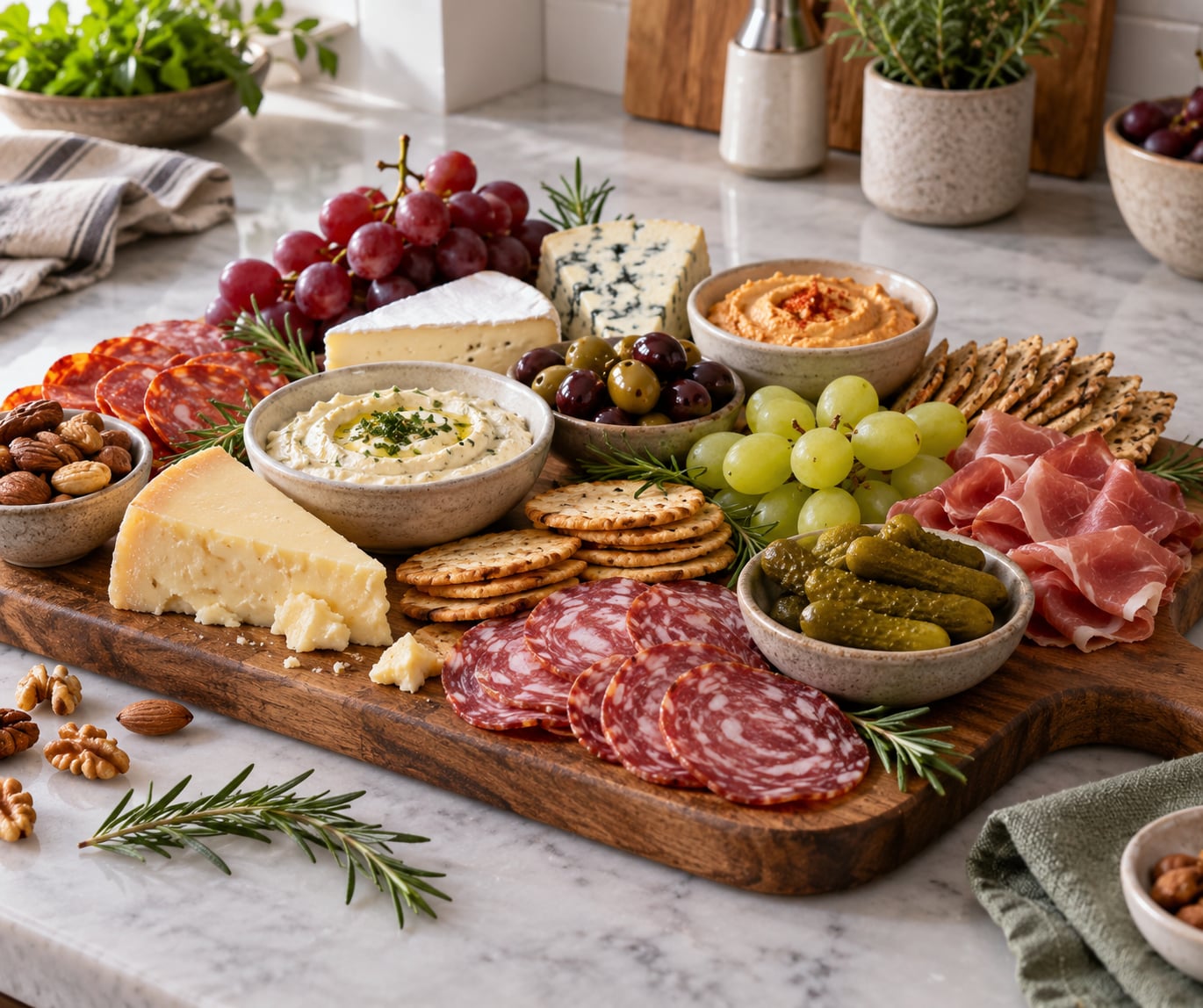
A game day charcuterie board is a no-cook spread of cured meats, cheeses, crackers, dips, fruit and pickles arranged on one large board so guests can graze with one hand while they watch. Building one takes about 30 minutes, most of it slicing, and it lets you stay on the couch instead of shuttling trays from the kitchen. Here is the whole method: what to buy, the order to assemble it in, and how to keep it safe through a long game.
Start with your headcount rather than the board. Six guests need a modest platter, fifteen need something you can barely fit in the oven. Everything below scales from that one number.
Table of Contents
- What You Need
- The shopping list by category
- How much per person
- Step-by-Step: How to Make a Charcuterie Board for Game Day
- How to Choose a Board and Arrange the Food
- How to Build a Balanced Game-Day Spread
- How to Keep Charcuterie Fresh and Safe
- Making it ahead
- Common Mistakes
- Final Tips
- Frequently Asked Questions
- What size charcuterie board do I need for a game-day party?
- How far in advance should I assemble a charcuterie board?
- How long can a meat-and-cheese board stay out at a party?
- What can I put on a charcuterie board instead of meat?
- What dips go best with a game-day charcuterie board?
- Conclusion
What You Need
Beyond the food itself you need very little: one board, two or three small bowls, a cheese knife, tongs or a fork for the pickles, and a stack of napkins. A wooden cutting board, a marble slab and a rimmed sheet pan all work. If you have no board at all, a clean cookie sheet lined with parchment does the same job.
The shopping list by category
Build the board in categories rather than grabbing random items. This list covers cured meats, cheeses, fruit, vegetables, crackers or bread, nuts, pickles, olives, spreads and condiments, and every category has a vegetarian or no-meat swap.
- Meats: sliced salami, prosciutto, coppa, bresaola, pepperoni, or leftover roast beef. Three kinds is plenty.
- Cheeses: one soft (brie or camembert), one hard (cheddar, gruyere or parmigiano reggiano), one sharp or blue. Skip pre-shredded; blocks look better and hold their shape.
- Crackers and bread: sturdy crackers that survive dipping, crostini, or a sliced baguette. Add something gluten free if anyone needs it.
- Fruit: grapes, apple or pear slices, dried apricots, berries.
- Vegetables: snap peas, baby carrots, cucumber rounds, roasted peppers, olives.
- Sweet and crunch: nuts, pretzel pieces, dark chocolate squares, fig jam, honeycomb.
- Dips: hummus, mustard, fig preserves, a soft cheese spread, guacamole or salsa.
- Acidic extras: cornichons, pickled red onions, pepperoncini, olives.
How much per person
Guests graze differently than they eat at dinner, and most people take three or four trips to the board rather than one plateful. Plan slightly under what you would serve at a seated meal.
| Guests | Cheese | Cured meat | Crackers or bread | Dip | Board size |
|---|---|---|---|---|---|
| 6 | 10 oz | 8 oz | about 30 pieces | 1 cup | 12 by 18 inch |
| 10 | 16 oz | 12 oz | about 50 pieces | 1.5 cups | 16 by 20 inch |
| 15 | 24 oz | 18 oz | about 75 pieces | 2 to 3 cups | 18 by 24 inch, or two boards |
If you are feeding twenty or more, use two boards instead of one crowded one. Two smaller boards also look better than one stretched surface where the food thins out at the edges.
Step-by-Step: How to Make a Charcuterie Board for Game Day
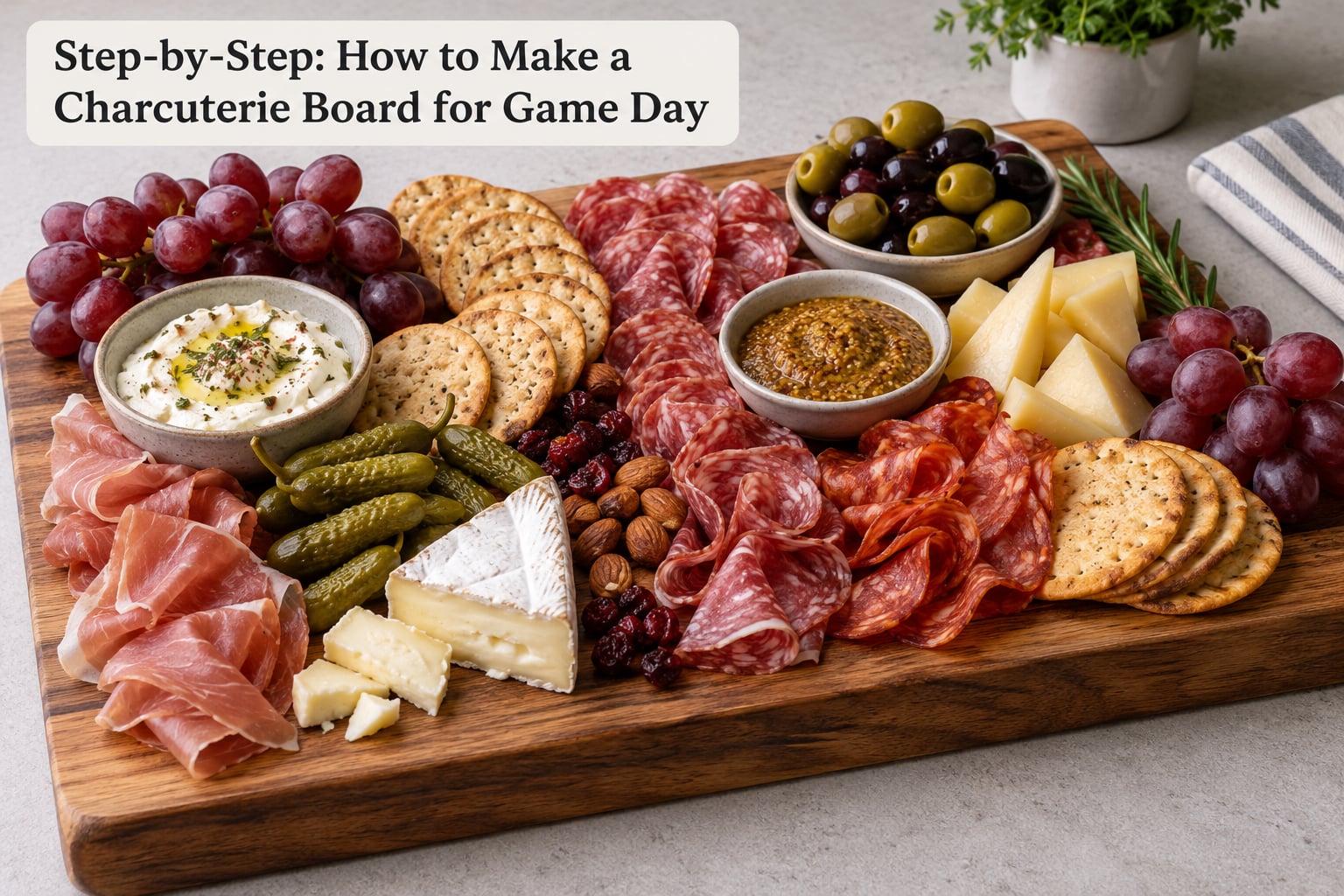
Assemble in the same order every time and you can build one without thinking about it. Work from the biggest anchors down to the small filler.
- Chill and stage first. Keep meats and cheeses cold in the fridge while you prep everything else, then bring them out when you are ready to build.
- Place the largest items. Set cheese blocks and rolled or folded meat in roughly the center, spaced apart so people can see what is what without dismantling the arrangement.
- Drop in the small bowls. Put dips, jams and mustard in small ramekins, leaving a thumb of space around each so guests scoop cleanly and crumbs do not fall everywhere.
- Fill every gap. Tuck crackers, bread, fruit and nuts into the empty spaces. Gaps are what make a board look sparse, and they are the easiest thing to fix.
- Add the wet items last. Pickles, olives and roasted peppers go near the bowls but away from the crackers and cheese so nothing goes soggy or soft.
- Stand things upright. Fan salami slices, stack cheese slices on their edge, or lean crackers in a small pile so the board has height and reads well from across the room.
- Add utensils and napkins. Each bowl gets its own small spoon or fork, and put the napkins on a separate plate rather than on the board where they will pick up grease.
- Garnish and move it out. A few rosemary sprigs, a handful of pistachios, or a drizzle of honey over the soft cheese finishes it. Then set the board out and stop fiddling with it.
How to Choose a Board and Arrange the Food
The rule of thumb is about 10 square inches of surface per guest, so six people need a 12 by 18 inch board and ten people need something closer to 16 by 20. If your board is much bigger than the food, the whole thing reads as empty no matter how pretty the cheese is arranged.
Keep moist foods away from crisp ones. Pickles and fruit release water, so give them their own zone on the board and put crackers on the opposite side. The same goes for strong smells: blue cheese and fish-based spreads can overpower everything within a few inches, so they get an edge to themselves rather than the middle.
Odd-shaped gaps are where the effort shows. Torn bread, irregular cheese wedges and clusters of grapes fill those spaces better than uniform squares, which leave dead air between them. Use the odd bits first so you are not saving scraps that nobody wants to look at.
How to Build a Balanced Game-Day Spread
A board works when every bite offers something different. You want rich, salty, sweet, acidic, creamy and crunchy all represented, and you can get there with a simple formula: one meat, two cheeses, two fruits or vegetables, two crunchy items, and one dip. Scaling that formula up is easier than picking nine items at the store.
The most commonly repeated shortcut is the 3-3-3 rule: three cheeses, three meats, three starches, three accompaniments. Follow it and your board looks generous and balanced without much thought. Fewer items than that and it reads thin; more and you are spending money on variety nobody picks up.
- Rich and salty: salami, prosciutto, sharp cheddar, blue cheese.
- Sweet: grapes, apple slices, dried apricots, fig jam, honey.
- Acidic: cornichons, pickled red onions, quick-pickled radishes.
- Creamy: brie, hummus, whipped feta, a soft cheese spread.
- Crunchy: nuts, pretzel pieces, sturdy crackers, crostini.
For one-handed eating, skip anything that requires a fork or a plate. Salami coins, cheese cubes, crackers with cheese, grapes and whole nuts can be picked up and eaten while watching. Dips break that rule, which is another argument for putting them in small bowls with short handles or letting people use a cracker as a shovel.
Vegetarian guests need a plan, not an apology. Swap cured meats for smoked salmon or marinated artichoke hearts, and add marinated olives, roasted red peppers, extra cheese and more crackers to make up the volume. A separate small board for meat-free items avoids the cross-contact question entirely.
How to Keep Charcuterie Fresh and Safe
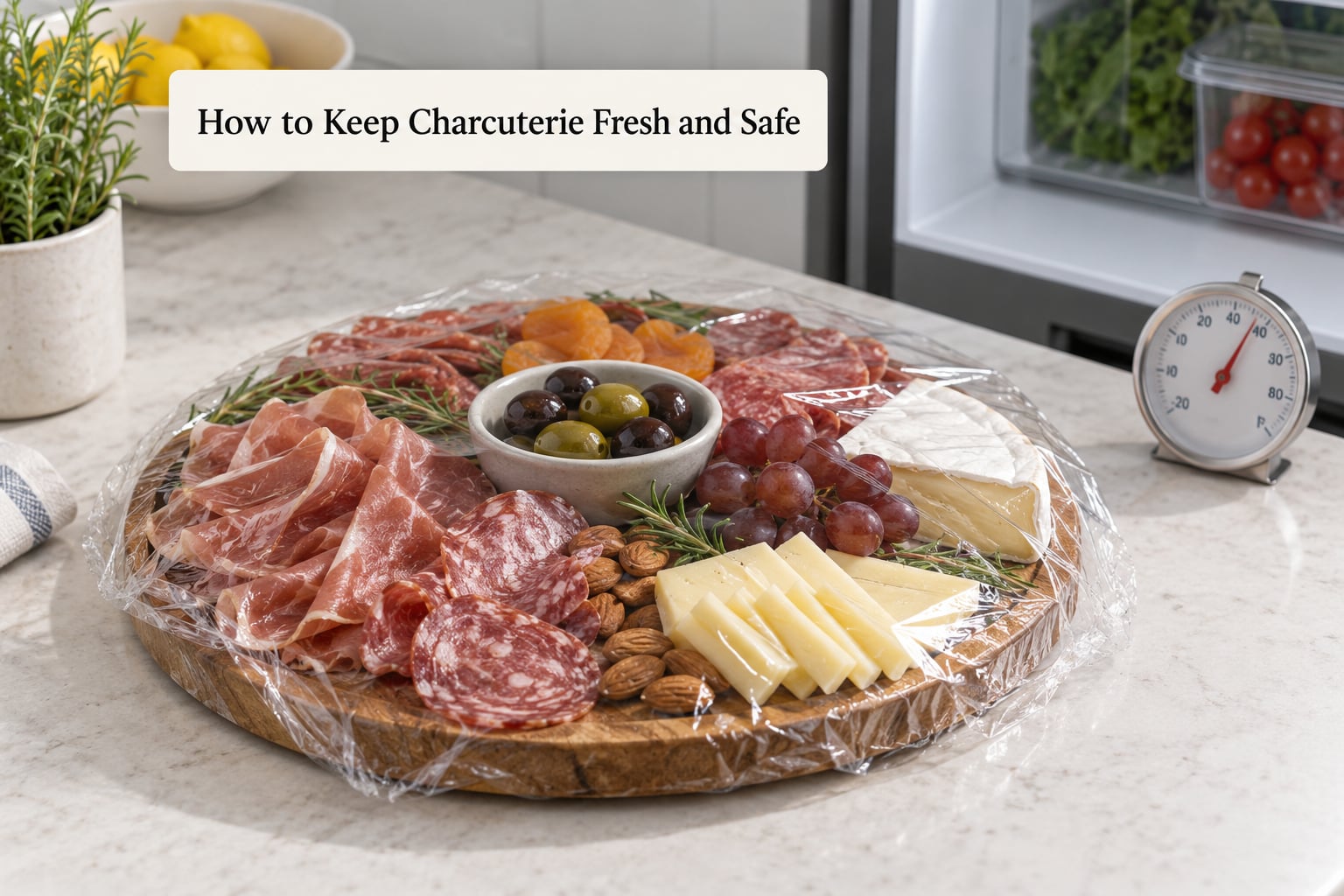
Perishable meat-and-cheese boards should stay at or below 40 degrees Fahrenheit until you serve them, and the safe window for room temperature service is two hours. If the room or the patio is above 90 degrees, that window drops to one hour. Once the window closes, either eat what is left within a few minutes or toss it.
Salami and other cured meats hold up longer than most items, and hard cheeses stay fine for the length of a game. Cut fruit and cut vegetables are the weak points. They brown, they soften, and they fall into the gray zone fastest, so add them close to kickoff rather than at breakfast.
Here is how long the usual suspects last on the board.
| Item | Comfortable window | Notes |
|---|---|---|
| Hard cheese blocks | 3 to 4 hours | Cut side down slows drying; loosely wrap if the game runs long |
| Soft cheese (brie) | 2 hours | Turns sticky past that |
| Soppressata, prosciutto, salami | 3 to 4 hours | Folded rather than flat lays out slower |
| Crackers and crostini | 2 to 3 hours | Add last so they start crisp |
| Grapes, whole olives | 3 to 4 hours | No cutting, no problem |
| Cut fruit, cut vegetables | 1.5 to 2 hours | Acidulated apple slices hold up best |
| Creamy dips and hummus | 2 hours | Keep in small bowls, not shallow smears |
For a three to four hour game, build the board 30 to 45 minutes before guests arrive and cover it loosely with plastic wrap or a box of cut produce. At halftime, pull the plastic, scrape the dip bowls, and tuck fresh crackers into the gaps before anyone notices. Put the whole board back in the fridge if kickoff is far away.
If you are transporting it, carry the board in the car with a towel under it to stop it sliding, keep dips in lidded containers separate from the crackers, and put ice packs beneath the meat and cheese. Nobody wants a warm soppressata.
Making it ahead
Most of the work can happen the night before. Slice the meats, cube the hard cheeses, toast the nuts, make any quick pickles and mix the spreads, then store each item separately in the fridge. Fruit waits, because it browns.
The night-before mistake is assembling too early. A board built a full day ahead has soggy crackers and wet cheese by kickoff. Assemble the night before only if you intend to serve it the next day.
Common Mistakes
Nearly every disappointing game day board fails for one of these reasons, and each has a quick fix.
- Crowding the surface. If items touch and overlap, guests have to dismantle the arrangement to reach the bottom layer. Pull two items apart and leave a lane between them.
- Buying a board that is too big. A 24-inch board for six people looks empty. Size to the guest count instead, or move to a second smaller board.
- Grouping everything by type. Three neat rows of cheese, meat and crackers make a display, not a snack board. Alternate items so every few bites the flavor changes.
- Cutting everything into identical squares. Uniform pieces look planned but they waste space. Mix rounds, wedges, folded slices and torn bread.
- Skipping the dips. A board with nothing to spread or scoop runs dry fast. Include at least one mustard, hummus or fig jam.
- Ignoring dietary restrictions. Ask before you shop, then build one separate meat-free section or a small second board.
- Leaving it out too long. Two hours is the limit for perishable items, and one hour in heat. Cover it loosely between quarters and set a phone reminder.
Final Tips
Cut every piece so it fits in one bite. Guests eat with one hand, and anything requiring a knife at the table ends up on a side plate.
Add sturdy crackers last, right before you carry the board out, and keep the softer bread on the edge where nobody will crush it. Small bowls for dips protect the board from spills and stop guests from plunging hands in.
A few more things worth doing: label anything with nuts, dairy or gluten if a guest asked, keep extra carrots and celery in the fridge as a backup when the cheese runs out, and use a tiered stand if you want height on the table. Always taste your sauces before serving. A dip that is bland at room temperature is a wasted bowl.
Frequently Asked Questions
What size charcuterie board do I need for a game-day party?
Plan about 10 square inches of board per guest, so six people need a 12 by 18 inch board and ten need roughly 16 by 20. For 15 or more guests, use two boards rather than one large one, since two smaller surfaces hold food better and waste less. If you already own a big board, use it and add a second tray rather than stretching one surface too thin.
How far in advance should I assemble a charcuterie board?
Build it 30 to 45 minutes before guests arrive. You can chop meats, cube cheeses, toast nuts and mix dips the night before and keep them separate in the fridge, but wait on cutting fruit, toasting crackers and arranging. A board assembled the day before has soggy crackers and tired cheese long before kickoff.
How long can a meat-and-cheese board stay out at a party?
Perishable meat-and-cheese boards should stay at or below 40 degrees Fahrenheit until serving, and perishable food left at room temperature should be eaten within two hours. If the temperature is above 90 degrees, cut that to one hour. For a long game, cover the board loosely between quarters and pull dips and cut fruit back out right before serving again.
What can I put on a charcuterie board instead of meat?
Smoked salmon, marinated artichoke hearts, roasted red peppers and marinated olives all fill the same role as cured meat. Add extra cheese, hummus or whipped feta to replace the salty richness, then load up on crackers, crostini, nuts and dried fruit so the board still has weight. Keeping meat-free items on a separate small board also solves the cross-contact question.
What dips go best with a game-day charcuterie board?
Choose dips that work with one hand, since guests are usually watching the game. Hummus, honey mustard, fig preserves and a soft cheese spread scoop cleanly onto crackers. Put each one in a small bowl with its own spoon, and add something acidic like pickled onions or pepperoncini so the board does not taste heavy by the fourth quarter.
Conclusion
The formula is simple enough to remember in the car on the way to the store: one meat, two cheeses, two fruits or vegetables, two crunchy items and one dip. Pick your guest count, size the board at about 10 square inches per person, and shop the categories rather than individual items.
Then buy one dip more than you think you need, cut everything a day ahead, and assemble it 30 minutes before kickoff. If you follow those three steps, learning how to make a charcuterie board for game day stops being a project and turns into the reason your guests never leave the couch.