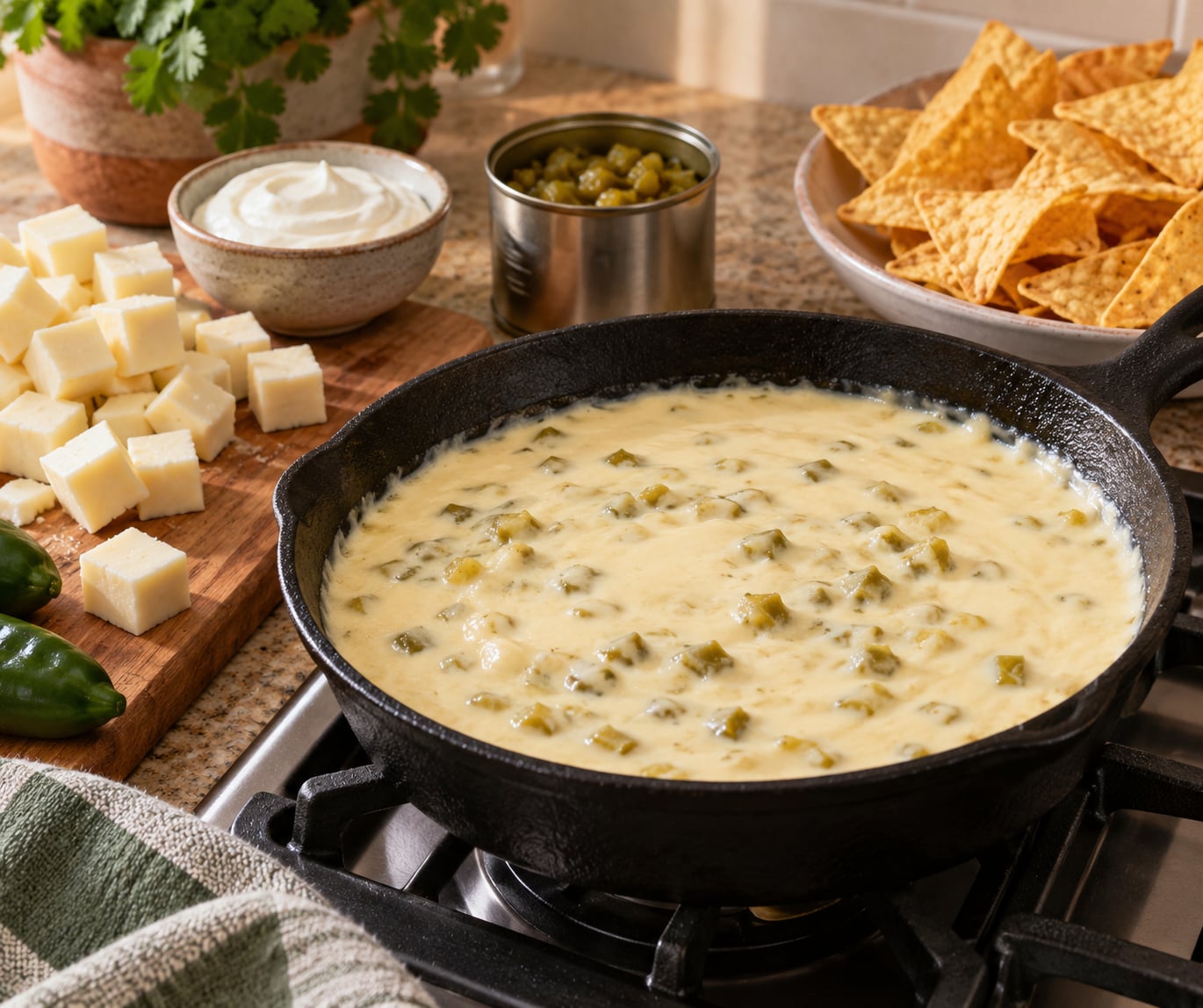
Queso blanco dip is melted white cheese thinned with milk and flavored with green chiles, and you can make a restaurant-smooth batch in about 10 minutes in one skillet with three core ingredients: white American cheese, milk and canned diced green chiles.
The whole difference between good white queso and the grainy, oily mess most people end up with is heat. Keep the burner low, cube the cheese yourself instead of using the bagged shreds, and stir constantly. That is the method below, and it takes less time than waiting in a drive-thru line.
One note before we start, because the name causes real confusion: the queso blanco in this recipe is a warm, melty dip. It is not the fresh, crumbly Mexican cheese sold in a tub under the same name. If you have one of those in the fridge, skip to the section on queso fresco before you start cooking.
Table of Contents
- What You Need
- The core ingredients
- Optional heat and flavor additions
- Equipment
- Substitutions and the crema question
- How to Make Queso Blanco Dip at Home: Step-by-Step
- Blend the Base for a Silky Texture
- Cook the Aromatics
- Melt the Cheese Gently for a Smooth Queso Blanco Dip
- Finish and Serve the Dip
- Common Mistakes and How to Fix Them
- Storing and reheating leftovers
- The cheese swap question, answered plainly
- Two faster methods worth knowing
- Frequently Asked Questions
- What is the best cheese for homemade queso blanco?
- Can I make queso blanco without Mexican crema?
- Why is my queso blanco dip too thick?
- How do I keep queso blanco smooth when reheating it?
- How long does homemade queso blanco last in the refrigerator?
- What can I serve with queso blanco dip?
- Conclusion
What You Need
This recipe makes roughly 4 to 6 servings, enough for a small game-day table. Prep takes five minutes and the whole thing cooks in a single pan.
The core ingredients
- 1 pound (450 g) white American cheese, cut from a block into quarter-inch cubes. Deli-counter slices work too. Buy a block rather than a bag of pre-shredded cheese.
- 1/2 cup (120 ml) whole milk or evaporated milk, plus more for thinning later.
- 4 ounces (115 g) Mexican crema, or sour cream if that is what you have.
- 1 can (4 ounces / 115 g) diced green chiles, drained, from Old El Paso or similar.
- 2 tablespoons diced pickled jalapeños, drained.
- 1/2 small white onion, finely diced.
- 2 garlic cloves, minced.
- 1/2 teaspoon ground cumin, a pinch of dried oregano, and salt to taste.
Optional heat and flavor additions
- One or two chipotle chiles in adobo, minced, for smoke and a slow burn.
- 1/2 cup cooked chorizo, browned and crumbled, stirred in at the end.
- Half a 10-ounce can of diced tomatoes with chiles for a Rotel-style version.
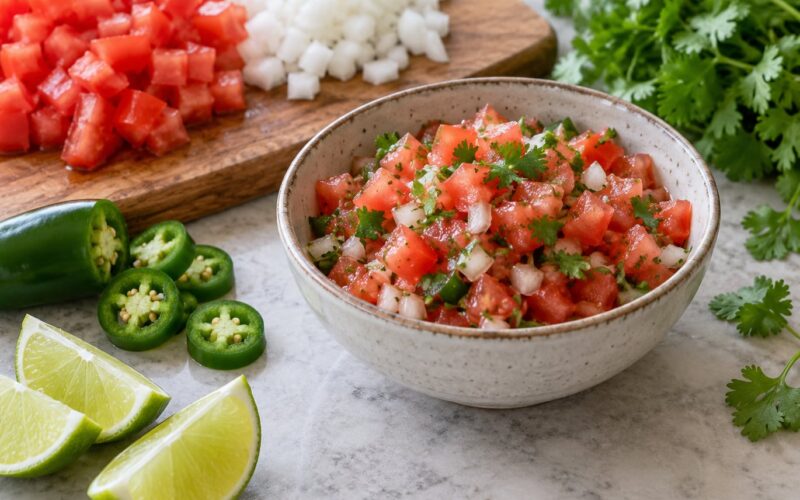
- A handful of diced tomato, onion and jalapeño for pico de gallo on top, added after cooking so it stays crisp.
- A squeeze of lime at the finish. It wakes the whole bowl up.
Equipment
A 10-inch skillet, a wooden spoon or whisk, a knife, and a blender if you want the extra-smooth texture. A double boiler is not required, though it makes the melt even gentler if you are nervous about heat.
Substitutions and the crema question
Mexican crema is thinner and tangier than sour cream, and it is the closer match to what Mexican restaurants ladle out. Sour cream will work in its place, just expect a slightly heavier, more tangy dip. Full-fat is the way to go here; low-fat versions carry less fat for the cheese to emulsify into and can turn thin and slick.
For the cheese, white American is the safest base because it is engineered to melt smoothly. Pre-shredded cheese is coated in anti-caking starch, which is exactly what makes bagged cheese refuse to melt into anything creamy. Shred your own from the block.
Evaporated milk in place of whole milk gives a richer, slightly sweeter result and is what many restaurant recipes use. It also holds cohesion better during a long hold on a warm setting.
How to Make Queso Blanco Dip at Home: Step-by-Step
Blend the Base for a Silky Texture
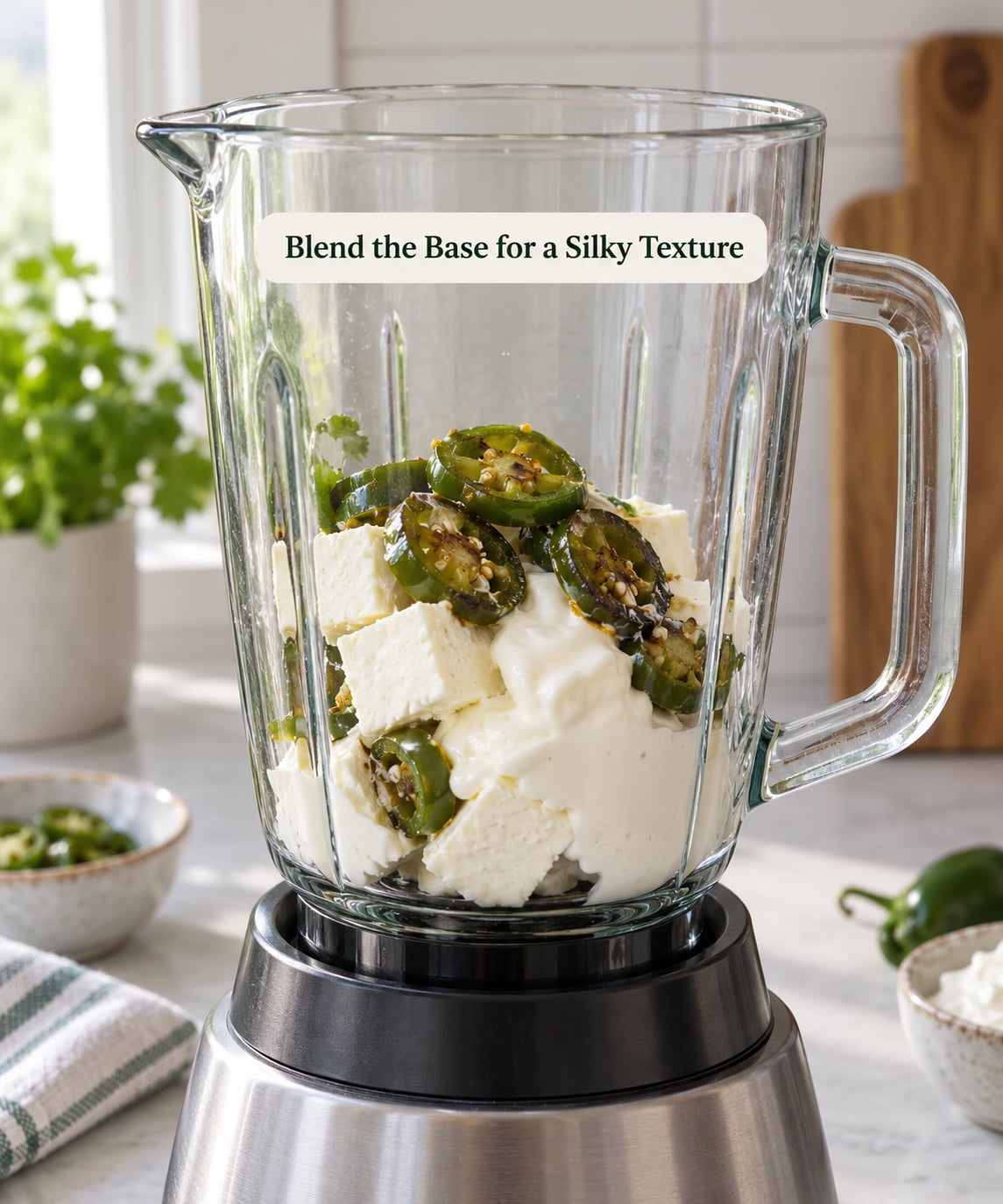
Blending the cheese before it hits the heat is optional, but it is the single easiest upgrade to texture. Put the cubed white American, the Mexican crema, the drained green chiles, the pickled jalapeños and the milk into a blender.
Start on low and pulse a few times rather than hitting high immediately. High speed builds heat from friction, and warm soft cheese plus a sealed lid is how you end up with a blown-out lid and a kitchen to wipe down. If the mixture refuses to move, let it sit at room temperature for five minutes; firm cheese straight from the fridge just sticks to the blades.
You are looking for a completely smooth, lump-free puree with no visible cheese cubes, about 45 seconds of blending. Taste a small dab on a spoon. If it tastes flat, add another pinch of salt now, because the salt in the cheese will tighten up as the dip thickens on the stove.
Skip this step if you do not own a blender, and the recipe still works. Dice the cheese small instead and give yourself an extra minute of stirring.
Cook the Aromatics
Melt one tablespoon of butter or a drizzle of oil in the skillet over medium-low heat. Add the diced onion and cook for 4 to 5 minutes until translucent and soft, then add the garlic and cook another 30 seconds.
You want the onions softened, not colored. Browning at this stage is the mistake that turns a clean, mild queso into something that tastes fried and bitter, because those dark bits carry through the finished dip. If your pan runs hot, turn the burner down a notch and give it another minute rather than rushing it.
If you like a smoky edge, add the minced chipotle here with the garlic. Cook it just long enough to wake it up, about 20 seconds, before the cheese goes in.
Melt the Cheese Gently for a Smooth Queso Blanco Dip
Turn the heat to low. If you blended the base, pour it in now. If you did not, add the milk first and let it warm for a minute, then add the cheese a half cup at a time, stirring between each addition.
Low heat is the whole game. Milk should barely bubble at the edges, never a rolling simmer, and a lazy simmer is fine. High heat boils the water out of the milk, the proteins tighten into strands, and those strands are what you see as grainy bits of curd floating in oil. Chefs in homes and restaurants hit the same wall at the same temperature.
Stir steadily with a whisk or wooden spoon, scraping the bottom of the pan, for about 5 to 8 minutes. The visual cues you want: the mixture goes from lumpy to glossy, the fat separates out and then reabsorbs as you keep stirring, and a spoon drawn through the middle leaves a clean line that slowly fills back in.
Drain and stir in the green chiles, pickled jalapeños, cumin and oregano in the last minute. Add the lime juice off the heat, then taste before you adjust anything. Salt and acid are cheap; an over-salted dip cannot be undone.
Finish and Serve the Dip
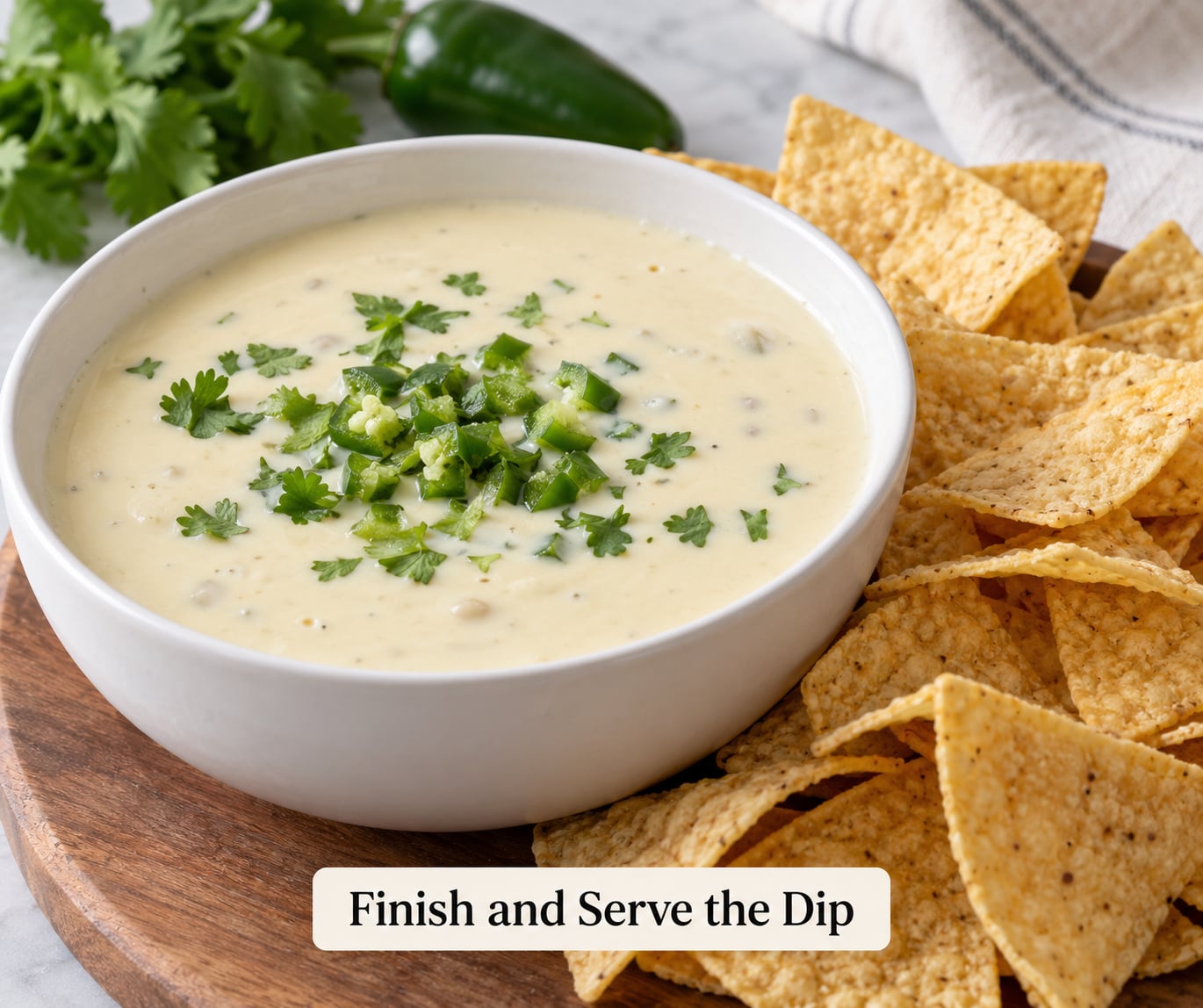
Adjust the seasoning now, while the dip is hot and thin. If it is thicker than you want for chips, trickle in warm milk a tablespoon at a time and stir. If it is looser than a dip should be, let it simmer uncovered for two or three minutes, or stir in a small handful of grated cheese.
Serve it warm, not hot. Dip cools fast enough that very hot queso sets into a rubbery skin within minutes of hitting the bowl. Somewhere between 130 and 150 degrees Fahrenheit feels right at the table, which is warm enough to be comforting and soft enough to coat a chip.
Top it with diced pickled jalapeños, cilantro, crumbled cotija or a spoonful of pico de gallo right before serving. If you are running a party, hold it on the lowest setting of a slow cooker or in a small fondue pot over a tea light. It will stay dippable for a couple of hours, and if it thickens on the warm setting, stir in a splash of milk.
As for keeping it in the fridge: a homemade dairy dip is good for three to four days refrigerated in a sealed container. After that the texture degrades even when the flavor is still fine, so make a fresh batch rather than serving day-old.
Common Mistakes and How to Fix Them
Almost every failed queso comes down to heat, speed, or the wrong cheese. Here is what each symptom means and what actually fixes it.
| Symptom | What caused it | How to fix it |
|---|---|---|
| Grainy or gritty texture | Heat too high, cheese added too fast, or pre-shredded cheese with its anti-caking coating | Lower the heat, add cheese in small batches, and whisk without stopping. Shred your own from the block. |
| Oily sheen with liquid pooling on top | Fat and water separated after boiling or after being reheated too fast | Whisk vigorously over low heat. The fat usually reabsorbs. If not, strain or skip the oil on top. |
| Too thin to scoop | Too much milk or crema for the amount of cheese | Simmer uncovered for 3 to 5 minutes, or stir in 1/4 cup grated cheese a handful at a time. |
| Too thick to dip | Not enough liquid, or it sat on the warm setting too long | Add warm milk one tablespoon at a time until it ribbons off the spoon. |
| Cheese clumps instead of melting | Cheese went in cold and dry, or it is a fresh cheese like queso fresco or plain Monterey Jack | Warm the liquid first, cube the cheese fine, and give it more time at low heat. See the queso fresco note below. |
| Splits into cheese and liquid overnight | The emulsion was never fully formed, usually from boiling | Reheat slowly in a double boiler or over the lowest heat with constant stirring, adding a splash of milk. |
| Reheats into a rubbery clump | Reheated too high, or reheated without any liquid | Warm gently with a tablespoon of milk per cup of queso. Never microwave it uncovered on high. |
| Texture is right but flavor is flat | Under-seasoned, which is a separate problem from texture | Add salt, a squeeze of lime and more cumin off the heat, then taste again. |
Storing and reheating leftovers
Cool the dip before it goes in the fridge, and use a container with a lid so it does not pick up fridge odors. Keep it at or below 40 degrees Fahrenheit and do not leave it sitting out for more than two hours at a party, less if the room is warm.
To reheat, put it in a saucepan over low heat with a tablespoon or two of milk and stir until it comes together again. A microwave works in short bursts, stirring between each one, but the stovetop gives you gentler heat and fewer rubbery edges.
The cheese swap question, answered plainly
Cooks who want the restaurant result without Velveeta do not need it. A block of white American from the deli counter performs as well or better, and it is the same cheese. White Velveeta is just a soft, pasteurized version of the same thing.
Monterey Jack melts nicely but has less fat and can turn grainy without careful heat, so it wants the slowest melt of any option. Pepper jack adds heat and meltability together, which makes it a good addition to a blend rather than a solo base.
Queso fresco is a different animal entirely. It is a fresh, crumbly, high-moisture cheese, and it does not melt into a sauce no matter how gently you heat it. Home cooks on cooking forums describe the result plainly: the cheese stays separate and the mixture curdles. If you want to use it, crumble it over finished nachos as a topping after the dip is made, or blend it with heavy cream and use it as a cold spread. Never try to substitute it one-for-one in this recipe.
Two faster methods worth knowing
Microwave: put cubed cheese, milk, crema and chiles in a microwave-safe bowl, cover it, and heat in 60-second bursts, stirring between each one. It takes about 3 minutes and the texture is slightly softer than the stovetop version.
Slow cooker for a party: add everything uncooked to a small slow cooker, set it to low, and stir every 30 minutes for the first hour. It is forgiving in a way a skillet is not, and it holds warm all afternoon without splitting.
Frequently Asked Questions
What is the best cheese for homemade queso blanco?
White American cheese cut from a block is the most reliable choice. It is formulated to melt smoothly, which is why restaurant queso stays creamy while plain cheeses turn grainy. White Velveeta works because it is the same cheese, softened. Monterey Jack melts well but has less fat and needs the lowest heat you can manage. Avoid pre-shredded bagged cheese, since the anti-caking coating keeps it from melting into a smooth sauce.
Can I make queso blanco without Mexican crema?
Yes. Sour cream is the easiest swap, and it gives you a slightly heavier, tangier dip. Full-fat sour cream works best because low-fat versions have less fat for the cheese to emulsify into. You can also leave the crema out entirely and use a little extra milk, though the result is thinner and less rich. For the richest version with no sour cream at all, use evaporated milk instead of whole milk.
Why is my queso blanco dip too thick?
Most often it is too much cheese for too little liquid, or it sat on a warm setting long enough to reduce. Stir in warm milk one tablespoon at a time until the dip ribbons slowly off the spoon. If you would rather not dilute the flavor, simmer it uncovered for three to five minutes to tighten it back up, or add a small handful of grated cheese and let it melt in.
How do I keep queso blanco smooth when reheating it?
Reheat gently, never hot. Put the dip in a saucepan over low heat with a tablespoon of milk per cup and stir until it comes together, or warm it in a double boiler. High heat is what makes reheated queso split into rubbery strands. If you use a microwave, work in 60-second bursts and stir between each one. A splash of fresh milk at the end usually restores a pourable, smooth texture.
How long does homemade queso blanco last in the refrigerator?
A homemade dairy dip keeps in a sealed container in the refrigerator for three to four days. Cool it fully before covering it so condensation does not make it watery, and keep the fridge at or below 40 degrees Fahrenheit. Beyond four days the flavor is usually still fine but the texture breaks down, so make a fresh batch. Do not leave it sitting out at a party for more than two hours.
What can I serve with queso blanco dip?
Tortilla chips are the obvious choice, and sturdy ones hold up best. Good additions: loaded nachos, warm tortillas, taquitos, tacos, or a cheeseburger topping. For a fuller spread, add chopped celery, carrot sticks, cucumber, apples or pear slices, and crackers. It also works as a sauce over roasted vegetables or as a drizzle over a bowl of chili. Garnish with cilantro, pickled jalapenos or crumbled cotija right before serving.
Conclusion
The first thing to get right is heat, not seasoning. Keep the burner on low, melt white American cheese slowly with milk, and stir the whole time so it turns glossy instead of grainy. Blend it first if you have a blender, and you will get a noticeably silkier dip than the skillet method alone.
Serve it warm rather than scorching, thin it with milk until it ribbons off the spoon, and taste for salt and lime before anything goes on top. Add diced jalapeños, cilantro or a little crumbled cotija at the table, and put out sturdy tortilla chips alongside. That is how you make queso blanco dip at home that people keep dipping into after the conversation has moved on.