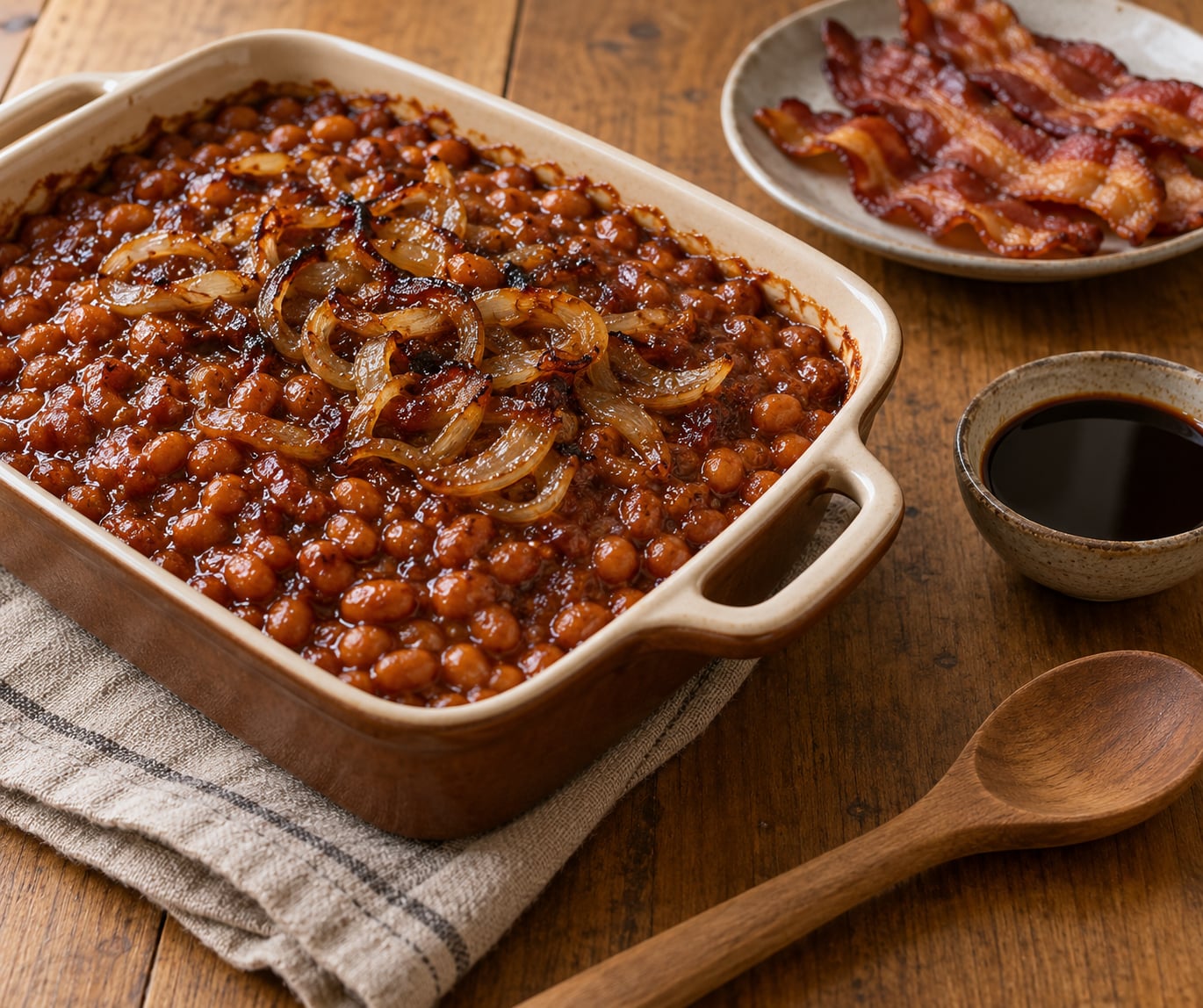
To make baked beans from scratch, sort and soak dried navy beans overnight, simmer them with a little baking soda until tender, then bake them in a sweet-sour sauce of molasses, brown sugar, tomato, and vinegar at 350 F until the sauce is thick and glossy. Most people spend a Saturday morning on it, though a pressure cooker cuts the soaking and simmer time to about an hour.
The reason to do it yourself is texture and seasoning. Canned beans arrive already soft, already sweetened, and sitting in thin watery liquid. Dried beans give you a creamy interior with an intact skin, a sauce thick enough to cling to a bun, and control over how much sugar and salt actually goes in.
This is the version we serve alongside burgers and hot dogs on the site, a pub-style bake with bacon, caramelized onion, and molasses. It leans sweet and smoky rather than tomato-heavy. Keep reading and you will get exact measurements, the timing for each stage, and the four mistakes that turn a good batch thin or scorch.
Table of Contents
- What You Need
- The beans and the base
- The pub-style sauce
- Optional additions
- Equipment
- Step-by-Step
- Step 1: Sort and Soak the Dried Beans
- Step 2: Cook the Beans Until Tender
- Step 3: Make the Pub-Style Sauce
- Step 4: Bake the Beans
- Step 5: Rest, Taste, and Serve
- Common Mistakes
- Frequently Asked Questions
- Do I have to soak the beans before making baked beans from scratch?
- Can I use canned beans instead of dried beans for this recipe?
- How long should baked beans cook in the oven?
- Why are my baked beans too watery?
- How long do homemade baked beans keep in the refrigerator?
- Can I freeze baked beans, and how should I reheat them?
- Conclusion
What You Need
The ingredient list is short, and most of it sits in a pantry already. Everything here feeds about eight people as a side dish.
The beans and the base
- 1 pound dried navy beans or Great Northern beans
- 1 teaspoon baking soda
- 8 cups water, plus more as needed
- 2 tablespoons bacon drippings or oil
- 1 large onion, diced
- 4 cloves garlic, minced
- 8 ounces bacon or salt pork, chopped (optional)
The pub-style sauce
- 1/2 cup molasses, the unsulfured kind if you can find it
- 1/3 cup packed brown sugar
- 1/2 cup ketchup or tomato puree
- 2 tablespoons apple cider vinegar
- 1 tablespoon yellow mustard or Dijon
- 2 teaspoons smoked paprika
- 1 teaspoon kosher salt, plus more to taste
- 1/2 teaspoon ground black pepper
- 2 cups reserved bean cooking liquid
The reserved liquid matters more than it sounds. That cloudy water left over after simmering holds the starch that makes the sauce thick and shiny, and no amount of flour does the same job without turning grainy.
Optional additions
A spoonful of maple syrup alongside the molasses gives you a woody note that plain brown sugar cannot. Some cooks add a whole bay leaf, a strip of orange peel, or a spoonful of coffee, which deepens the color and rounds out the molasses without adding sweetness.
Equipment
You need one heavy pot for the soak and simmer, a wooden spoon, a colander, and either a Dutch oven or a 9 by 13 inch baking dish for the oven. A Dutch oven wins here because the tight lid holds moisture in and the beans cook more evenly than a wide open dish. If you only have a baking dish, cover it tightly with foil for the first part of the bake.
Step-by-Step
Step 1: Sort and Soak the Dried Beans
Pour the dried beans onto a light-colored towel and pick out any that look shriveled, dusty, or oddly pale, plus any small stones that came along for the ride. That takes about five minutes and saves you picking them out of the finished dish one at a time.
Rinse the beans under cold running water until the water runs clear, then put them in your pot with enough water to cover by about 2 inches. Stir in 1 teaspoon of baking soda. Let it sit overnight at room temperature, or for 8 to 10 hours if you are short on time.
After soaking, the beans should be noticeably larger, roughly 1.5 times their dry size, and the skins should look loosened rather than tight and chalky. Drain and rinse them well, discarding the soaking water.
No time to soak? Bring the beans to a boil, cover, turn off the heat, and leave them for an hour. Then drain and rinse as directed. They will be slightly firmer and need a longer simmer, which is why the overnight method is worth it when you can.
Step 2: Cook the Beans Until Tender
Return the beans to the pot with 8 cups of fresh water, 1 more teaspoon of baking soda, the bay leaf if you are using one, and a teaspoon of salt. Bring to a boil, then drop the heat to a low simmer and partly cover.
Simmer for 60 to 90 minutes, stirring occasionally so nothing catches on the bottom. The beans are done when a fingertip pushes one against the side of the pot and the skin wrinkles and slips back a little. That slipping skin is the doneness test that matters.
Do not drain this liquid. You will need about 2 cups of it for the sauce, and the rest works for soup later in the week. Drain the beans in a colander for a few minutes while you build the sauce.
If you own a pressure cooker, skip the stovetop simmer. Cook the soaked beans with 6 cups of water and 1 teaspoon of baking soda on high pressure for 25 to 30 minutes, then let the pressure release on its own for 15 minutes. The liquid from that pot works as your reserved liquid just the same.
Step 3: Make the Pub-Style Sauce
Heat the oven to 350 F while you work. In a wide pan, melt 2 tablespoons of bacon drippings over medium heat, add the chopped bacon if you are using it, and cook until the fat runs and the edges crisp. Push the meat aside.
Add the diced onion to the fat and cook for 8 to 10 minutes until soft and golden at the edges. Add the garlic and smoked paprika and cook one minute more, until you can smell it from across the kitchen.
Whisk in the molasses, brown sugar, ketchup, vinegar, and mustard. Keep it on the heat just until it comes to a bubble and looks like a loose glaze, about 2 minutes. Pour it over the drained beans, add 2 cups of reserved bean liquid, the bay leaf, and the pepper, then stir gently so you do not crush the beans.
Step 4: Bake the Beans
Transfer everything to your Dutch oven or baking dish. If you baked the sauce in a separate pan, scrape every sticky bit of it across.
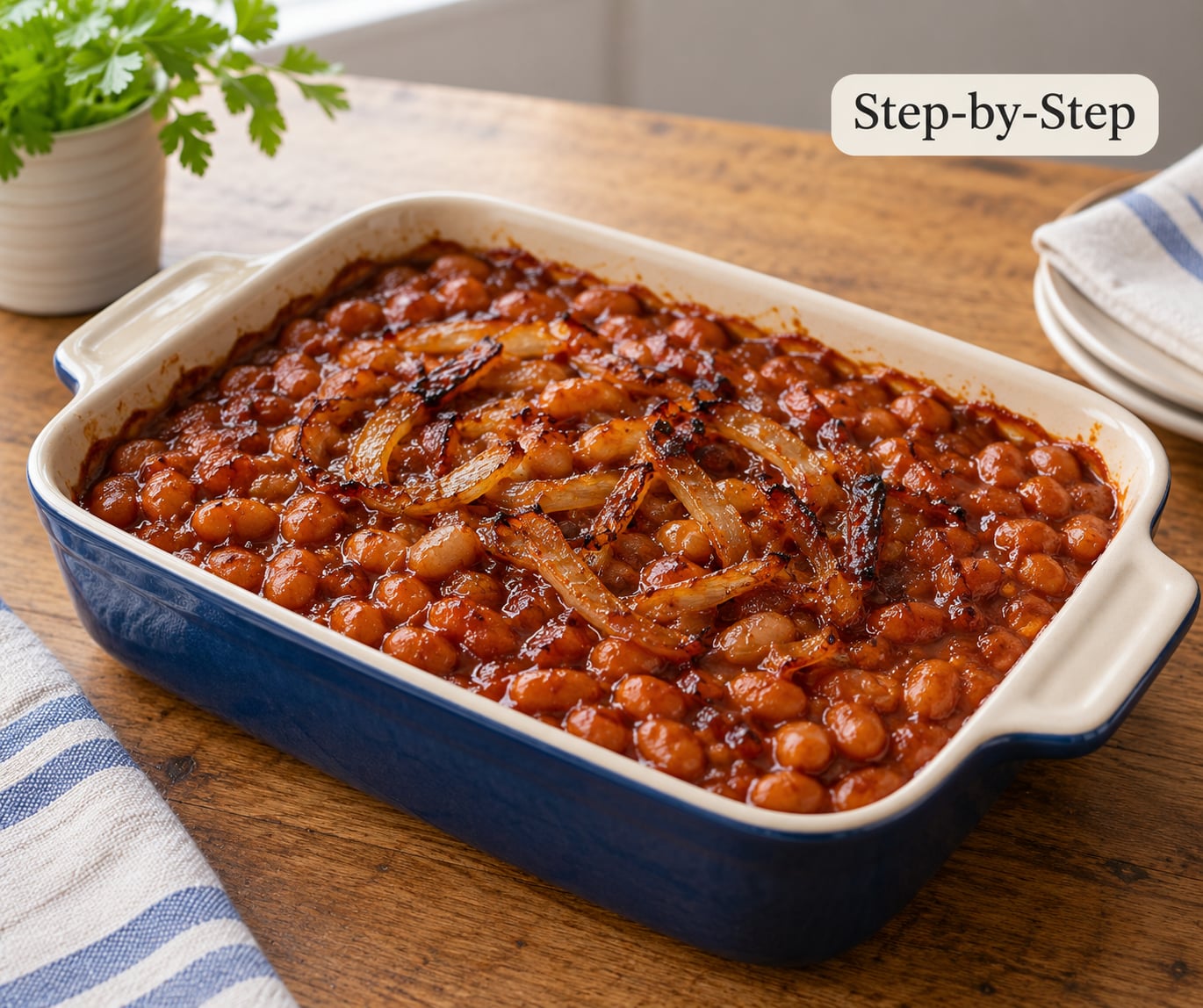
Bake uncovered at 350 F for 1 to 1.5 hours, stirring once halfway through. The sauce should reduce to a thick, glossy coat that clings to the beans, and it should bubble slowly rather than spit.
If you want deeper flavor and have the afternoon for it, drop the temperature to 250 F and bake for 8 to 10 hours with the lid on. That low, slow version is closer to the old pub versions, and the sugars in the molasses go dark and toasty rather than just sticky. It is a genuinely different dish, not a slower version of the same one.
Watch the last 20 minutes closely. If the top is browning faster than the sauce is reducing, tent loosely with foil or turn the heat down.
Step 5: Rest, Taste, and Serve
Take the dish out and let it sit for at least 20 minutes. The sauce finishes setting as it cools, and beans served straight from a screaming hot dish are usually looser and wetter than they taste the next day.
Taste the sauce before serving and adjust. Too sweet gets more vinegar, too flat gets a hit of mustard, too thick gets a splash of bean liquid or water. This is the last chance to season, and getting it right here matters more than any single ingredient going in.
Serve alongside burgers, hot dogs, grilled chicken, or a plate of breakfast sausages. It also does real work as a potluck dish since it travels well and only improves after a night in the fridge.
Common Mistakes
The beans are still hard. Old beans take forever, and hard water makes it worse. If they are not tender after 90 minutes of simmering, add another half teaspoon of baking soda and keep going. Water that is already simmering when you add the beans also helps, because the outside of the bean does not set before the inside catches up.
The result is watery. You either put too much liquid in the dish or you baked it uncovered at too high a heat for too short a time. Hold back a cup of reserved liquid and add it during the bake instead of pouring it all in at once, and let it go a full 90 minutes at 350 F before you judge it.
It tastes too sweet. Two fixes work better than the third. Cut the molasses in half and lean on brown sugar for the body, or add a tablespoon of cider vinegar, which reads as tartness rather than dilution. Do not simply reduce the brown sugar and leave the molasses alone, since molasses carries the strongest sweetness of anything in the pan.
The sauce is thin and will not thicken. You probably drained and threw away the bean liquid. If it is already in the oven, mash a small scoop of beans against the side of the dish and stir them back in. The released starch thickens the sauce within the next 20 minutes, which is far better than reaching for a slurry.
The top scorched before the sauce reduced. Too high and too hot. Either tent with foil, or move the dish to a lower rack so the top browns more gently while the middle keeps cooking.
The beans turned to mush. Usually this means they sat in the pot after they were already tender. Pull them at the first sign of give, then hold them in the sauce rather than on the stove. Mushiness is nearly always overcooking, not overcooking in the oven.
Frequently Asked Questions
Do I have to soak the beans before making baked beans from scratch?
No, but soaking makes the beans more predictable. A quick soak is boiling the beans for 2 minutes, resting them covered off the heat for 1 hour, then draining. An overnight soak works better and cuts the simmering time by roughly 30 minutes. Skip soaking entirely and the beans will still cook, but expect to simmer them closer to 2 hours.
Can I use canned beans instead of dried beans for this recipe?
You can, and the beans turn into a 40-minute dish. Drain and rinse two cans of navy, cannellini, or Great Northern beans, then skip everything about soaking and simmering. Add them straight to the sauce with a cup of water or bean liquid instead of 2 cups, and bake at 350 F for 30 to 40 minutes. The texture will never match dried beans, but the flavor is still good.
How long should baked beans cook in the oven?
At 350 F uncovered, plan on 1 to 1.5 hours, stirring once at the halfway mark. You want the sauce reduced to a thick glossy coat that clings to the beans. The slow route is 250 F for 8 to 10 hours with the lid on, which concentrates and darkens the molasses into a deeper, toastier sauce.
Why are my baked beans too watery?
Two reasons are usual: too much reserved liquid went into the dish, or the beans did not bake long enough for that liquid to reduce. Hold back a cup of the bean liquid and add it partway through the bake. Give the full 90 minutes at 350 F uncovered before deciding. A little extra simmer on the stovetop at the end also tightens a thin sauce quickly.
How long do homemade baked beans keep in the refrigerator?
Four days in the fridge is the safe window, stored in a sealed container and used within that time. Properly cooked beans keep well, and the sauce only gets better as the flavors settle. Many people find day-two beans better than day-one ones. Reheat gently on the stovetop with a splash of water so the sauce does not scorch.
Can I freeze baked beans, and how should I reheat them?
Freezing works, but expect the beans to be a little softer and the sauce a little thinner once thawed. Cool them completely first, leave a space for expansion, and freeze in portions for up to three months. Thaw overnight in the fridge, then reheat slowly on the stovetop, stirring and adding a splash of water or stock until the sauce thickens again.
Conclusion
Start tonight: sort a pound of dried navy beans, cover them with water and a teaspoon of baking soda, and let them soak on the counter while you do everything else. From there it is simmer, sauce, bake.
One tip carries more weight than any ingredient. Taste the sauce before it goes in the oven, then taste again after the rest. That final adjustment, a splash of vinegar or a little more mustard, is the difference between baked beans that are merely sweet and the ones people ask about all night.