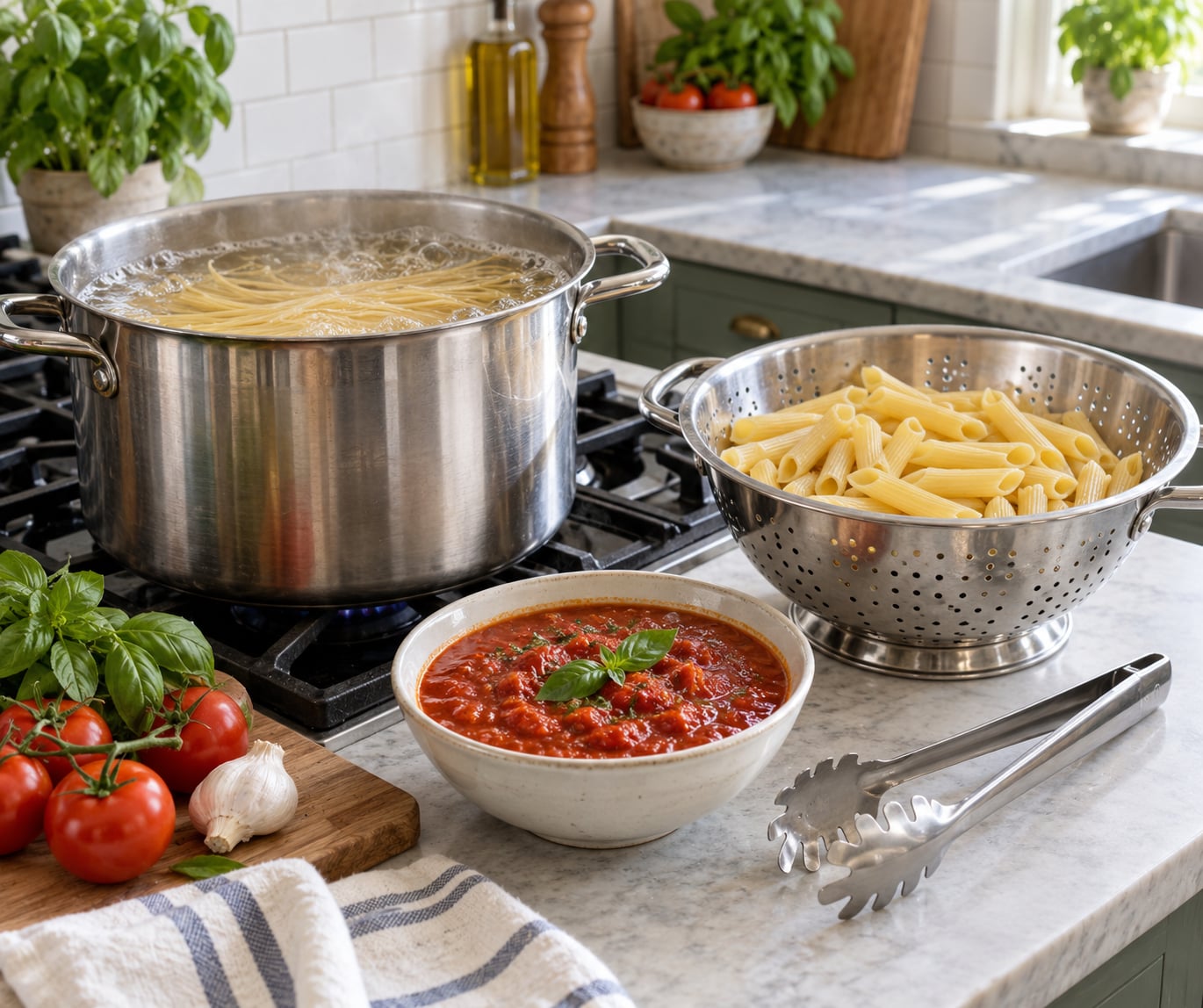
If you have ever wondered how to cook pasta for a party without it sticking, the problem is almost always one of three things: the pot is too small for the batch, nobody stirred during the first two minutes, or the drained noodles sat somewhere warm while the rest of the batches cooked. Salt the water heavily, keep the pasta moving right after it goes in, and toss the drained noodles with a small splash of oil or a cup of their own starchy water the moment they come out of the colander. Updated for 2026. The same method holds from a single pound at home to 25 pounds for a hundred guests.
If you have read more than one thread on this question, you have probably seen rinse or do not rinse, oil or no oil, mix with sauce now or serve the sauce on the side. All of it is advice from someone who was solving a slightly different problem. Here is one method, with the quantities stated, plus the honest caveat about holding pasta warm at all.
Table of Contents
- What You Need
- Step-by-Step
- 1. Calculate the Pasta and Sauce
- 2. Prepare the Sauce and Work Area
- 3. How to Cook Pasta for a Party Without It Sticking
- 4. Reserve Water and Drain in Manageable Portions
- 5. Toss Pasta With the Right Sauce
- 6. Serve Immediately or Hold Safely
- Common Mistakes
- Frequently Asked Questions
- How much pasta should I cook for a party?
- What type of pasta is least likely to stick?
- Should I rinse cooked pasta before adding sauce?
- How can I keep cooked pasta from sticking at a buffet?
- How long can cooked pasta sit before serving?
- Conclusion
What You Need
The equipment list is short, and most of it you already own. The pot is the one thing worth thinking about before the day of, because it is the single biggest cause of clumping.
- A wide, heavy pot with a capacity of at least three times the volume of the dry pasta you are cooking, plus handles you can grip with oven mitts
- A large colander set in the sink, or a second pot if your colander is small enough that a full batch would sit heaped in it
- Long tongs or a slotted spoon for lifting and tossing
- A timer, because every timing in this guide is measured from when the water returns to a boil, not from when you add the pasta
- Shallow foil pans or low-sided serving dishes for holding, plus a cover
- Optional: a chafing dish with fuel cans, a warming tray, or a slow cooker for long holds
For quantities, start here and adjust for your crowd. Dry pasta is the number to measure, because cooked pasta expands to roughly three times its dry volume.
| Guests | Dry pasta | Batches at 4 lbs each | Finished volume |
|---|---|---|---|
| 10 | 2.5 lbs | 1 | about 4 quarts |
| 20 | 5 lbs | 2 | about 8 quarts |
| 30 | 7.5 lbs | 2 | about 12 quarts |
| 50 | 12.5 lbs | 3 to 4 | about 20 quarts |
| 100 | 25 lbs | 7 | about 40 quarts |
That works out to roughly 4 ounces of dry pasta per adult, or 1 pound per 4 to 5 guests. If the party includes a big table of teenagers, or a buffet where people will take seconds, add 15 percent. If a pasta bar has three sauces, people take smaller first portions, so the extra 15 percent usually covers it.
Measure by weight if you can. A kitchen scale beats guessing because pasta shape changes the volume of a cup dramatically, and nobody wants to run out at the last batch.
For water, use at least 4 quarts per pound of pasta, and 6 quarts per pound for long shapes like spaghetti and linguine that need room to move. Salt it until it tastes like the sea, which usually means about 1 tablespoon of kosher salt or 2 teaspoons of table salt per 4 quarts.
Before the guests arrive, do three prep jobs. Make the sauce completely and hold it warm, or make it cold and plan to reheat it. Measure every batch of dry pasta into its own container so there is no portioning pressure mid-cook. Clear a landing area next to the stove that is big enough for a hot pot to be set down, because setting a hot colander on a wet counter is how you get a broken bowl and a scraped arm on the same night.
Step-by-Step
1. Calculate the Pasta and Sauce
Budget 4 ounces of dry pasta per adult, 1 pound per 4 to 5 guests, and round up rather than down. The rounding is not waste, because it is insurance against the batch that lands in the serving dish five minutes before anyone is allowed to eat.
For sauce, plan about three-quarters cup of finished sauce per person if it is a meat or tomato sauce, and closer to a half cup for a cream sauce, which is richer. Write the numbers on a scrap of paper and tape them above the stove. At 50 guests that is roughly 9 gallons of sauce, which means two stockpots and probably two burners going at once.
Sauced pasta needs more water than plain boiled pasta because the sauce has to coat a slick noodle. If your sauce is thick, such as a slow-cooked ragu or a dense pesto, loosen it with a ladle of starchy pasta water before it ever meets the noodles.
2. Prepare the Sauce and Work Area
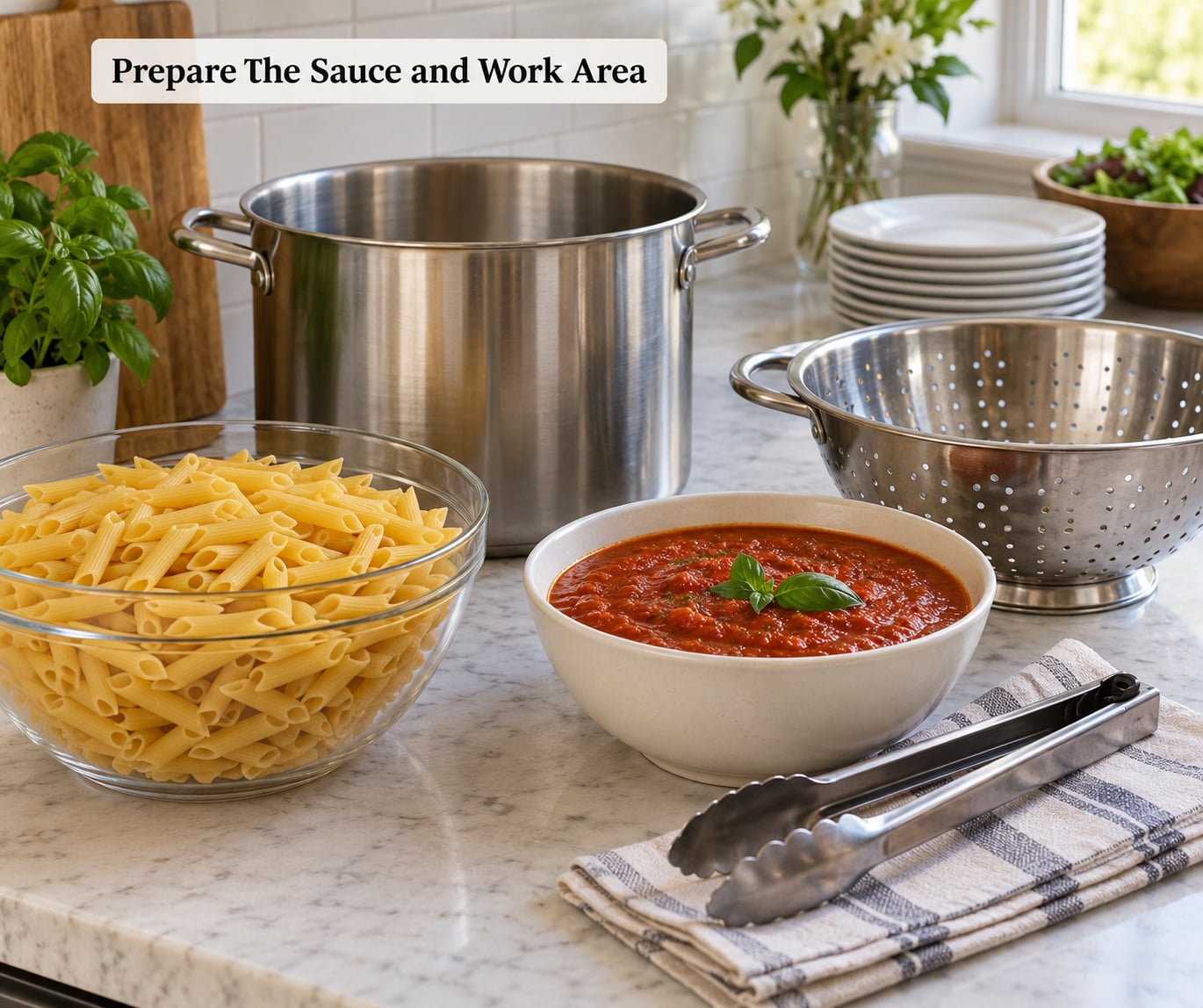
Sauce should be finished, seasoned and hot before the first batch of noodles hits the water, not simmering hopefully while you drain. Every minute you spend scrambling at the stove between batches is a minute the sauce thickens and a minute the finished pasta sits.
Set out your tools before you fill the pot: colander in the sink, tongs resting on a clean towel, the measured dry pasta in a container within arm’s reach of the stove, and the sauce pot on a back burner at a bare simmer. Keep one set of tongs or spoons for raw pasta and a separate set for serving. It takes ten seconds to do and it is the difference between serving someone a vegetarian dish that somebody already handled with bare hands at the deli counter.
Fill the pot no more than two-thirds full of water. A pot that is more than two-thirds full of water plus pasta will climb over the rim the moment you stir it, and there is no recovering from that with 25 pounds of pasta going down the drain.
3. How to Cook Pasta for a Party Without It Sticking
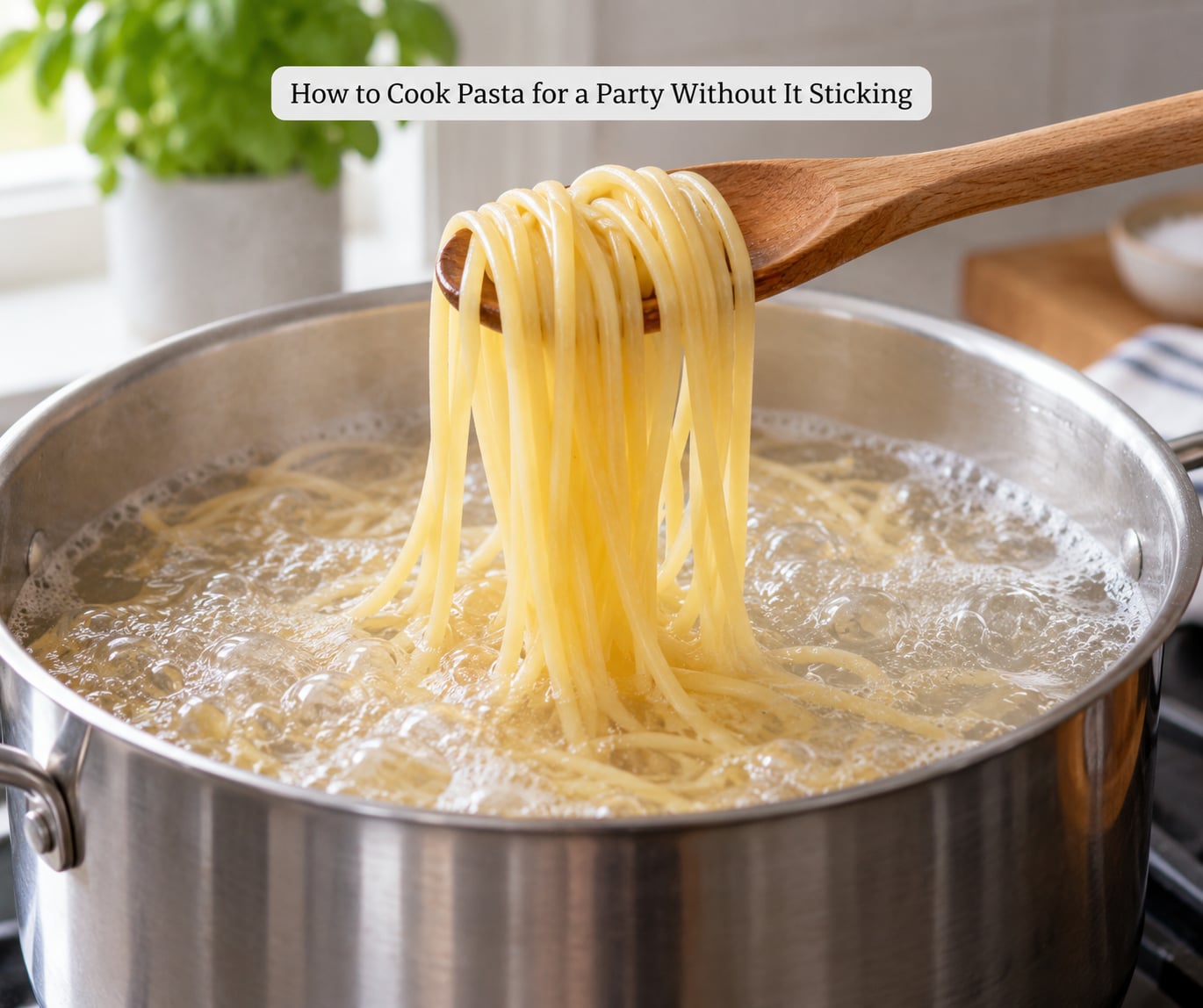
Bring the water to a full rolling boil before the pasta goes in, and salt it now if you did not salt it with the cold water. Add the pasta in one motion and stir immediately with a wooden spoon or a pair of tongs, working from the bottom of the pot upward so nothing is left sitting against the metal.
The first two minutes decide everything. Pasta releases surface starch as it cooks, and freshly added strands touch each other before that starch has washed into the water. Stir often during those two minutes, once every twenty seconds or so, then drop to every minute or two once the strands have softened and started moving on their own. If the pasta cannot move freely in the pot, it will clump whether or not you stir, so the crowding rule wins over the stirring rule.
Start the timer when the noodles go in, not when the water boils. Long shapes like spaghetti need about 8 to 10 minutes, penne and rigatoni about 9 to 11, ziti and cavatappi about 11 to 13. Large batches run slightly longer than small ones because the pot takes longer to recover its boil.
How do you know when it is done without cutting a strand open? Lift a few pieces with the spoon and flex them. Al dente noodles bend easily at the center with no visible hard white core in the middle, and they have a slightly chalky core you can feel through the bite. Mushy, uniformly soft strands that bend in a U with no resistance are past done. Taste one. It costs you a bite and saves the batch.
Drain a noodle about two minutes earlier than the package time. Pasta keeps cooking from residual heat after it leaves the water, and at party volume a deep pot holds enough heat to push a whole batch from al dente to mush while you are still draining it.
4. Reserve Water and Drain in Manageable Portions
Before you drain, set a heatproof bowl or a second pot within reach and scoop out at least a cup of the cloudy starchy water. That water is the glue for your sauce, and it is free, so throw away none of it.
Work in small batches at the drain too. Dump a manageable amount of noodles into the colander, let it drain for maybe fifteen seconds, and move it straight to your serving dish or sauce pot. Do not let the first batch sit heaped in a wet colander while the second batch boils, because a mound of pasta under its own weight and steam will bond into one solid lump long before it is sauced.
Do not rinse sauced pasta. If you cool the noodles for a make-ahead plan, that is a different method covered below. For pasta going into a sauce, rinsing washes away the surface starch that lets the sauce cling, and you end up with a slippery plate of noodles with sauce pooling at the bottom.
5. Toss Pasta With the Right Sauce
Put the sauce in the pot or serving dish first, then add the noodles on top, or add noodles to the warm sauce pot directly. Either order works. Toss gently with tongs, lifting from the bottom rather than stirring hard, until every piece has a thin, even coat.
If the sauce looks heavy and pasty before the noodles go in, loosen it with a ladle of reserved pasta water. If the noodles look dry and the sauce has gone sticky after a few minutes in the pan, add reserved water a quarter cup at a time and toss again. You are looking for sauce that moves with the noodles, not sauce that grips them.
On oil, here is the number nobody gives you: about 1 tablespoon of oil per pound of dry pasta, tossed into the drained noodles while they are still steaming. A neutral oil such as grapeseed or canola keeps the flavor of the sauce clean and leaves no green cast on a plated noodle, where a heavy olive oil does. Past that tablespoon per pound you are greasing the noodle, and greasy noodles repel sauce. The sauce slides off and pools in the bottom of the dish. A light drizzle, tossed before the sauce, is insurance against sticking during a hold. It is not a substitute for the pot being big enough.
6. Serve Immediately or Hold Safely
The cleanest solution is to time backwards from service. Noodles drained at 12:50 are at their best at 12:55 and still good at 1:05. They are unremarkable at 1:30. If dinner is at 7, drain your first batch at 6:35, your second at 6:50, and hold the first batch in whatever warm setup you have, loosely covered, with the sauce in a separate covered dish kept hot.
Serve the sauce hot and separate whenever you can. That single change solves most of the holding problem, because the noodles stop absorbing a thickening sauce while they sit, and the sauce re-cooks them at the moment a guest makes a plate. Pre-mixing is the better option only when you are serving immediately, within a few minutes.
For hot holding, keep food at 140F or above and use shallow containers, no more than two inches deep, so the center of the pan does not stay in the danger zone. Toss once before it goes out and once every twenty minutes or so with serving tongs, never the raw-pasta tongs.
| Method | Capacity | Good run time | Watch out for |
|---|---|---|---|
| Chafing dish with fuel cans | one to two pans | about 2 to 4 hours per fuel can | Pans dry out, so keep a splash of water in the well and check the fuel |
| Slow cooker on warm | about 4 quarts | all evening on one fill | Drying out and a scorched bottom; stir and add water |
| Warming tray | full sheet pans | 2 to 3 hours | Needs water in the pan or the noodles turn dry and glue together |
| Oven, warmed shallow foil pans | two pans at once | about 1 hour at 200F | Dries out fast; tent loosely with foil |
Refrigerate leftovers within two hours of serving, in shallow containers so they cool quickly. Reheated pasta is fine the next day, just looser, and it never gets its texture back, so cook extra for the take-home container rather than planning seconds.
Common Mistakes
Every one of these shows up in the same handful of forum threads, usually with someone asking whether to rinse or add oil. Here is the symptom, the cause, and the fix.
| Symptom | Cause | Fix |
|---|---|---|
| Clumps right after draining | Crowded pot, so the noodles could not move apart | Cook in smaller batches or use a wider pot |
| Stuck to the bottom | Not enough water, or the boil dropped while cooking | Use 4 to 6 quarts per pound and keep a full boil |
| Matted ball of noodles | No stirring in the first two minutes | Stir every twenty seconds until the strands soften |
| Soggy, overdone | Drained too early and left sitting through several more batches | Pull two minutes early, stagger the batches, serve sauce hot and separate |
| Sauce pooling at the bottom of the bowl | Rinsed noodles, or too much oil | Do not rinse; cap oil at about 1 tablespoon per pound |
| Noodles glued in the serving dish | Deep container, undisturbed, covered tightly | Shallow pans, loose cover, toss every twenty minutes |
| Stuck solid and unusable | Drained noodles left heaped and pressed together | Add warm water, let it sit five minutes, separate gently with tongs |
Two more worth naming. Never add oil to the cooking water; it floats on the surface, coats nothing useful, and makes the drained noodles slippery in a way that blocks the sauce. And never pour cold sauce over hot pasta waiting to be served, because the temperature drop makes the noodles release more starch and turn gluey right before you need them loose.
If a batch has already fused into a block, put it back in the pot with a couple of cups of hot water and let it sit for five to ten minutes, then work it apart with tongs. You will not get it back to al dente, but you will often get something servable instead of a bin full.
One honest alternative. A pasta bar where guests toss their own noodles with sauce at the counter has zero holding problem, because nothing sits. A cold pasta salad, made the night before, has the same advantage from the other direction, since it is meant to be eaten cool and firm. If your guests are mingling rather than sitting down to eat, that format beats fighting the clock with a chafing dish.
Frequently Asked Questions
How much pasta should I cook for a party?
Plan 4 ounces of dry pasta per adult, or 1 pound per 4 to 5 guests. For 100 people that is roughly 25 pounds, which means seven batches at 4 pounds each. Add 15 percent if teenagers are eating or the pasta is one of several mains, and round up rather than down so the last batch is not the one that runs short.
What type of pasta is least likely to stick?
Short, ridged shapes hold up best at a party. Rigatoni, ziti and cavatappi have grooves and cavities that trap sauce and keep strands separated, and none of them tangle the way spaghetti does when it sits. Spaghetti is the most likely to clump because the strands mat together into a ball as soon as they stop moving.
Should I rinse cooked pasta before adding sauce?
No, not for sauced pasta. Rinsing washes away the surface starch that sauce needs to cling to, so the noodles turn slippery and the sauce slides off into the bottom of the bowl. The exception is a make-ahead method where you partly cook noodles, cool them under running water, and store them in starchy water to use later.
How can I keep cooked pasta from sticking at a buffet?
Hold it in shallow pans rather than one deep pot, toss with serving tongs every twenty minutes, and keep the pans above 140F. Add a splash of pasta water and a tablespoon of oil per pound of pasta before it goes out, and cover loosely. Serving the sauce hot and separate stops the noodles from sitting in a thickening sauce while guests arrive.
How long can cooked pasta sit before serving?
Drained pasta is at its best within about five minutes and stays good for roughly fifteen, then declines quickly as residual heat keeps cooking it. Plan the last batch to drain no more than fifteen minutes before you intend to serve. Anything sitting longer than an hour should be refrigerated rather than held warm, and leftovers go into the fridge within two hours.
Conclusion
Three things decide whether party pasta sticks, and none of them are complicated. A pot big enough that the noodles move freely, a hard stir every twenty seconds for the first two minutes, and a quick toss with a tablespoon of oil or a cup of starchy water the second the noodles hit the colander. Everything else is timing, and timing is just arithmetic run backwards from when you want to eat.
Start by measuring tonight. Weigh out your dry pasta into per-batch containers, check that your largest pot is at least three times the volume of a 4-pound batch, and write your sauce number on the same scrap of paper. On the day, finish the sauce first, then cook batches backward from your serving time. That is how to cook pasta for a party without it sticking, and it takes about two hours of stove work for fifty people.