Punch is a big bowl of mixed base liquid, sweetener, and acid that you pour instead of shake, and learning how to make spiked and non alcoholic punch options is mostly about order of operations: build the flavor first, get it properly cold, then add anything fizzy, frozen, or boozy in the last few minutes before guests arrive. Two pitchers, one shared fruit base, about ten minutes of actual work.
That two-pitcher arrangement is the whole trick. The drink itself is not complicated, and the syrups and juices you need are ordinary grocery items, but the version most hosts end up serving is either a syrupy bowl of melted sherbet or a pitcher of flat, vaguely boozy juice. Both are fixable with the same method.
I make punch for a lot of gatherings, and the pattern holds every time: the pitcher that tastes flat tastes flat because the bubbles went in too early, and the bowl that tastes like a candy dish usually had three sweet things in it and nothing sour. Below is the method I use, with two recipes and a batch chart so you can scale to whatever guest list you have. It is the same approach whether you are pouring for a summer cookout, a holiday dinner, or a brunch crowd, and it works whether the party is dry, partly dry, or not at all.
Table of Contents
- What You Need to Make Spiked and Non-Alcoholic Punch
- The shared shopping list for both pitchers
- What you can make ahead and what has to wait
- Step-by-Step: Two Punches From One Method
- 1. Choose the punch style and calculate the batch size
- 2. Prepare the fruit and herb base
- 3. Build the spiked citrus-herb punch
- 4. Make the nonalcoholic sparkling fruit punch
- 5. Chill, garnish, and serve
- Common Mistakes: Six Fixes for Six Bad Bowls
- Punch that is too sweet
- Punch that is thin or watery
- Punch that is bitter or harsh
- Punch that goes flat
- Punch of unpredictable strength
- Sherbet punch that turns to water
- Frequently Asked Questions
- How much punch do I need per person?
- How far in advance can I make punch?
- How do I keep punch fizzy for a whole party?
- How do I make nonalcoholic punch that is not too sweet?
- Can I use one base for both an alcoholic and a nonalcoholic punch?
- Should I put ice in the punch bowl?
- Conclusion: Decide the Batch, Then Taste Before You Serve
What You Need to Make Spiked and Non-Alcoholic Punch
Every punch on this page, and nearly every punch worth serving, is the same four-part formula built in a specific order: a base, a sweetener, an acid, and something cold and bubbly. Once you can name those four parts, you can build a punch from what is already in your kitchen instead of following a recipe line by line.
The base is the volume of the punch. Fruit juice, lemonade, cranberry or pomegranate juice, dry vermouth, a splash of orange juice, or a batched simple syrup. In the citrus-herb punch below, the base is lemon juice plus a rosemary-mint syrup. In the sparkling fruit punch, it is a blend of juices with soda water added at the end.
The sweetener is what people overdo. A simple syrup made one-to-one sugar and water is the useful middle ground, because it dissolves clean and you control the amount. Fruit sherbet, ice cream, and honey-sweetened juice all count as sweetener, and so does grenadine, which people rarely count.
The acid is the piece that makes punch taste grown-up rather than like juice. Fresh lemon juice, lime juice, or a small amount of vinegar does the work. If a punch tastes flat and heavy at the same time, that is almost always missing acid rather than missing spirit.
The cold and bubbly element is sparkling water, soda water, ginger ale, ginger beer, tonic water, or prosecco. This is what keeps punch festive, and it is the part that goes in last. Ice, frozen fruit, and sherbet belong to this same category of things that thin a punch out if they sit too long.
The shared shopping list for both pitchers
You can build both recipes from one trip to the store. Lemons and limes, a bunch of mint, a few sprigs of rosemary, oranges, cranberries or another seasonal fruit, simple syrup, two kinds of juice, two kinds of sparkling ingredient, a spirit if you are serving alcohol, and ice. A large pitcher, a ladle, a muddler, and a sharp knife handle the rest.
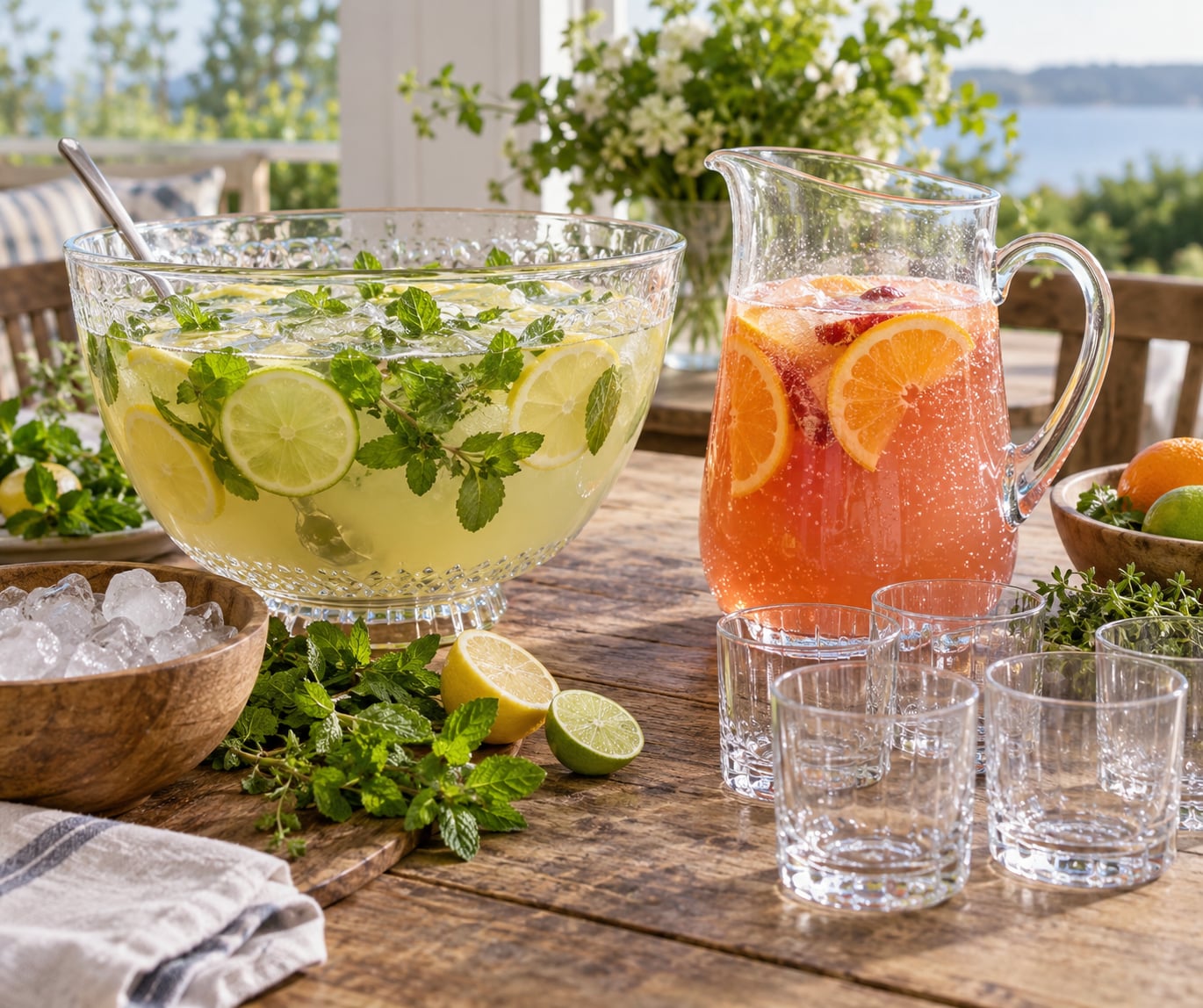
The bowl matters more than people expect. A glass punch bowl on a stand keeps the fruit visible and lets guests see what is in it, which matters a lot when one pitcher is alcoholic and one is not.
What you can make ahead and what has to wait
Most of the work happens hours before the party. Fruit syrups, juice blends, and garnishes are all fine the night before, refrigerated. Fruit that will brown, like cut apples or pears, gets added at the last minute instead, and a squeeze of lemon juice on the cut surfaces slows that down.
Spirits, sparkling ingredients, ice, and sherbet are all last-minute additions. A base that sat overnight without them is actually better, because it has time to chill all the way through, and a pitcher that has already gone flat cannot be rescued by garnishing it.
Step-by-Step: Two Punches From One Method
1. Choose the punch style and calculate the batch size
Choose a citrus-herb punch if you want something that reads as a real drink and holds up next to grilled food, or a sparkling fruit punch if you want brightness and sweetness control with nothing boozy in it. The two recipes below use the same method, so the deciding factor is the occasion rather than the difficulty.
Budget 8 to 10 ounces of finished punch per guest for a party running two to three hours, and round up. A holiday punch with sherbet on top drinks faster than a dry sherry punch, because the sugar makes people come back for another glass, and a warm-weather crowd will take more per person than a winter one, since cold drinks go down easier when the sun is out.
Double the recipe for 20 to 25 guests, quadruple it for 50, and for anything bigger than that, work in batches. Punch mixed in a home blender or a large stockpot at 50-plus servings turns into an emulsion of foam and fruit pulp that no straining will fix, and the flavors stop tasting clean somewhere past a gallon and a half.
Keep the alcoholic and nonalcoholic versions in separate pitchers, no exceptions, and use different garnishes so guests can tell them apart at a glance. The most common question on party forums is not how to make punch, it is how to run a two-drink table without somebody ending up holding the wrong glass all evening. Two pitchers, two ladles, two garnishes, and a small sign solves it.
| Guests | Finished punch | Base (juice, syrup, acid) | Spirit (if serving alcohol) | Sparkling, added last |
|---|---|---|---|---|
| 10 to 12 | 1.25 gallons | 6 cups | 1.5 cups | 3 cups |
| 25 | 2.5 to 3 gallons | 1 gallon | 1 quart | 1.5 quarts |
| 50 | 5 to 6 gallons | 2 gallons | 1 gallon | 3 quarts |
| 100 | 10 to 12 gallons | 4 gallons | 2 gallons | 3.5 gallons |
Those numbers are a starting point, not a rule. Plan on roughly a third of your guests drinking punch at all, add a little extra if the bowls are decorative and people keep refilling, and if children are present, count the zero-proof pitcher on its own, because that is the one that empties.
2. Prepare the fruit and herb base
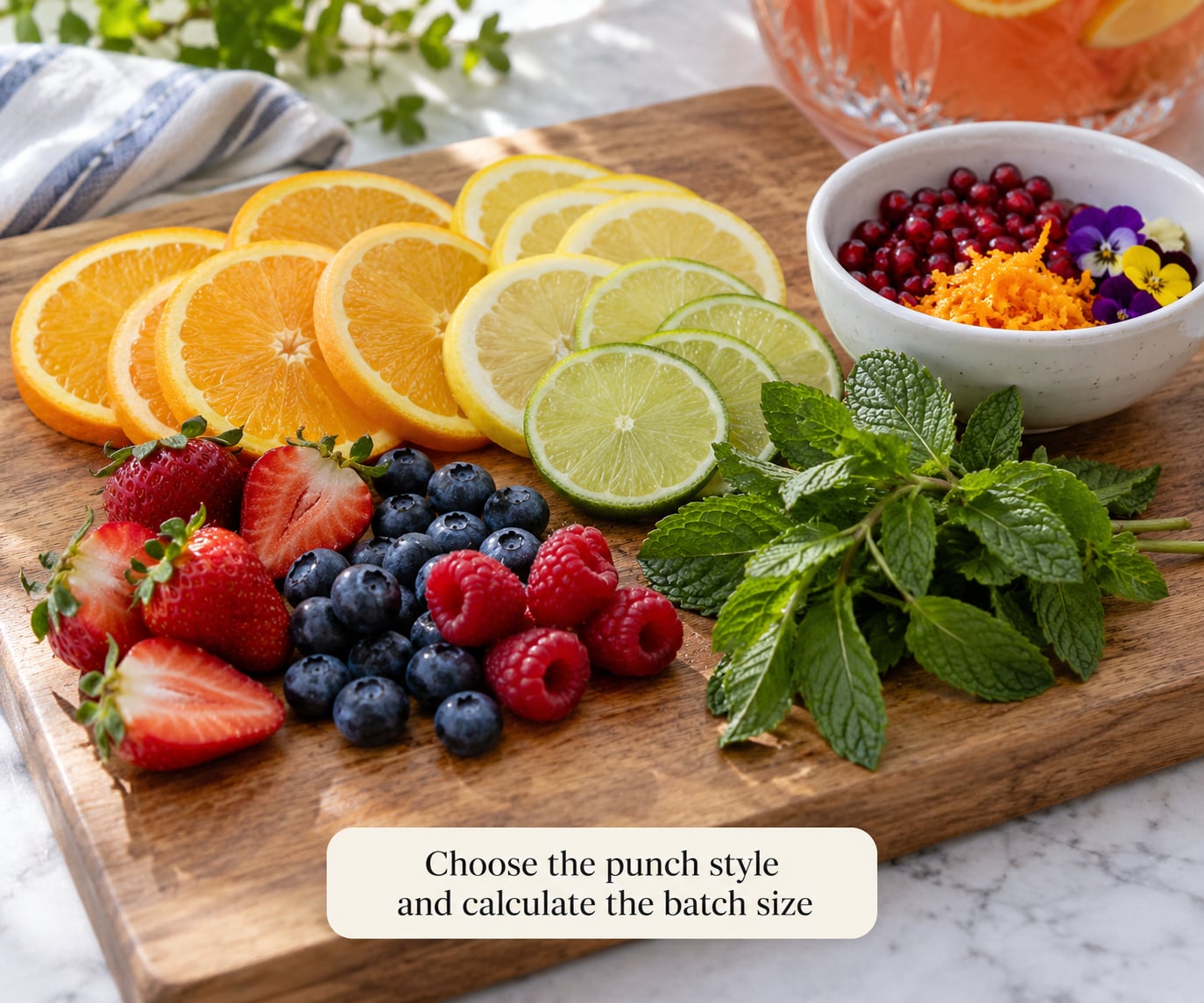
Wash everything first, then work fast. Slice lemons and limes thin enough that guests can pick pieces out of the bowl with a ladle, cut oranges into wedges rather than cubes so the juice is still visible, and leave berries whole.
Roll citrus between your palm and the counter before you cut it, or microwave it for ten seconds. That pressure is what pushes the aromatic oils out of the peel, and those oils are most of what makes a citrus punch smell like a drink instead of a juice.
For herbs, bruise rather than chop. Clap a bunch of mint between your hands a few times, or press rosemary and thyme with the flat of a knife for a few seconds, just until the leaves break and the needles darken. You are trying to break the cell walls and let the oils out into the liquid, not pulverize the herb into green flecks.
Sliced fruit does not need much prep. A couple of light muddles in the bottom of the pitcher is plenty, and over-muddling is the single most common way fresh fruit ends up as pulp floating in brown liquid. Twenty or thirty seconds per fruit, with the muddler leaning more on the peel than the flesh, gives you aroma without the mess.
For the simple syrup in both recipes, stir one cup of sugar into one cup of hot water until clear, then cool it. It keeps two weeks in the fridge, and making it once means the second pitcher of punch takes five minutes instead of fifteen.
3. Build the spiked citrus-herb punch
This is the one for a grill night, a holiday table, or any crowd that includes drinkers. It is deliberately not very sweet, because sugar gets amplified as the ice melts and the punch sits out.
Spiked citrus-herb punch, 10 to 12 servings: the juice and zest of 3 lemons, 1 cup homemade simple syrup, 1 sprig of rosemary about 4 inches long, 1 packed cup of mint leaves, 1.5 cups of vodka, gin, or white rum, 2 cups of soda water or dry sparkling wine, ice, and mint sprigs and lemon wheels for garnish.
Put the lemon juice, zest, simple syrup, rosemary, and about three quarters of the mint in the bottom of a large pitcher. Muddle gently for about thirty seconds, fill with ice, and let it sit for ten minutes so the citrus oils spread through the liquid. Pour in the spirit, then top with the soda water or sparkling wine.
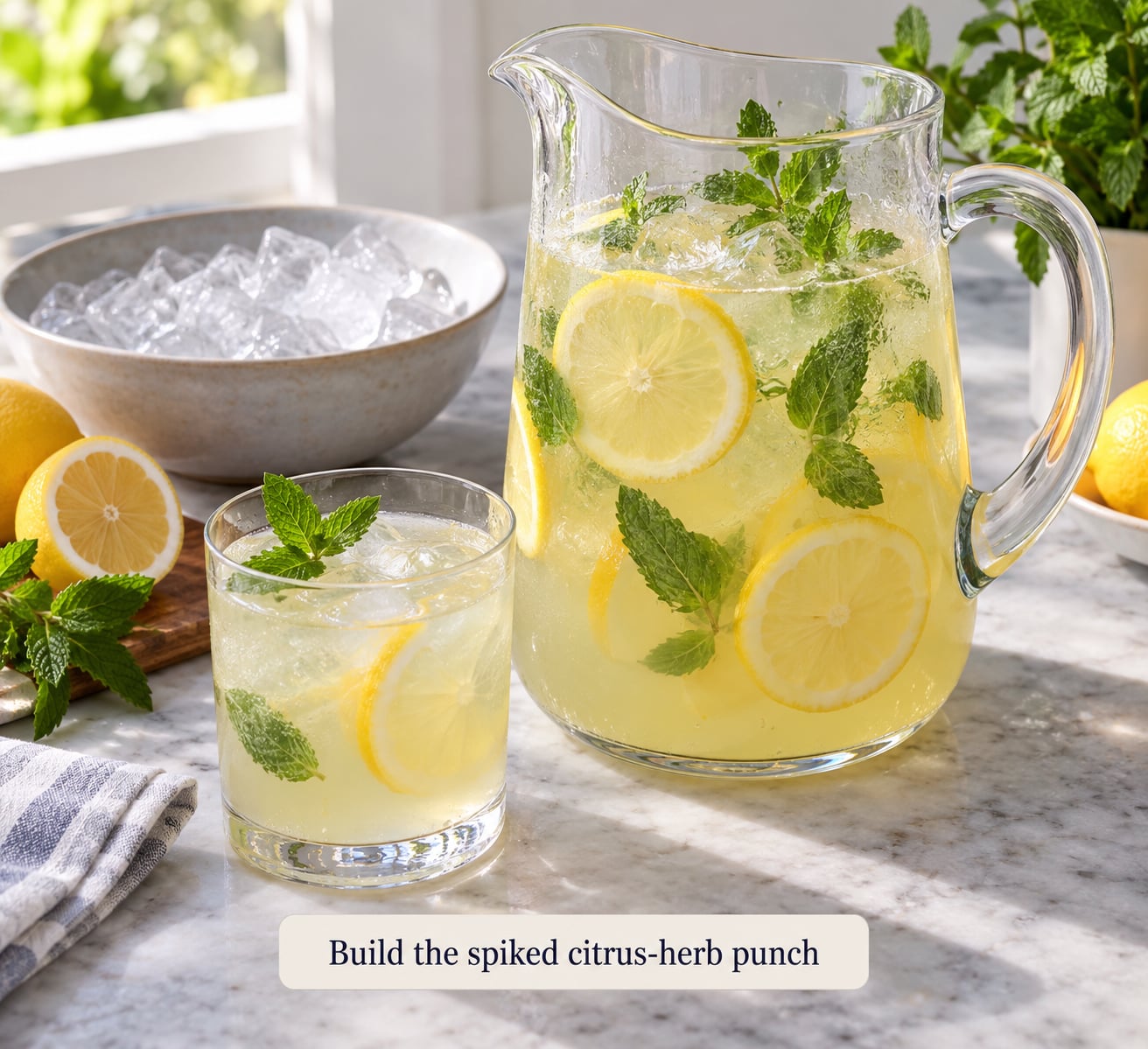
Taste before the ice goes in, and taste again after. A spoon with a splash of syrup fixes a punch that tastes sharp; a squeeze of lemon fixes one that tastes flat. The recipe is built so each glass lands around one and a half ounces of spirit, which is a noticeable drink over three hours and is why people often assume it is weaker than it is.
To go lighter, cut the spirit to one cup and add a cup more soda water. To go stronger, leave the soda water out entirely and add the spirit right before serving, which also solves the flatness problem because nothing is diluting the aromatics. Rum brings the fruit forward, gin makes the rosemary read more clearly, and vodka stays neutral so the citrus and herbs do all the talking.
For bourbon or whiskey instead, reduce the simple syrup by half, add a quarter cup of water, and skip the sparkling ingredient. That version wants to be stirred cold and served over ice in short glasses, not poured from a bowl.
4. Make the nonalcoholic sparkling fruit punch
Most zero-proof punch fails because it is built like dessert. This one is built in the opposite order: tartness first, sweetness second, bubbles last.
Sparkling fruit punch, 10 to 12 servings: 4 cups cranberry juice, 2 cups orange juice, 1 cup pineapple juice, the juice of 2 limes, half a cup simple syrup, 1 cup ginger ale, 3 cups soda water, and orange slices, cranberries, and a few mint leaves.
Stir the juices, lime, and syrup together in the pitcher and refrigerate them for at least two hours beforehand. This is the part that people get wrong: a warm base cannot be rescued by ice, it just makes a weaker drink. Cold liquids hold more sugar and more aroma, so the flavor tastes fuller even though nothing was added.
Add the ginger ale and soda water in the last minute, stirring once from the bottom with a ladle rather than shaking or stirring hard. Every bit of agitation pushes dissolved carbon dioxide out of solution, and a pitcher poured from a height loses its fizz even faster.
To keep it from tasting like a sweet soda, add the lime juice before the syrup, and taste. Cranberry juice is sharp enough to carry the whole bowl on its own, and it is the ingredient most people leave out even though it is what makes the drink read as punch. If you only have sweet juice, cut the syrup in half and add a splash of pomegranate or cranberry to pull it back.
A zero-proof spirit works here too if you want the adults to be drinking the same thing. Nonalcoholic whiskey, nonalcoholic rum, and alcohol-removed wine are all reasonable in a bowl punch, and at 10 percent of the volume in a big batch, a few people will not notice at all. Add them with the other liquids, not with the bubbles.
5. Chill, garnish, and serve
Cold punch is the difference between a good drink and a warm one. Refrigerate the base for at least two hours, and if you can, chill the pitcher itself, which in a pinch means a few minutes in the freezer with a towel wrapped around the glass, not a forgotten container of ice-water.
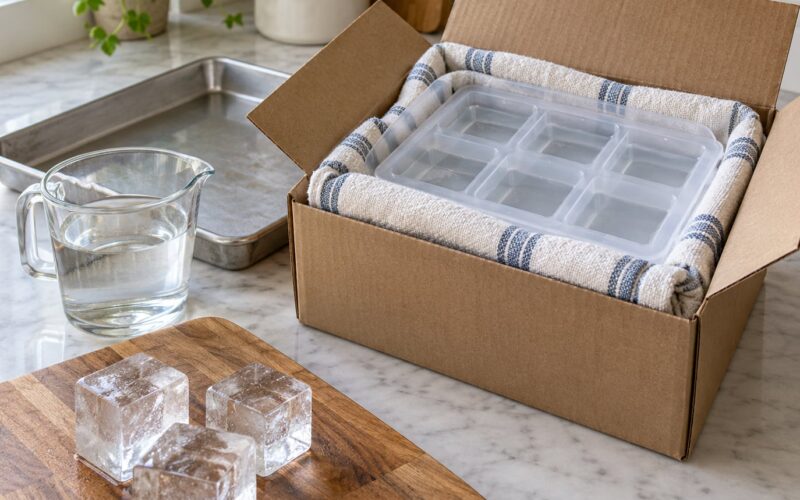
For a 25-guest or larger batch, freeze the fruit itself into the ice instead of using plain cubes. A ring of frozen cranberries, citrus, and herbs in the bottom of the bowl keeps the drink cold as it dilutes, slowly, instead of fast. A standard ice ring is made by freezing the liquid in a bundt pan, or in nested loaf tins if you do not have one.
Sherbet punches have a specific problem, which is that the bowl turns to water. The fix is to freeze the sherbet into scoop-shaped blocks or a ring ahead of time, then set those blocks into the punch at serving time. They melt slowly, foam on contact, and turn a diluted bowl back into something that looks worth taking a photo of.
Serve from a pitcher or dispenser with a spigot into short glasses over ice, and put the ice in the glass rather than the bowl. That way the bowl stays full of flavor for the whole party, and nobody is drinking a warm cup of fruit water at hour three. To refill, top the pitcher with more of the cold base, never with ice, and add only enough sparkling ingredient to bring the fizz back.
Refill sparingly, though. A pitcher that gets topped every twenty minutes never goes flat, but a bowl that never empties also never gets noticed by anyone. Refill when it is down to a third and give it a gentle stir with the ladle first.
Common Mistakes: Six Fixes for Six Bad Bowls
The list of punch problems is short and each one has an obvious cause. Work down it before you serve and most bad bowls never reach the table.
Punch that is too sweet
Too sweet is the most repeated complaint about homemade punch, and it is almost always one of three things: too much simple syrup, sherbet counted as a drinkable ice, or juice that already contains added sugar. The fix is dilution, in this order. Add an equal part of soda water, add a squeeze of fresh citrus, and only then consider cutting the syrup in your next batch. A punch needs a sweet point and a tart point working at the same time, and once the sweet wins, no amount of sparkling water fully rescues it because the sugar is already in solution.
Punch that is thin or watery
Thin punch is the opposite problem and it is a dilution issue. Ice and sherbet melt into the bowl faster than people drink it, and by the third hour the pitcher is mostly melted water with a lemon slice floating in it. The fix is to freeze the fruit rather than using cubes, hold the base at a higher concentrate, and serve the ice in the glass instead of the bowl. A pitcher that starts at 2 cups of base per 10 guests rather than 3 will still taste full-strength after two hours of melting ice.
Punch that is bitter or harsh
Bitterness in punch comes from three places: too much citrus peel, an over-bruised herb, or tannin. Citrus zest turns bitter fast, so zest only the yellow part of the lemon and keep the quantity modest. Herbs like rosemary, thyme, and sage are the ones to watch, since bruising releases their bitterness along with their aroma, and one sprig is usually enough for a gallon.
Punch that goes flat
Flat punch is a timing problem, not a recipe problem. Carbonation begins leaving the moment it is mixed, so sparkling wine, soda water, ginger ale, and tonic all go in within fifteen minutes of serving, poured down the side of the pitcher, and never stirred after. A second trick is a squeeze of lemon, which perturbs the dissolved gas enough to help a tired pitcher perk up in the glass.
Punch of unpredictable strength
This is the one to think about before the party, not after. A large-format drink measures itself out to a guest who has poured from a communal bowl twice, and the person pouring takes the smallest glass on the table. Decide on one measure that counts as a serving, roughly 8 to 10 ounces, and pour to that mark. For guests who are driving, pregnant, taking medication, or simply not drinking, keep the zero-proof pitcher beside it, use a different garnish, and say out loud which is which. Most home brewers of punch are a designated driver, and a labeled table is the simplest courtesy there is.
Sherbet punch that turns to water
Spooning sherbet into a bowl looks festive and works fine for the first ten minutes. After that, it is a dilution problem with a sugar problem attached. Freeze the sherbet the night before into blocks or a ring, set them in at serving time, and cut back the syrup in the base, because frozen sherbet brings its own sweetness as it goes down.
Frequently Asked Questions
How much punch do I need per person?
Plan on 8 to 10 ounces of finished punch per guest for a party lasting two to three hours, and round up. That works out to about 1.25 gallons for 10 to 12 people, 2.5 to 3 gallons for 25, and 5 to 6 gallons for 50. Sweet or creamy punch disappears faster than dry punch, and children drink the zero-proof pitcher at their own pace, which is usually slower than adults expect.
How far in advance can I make punch?
Mix the base, the sweetener, and the acid up to 48 hours ahead and refrigerate it. The juice and syrup blend actually tastes more balanced on the second day once the flavors have married. Leave the sparkling ingredients, the ice, fresh fruit, and any sherbet out until the last fifteen minutes before serving, since carbonation and volume cannot be recovered later.
How do I keep punch fizzy for a whole party?
Add soda water, ginger ale, tonic, or sparkling wine within fifteen minutes of serving and pour it down the side of the pitcher without stirring. Chill everything beforehand, because cold liquid holds carbonation better than warm. If a pitcher goes flat during the party, skip the ice and add cold base plus a fresh splash of sparkling water rather than topping with ice, which thins the flavor fastest.
How do I make nonalcoholic punch that is not too sweet?
Build the drink tart first and sweet second. Use cranberry or pomegranate juice for the base, add fresh lime or lemon juice, then add simple syrup in small amounts while tasting. Skip the syrup entirely when your juice is already sweetened, and count sherbet and grenadine as sweeteners. Finishing with a squeeze of citrus and cold soda water is usually enough to make a batch read as punch instead of candy.
Can I use one base for both an alcoholic and a nonalcoholic punch?
Yes, and it is the most efficient way to run a mixed crowd. Mix one large base of juice, syrup, and citrus, then split it into two pitchers. Add your spirit to one and an equal volume of cold soda water to the other so the strength of both matches. Garnish them differently, label them, and keep separate ladles so nobody pours the wrong one.
Should I put ice in the punch bowl?
Only if the ice is frozen into the fruit rather than used as plain cubes. Plain ice melts into the bowl and leaves a watery pitcher after a couple of hours. Freeze citrus slices, berries, and herbs into a ring or blocks instead, serve regular ice in the glasses, and refill pitchers with more cold base rather than more ice. That one change fixes the most common complaint about homemade punch.
Conclusion: Decide the Batch, Then Taste Before You Serve
Start with the guest count, because everything else follows from it. Pick eight to ten ounces per person, build the fruit and herb base from the shopping list above, and taste that liquid on its own before any spirit, soda, or ice goes into it. That one taste tells you whether you need more acid, more syrup, or more dilution, and it is the step most people skip.
After that, the method is identical whether you are serving alcohol or not. Chill the base for two hours, add the bubbles and the fruit in the last fifteen minutes, and keep the two pitchers separate and clearly labeled so a group of mixed drinkers and non-drinkers can all have a glass that tastes deliberate rather than like an afterthought.