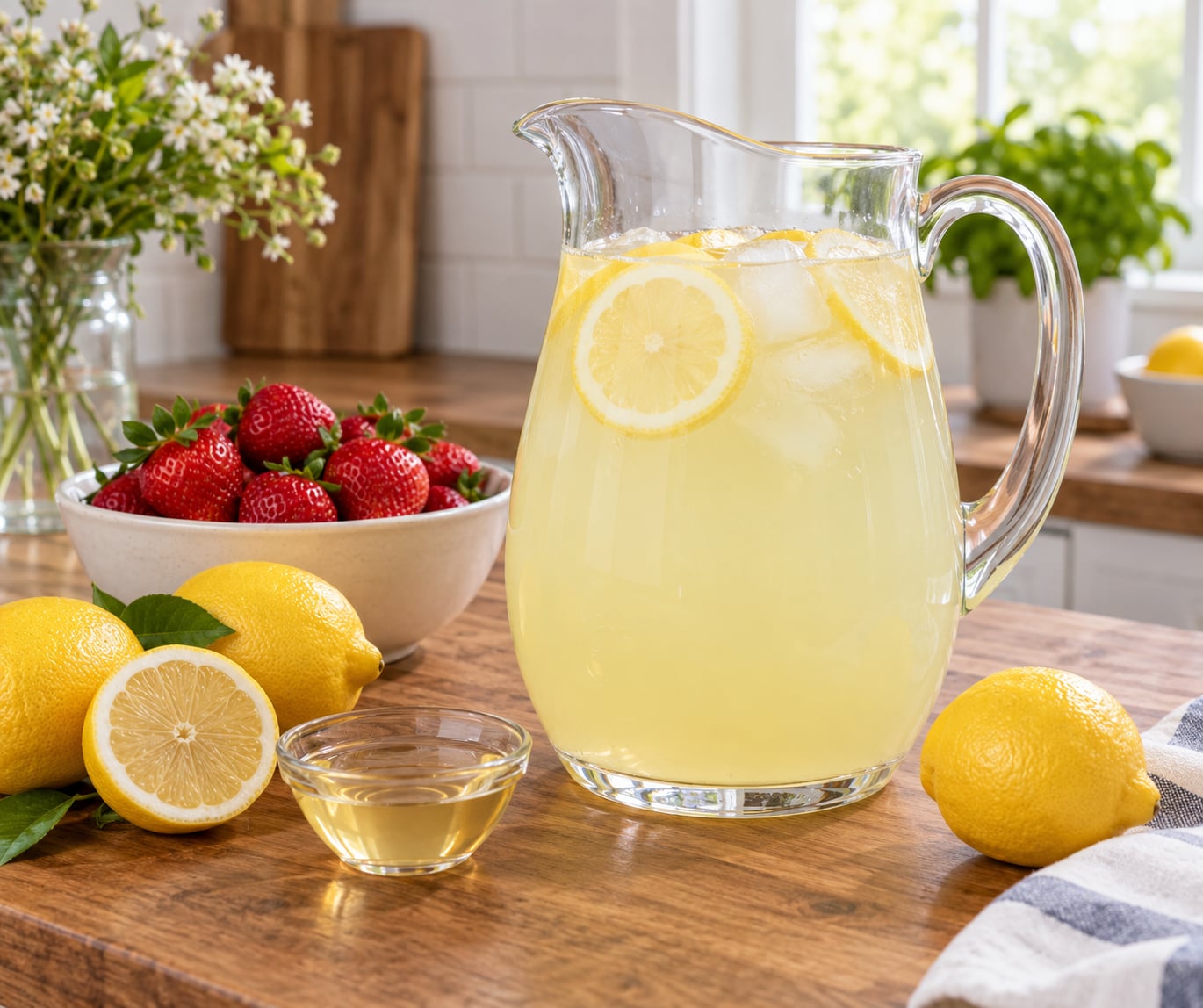
The reliable way to make flavored lemonade for a crowd is to build one strong base — a 1:1 simple syrup plus measured lemon juice — and add your fruit, herb, or spice flavor to that base instead of mixing each flavor from scratch. Plan on about one gallon per 10 to 12 guests for a two to three hour party, and budget an hour of active time.
I make this every summer for a backyard gathering of roughly 30 people, and the thing that used to trip me up was never the flavor. It was running out at half past five, when the grill was still going and nobody wanted to leave.
A gallon of finished lemonade is 16 cups, which lands somewhere between 12 and 16 servings depending on whether people are nursing an 8 ounce glass or topping up a 16 ounce cup. Over a three hour party, that is a realistic number. Cooks working this out on forums keep landing on the same figure of roughly a gallon per 10 to 12 guests, with more if the event is outdoors in July.
Table of Contents
- What You Need
- Equipment for a batch and a half
- Base ingredients for 1 gallon (12 to 16 servings)
- How much lemonade for your guest count
- Step-by-Step: How to Make Flavored Lemonade for a Crowd
- Make the Simple Syrup
- Skip the Stove: The No-Cook Route
- Choose and Blend the Flavor
- Dilute, Chill, and Serve
- Make-Ahead Timeline for Party Day
- Common Mistakes
- Frequently Asked Questions
- How much flavored lemonade should I make for a crowd?
- Can I make flavored lemonade ahead of time?
- Is bottled lemon juice good for a large batch?
- How do I keep flavored lemonade from getting watery?
- What is a kid-friendly flavor for a lemonade pitcher?
- Conclusion
What You Need
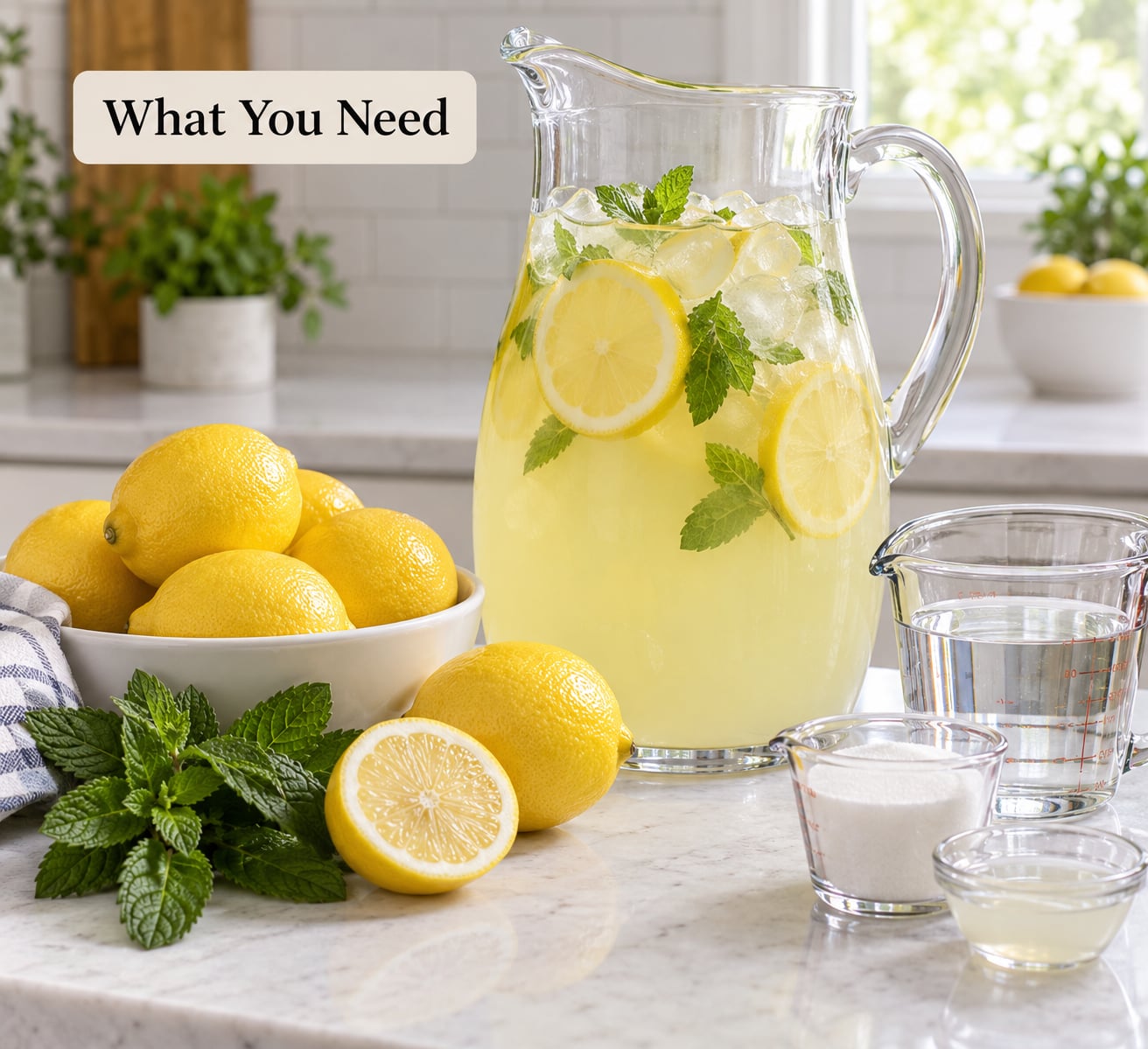
The ingredient list is short. What changes at scale is your equipment — a one-gallon batch fits in a large pitcher, three gallons or more does not.
Equipment for a batch and a half
- A heavy-bottomed pot with a lid, at least 3 quarts, for the syrup
- A 5 gallon food-safe bucket or two 2 gallon containers, for anything above 2 gallons
- A long spoon or whisk, plus a strainer
- A citrus juicer, or an electric one if you are squeezing more than 30 lemons
- Airtight containers with lids for storage
- A spigot dispenser or a pitcher plus ladle for serving
Base ingredients for 1 gallon (12 to 16 servings)
- 3 cups granulated sugar
- 3 cups water for the syrup
- 2 cups fresh lemon juice, roughly 6 to 8 lemons
- 8 cups cold water to finish the batch
- Flavor of your choice — see the flavor table below
- Ice, roughly 1 pound per gallon for serving in glasses
Use real lemons if the drink is the centerpiece. Bottled juice works, and I will get to that below, but fresh zest plus fresh juice has an aroma that bottling flattens out.
How much lemonade for your guest count
This is the table I wish someone had handed me before my first big party. Multiply the sugar and water columns by two if you want a sweeter drink, and always round up.
| Guests | Gallons | Lemons | Sugar | Syrup Water | Cold Water |
|---|---|---|---|---|---|
| 10 | 1 | 6 to 8 | 3 cups | 3 cups | 8 cups |
| 25 | 2 | 12 to 16 | 6 cups | 6 cups | 16 cups |
| 50 | 5 | 30 to 40 | 15 cups | 15 cups | 40 cups |
| 75 | 7 | 42 to 56 | 21 cups | 21 cups | 56 cups |
| 100 | 10 | 60 to 80 | 30 cups | 30 cups | 80 cups |
Step-by-Step: How to Make Flavored Lemonade for a Crowd
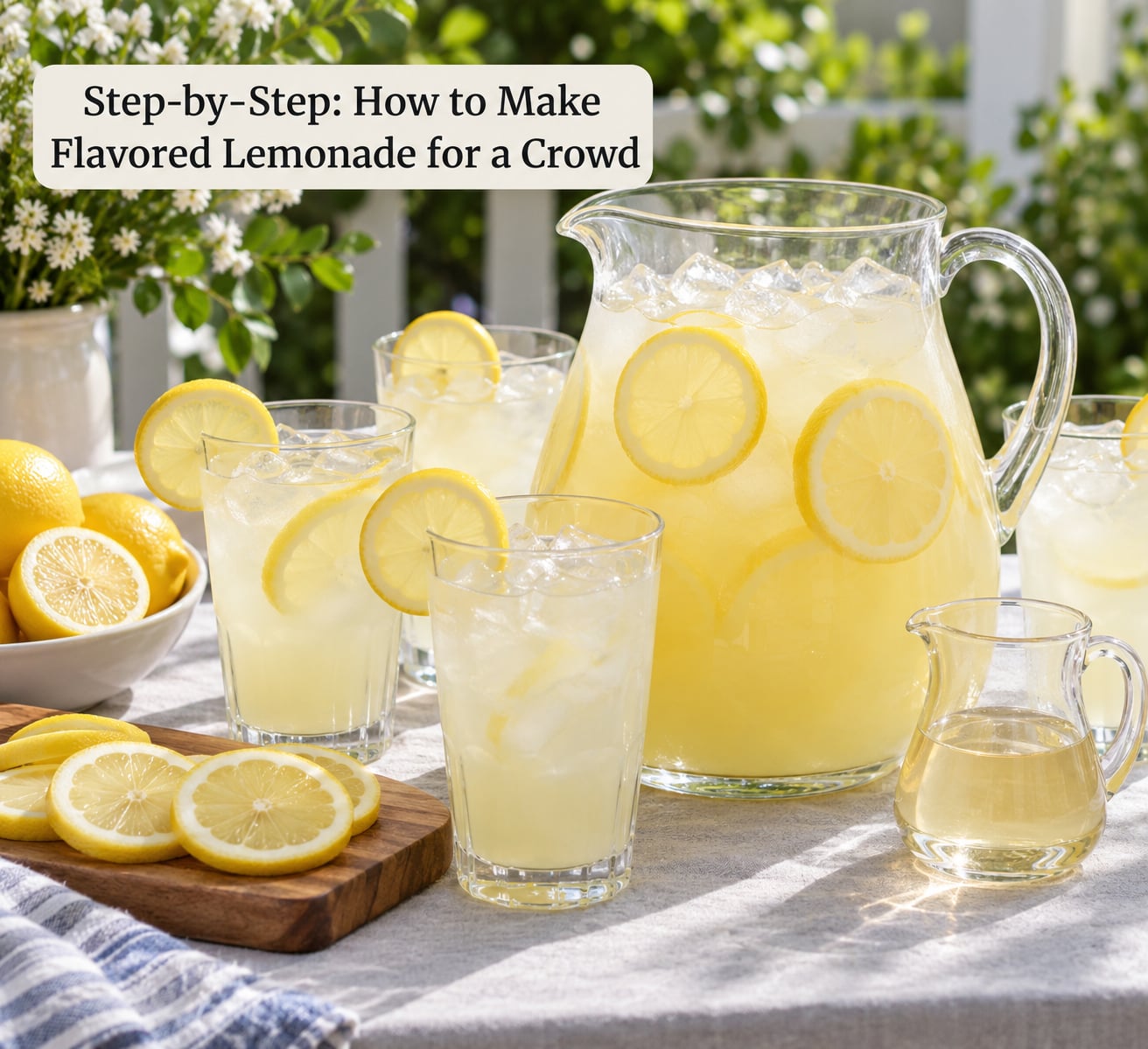
There are four stages: syrup, lemon base, flavor, and dilution. Get the first three right and the last one is a two-minute taste test.
Make the Simple Syrup
Simple syrup is sugar and water in equal weights. For one gallon of finished lemonade, combine 3 cups sugar and 3 cups water in your pot and bring it just to a boil, stirring until the sugar vanishes.
Pull it off the heat the moment it clears and let it simmer no more than 5 minutes. Longer simmering concentrates it, and a heavy syrup that does not pour cleanly is harder to measure into a big bucket later. If you overshoot it, add a splash of hot water to loosen it back up.
Cool the syrup before it meets lemon juice, or you will cook the juice and dull the flavor. It cools fastest in a wide bucket with the lid off. Once cool, cover and refrigerate; it holds for about a week and freezes fine if you made too much.
Skip the Stove: The No-Cook Route
You have two no-cook options and both beat a warm pot on a hot day. The cold brew method is the simplest: put the sugar in a lidded jar with the measured water, shake for 30 seconds, then shake again every 20 minutes or so for an hour until the sugar disappears from the bottom.
The second option steeps fruit directly in sugar overnight, which is what most home cooks do with berries. Berries release juice as they sit, and the sugar draws it out without any heat at all.
Choose and Blend the Flavor
Add flavor after the base is made, and measure it. The table below gives a per-gallon quantity for each one, since a tablespoon of lavender goes a long way and a cup of watermelon does not.
| Flavor | What to Add Per Gallon | Time | Watch For |
|---|---|---|---|
| Lemon mint | 1 packed cup mint leaves, 1 extra lemon zest | 30 minutes steep | Bitter notes if you boil the mint |
| Strawberry lemon | 2 cups mashed strawberries, about a pint | 1 to 2 hours at room temperature | Add the berry juice too, not just the pulp |
| Cucumber lime | 4 thin-sliced cucumbers, swap half the lemon juice for lime | 2 hours | Too much lime makes it sour, not balanced |
| Ginger lime | 1 tablespoon finely grated ginger, lime juice in place of half the lemon | 30 minutes, strain | Grate it fine or it tastes gritty |
| Watermelon | 3 cups cubed watermelon, blended | 1 hour | Strain out the seeds |
| Peach | 3 cups sliced ripe peaches | 1 to 2 hours | Underripe peaches will not give up flavor |
| Raspberry | 2 cups mashed raspberries | 1 hour | Dusty skin, so press and strain |
| Lavender | 2 teaspoons culinary dried buds | 15 to 20 minutes, strain out every bud | Buds left in turn the whole batch soapy |
Herbs go in cold and steep; they lose their aroma in boiling liquid. Fruit can go in either way, but berries and melon prefer the counter, not the fridge, where cold dulls them.
Fresh fruit, extracts, and herbs all have a place here. Fruit gives body and color, extracts give a clean note when you cannot get good produce, and herbs give the top note people actually smell before they taste.
Watch the acid. When you swap in lime juice or add something sharp like ginger, cut the lemon juice by half a cup per gallon first, then taste. Two acidic flavors stacked on top of each other is how you end up with a batch nobody finishes.
Dilute, Chill, and Serve
For a crowd pitcher, the ratio is 4 parts syrup to 1 part lemon juice to 2 parts cold water. That comes to 4 cups syrup, 2 cups lemon juice, and 8 cups water for your finished gallon.
Mix the syrup and lemon juice first in the bottom of the container, then add the cold water. It dissolves faster and it means you can adjust the water without disturbing sugar that has already settled.
Now taste it with a teaspoon, not a strawful, and adjust one thing at a time. Too tart, stir in simple syrup a quarter cup at a time. Too sweet, add water a cup at a time. Too harsh, a splash of cold water softens the acid faster than more syrup does.
Chill for at least four hours, and six is better. Cold dulls sweetness, so a drink that tasted slightly sweet at room temperature usually lands right in the refrigerator.
For the ice, do not dump it all into the batch. Ice melts and thins the lemonade within about 20 minutes. Put ice in the glasses and keep the pitcher cold, either in a tub of ice and water or in the fridge with a spigot dispenser on the porch.
Garnish last, right before serving, so the herbs and fruit do not go soft and brown in the jar. Lemon wheels, a few mint sprigs, or a small pitcher of extra syrup for people who want it sweeter handles the whole room.
Make-Ahead Timeline for Party Day
- The day before: cook the syrup, steep the fruit or herbs, cover both, refrigerate
- Morning of: combine syrup, lemon juice, and cold water in the serving container, stir, refrigerate
- Four hours out: freeze lemon or fruit ice cubes in trays
- One hour out: set up the dispenser, chill glasses if you have the space
- At serving: add ice to glasses, garnish, keep the container cold on ice
Common Mistakes
Too sweet. You scaled a recipe written for eight glasses and kept the sugar. Fix it with cold water, a cup at a time, and taste again. Next time hold back a quarter cup of sugar per gallon and let guests add it at the table.
Too sour. Usually too much lime or a squeezed lemon that was mostly pith. Blend in a half cup of simple syrup per gallon, and add lime juice after the lemon, never before.
Watery. Ice melted into the batch, or you were generous with the cold water. Keep the pitcher on ice instead of serving it over a mound of cubes, and use smaller cubes since they melt slower.
Bitter. Lemon zest got boiled, or lavender buds stayed in. Strain now if you can and add a tablespoon of honey or sugar water to soften what is left.
Separated or dull. Fruit sat for hours without being strained or pressed. Press the fruit, strain out the seeds and skins, and keep the juice, because that is where the flavor is.
Scaling past 50 guests, stop doubling recipes and build the batch from the per-gallon numbers in the table instead. Doubling a home recipe four times usually means four times the sweet and a third of the lemon. And if five gallons feels like too much to squeeze, freeze the lemon juice in ice cube trays the night before, then blend the cubes straight into the syrup.
Frequently Asked Questions
How much flavored lemonade should I make for a crowd?
Plan one gallon per 10 to 12 guests for a two to three hour party, which works out to roughly 12 to 16 servings of 8 to 12 ounces. That is 2 gallons for 25 people, 5 gallons for 50, and 10 gallons for 100. Add half a gallon if the party is outdoors in hot weather or the kids are running around.
Can I make flavored lemonade ahead of time?
Yes, and it actually tastes better. Cook the simple syrup and steep your fruit or herbs the day before, both covered in the fridge. On party day just combine syrup, lemon juice, and cold water, then refrigerate at least four hours before serving. Finished lemonade keeps about 3 to 4 days refrigerated.
Is bottled lemon juice good for a large batch?
It works fine, and most home cooks use it once they are squeezing more than 30 lemons. The difference is aroma and a slightly flatter taste, so compensate with a little fresh zest and a fresh herb. Use roughly two cups of juice per gallon and adjust with cold water until it tastes balanced.
How do I keep flavored lemonade from getting watery?
Keep ice out of the batch and put it in the glasses instead, since cubes dilute the drink within about 20 minutes. Set the container in a tub of ice and water, or pre-chill it in the fridge, and use smaller cubes because they melt more slowly. Refill from the cold container rather than from whatever is left on the table.
What is a kid-friendly flavor for a lemonade pitcher?
Strawberry lemon is the safe pick, and watermelon works well in summer. Muddle two cups of berries per gallon with a little lemon juice, let them sit an hour, then strain and add them to your base. Skip anything bitter or floral like lavender, and hold the acidity down if the kids are sensitive to sour drinks.
Conclusion
Start with the syrup and the lemon base, get that batch cold, and only then add your flavor and your water. Ice goes in the glasses, not the pitcher, and the drink stays balanced for the whole party.
Once you have that base down, you can split a three gallon batch into three containers and turn each one into a different flavored lemonade for the same gathering, without making three separate recipes.