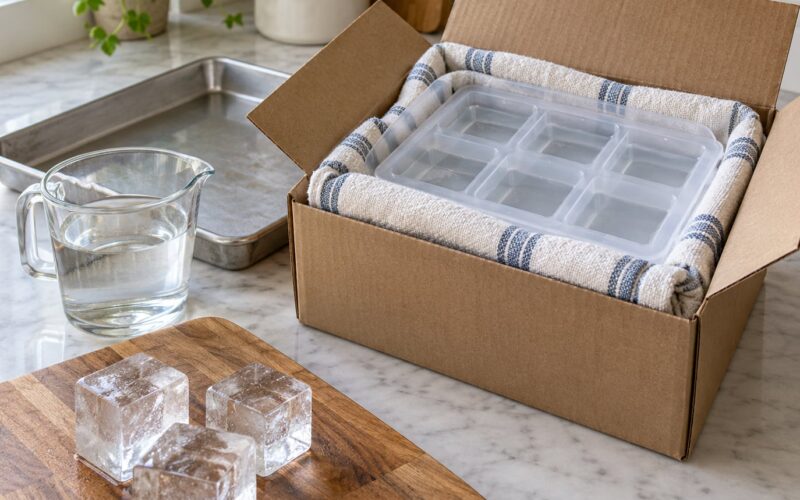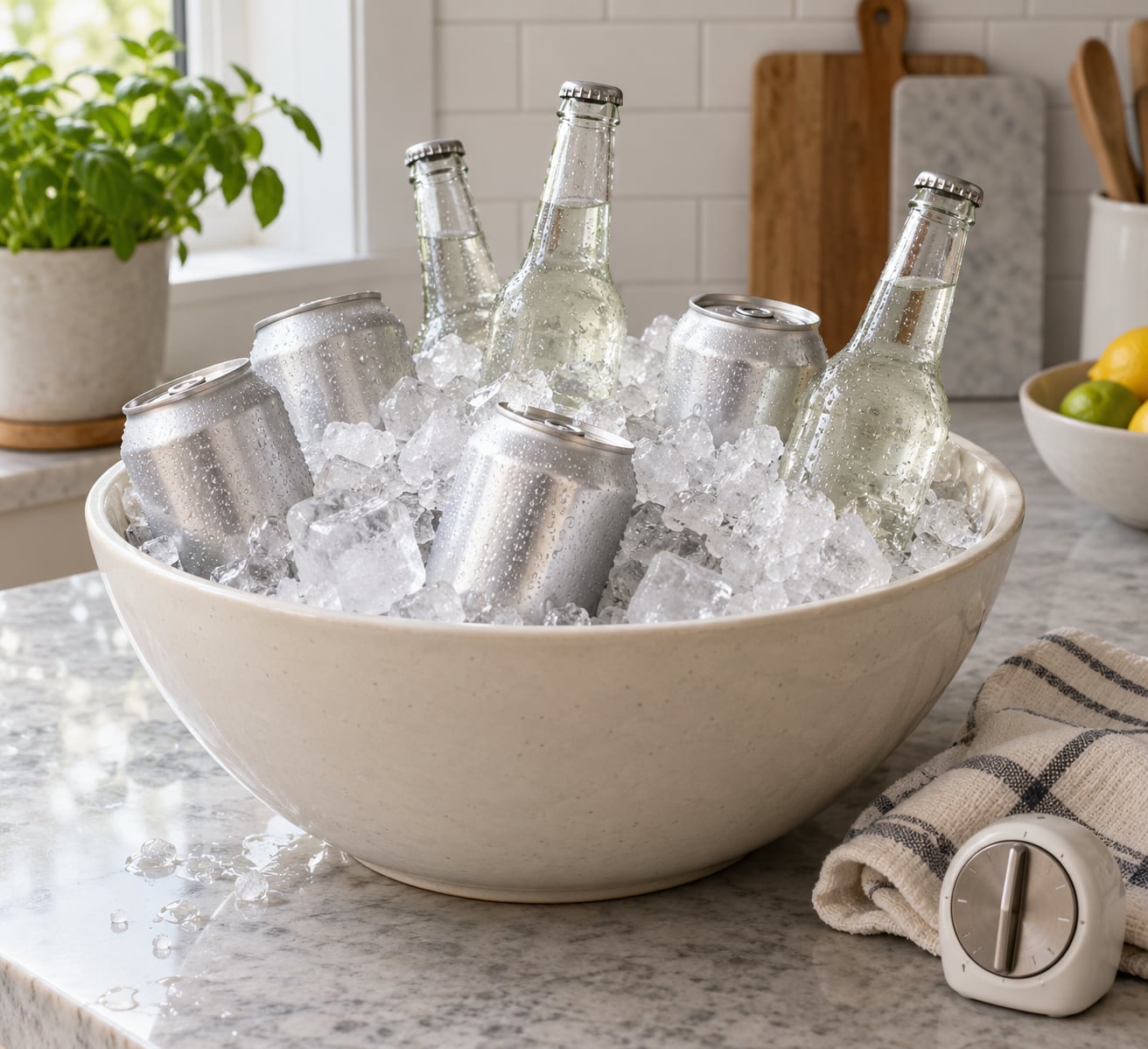
The fastest way to chill drinks fast without ice is a salt bath: bury the cans or bottles in ice with coarse salt and a splash of water, then rotate them for 10 to 15 minutes. A timed freezer chill is the runner-up, and for a real crowd, chilling bottles in the refrigerator a few hours ahead beats everything.
Most people only need this once a year, right when the ice bin runs empty an hour before kickoff. Which is exactly when nobody wants to be improvising.
Here is the whole playbook: what to gather, five methods ranked from fastest to most convenient, the mistakes that cost you ten minutes, and how each method behaves with beer, soda, wine and cocktails.
Table of Contents
- What You Need
- Step-by-Step: 5 Ways to Chill Drinks Fast
- 1. Use Ice and Salt for the Fastest Chilling
- 2. Use Wet Salt Around the Drinks
- 3. Turn Bottles While Soaking Them in Cold Water
- 4. Chill Cans in a Freezer With a Timer
- 5. Chill Bottles in the Refrigerator in Advance
- Common Mistakes
- Frequently Asked Questions
- Can salt chill drinks without adding ice?
- Is the ice-and-salt method safe for glass bottles?
- How long does it take to chill a warm drink?
- Can I chill a carbonated can in the freezer?
- What is the fastest way to chill a bottle for serving right away?
- Conclusion
What You Need
The salt bath needs very little, and you probably own all of it already.
- A large bowl or stockpot. Wide matters more than deep. Drinks packed shoulder to shoulder touch more of each other and chill faster.
- A metal or food-safe plastic container. Metal pulls heat out of the liquid quicker than plastic or glass.
- Coarse salt. Pick the box that says sea salt or kosher salt. Table salt dissolves too fast and you lose the slush that does the work.
- Water. Just enough to wet the salt, not enough to submerge the drinks.
- A bottle opener. For once, opening first is better than opening later.
- A towel. The salt bath gets messy, and so does everything after it.
- A timer. This one matters. It is the difference between a cold beer and a burst can.
A few optional extras unlock the other methods: a freezer for the timed chill, a roll of paper towels for the wet wrap, and a bucket or cooler if you are working outdoors.
Step-by-Step: 5 Ways to Chill Drinks Fast
1. Use Ice and Salt for the Fastest Chilling
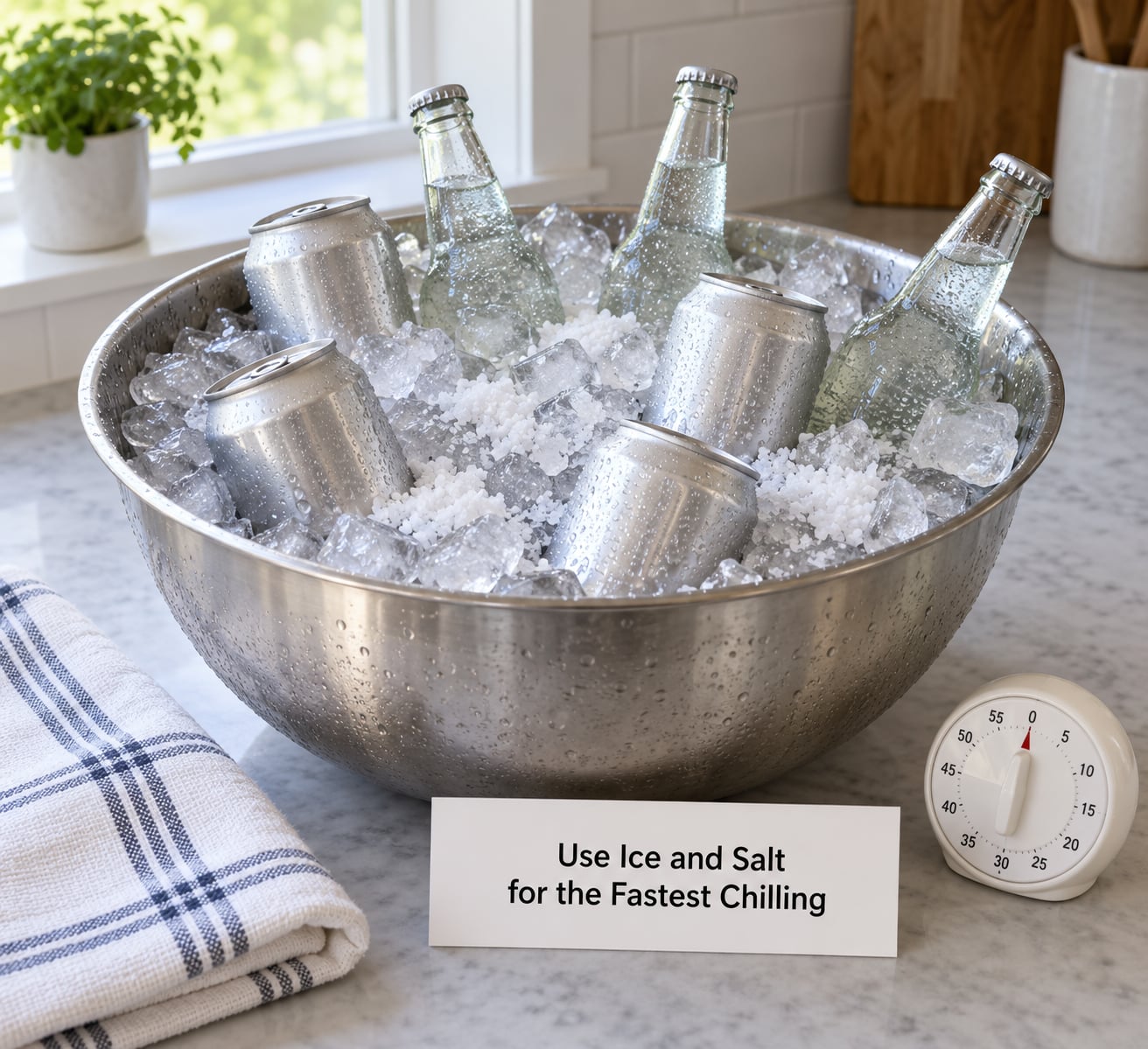
Ice plus salt chills most cans and bottles to drinkable temperature in about 10 to 15 minutes. The salt drops the melting point of the ice, so the bath keeps pulling heat out of the drink long after plain ice would have warmed up.
Pack the container about two-thirds full of ice, nestle the drinks in, then pour coarse salt over the top until the ice looks grey-white. Add a small splash of water, just enough to bridge the gaps between the ice pieces.
Turn each container a quarter rotation every three minutes. Drink containers that sit still warm unevenly, and the one leaning against the side of the bowl chills more slowly than the one in the middle.
You will know it worked when the outside of the can or bottle is frosted solid and the drink is visibly sweating.
Two warnings. Do not freeze glass bottles in this bath, and throw that bath water away afterwards rather than pouring it into a drink. It is far too salty to taste good.
2. Use Wet Salt Around the Drinks
Wet salt is the near-dry version of the same idea, and it takes 12 to 18 minutes because there is less water moving heat through the drinks.
Lightly dampen the bottom of your container, spread coarse salt across it, and push the drinks down into the salt until each one sits in a shallow bed. Turn them once halfway through.
A dry crust forming on the surface of the salt means the moisture has been pulled out of the bed, which is the cooling step doing its job.
The tradeoff is handling. Every drink has to be lifted out of dry salt rather than scooped out of slush, so this suits five or six bottles better than a case of cans.
3. Turn Bottles While Soaking Them in Cold Water
Cold water with bottles turned by hand chills long-neck glass bottles in 20 to 30 minutes, and it is the gentlest method on fragile glass.
Fill a bucket or pot with cold tap water, submerge the closed bottles, and add a handful of ice if you have any. That handful is optional, not the point of the method.
Rotate the bottles every five minutes or so. Water that sits still forms a warm layer against the glass, and moving it resets that layer.
A room-temperature bottle needs roughly 20 to 30 minutes in cold water. Pull one that started in the refrigerator and it is drinkable in about 10. Thin aluminum cans chill quicker than glass bottles but also come straight to room temperature the moment they leave the water.
4. Chill Cans in a Freezer With a Timer
Twenty to 30 minutes in a freezer chills a can of soda or beer, but only with a timer set the moment it goes in.
Lay cans flat in a single layer rather than stacking them, since stacked cans touch each other and warm each other from the outside in. Thick glass bottles can handle this, though they need longer.
Never leave a carbonated drink in the freezer unattended. Liquid expands as it freezes, and the pressure has nowhere to go in a sealed can or bottle. Set the timer, and if you step away, pull them out.
The ice-and-salt bath still wins when drinks are needed immediately. The freezer only looks faster because you can walk away from it, and that gap is exactly how cans get forgotten.
If a can does burst, clean it up before it dries. The sticky residue is sugar and syrup, and it attracts every insect within a mile.
5. Chill Bottles in the Refrigerator in Advance
The refrigerator is the lowest-effort method and the best one when the gathering starts in a few hours rather than a few minutes.
Move bottles to the coldest shelf, usually the back of the bottom shelf, and leave them there for two to four hours. A bottle that has been at room temperature needs the closer to four hours.
Handle glass gently. A quick cold bottle straight from the shelf has enough thermal shock to crack if you drop it on a hard floor, so set it down instead.
This is the one method with no failure mode. Nobody has ever burst a beer in a refrigerator, and nobody has ever regretted stocking the shelves two hours early.
Common Mistakes
Most slow chilling comes down to six repeatable errors, and each has a one-line fix.
Not enough ice. A half-full bowl chills a case of cans badly. Fill the container two-thirds with ice and pack the drinks in tight, because touching surfaces move heat faster than air gaps.
A container that is too small. Crowding is actually helpful, but a shallow tray leaves cans sitting on warm counter instead of surrounded by cold. Use the deepest bowl you have.
Forgetting to rotate. Turn or roll every container every three to five minutes. The drink touching the side of the bowl is always the slowest one to chill.
Overfilling the freezer. Two layers of cans cannot chill evenly, and the middle of the pile stays warm while the edges freeze. One flat layer, timer running.
Freezing glass. Thick glass and carbonated drinks are a bad pairing in a freezer. Save glass bottles for the fridge or the water soak.
Judging by the container. A frosted can with a warm core feels colder than it is. Press the middle of the can against your palm, not the ends, before you pull the whole batch.
Here is the short version for serving night. Start the salt bath or set the freezer timer before you touch the food, put out the towel and opener at the same time, and test one drink in the center of the batch rather than the one you happen to grab first.
Frequently Asked Questions
Can salt chill drinks without adding ice?
Yes. Salt lowers the freezing point of water, so a salty slush stays colder than plain ice and keeps absorbing heat from the drinks around it. This is why professional kitchens use salt baths for rapid chilling. You can make a near-dry version by dampening a container, spreading coarse salt across the bottom and nesting the drinks into it, though it runs a little slower than the wet version.
Is the ice-and-salt method safe for glass bottles?
It works, but glass takes more handling than aluminum. Thin-walled bottles are the risk, since cold glass is brittle and drops easily. If your bottles are thick standard wine or beer glass, set them into the slush gently instead of dropping them, and turn them by the neck. If you want zero risk, use the cold water soak or the refrigerator instead.
How long does it take to chill a warm drink?
A room-temperature can or bottle needs about 10 to 15 minutes in an ice and salt bath, roughly 20 to 30 minutes in cold tap water with rotation, and 20 to 30 minutes in a freezer. A drink that already sat in the refrigerator reaches serving temperature about twice as fast in every method. Test the middle of the batch before you commit to pouring.
Can I chill a carbonated can in the freezer?
You can, with a timer set the moment the can goes in and a conservative 20 to 30 minute limit. Freezing liquid expands, and a sealed carbonated can has nowhere for that expansion to go. Never leave carbonated drinks unattended in a freezer, and remember that a can chilled to the edge of freezing loses some of its carbonation when you open it.
What is the fastest way to chill a bottle for serving right away?
The ice and salt bath, by a wide margin. Fill a bowl two-thirds with ice, bury the bottles, cover them with coarse salt, add a small splash of water and rotate every three minutes. Expect 10 to 15 minutes for most bottles. For glass specifically, the cold water soak takes 20 to 30 minutes and removes the risk of cracking.
Conclusion
The ice and salt bath is the answer when people are already waiting on a drink, and 10 to 15 minutes is a realistic window rather than a marketing number. For a bigger group or a planned afternoon, moving bottles into the refrigerator a few hours ahead is quieter and safer, and it never fails.
Start the salt bath or set the freezer timer before you arrange the food. By the time the burgers are plated, the drinks are cold, and nobody is standing at the sink with a towel wondering what went wrong.