Yes, sangria is one of the easiest drinks to make ahead of time, and a longer chill usually makes it better. Mix the wine, liqueur, juice and fruit, cover the pitcher, and refrigerate for 4 to 8 hours or overnight, then add sparkling water and ice only when you are ready to serve.
Best flavor lands inside 48 hours, and a covered pitcher in the fridge holds about 3 to 4 days. The one rule that decides whether a make-ahead batch tastes great or tastes flat is simple: nothing fizzy and nothing frozen goes in until the moment you pour.
I make a pitcher for every cookout, and the version I bring out is mixed the night before while I am still chopping peppers for the burgers. Ten minutes of work buys me a pitcher that pours like a finished bar drink instead of a last-minute scramble. Total hands-on time is about 20 minutes. The waiting is free.
Below is the method I use, plus the numbers I actually measure with rather than eyeballing. If you only take one thing from it, make the base the night before, skip the ice, and finish it at serve.
Updated for 2026
Table of Contents
- What You Need
- The base
- Optional additions
- Equipment
- How much to make for a crowd
- Step-by-Step: How to Make Sangria Ahead of Time
- Step 1: Chill the wine
- Step 2: Cut the fruit the right way
- Step 3: Build the base in the right order
- Step 4: Cover and chill for 4 to 8 hours, or overnight
- Step 5: Taste and adjust on serve day
- Step 6: Add the sparkle and the cold at the last minute
- The make-ahead timeline at a glance
- How to Store Sangria Made Ahead of Time
- How to Keep Sangria From Getting Too Diluted
- Common Mistakes
- Adding ice while the sangria chills
- Adding sparkling water too early
- Slicing citrus thin or leaving the pith on
- Using sweet wine, sweet juice and added sugar together
- Skipping the chill because it seems like an extra step
- Mixing too strong and planning to fix it later
- Forgetting that fruit keeps releasing after mixing
- Serving tips for party day
- Frequently Asked Questions
- Can I make sangria the night before?
- How long does sangria last in the refrigerator?
- Should I add fruit before chilling sangria?
- Can I add soda or sparkling water ahead of time?
- How do I transport sangria without it getting watery?
- What wine is best for sangria made ahead?
- Conclusion
What You Need
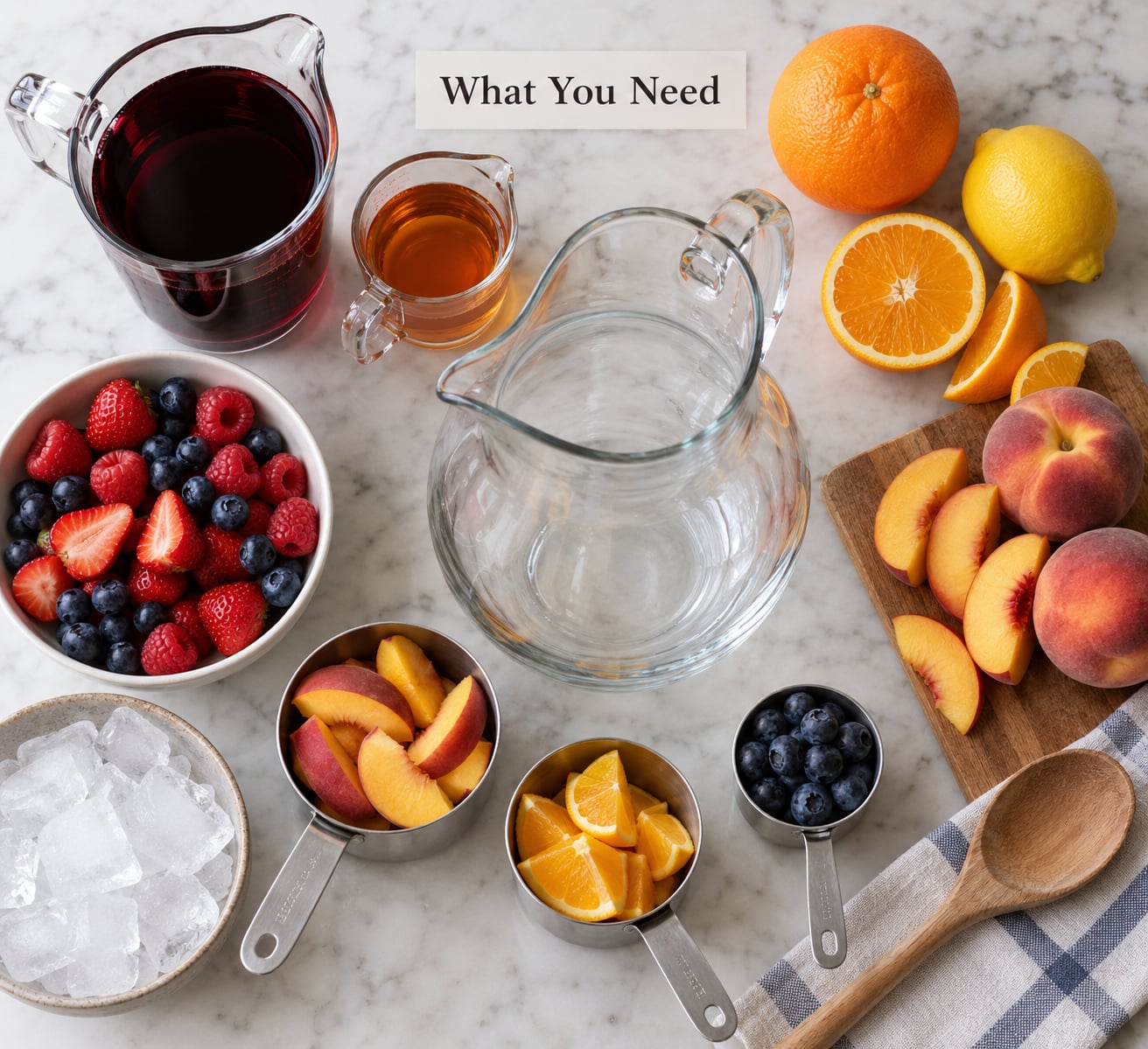
The base recipe below makes about 10 servings and scales cleanly. The ratio that matters is roughly 2 cups of sliced fruit per 750 ml bottle of wine, a benchmark that recipe writers treat as flexible rather than exact, which is reassuring when you are eyeballing fruit at the market.
The base
- 1 bottle (750 ml) red wine. A dry or semi-dry Spanish red such as Rioja, Ribera del Duero, tempranillo or garnacha works well. Sweet red wine plus sweet juice plus added sugar is the fastest route to a syrupy pitcher.
- 1/2 cup orange liqueur such as triple sec, Cointreau or Grand Marnier, or 1/2 cup brandy if you want the spirit sharper and less sweet.
- 1/2 cup fresh orange juice. Half juice and half simple syrup if your fruit is underripe.
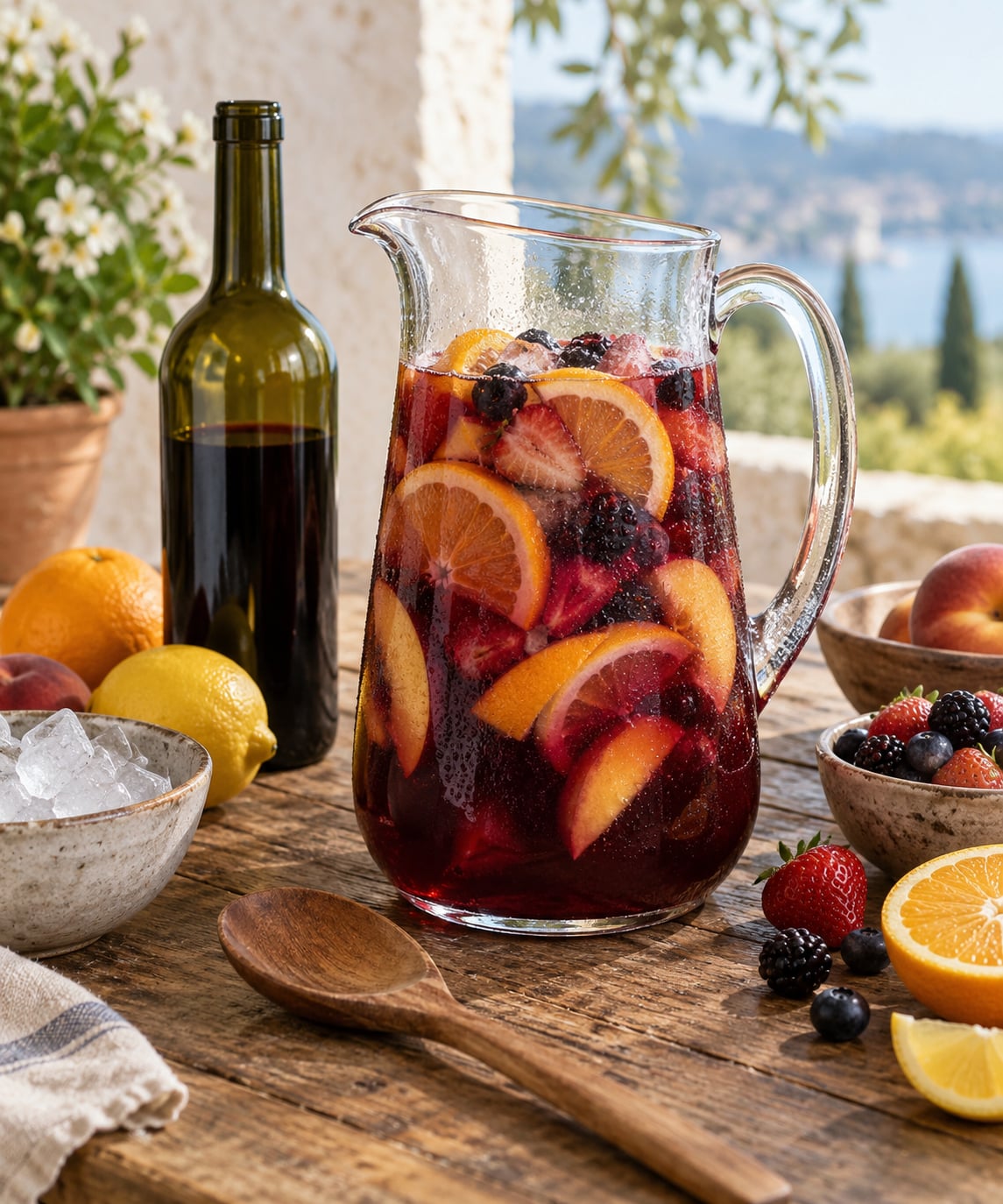
- 2 cups sliced fruit. One orange, one lemon or lime, one peach or apple, and a handful of strawberries, blueberries or blackberries.
- 3 to 4 cups sparkling water, club soda, ginger beer or prosecco, held back until serving.
- Ice, in one large block if you can manage it.
Optional additions
- A spice bag with one cinnamon stick, 2 cloves and a star anise. Bar staff commonly build a batch two days ahead with exactly this in the pot, and it turns a simple pitcher into something that tastes deliberate.
- A splash of brandy or rum for a warmer profile.
- A vanilla bean split down the middle, or a few mint leaves added at serve.
Equipment
- A glass pitcher with a lid, 2 quarts or larger. The lid matters more than the material, because a covered pitcher is what holds scent and limits oxidation.
- A long wooden spoon, long enough to reach the bottom without splashing the counter.
- Measuring cups or a jigger, a paring knife, and a cutting board.
- A large bowl, drink dispenser or punch bowl for serving crowds, plus a fine strainer if you want to ladle without the fruit.
Chill the wine the night before if you can. Room-temperature wine in a cold pitcher takes a while to drop, and a pitcher that only partly chills tastes thin even when the fruit has steeped properly.
How much to make for a crowd
Plan on roughly one 750 ml bottle per four to five guests, with more if the party runs long or the sun is out. Double or triple the base and serve it from a dispenser or punch bowl rather than trying to mix it in a pitcher twice the size.
| Guests | Wine bottles | Sliced fruit | Orange liqueur | Juice | Sparkling water |
|---|---|---|---|---|---|
| 4 | 1 | 2 cups | 1/2 cup | 1/2 cup | 3 cups |
| 8 | 2 | 4 cups | 1 cup | 1 cup | 6 cups |
| 12 | 3 | 6 cups | 1 1/2 cups | 1 1/2 cups | 8 cups |
| 20 | 4 to 5 | 8 to 10 cups | 2 cups | 2 cups | 12 to 14 cups |
For a single serving, use 4 ounces of the chilled base, top with 2 ounces of sparkling water, and add fruit from the pitcher. It tastes identical to the poured version, which is the whole point of making the batch ahead.
Step-by-Step: How to Make Sangria Ahead of Time
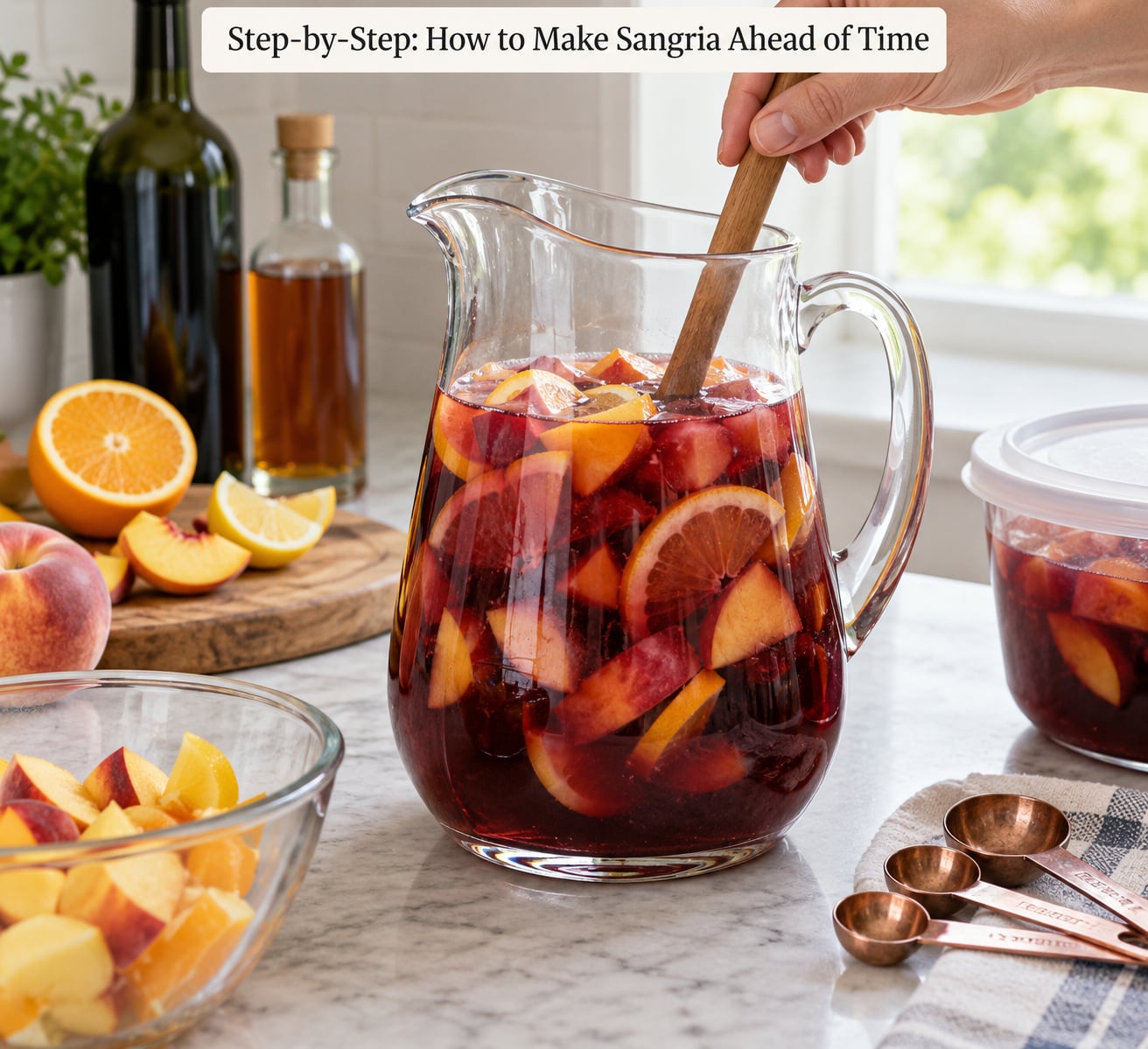
Each step below tells you what done looks like, so you are not guessing halfway through a party eve.
Step 1: Chill the wine
Put the bottle in the fridge for at least 2 hours, or stand it in an ice bucket with cold water and stir for 20 minutes. It is ready when the bottle feels cold to the touch all the way around, not just near the neck.
Step 2: Cut the fruit the right way
Slice citrus into quarter rounds or thick half-moons, no thinner than a quarter inch, and shave off the white pith where you can. Thinner slices release their oils faster, and pith is the single biggest reason a make-ahead batch turns bitter by day two.
Cut peaches, plums and apples into thick wedges, and leave berries whole unless they are large enough to halve. Fruit that is already broken up turns to mush faster in a long chill, and you want pieces that still look like fruit when you pour a glass four hours later.
Step 3: Build the base in the right order
Pour the chilled wine into the pitcher first, then the orange liqueur or brandy, then the juice, then all the fruit. Add fruit last so it sits on top instead of being buried under liquid, and give it ten slow stirs with the wooden spoon.
You are looking for the fruit to be submerged and the liquid to be a uniform deep red. If pieces float, press them down gently or wait ten minutes, since floating fruit is what pokes above the surface and dries out.
Step 4: Cover and chill for 4 to 8 hours, or overnight
Put the lid on and refrigerate. Four hours is the floor for noticeable infusion, eight hours is the sweet spot for a weeknight batch, and overnight is where the fruit flavor really comes through. Beyond 48 hours, start planning a refresh.
Do not freeze it, and do not add ice to the pitcher while it chills. Ice is a dilution device, and chilling is supposed to concentrate flavor.
Step 5: Taste and adjust on serve day
Take a spoonful straight from the pitcher. If it tastes sharp and thin, stir in 1/4 cup orange juice. If it tastes sweet and flat, add a splash of good wine or a squeeze of lemon. If the fruit has softened past your liking, fish out the citrus and add a handful of fresh fruit at the last second.
Step 6: Add the sparkle and the cold at the last minute
Top the pitcher with sparkling water, club soda, ginger beer or prosecco right before guests arrive, and drop in one large ice block or a few frozen fruit cubes. Give the pitcher one gentle stir and serve it with a ladle so guests get fruit in their glass.
The make-ahead timeline at a glance
| When | What to do | Why it matters |
|---|---|---|
| 2 days ahead | Mix the base with fruit and a spice bag | Deep flavor for large batches; skip fresh citrus peel here |
| Night before | Cover and refrigerate; chop extra fruit for garnish | Peak flavor window, fruit stays firm |
| 4 to 8 hours ahead | Cover and refrigerate if morning-of is your only option | Enough infusion for a same-day party |
| 1 hour ahead | Taste, adjust, strip off any bitter citrus, add fresh fruit | Fixes flavor before anyone pours |
| At serve | Add sparkling water and one large ice block | Carbonation and dilution control |
How to Store Sangria Made Ahead of Time
Store sangria covered, in the fridge, and away from anything raw. A pitcher with a snapped lid is the usual reason a batch tastes flat by noon, because aroma and freshness both leak out of an open container.
Count the days from the moment the base goes in. Day one through day three is comfortable territory. Beyond three days the fruit turns papery, the citrus pith turns bitter, and the color dulls, so treat day four as a hard ceiling rather than a suggestion.
If you are storing it past two days, pull the citrus and lemon slices out after the first night and refrigerate them separately. The wine keeps its fruit flavor for longer without the peel, and you can add a fresh orange at serve. This is the single trick that makes a three-day-old batch taste like a one-day-old one.
A glass pitcher is fine for up to a gallon. Beyond that, a covered drink dispenser on ice keeps a large batch cold for hours at a buffet, and a punch bowl works for a table you are refilling rather than guarding. Whatever you use, keep it in the shade outdoors, because direct sun flattens carbonation faster than ice melts.
How to Keep Sangria From Getting Too Diluted
Dilution comes from two places: ice melting into the pitcher, and fruit water bleeding out. Both get worse the longer a batch sits, which is why chilled sangria should be stored undiluted and iced only at the table.
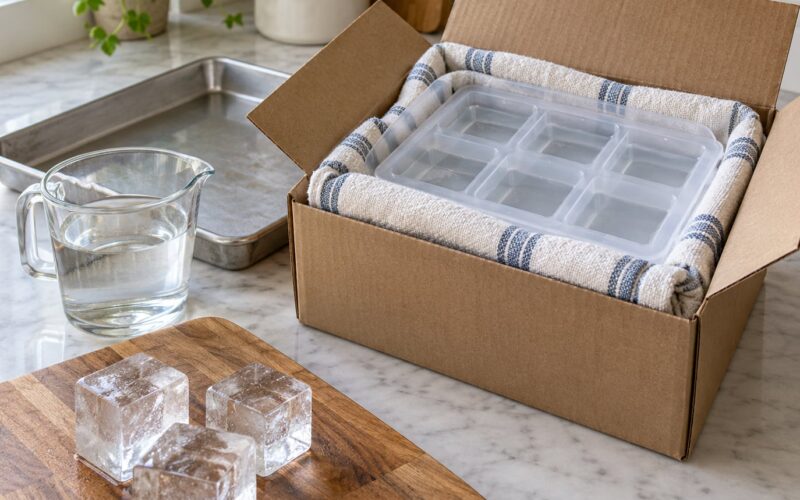
Freeze some of your fruit in ice cubes overnight and use those instead of plain ice. They chill the pitcher and they do not dilute it, and a peach cube in a glass of sangria is the sort of detail nobody expects. Failing that, freeze water in a loaf pan for a block that fits the pitcher mouth and lasts a couple of hours without collapsing.
If a batch has already been sitting with ice in it, do not dump it. Pour off about a quarter of the liquid and top the pitcher back up with chilled wine and a splash of orange liqueur. That restores body without wasting what is already there.
For individual servings that need to hold for more than an hour, build them in the glass rather than in the pitcher. Two ounces of base, two ounces of sparkling water poured on top, fruit from the pitcher, and ice at the last second keeps a single glass drinkable for much longer.
Common Mistakes
Almost every disappointing make-ahead pitcher traces back to one of these. Work down the list before you blame the recipe.
Adding ice while the sangria chills
The most common error, and the least recoverable. Ice in the pitcher during a four-hour chill leaves you serving wine that tastes like someone watered it down. Chill the base undiluted, then add one large block at the table.
Adding sparkling water too early
Carbonation starts leaving the moment it is mixed, and an overnight head start means flat, warm-tasting soda water by party time. Keep the base sparkling-free and top off at serve. Prosecco and ginger beer go in at the last second for the same reason.
Slicing citrus thin or leaving the pith on
Thin slices and heavy pith release bitter compounds quickly, and a batch sitting two days magnifies it. Cut citrus no thinner than a quarter inch, shave the pith, and pull lemon and lime slices out after the first night.
Using sweet wine, sweet juice and added sugar together
Three sweet sources stack into something closer to a dessert than a drink. Pick a dry or semi-dry wine, add no sugar, and get sweetness from the fruit and a splash of orange juice. If your fruit is underripe, a quarter cup of simple syrup balances it better than more juice.
Skipping the chill because it seems like an extra step
Sangria mixed and served immediately tastes thin and sharp, no matter how good the wine. The four-hour minimum is not optional flavoring, it is the technique. Fruit releases its juice and oils into cold liquid over time, which is the whole point.
Mixing too strong and planning to fix it later
A base with spirits in it is stronger than a finished glass because the sparkling water has not been added. Build the base at roughly three-quarters the strength you want to drink, and let the top-off at serve do the rest.
Forgetting that fruit keeps releasing after mixing
A pitcher made two days before serving has more fruit flavor than one made that morning, and also less fresh fruit color and texture. Add a handful of fresh berries, orange slices or mint at serve so the pitcher looks as good as it tastes.
Serving tips for party day
Set the pitcher in a bowl of ice rather than filling the pitcher with it, and ladle rather than pour so guests get fruit. Keep a carafe of sparkling water beside the pitcher for second helpings, and expect about a 10-ounce serving to be the comfortable amount for most people, less if food is heavy.
If the drink leans toward a specific wine, the same pitcher logic works well next to a grilled menu. I keep the fruit profile neutral on purpose, apple and peach, so the sangria does not fight the plate.
Frequently Asked Questions
Can I make sangria the night before?
Yes, and the night before is the sweet spot. Mix the wine, liqueur, juice and fruit, cover the pitcher, and refrigerate for 8 to 12 hours. That gives the fruit time to infuse the wine without the citrus pith turning bitter. Hold back all sparkling water, ginger beer, prosecco and ice until you are ready to serve, then top off and drop in a large ice block right before guests arrive.
How long does sangria last in the refrigerator?
A covered pitcher keeps for 3 to 4 days in the fridge, but the flavor window is much shorter than the safety window. Best taste falls inside 48 hours. After that, pull the citrus and lemon slices out, and at serving time strain out any fruit that has turned mushy, then add fresh fruit. The wine base itself will still be perfectly drinkable on day four.
Should I add fruit before chilling sangria?
Yes, fruit goes in before chilling, because the infusion is the entire point of making sangria ahead. Cut it thick, no thinner than a quarter inch, and shave the white pith off the citrus to avoid bitterness. The exception is very delicate fruit such as raspberries, which can be added a few hours before serving so they keep their shape and color.
Can I add soda or sparkling water ahead of time?
No. Carbonation starts escaping the moment sparkling water, club soda, ginger beer or prosecco meets liquid, and a covered pitcher overnight will leave you with flat, lifeless sangria. Keep the base sparkling-free in the fridge and top off the pitcher at serve. The same applies to ice, which dilutes as it melts during the chill.
How do I transport sangria without it getting watery?
Carry the pitcher cold and covered, with no ice inside, and add the ice and sparkling water when you arrive. A covered drink dispenser on a bed of ice is steadier for a large batch than a full pitcher, and a punch bowl is best for a table you refill. For a short drive, freeze the fruit into cubes so the chill comes from the fruit rather than from loose ice.
What wine is best for sangria made ahead?
A dry or semi-dry red is the safest choice, and Spanish reds such as Rioja, Ribera del Duero, tempranillo or garnacha are the classic pick because they are fruit-forward and not too tannic when cold. White and rosé also work well for a make-ahead batch. Avoid sweet dessert wines, which taste cloying once the fruit has steeped overnight.
Conclusion
Start tonight. Build the base with roughly two cups of sliced fruit per bottle of dry or semi-dry wine, a splash of orange liqueur, and fresh juice, then cover it and put it in the fridge with no ice and nothing fizzy.
Chill it 4 to 8 hours or overnight, pull any bitter citrus after two days, and finish the pitcher at serve with sparkling water, fresh fruit and one large ice block. Ten minutes of work the night before, and the drink pours itself all afternoon.