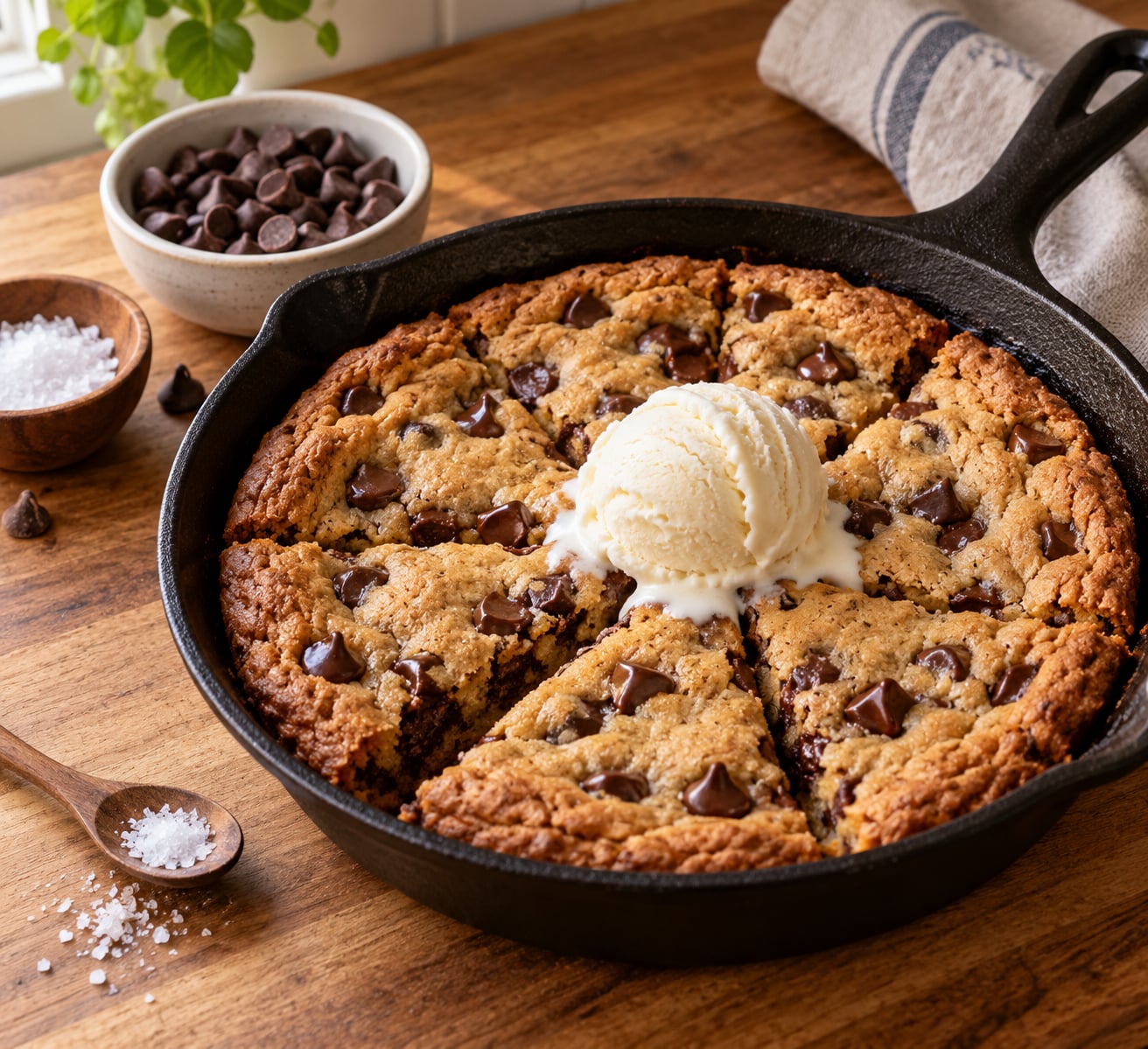
How to make skillet cookie for sharing is one bowl of dough, one heavy skillet, and about 35 minutes from counter to table. You press the dough into a 10- or 12-inch oven-safe pan, bake it at 350°F until the edges turn golden brown, and cut the whole thing into wedges like a pizza. One 12-inch skillet feeds eight to twelve people, which is why it works so well for game day.
I make this any time a group shows up and I don’t want to run two pans of cookies. The skillet does most of the work: cast iron holds heat, so the outside caramelizes and crisps while the middle stays soft.
Table of Contents
- What You Need
- Step-by-Step: How to Make Skillet Cookie for Sharing
- Brown the butter and make the dough
- Press, bake, and watch the edges
- Rest, slice, and serve the skillet cookie
- Common Mistakes
- Frequently Asked Questions
- What size skillet should I use for a shareable skillet cookie?
- How do I know when a skillet cookie is done baking?
- How many people does one skillet cookie serve?
- Can I make skillet cookie ahead and reheat it?
- How long should I let a skillet cookie cool before slicing?
- Can I use a regular baking pan instead of cast iron?
- Conclusion
What You Need
A skillet cookie, also called a pizookie or cookie cake, is a standard chocolate chip dough with a slightly higher butter-to-flour ratio and no chill step. The pan, not the dough, is what makes it special.
- 1/2 cup unsalted butter (115 g), melted and cooled a few minutes
- 3/4 cup light brown sugar (150 g), packed, for moisture and chew
- 1 large egg, plus 1 egg yolk for density
- 1 teaspoon vanilla extract
- 1 1/4 cups all-purpose flour (155 g)
- 1/2 teaspoon baking soda and 1/2 teaspoon salt
- 1 cup semisweet chocolate chips (150 g), plus roughly chopped chocolate bar for bigger puddles
- Flaky sea salt for the top, and vanilla ice cream or salted caramel for serving
Equipment is short: a 10- or 12-inch oven-safe cast iron skillet, a mixing bowl, and an oven set to 350°F. Bake times below assume a 10-inch skillet with a room-temperature pan.
| Pan size | Temp | Bake time | Serves |
|---|---|---|---|
| 8 inch | 350°F | 15 to 18 min | 4 to 6 |
| 10 inch | 350°F | 18 to 22 min | 6 to 8 |
| 12 inch | 350°F | 20 to 25 min | 8 to 12 |
| 14 inch | 350°F | 24 to 28 min | 12 to 16 |
If you don’t own cast iron, a pie dish, cake pan, or even a baking sheet works, with one tradeoff: you lose the crisp skillet edge and the edges brown faster, so check the food a couple of minutes early.
Step-by-Step: How to Make Skillet Cookie for Sharing
Read the dough steps through once before you start. Everything moves fast once the pan is hot, so measuring flour and chocolate ahead matters.
Brown the butter and make the dough
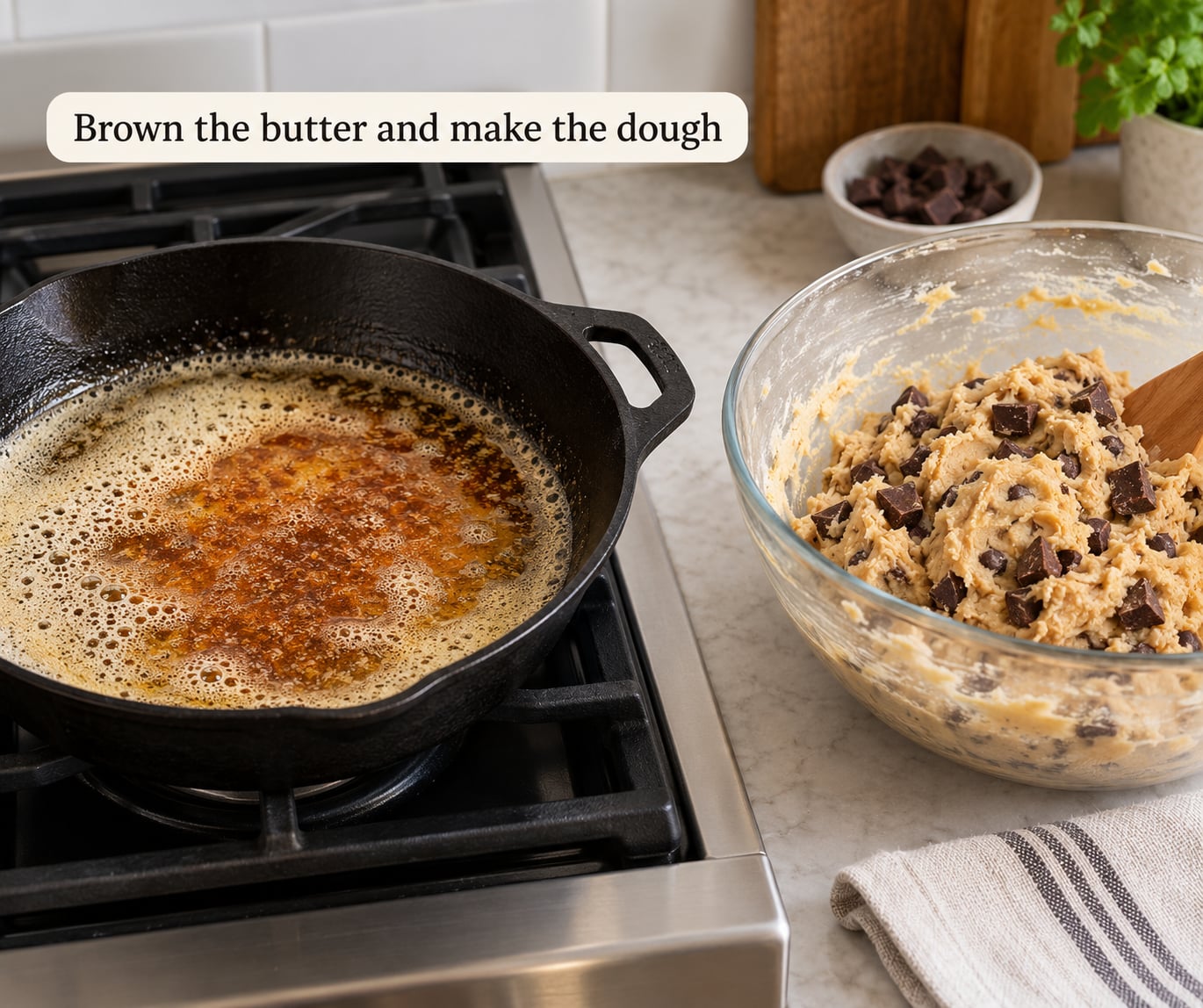
Melt the butter in a light-colored skillet over medium heat and keep cooking until the milk solids turn amber and the kitchen smells like toffee, about 3 to 4 minutes. Pull it off the heat the second it smells nutty. If it goes dark brown and sharp, the cookies will taste bitter no matter how well everything else goes.
Pour the butter into a bowl and let it sit for 5 minutes so it’s warm rather than hot. Whisk in the brown sugar, then the egg, yolk, and vanilla until the mixture is smooth and slightly glossy.
Add the flour, baking soda, and salt and stir with a spatula until no dry streaks remain, then 10 more folds. Overmixing is what makes a skillet cookie tough. Fold in the chocolate chips and chopped chocolate, then stop.
Press, bake, and watch the edges
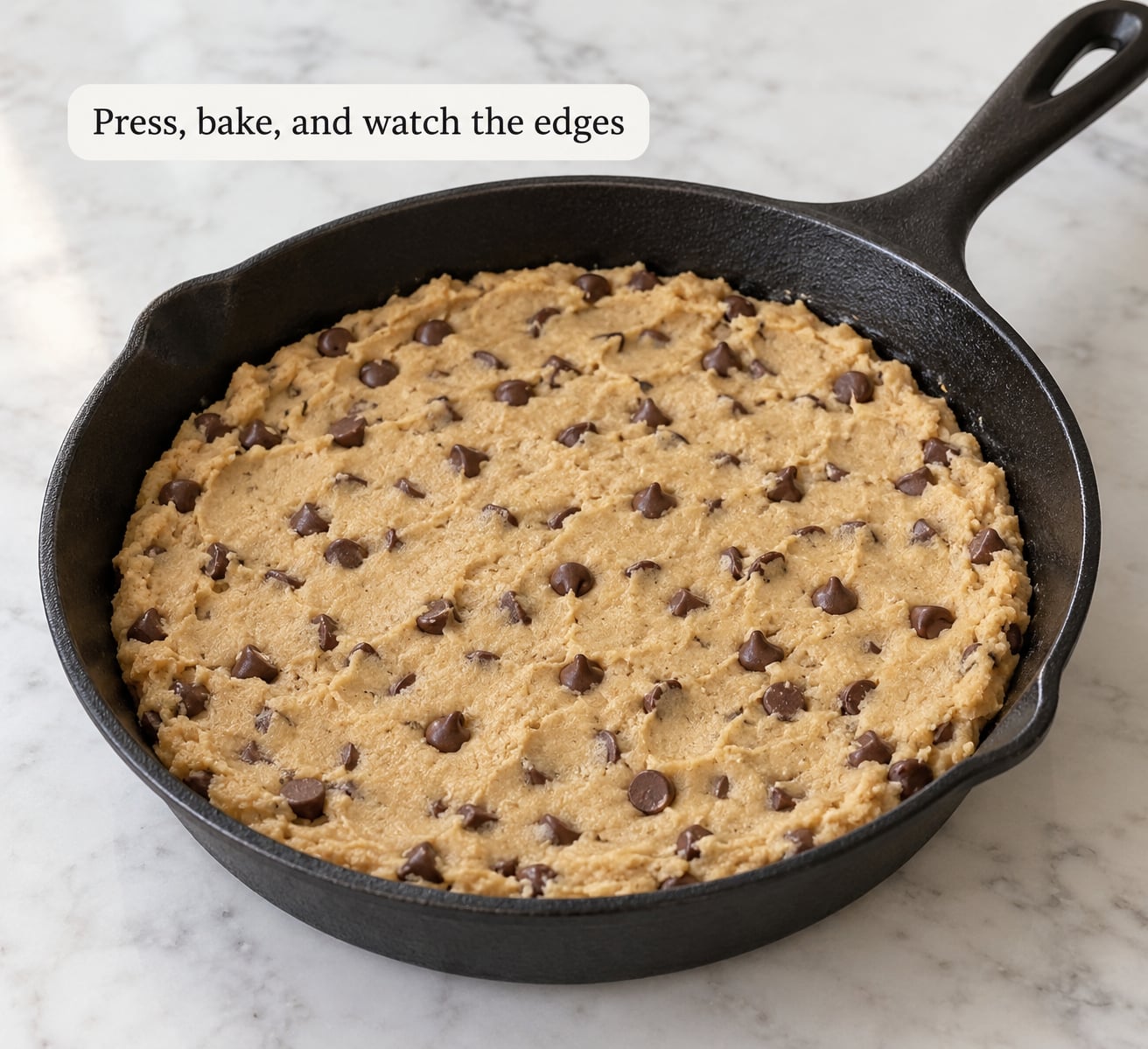
Set the rack in the middle of the oven and preheat to 350°F. Put the cold skillet in the pan, then add the dough and press it into an even layer about 3/4 inch thick with the back of a spoon or a flat spatula.
Press dough up the sides of the skillet about half an inch. That raised rim is the part that turns into the crisp edge everyone fights over, and it also gives the cookie a defined boundary instead of one flat puddle.
Bake for 18 to 22 minutes. The edges should be golden brown and the center should look set but still slightly pale and soft when you nudge the pan. Cast iron keeps cooking after it leaves the oven, so pulling it a minute early is usually right.
Rest, slice, and serve the skillet cookie
Cool the skillet on a wire rack for at least 20 minutes before cutting. Hot skillet cookie is soft enough to deflate and crack under a knife, so this rest is not optional.
Slice with a sharp knife in pizza-style wedges, cutting all the way to the center for eight to twelve pieces from a 12-inch pan. For a casual crowd, set out spoons and let people scoop their own portion, which avoids the whole cutting-and-serving queue at a party.
Finish with a scoop of vanilla ice cream, a drizzle of salted caramel, and a pinch of flaky sea salt. To land it warm at dessert time, bake it during the main course, not before. If you need to hold it, keep the uncovered skillet in a 200°F oven for up to an hour.
Another good trick: pull six squares of refrigerated cookie dough from the package, let them soften for 10 minutes, and press them across the skillet. You get the same result in about 20 minutes of oven time with no mixing bowl to wash.
Common Mistakes
Five failures account for nearly every disappointing skillet cookie, and all five are avoidable.
- Baking to the timer instead of the color. Pull it when the edges are golden brown and the center still looks a little underdone. Ten extra minutes turns a soft center into a dry one.
- Burning the butter. Nutty and amber is right. Dark brown and smoking means bitter cookies, and no topping will hide it.
- Letting the dough spread to the rim. That happens when the layer is too thin or the skillet is too big for the batch. Press it thicker and leave an inch of bare pan at the edge.
- Slicing while hot. The cookie is still setting. Twenty minutes of cooling keeps the wedges clean and the center chewy.
- Using a skillet that isn’t oven-safe. If the handle is plastic or riveted steel, don’t put it in the oven. Move the dough to a pie dish or baking sheet and drop the temperature by 25°F for thin pans.
On seasoning: a sweet dough will not ruin cast iron, but it does leave behind sticky sugar. Grease the pan lightly with butter or coconut oil before pressing the dough in, and wash the skillet with warm soapy water afterward, dry it on the burner, and wipe a thin coat of oil back on while it’s still warm.
For a crowd of 20, one pan won’t do it. Two 10-inch skillets or one 12-inch plus an 8-inch gives you about 24 portions, and baking them in sequence on the same oven rack keeps the timing predictable.
Frequently Asked Questions
What size skillet should I use for a shareable skillet cookie?
A 12-inch oven-safe skillet feeds 8 to 12 people, which is the sweet spot for most gatherings. A 10-inch skillet serves 6 to 8 and bakes in 18 to 22 minutes at 350F. Go smaller only if you want individual desserts, and go larger than 14 inches only if you are confident with an even dough layer, since a very wide pan gives you a thin, flat cookie.
How do I know when a skillet cookie is done baking?
Look at the edges, not the clock. They should be golden brown and slightly crisp looking, while the center still looks pale and a little soft. Cast iron holds heat and keeps baking the cookie after it leaves the oven, so pulling it one to two minutes early usually gives you the right texture once it cools.
How many people does one skillet cookie serve?
A 10-inch skillet yields about 8 wedges and serves 6 to 8 people; a 12-inch yields about 12 wedges and serves 8 to 12. People with big appetites or a plate of ice cream on top will take two wedges, so plan for one wedge per person as a starting point and bake a second pan if the group is hungry.
Can I make skillet cookie ahead and reheat it?
Yes, and it reheats well. Let the cookie cool completely in the skillet, then cover it loosely with foil and keep it at room temperature for up to two days. To reheat, put it in a 325F oven for 5 to 10 minutes until warm; the center turns gooey again while the edges stay crisp.
How long should I let a skillet cookie cool before slicing?
Wait at least 20 minutes for a 10-inch skillet and about 30 minutes for a 12-inch one. The cookie finishes setting as it cools, so cutting too early flattens the wedges and cracks the top. If you are in a hurry, set the skillet on a wire rack rather than a countertop, since trapped steam keeps the crust soft.
Can I use a regular baking pan instead of cast iron?
Yes. Any oven-safe skillet, pie dish, round cake pan, or even a rimmed baking sheet will work. Cast iron is what gives you the crisp caramelized edge and keeps the center gooey; a lighter pan browns faster and runs thinner, so check it a couple of minutes early and drop the temperature by 25F if edges darken too fast.
Conclusion
Start by melting and browning the butter until it smells nutty, whisking in the brown sugar, egg, and vanilla, then folding in the flour and chocolate. Press the dough into a greased 10- or 12-inch oven-safe skillet, push it up the sides for that crisp rim, and bake at 350°F until the edges are golden and the center still looks soft. Rest it 20 minutes, slice it into wedges, and put ice cream in the middle of the table.
For bigger crowds in 2026, bake two skillets in sequence and keep the first one warm at 200°F while the second finishes.