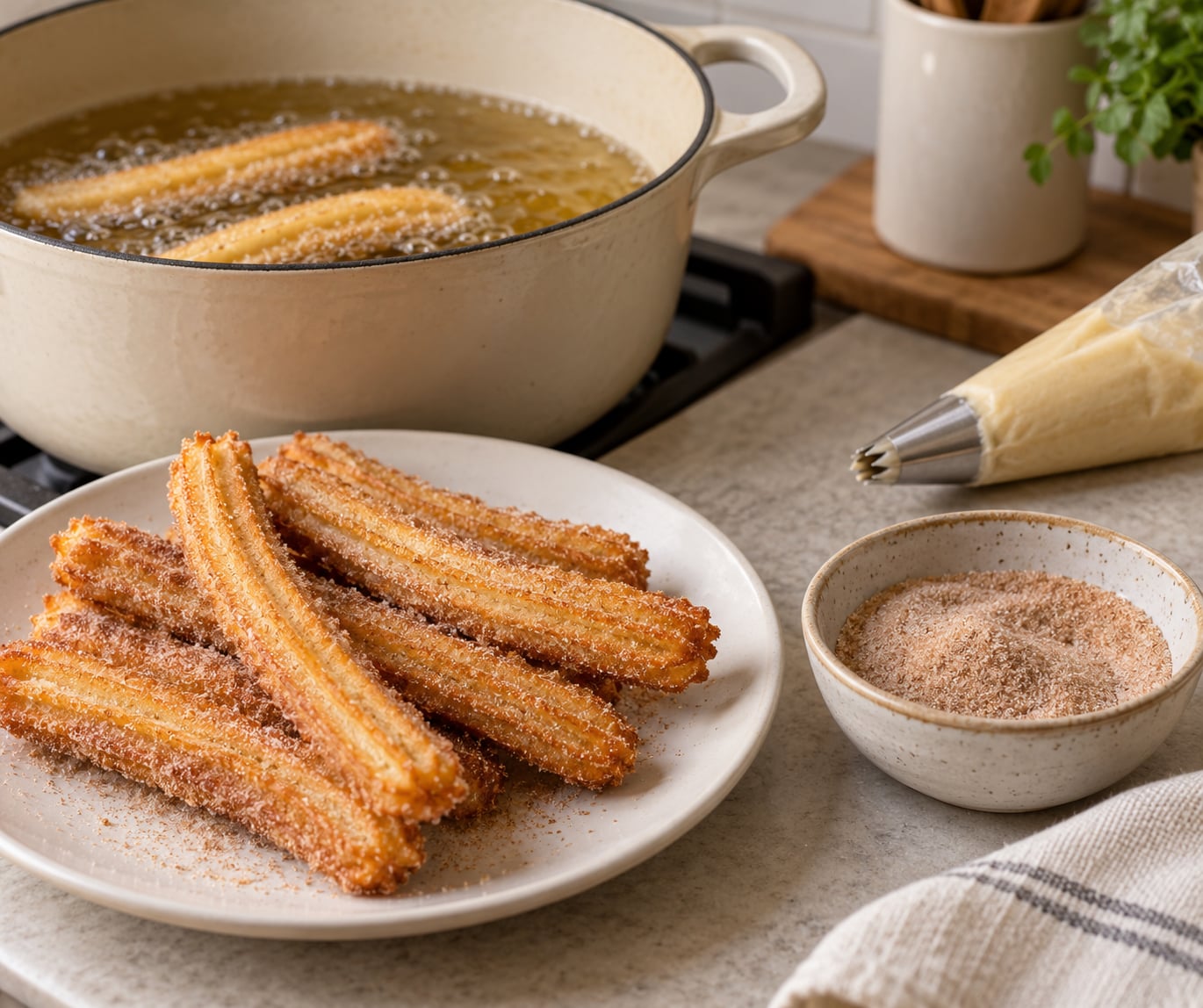
Churros at home come down to three stages: cook a thick flour dough on the stove, pipe it into oil held at 375 to 400F, then roll the hot churros in cinnamon sugar. Learning how to make churros at home takes roughly 40 minutes start to finish, and no churro machine is required, just a piping bag with a star tip and a heavy pot. Nearly everything that goes wrong comes down to two things: how the dough is cooked, and how hot the oil actually is.
Table of Contents
- What You Need to Make Churros at Home
- Dough
- Cinnamon sugar
- Frying and dipping
- Equipment
- Step-by-Step: How to Make Churros at Home
- How to Make Churros at Home: Cook the Dough
- How to Make Churros at Home: Pipe the Dough
- How to Make Churros at Home: Fry Until Crisp
- Common Mistakes When Making Churros
- Tips for Extra-Crisp Churros
- Frequently Asked Questions
- What ingredients do I need to make churros at home?
- Do I need a piping bag and star tip to make churros?
- What oil temperature is best for frying churros?
- Why are my churros falling apart or breaking while frying?
- Can I make churros ahead of time and reheat them?
- How do I keep churros crisp after frying?
- Conclusion: Start With the Dough and Keep the Oil Steady
What You Need to Make Churros at Home
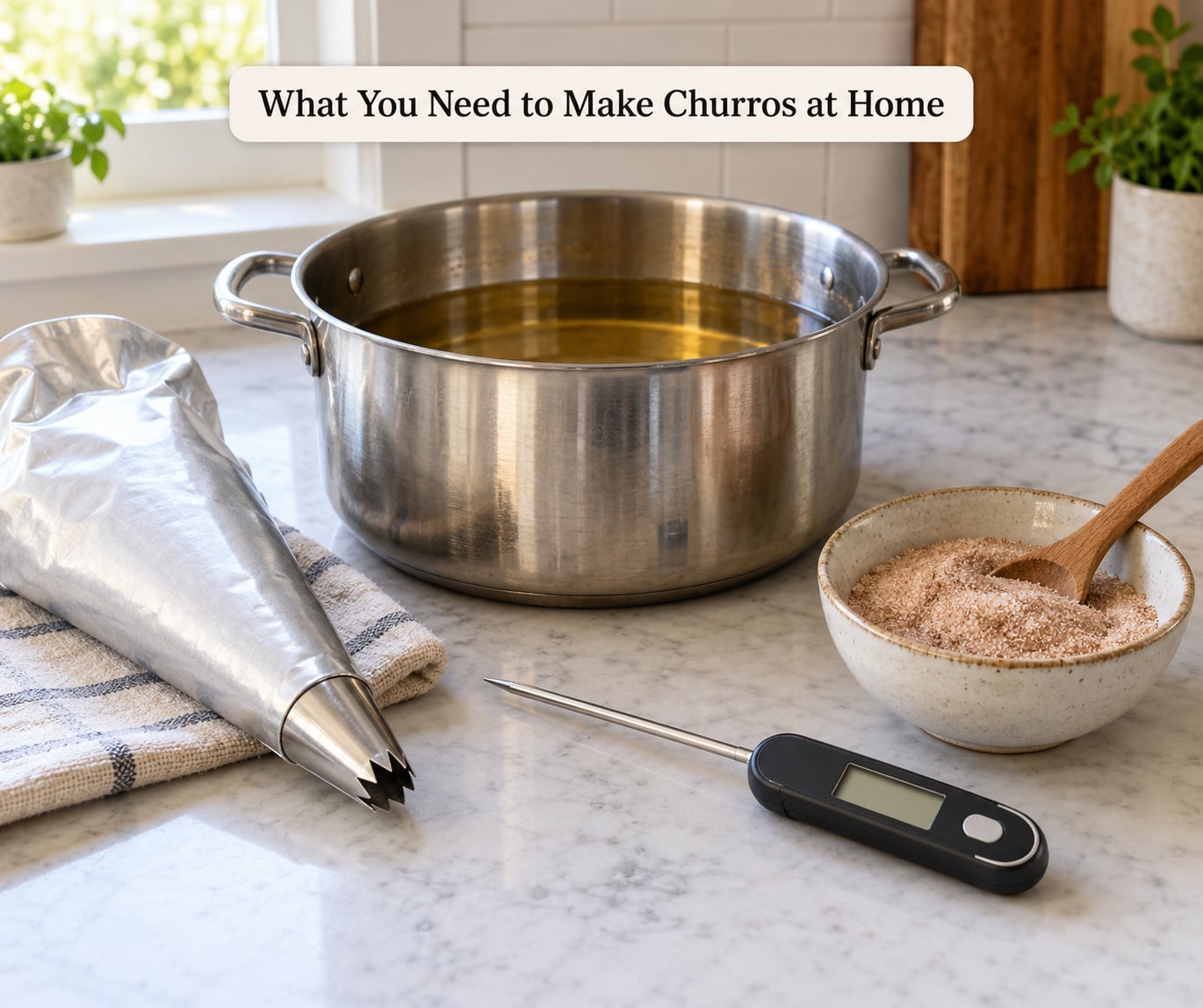
Here is the shopping list, grouped the way you will actually use it.
Dough
- 1 cup (240 ml) water
- 6 tablespoons (85 g) unsalted butter, cut into pieces
- 1 tablespoon sugar
- 1 teaspoon fine salt
- 2 cups (250 g) all-purpose flour, sifted
- 2 large eggs (optional, see below)
The eggs are the one flexible item. Plenty of home cooks on r/Baking skip them, because a plain roux dough pipes more smoothly and there is less chance of the mixture seizing when the egg hits. Both versions work, so pick one and stay with it.
Cinnamon sugar
- 1 cup (200 g) granulated sugar
- 2 teaspoons ground cinnamon
That 1 cup to 2 teaspoons ratio is the classic. Confectioners sugar works too if you want a softer, less grainy shell that melts into the dough.
Frying and dipping
- Vegetable, canola, or sunflower oil, 4 to 6 inches deep in your pot
- 4 ounces (115 g) dark or semisweet chocolate and 1 cup (240 ml) heavy cream for dipping sauce
Equipment
- Heavy-duty piping bag plus a star nozzle, roughly 1.5 to 2 cm across
- Heavy pot, Dutch oven, or deep skillet with at least 3 inches of clearance above the oil line
- Instant-read thermometer (a thermometer matters more here than in most recipes)
- Slotted spoon, paper towels, mixing bowl, wooden spoon, and kitchen scissors
Only the piping bag and star nozzle are truly non-negotiable for the ridged look, and even those have a substitute. Everything else is standard kitchen gear.
Step-by-Step: How to Make Churros at Home
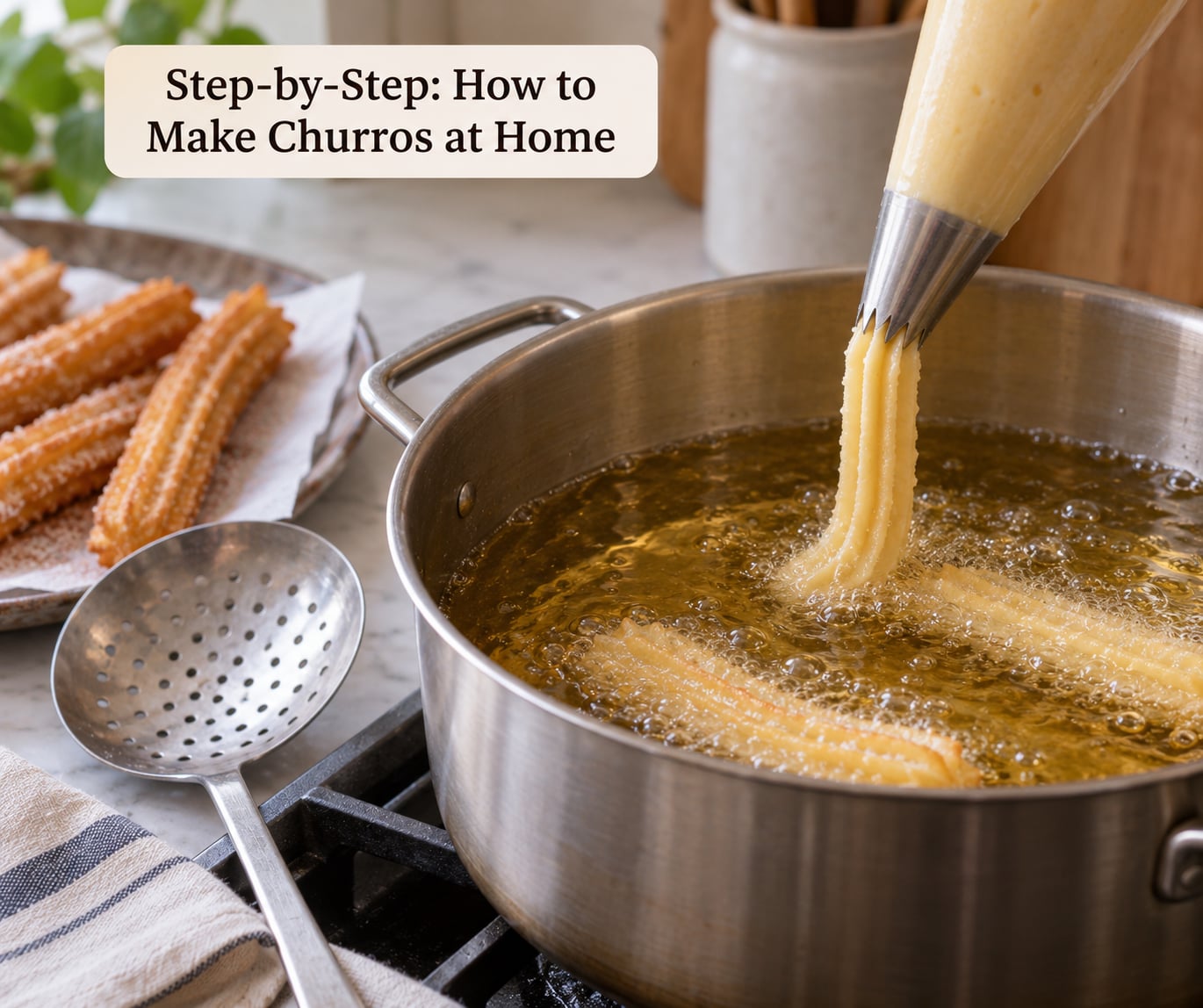
Read the whole method once before you start. Once the oil is on the burner, you want to be piping rather than reading.
How to Make Churros at Home: Cook the Dough
- Bring the water, butter, sugar, and salt to a boil in a saucepan over medium-high heat, stirring until the butter melts.
- Take the pan off the heat. Add the flour all at once and beat hard with a wooden spoon until the dough pulls into a single thick ball and the pan shows almost no dough left behind.
- If you are using eggs, let the dough cool 10 minutes first, then beat the eggs in one at a time until each disappears.
- Wrap the bowl and rest the dough 10 to 15 minutes at room temperature.
That last step is the one people skip and then blame the results on. Resting lets the flour hydrate and the steam escape, which is what turns a stiff dough into something that flows through a nozzle instead of tearing.
The finished dough should look like thick, soft playdough. It should hold a peak, and when you lift a spoonful it should slump slowly rather than pour.
How to Make Churros at Home: Pipe the Dough
- Spoon the rested dough into the piping bag and fit the star nozzle on the end.
- Hold the bag a few inches above the oil and squeeze with steady pressure, moving your hand along in one smooth motion to make ropes about 4 to 6 inches long.
- Snip each rope with scissors or a knife, letting the piece drop into the oil.
- Fry 4 to 6 at a time. Crowding the pot drops the oil temperature and gives you greasy churros.
No piping bag? A zip-top bag with one corner snipped off works and gives you ridges too, just less defined. A freezer bag with a hole punched in the corner is the last resort, and expect rounder churros.
How to Make Churros at Home: Fry Until Crisp
- Heat the oil to 375F (190C) and check it with the thermometer. Aim for 375 to 400F (190 to 205C).
- Lower the churros in gently away from you, then fry 2 to 3 minutes, turning once so they brown evenly.
- They are done when deep golden brown and firm, with a cooked, tender, slightly custardy interior.
- Lift out, drain on paper towels for 30 seconds, and toss in cinnamon sugar while still hot.
Drain briefly rather than letting them sit. Paper towel sitting contact steals the crispness you worked for, and the cinnamon sugar clings better to a churro that is still steaming.
Common Mistakes When Making Churros
Dough is too runny. It almost always means the flour was not cooked long enough or enough of it went in. Return the dough to a low flame and stir for another minute or two, then let it cool before handling. If you have already mixed in eggs, add another tablespoon or two of flour and beat it in.
Dough is too sticky and tears in the bag. Do not add flour straight to a wet dough, which makes it gluey. Chill it for 20 minutes instead, then pipe with firmer pressure. If it still tears at the nozzle, the tip is probably too small for the dough.
Churros break apart in the oil. Two causes. Either the dough was dropped from too high a point, which splashes and tears the ends, or the oil was well below temperature so the outside set before the inside. Lower each rope from the nozzle, and re-check the thermometer.
Churros are pale and greasy. The oil was too cool. Greasy churros also come from frying too many at once. Bring the oil to 375F, and cook 4 to 6 per batch.
Churros go dark before they cook through. The oil is too hot for the size you piped. Either fry at 375F or make shorter ropes, since a thicker rope needs a longer, gentler fry.
No ridges on the churros. You used a round nozzle, or too little pressure. A star tip and firm, even squeezing give you the craggy surface that holds sugar and drinks up sauce.
Cinnamon sugar falls off or clumps. Two fixes. The churros were too cool when you tossed them, so coat within a minute of draining. And do not put sugar in the bowl ahead of time and let it sit with moisture, which makes it clump.
Cinnamon sugar dissolves or disappears. Toss in small batches, straight onto the churros, with no pouring motion to flatten the sugar into a paste.
Everything on the plate goes soft fast. That is steam, and it is why a full batch stacked on one plate turns disappointing within an hour. Serve in small waves instead.
Tips for Extra-Crisp Churros
Keep every rope the same length and thickness. Uniform pieces cook at the same rate, which is why the last batch from the same dough is usually the best one.
Give the resting period the full 15 minutes if you can, and treat it as part of the cooking rather than an optional pause. Dough that has rested pipes noticeably smoother and needs less squeezing at the nozzle.
Make the chocolate sauce while the oil heats. Warm 1 cup of cream just until steaming, pour over 4 ounces of chopped chocolate, wait 2 minutes, then stir until glossy. A pinch of salt and a small splash of cinnamon push it past plain melted chocolate. A little cayenne is worth trying too.
Air fryer and oven method. Pipe or roll the ropes directly on a lined tray, brush or spray with oil, and cook at 400F (200C) for 12 minutes, turning halfway. They come out golden and ridged rather than deeply fried, and you trade a bit of crunch for none of the hot oil. Finish with a light spray of oil right out of the oven to re-crisp the surface.
Storage. Plain cooked churros keep at room temperature for about 2 hours before turning soft. Fridge storage makes them hard and chewy, so it is not worth it. For make-ahead work, freeze the uncooked dough in rope shapes on a tray, then bag them once solid.
Reheating. Air fryer or oven at 375F (190C) for 5 to 7 minutes brings back the crunch without drying the center. A microwave works but softens the crust, so if you use it, finish in the oven for two minutes.
Scaling for a party works cleanly: multiply everything by 1.5 for about two dozen churros, and fry the same 4 to 6 per batch no matter how much dough you made. People eat them with horchata, a warm Mexican hot chocolate, or black coffee, and a bowl of fruit compote handles anyone who wants to skip the chocolate.
Frequently Asked Questions
What ingredients do I need to make churros at home?
You need flour, water, butter, sugar, and salt for the dough, plus eggs if you want the softer enriched version. For the coating, it is 1 cup of granulated sugar mixed with 2 teaspoons of cinnamon. For frying, use vegetable, canola, or sunflower oil heated to 375 to 400F. A heavy cream and dark chocolate dipping sauce is optional.
Do I need a piping bag and star tip to make churros?
A piping bag gives you the ridged shape churros are known for, and a star nozzle is what creates those ridges. But it is not the only route. A zip-top bag with one corner snipped works nearly as well, and a freezer bag with a small hole punched in it gives you rounder, snack-sized churros. Any of these three gets you a good result.
What oil temperature is best for frying churros?
Aim for 375 to 400F (190 to 205C) and check with an instant-read thermometer rather than guessing from the pan. Below 375F the churros soak up oil and turn greasy, while above 400F the outsides darken before the centers cook. If you skip the thermometer, drop a small cube of bread and time it: golden in about 60 seconds means the oil is ready.
Why are my churros falling apart or breaking while frying?
Usually the rope was dropped from too high and splashed the oil, which tears the end off as it hits. Second cause is oil below temperature, so the outside sets before the inside. Lower each piece from just above the nozzle, keep batches to 4 or 6, and confirm the oil reads 375F with a thermometer before you pipe.
Can I make churros ahead of time and reheat them?
Yes, but freeze them uncooked. Pipe the ropes onto a lined tray, freeze until solid, then bag them and keep them frozen for up to a month. Fry straight from frozen, adding a minute to the fry time. Already-cooked churros can be reheated at 375F in an oven or air fryer for 5 to 7 minutes to bring back the crunch.
How do I keep churros crisp after frying?
Drain each batch on paper towels for about 30 seconds, then toss in cinnamon sugar right away while the churros are still hot. Serve in small waves rather than stacking the whole batch on one plate, because trapped steam softens the crust within an hour. For longer storage, hold them loosely on a rack instead of an airtight container.
Conclusion: Start With the Dough and Keep the Oil Steady
Start with the dough. Boil the water, butter, sugar, and salt, beat in the flour off the heat until it forms a ball, then let it rest 15 minutes before it goes near a nozzle. That is the step that decides whether the churros pipe cleanly.
After that, the only other variable that really matters is oil temperature. 375F, verified with a thermometer, four to six churros per batch, and a cinnamon sugar toss within a minute of draining. Serve them right away with a warm drink and do not stack the batch.