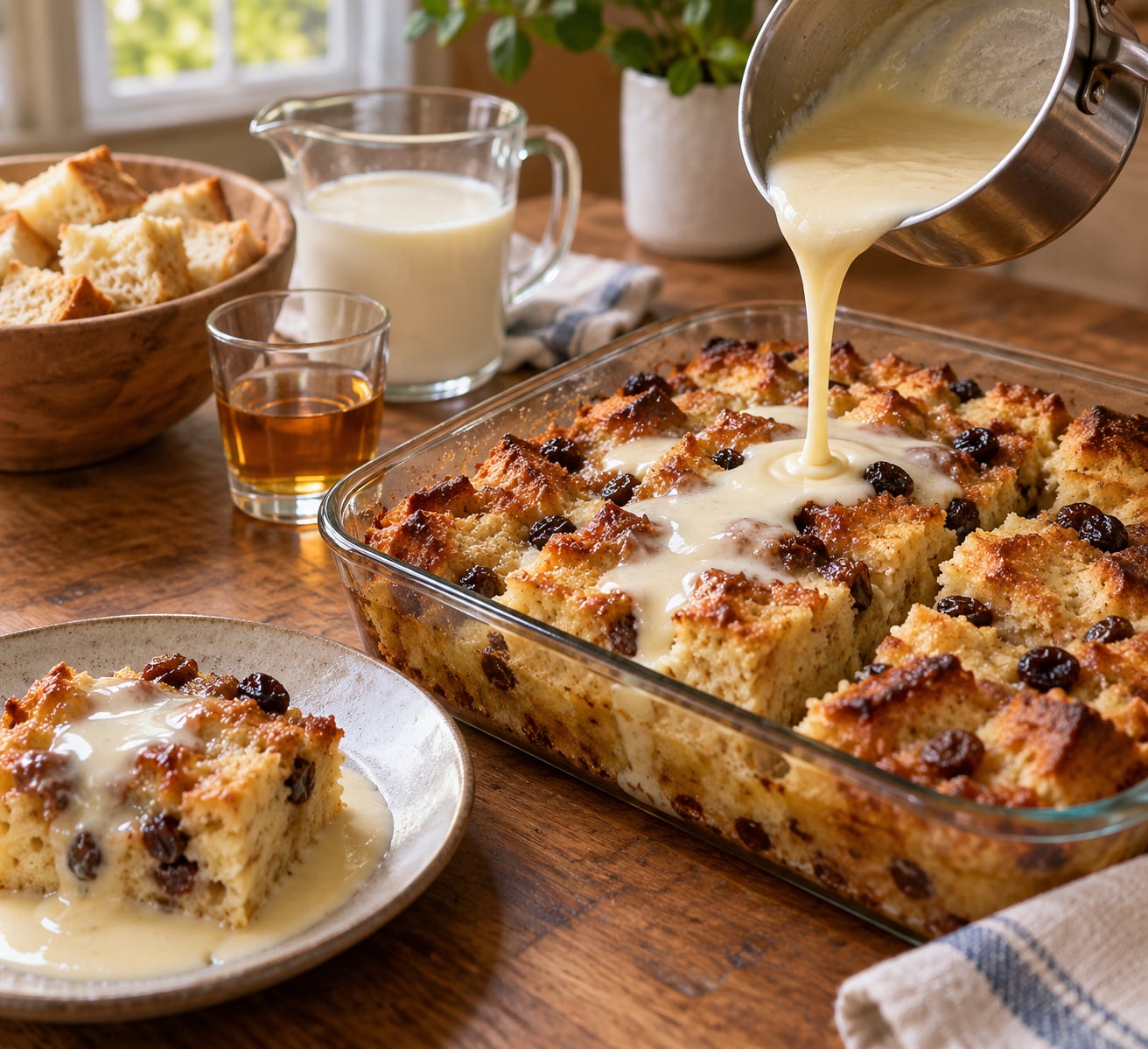
Bread pudding with whiskey sauce is a baked dessert of day-old bread soaked in an egg-and-milk custard, baked at 350°F (175°C) until set, and served warm under a bourbon cream sauce thickened with cornstarch.
The hands-on time is about 20 minutes, plus a 30 to 45 minute soak in the fridge and a 50 to 60 minute bake. The sauce itself takes ten minutes on the stove and you can make it a day ahead, which is why this dessert is so popular for Thanksgiving, Christmas, and any dinner party where you would rather not juggle two last-minute preparations.
Below is the version I make every holiday season: day-old French bread, a custard of eggs, whole milk, and heavy cream, and a bourbon sauce that is thin enough to pour but thick enough to coat a spoon. I have included the failure points too, since soggy pudding and a grainy sauce are the two things that go wrong most often.
Table of Contents
- What You Need
- How to Make Bread Pudding with Whiskey Sauce
- Step 1: Prepare the Bread
- Step 2: Make the Custard
- Step 3: Assemble the Bread Pudding
- Step 4: Bake Until Golden and Set
- How to Make Whiskey Sauce
- Common Mistakes
- Frequently Asked Questions
- What kind of bread is best for bread pudding?
- Can I make bread pudding with stale bread?
- Can I use any type of whiskey in the sauce?
- Will the alcohol cook off in the whiskey sauce?
- How long should bread pudding bake at 350°F?
- Can I make bread pudding ahead and reheat it?
- Conclusion
What You Need
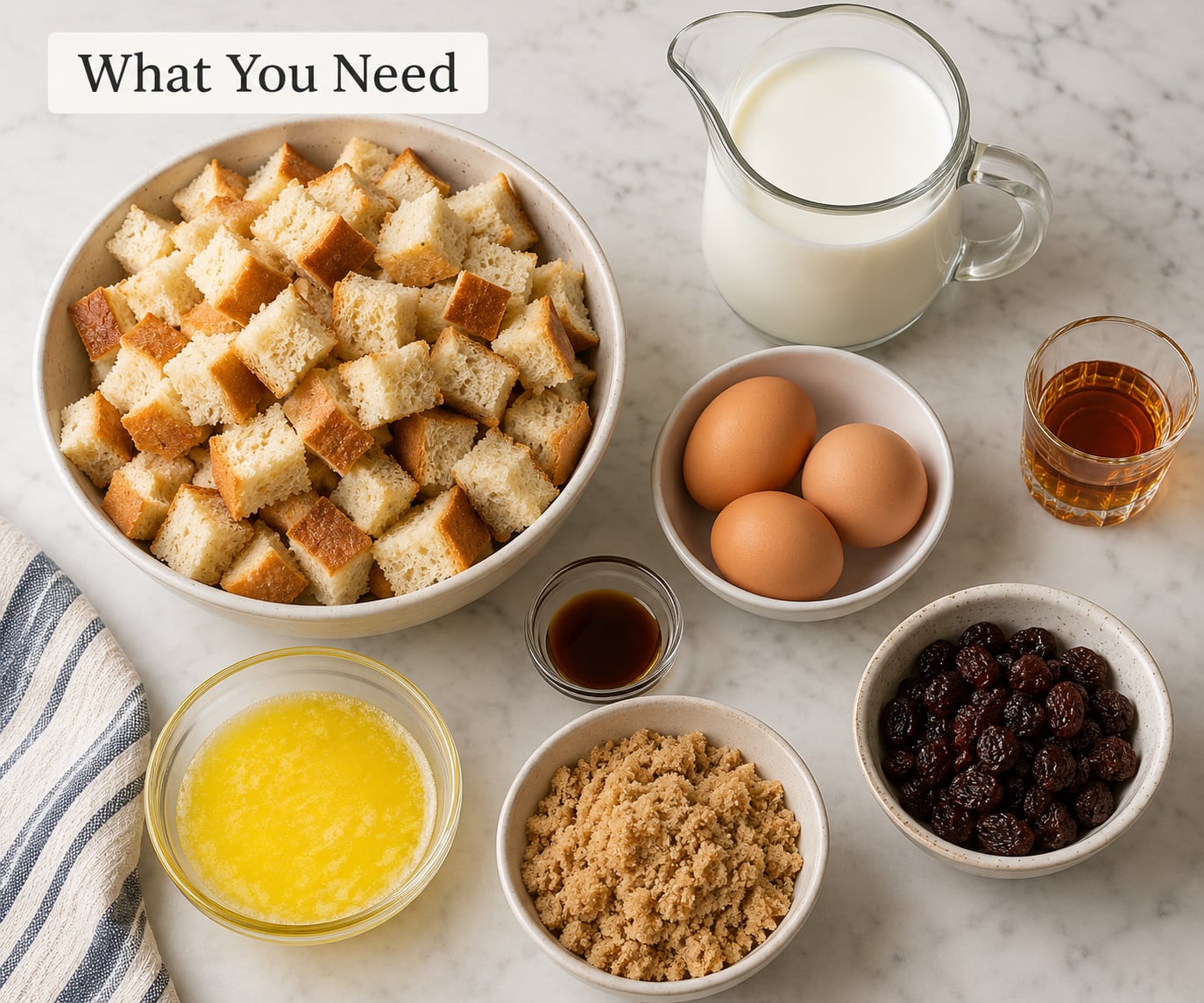
This recipe makes one 9×13-inch dish, about 10 to 12 servings, and roughly 1.5 cups of sauce on the side. Measure everything before you start, because the bread needs to sit in liquid for half an hour and you will not want to be hunting for the vanilla at that point.
Bread Pudding
- 10 to 12 cups of day-old white bread, French bread, or Italian bread, about 1 pound, cut into 1-inch cubes
- 3 large eggs
- 2 cups whole milk
- 1 cup heavy cream
- 3/4 cup light brown sugar, divided
- 2 tablespoons unsalted butter, melted and cooled slightly
- 2 teaspoons vanilla extract
- 1 teaspoon ground cinnamon
- 1/4 teaspoon freshly grated nutmeg
- 1/2 teaspoon fine salt
- 1/2 cup raisins, optional, plumped in hot water
- 1/2 cup chopped pecans, optional, toasted
- A pinch of cream of tartar, optional, for a slightly lighter texture
Whiskey Sauce (about 1.5 cups)
- 1 cup heavy cream
- 1/2 cup whole milk
- 1/3 cup granulated white sugar
- 2 tablespoons cornstarch
- 2 tablespoons cold water
- 1/3 cup bourbon, divided, plus more to taste
- 2 tablespoons unsalted butter
- 1 teaspoon vanilla extract
Equipment
A 9×13-inch baking dish, a 2-quart saucepan for the sauce, a whisk, a rubber spatula, a toothpick, and a fine-mesh strainer if you want the sauce perfectly smooth. A scale is genuinely useful here, because dividing 3/4 cup of brown sugar between the custard and the top of the dish is easier by weight than by eye.
Substitutions that work
For dairy, use half-and-half in place of some of the cream for a lighter pudding, or go the other direction and use all cream. The most popular version I have seen on r/food replaces the cream and milk with two 12-ounce cans of evaporated milk, which gives a sweeter, almost fudge-like center.
For bread, day-old brioche, challah, or ciabatta all work. Italian bread is the best stand-in when French bread is not available, because it has enough open crumb to soak without going to mush. Avoid dense sandwich bread and multigrain, which is the single most common reason a bread pudding turns out gummy.
For thickener, cornstarch gives the cleanest glaze. Arrowroot or flour work too, but use a third less and add them earlier, since flour needs a longer simmer to cook out its raw taste. For the spirit, Irish whiskey is softer and fruitier than bourbon, rye is smoky and spicy, brandy gives a wine-like depth, and rum works well for a Caribbean version.
Measure ahead: whisk the brown sugar with the cinnamon, nutmeg, and salt in a small bowl, melt the butter and let it cool to room temperature, and take the dairy out of the fridge 30 minutes before you whisk. Cold dairy and melted hot butter both shock the eggs, and shocked eggs make a grainy custard.
How to Make Bread Pudding with Whiskey Sauce
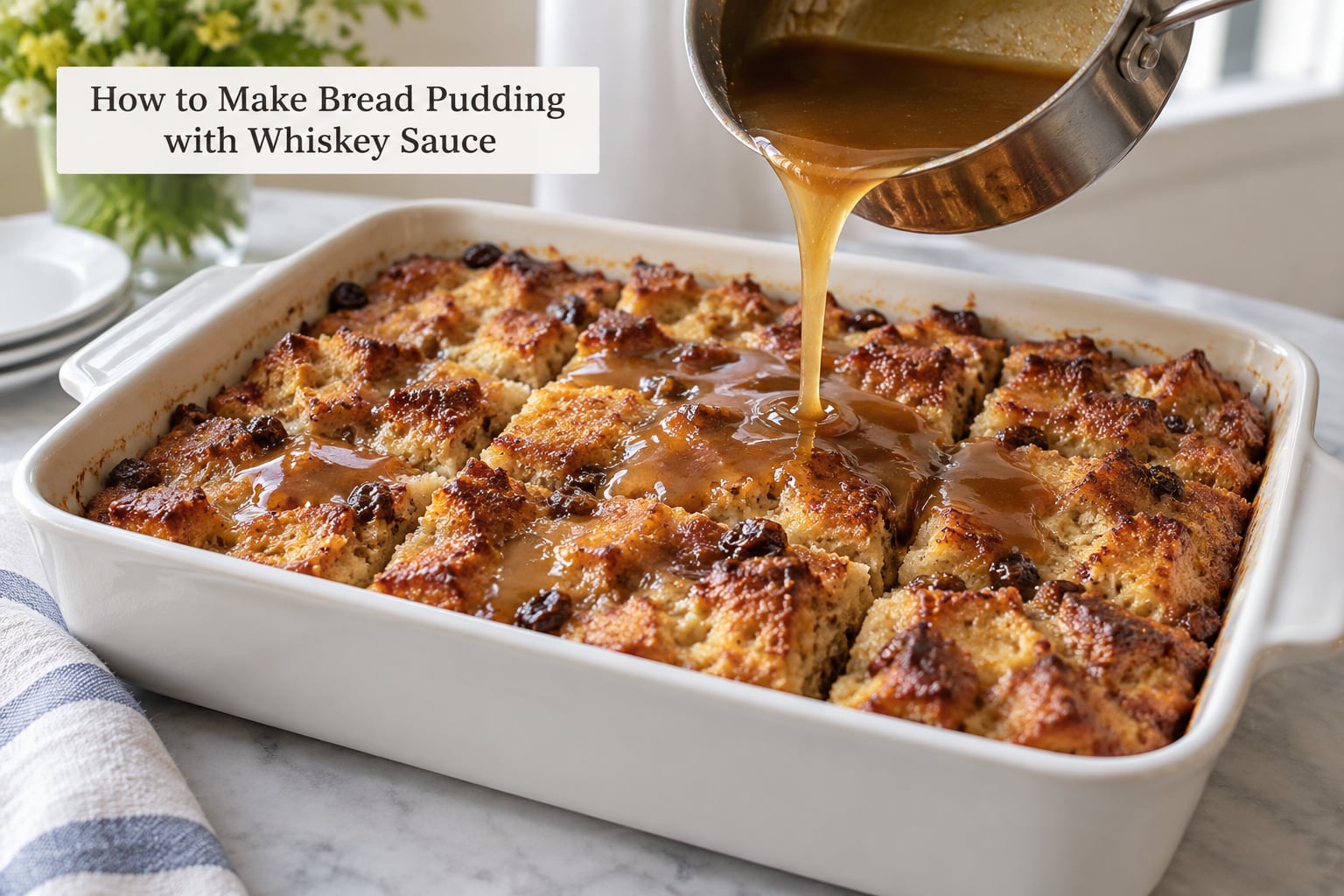
Two different things are happening in this recipe, and keeping them separate is what makes it work. The pudding is an egg custard that sets in the oven at 350°F (175°C) and firms up as it cools, while the whiskey sauce is a cream sauce thickened on the stove with a cornstarch slurry and kept warm, never baked. One should be a soft set that springs back under a spoon, the other should run off the spoon in a slow ribbon.
Step 1: Prepare the Bread
Cut the bread into 1-inch cubes and let the cubes dry, uncovered, at room temperature for 20 to 30 minutes, or 10 minutes in a 250°F (120°C) oven on a baking sheet.
Drying matters because stale bread has already given up some of its moisture, so it drinks custard without dissolving into it. Tearing gives you irregular pieces with torn faces that soak faster, which is good for a rustic texture but risks dry pockets, so I cube unless I am deliberately making a torn rustic version. If you use a loaf that is only a day old rather than three or four days old, giving it that extra drying window is the single most useful thing you can do for the final texture.
Step 2: Make the Custard
Whisk 1/2 cup of the light brown sugar with the cinnamon, nutmeg, and salt in a large bowl, then beat in the eggs until smooth and slightly pale.
Pour in the milk and cream a little at a time, whisking after each addition. Whisk in the cooled melted butter, the vanilla, and the cream of tartar, then stir in the remaining 1/4 cup of brown sugar until no dry streaks are left at the bottom of the bowl.
You know it is ready when the mixture is completely uniform, no sugar sits on the bottom, and a finger drawn through the surface leaves a clean line that closes slowly. Any visible streaks of egg white or undissolved sugar will turn into bits of cooked egg in the finished pudding.
Step 3: Assemble the Bread Pudding
Butter a 9×13-inch baking dish generously, including the sides, then layer half the bread cubes in the dish and pour over half the custard.
Press the cubes down gently with the back of a spoon or a sheet of plastic wrap so every piece sits under the liquid, and make sure the custard reaches the edges of the dish. Scatter over half the raisins and pecans, add the remaining bread and custard, press again, and finish with the rest of the dried fruit, nuts, and the last of the brown sugar.
Cover with plastic wrap or foil and refrigerate for 30 to 45 minutes. The soak lets the bread take in the custard gradually and evenly, so the center sets at the same rate as the edges instead of staying liquid while the top dries out. You can tell it is ready when a cube compresses easily under a fingertip but still holds its shape rather than falling apart.
Step 4: Bake Until Golden and Set
Bake at 350°F (175°C) for 50 to 60 minutes in a 9×13-inch dish, until the top is golden brown and the custard is set, or a toothpick comes out clean.
Look for three signs together: a golden brown top, edges that have puffed up slightly from the dish, and a center that jiggles once when you nudge the pan and then settles. If you want a number instead of a cue, an instant-read thermometer in the center should read 160°F (71°C), which is where the egg custard is fully set. If the top is coloring faster than the center is setting, lay a sheet of foil over the dish and let the rest of the bake happen under cover.
Let the pudding cool in the dish for 15 to 20 minutes before cutting. It firms up as it cools, so cutting too early gives you molten edges that run onto the plate.
How to Make Whiskey Sauce
A smooth whiskey sauce comes from a cornstarch slurry: you whisk the cornstarch into cold water to make a paste, then whisk the bourbon into that paste before it meets any heat.
Combine the cream, milk, and sugar in a saucepan over medium-low heat and stir until the sugar dissolves and the surface just begins to steam. In a separate small bowl, whisk the cornstarch with the cold water until smooth, then whisk in 1/4 cup of the bourbon. Pour the slurry into the pan in a thin stream while stirring constantly, and let it simmer gently for 2 to 3 minutes, stirring nonstop, until it coats the back of a spoon.
Take the pan off the heat, then stir in the remaining bourbon, the butter, and the vanilla. This split addition is why the sauce stays smooth: the cornstarch protects the first measure of bourbon from the boil, and the second goes in off the heat so nothing burns off or turns grainy.
Strain through a fine-mesh sieve if you want it perfectly clear. If it is too thin, simmer it another minute or two; if it is thicker than you like, whisk in warm cream a tablespoon at a time. You are aiming for a sauce that coats the back of a spoon but still runs off the edge in a ribbon, and that is easier to judge in the pan than in a measuring cup.
Common Mistakes
Almost every disappointing bread pudding traces back to the soak-bake ratio, the amount of liquid, or a sauce that was boiled too hard. Here is what went wrong and how to fix it.
- Soggy or soupy in the middle: There is too much liquid for the bread, or the bake was cut short. Measure the custard, do not eyeball it, and bake the full 50 to 60 minutes at 350°F (175°C). Next time, use a slightly denser loaf and shorten the soak to 30 minutes.
- Dry, chewy, or rubbery texture: Too much liquid relative to bread, or too many eggs, makes a pudding that bakes into a dense bouncy block. Stick to 3 eggs and 3 cups of dairy for 10 to 12 cups of bread, and never let the dish boil in the oven, which overcooks the egg proteins.
- Custard falls in the middle or the dish sinks: Underbaked custard has not reached 160°F (71°C), and it collapses when it finally sets off heat. Always use the doneness cue, and cover with foil early so the top does not brown before the center sets.
- Scrambled egg bits or streaky patches: The eggs were under-whisked, or the milk went in too fast, or the butter was still hot when you whisked it in. Whisk the eggs and sugar until pale before adding dairy, and temper everything to room temperature.
- Grainy or gritty whiskey sauce: Cornstarch was dumped into hot liquid instead of whisked into cold water first, so lumps never dissolved. Make a true slurry, add the bourbon to the slurry, and stir constantly while it simmers. Never let the sauce come to a rolling boil.
- The sauce is too boozy to serve to everyone: This is the most common complaint about the dish. Add the bourbon off the heat, start with half the recommended amount, and taste before adding more, or swap in 1/3 cup of orange juice with an extra teaspoon of vanilla for a family-friendly sauce.
- Uneven portions or dry pockets: Dumping all the bread and all the custard in at once leaves air pockets that bake dry. Layer them in halves and press the bread under the liquid each time.
Two smaller notes worth knowing. Raisins that sit on the surface will scorch before the pudding sets, so tuck most of them into the middle layers and save a few for the top in the last ten minutes. And if you want the sauce on the pudding before it goes in the oven, drizzle about 1 cup over the surface and return the dish for 5 minutes, which sets the sauce into a thin glaze.
Frequently Asked Questions
What kind of bread is best for bread pudding?
Day-old French bread or Italian bread is the classic choice, because the open crumb soaks up custard without dissolving into it. Day-old brioche, challah, or ciabatta also work well. Skip dense sandwich bread and multigrain, which hold too little liquid and turn gummy in the middle. If your loaf is only fresh, cut it and let the cubes dry uncovered for 20 to 30 minutes before soaking.
Can I make bread pudding with stale bread?
Stale bread is exactly what you want, not a compromise. Bread that has gone dry over two to three days drinks the egg custard instead of staying saturated and collapsing. If you are using bread that is only a day old, spread the cubes on a baking sheet and dry them in a 250°F oven for 10 minutes, or leave them out on a rack for half an hour.
Can I use any type of whiskey in the sauce?
Yes, and bourbon is simply the sweetest and most crowd-friendly choice. Irish whiskey is lighter and fruitier, rye is smoky and spicy, brandy gives a wine-like depth, and rum turns the dessert Caribbean. Split the addition the same way for any spirit: a quarter cup whisked into the cornstarch slurry before heat, the rest stirred in off the heat.
Will the alcohol cook off in the whiskey sauce?
Not much of it does. A brief simmer thickens the sauce, but the bourbon goes in afterward, so the dish keeps a clear boozy warmth and a real bourbon aroma. For a table that includes kids or guests who do not drink, replace the bourbon with orange juice and an extra teaspoon of vanilla, or skip the spirit and make a plain vanilla cream sauce.
How long should bread pudding bake at 350°F?
About 50 to 60 minutes in a 9×13-inch dish. An 8×8-inch square bakes in roughly 35 to 45 minutes, and individual ramekins take 25 to 35 minutes, so check those earlier. Look for a golden brown top and a center that jiggles once and settles. If you prefer a thermometer, 160°F in the middle means the egg custard is fully set.
Can I make bread pudding ahead and reheat it?
Yes. Assemble the soaked, unbaked pudding up to 24 hours ahead, cover it, and refrigerate it; bake it the next day, adding 5 to 10 minutes since it starts cold. Baked bread pudding keeps about 3 to 4 days refrigerated. Reheat portions at 300°F for 15 to 20 minutes, and warm the sauce gently on the stove rather than in a microwave so it stays smooth.
Conclusion
Start by cutting the bread and letting the cubes dry, then whisk the custard and pour it over the layers, and bake at 350°F (175°C) for 50 to 60 minutes until the top is golden and the center has set.
Serve it warm with the whiskey sauce spooned over each portion and a dusting of confectioners’ sugar. It is at its best the same day, so time the bake to finish about 20 minutes before your guests are ready to eat, and keep the sauce on the lowest burner until then.