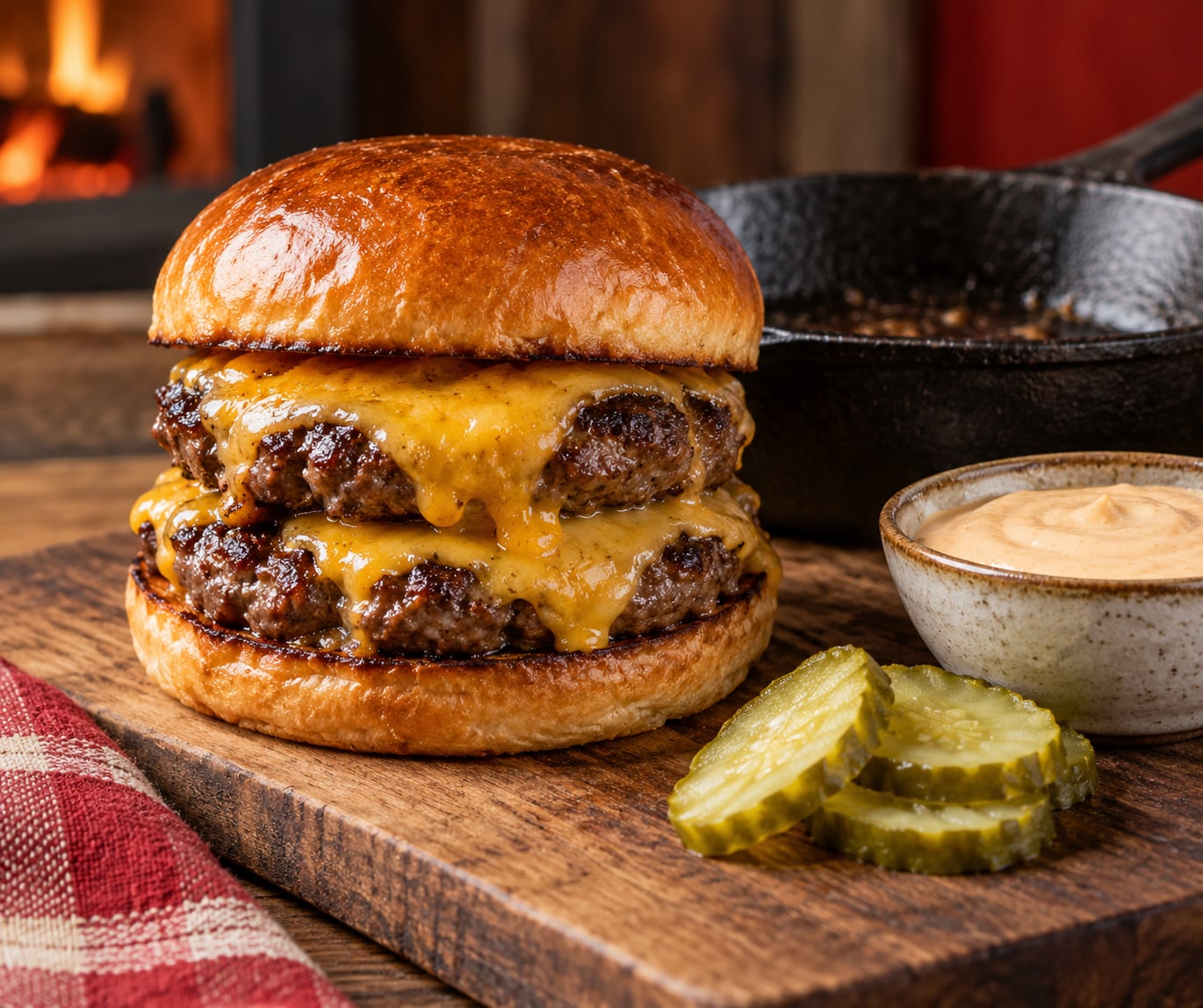
A double cheeseburger is two thin beef patties, each topped with melted cheese, stacked together in one toasted bun, and you can make one at home in about 15 minutes on a hot cast-iron skillet. Three things decide the result: a pan hot enough to brown the beef almost instantly, patties shaped thin and handled gently, and exactly one flip.
It is a weeknight-friendly cook. The active work is closer to ten minutes, and the rest is waiting for the pan to heat while you toast the buns and slice the pickles.
One safety note up front, because it applies no matter which doneness you prefer. Ground beef needs to reach 160°F (71°C) at its thickest point, checked with an instant-read thermometer. That is the USDA safe minimum internal temperature for ground meat, and it is the number to watch on thin patties that are easy to overcook by accident.
Table of Contents
- What You Need
- Ingredients
- Equipment
- Step-by-Step: How to Make a Double Cheeseburger at Home
- 1. Set Up Your Cooking Station
- 2. Season and Divide the Beef
- 3. Cook the First Side of the Double Cheeseburger Patties Without Pressing
- 4. Flip and Cook the Burgers Through
- 5. Add Cheese and Melt It
- 6. Toast the Buns and Build the Burgers
- 7. Rest and Serve Immediately
- Common Mistakes
- Tips for Juicy Double Cheeseburgers
- Frequently Asked Questions
- How hot should a cast iron skillet be for burgers?
- Do you grill hamburgers with the lid open or closed?
- What is the difference between a double cheeseburger and a quarter pounder?
- What is the best cheese to melt on a burger?
- How do I stop my double cheeseburger falling apart?
- How hot should the internal temperature of a burger be?
- Conclusion
What You Need
Quick facts before the list: 5 minutes prep, 8 to 10 minutes cook, about 15 minutes total, and the quantities below make two double cheeseburgers with four patties at roughly 2 oz (55 g) each.
Ingredients
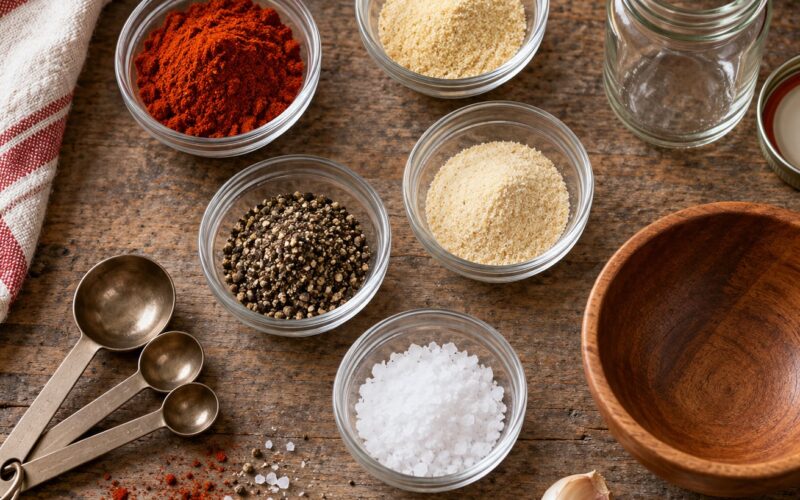
- 1 lb (450 g) 80/20 ground chuck, kept cold in the fridge until you are ready
- 4 slices American cheese (cheddar, Swiss, or provolone all work)
- 2 brioche, potato, or sesame seed buns
- 1/2 tsp kosher salt, plus more to taste
- 1/4 tsp freshly ground black pepper
- 1 tsp Worcestershire sauce
- 1 tbsp neutral cooking oil or unsalted butter
- Dill pickle slices, thin lettuce leaves, tomato slices, or thin onion rings
- For the sauce: 3 tbsp mayonnaise, 1 tbsp ketchup, 1 tbsp sweet pickle relish, 1 tbsp pickle brine
Equipment
- A cast-iron skillet or flat griddle, the two work best for a browned crust
- A wide, thin-edged spatula for flipping and for pressing a patty
- A small bowl and a fork for mixing the sauce
- An instant-read thermometer, which is the only reliable way to hit 160°F
American cheese is the one to reach for by default. It has emulsified salts in it, so it melts into a smooth sheet that sticks to the beef instead of sliding off or pulling into rubbery strings, and it is mild enough not to fight the meat. Sharp cheddar tastes better but needs a lid or it will not melt evenly on a fast cook.
On the beef, buy 80/20 ground chuck rather than anything leaner. The 20% is fat, and fat is flavor and moisture. Lean beef shrinks hard on contact with a hot pan and turns rubbery, which is the usual reason a home double cheeseburger disappoints. A coarse grind also helps: it gives the crust more surface to catch on.
Step-by-Step: How to Make a Double Cheeseburger at Home
1. Set Up Your Cooking Station
Everything within arm’s reach before the beef comes out of the fridge. Toast the buns first if you are using a skillet, or in a toaster oven while the pan heats, then slice the pickles and onions.
Mix the sauce while the pan is heating: mayo, ketchup, relish, and pickle brine, stirred together with a fork. Assembly takes about thirty seconds, and that only works if nothing else needs chopping once the meat hits the pan.
2. Season and Divide the Beef
Put the beef in a bowl and season it lightly with the salt, pepper, and Worcestershire. Work it with your fingertips for about fifteen seconds, just until the loose beef looks evenly seasoned, then stop. Overworking warms the meat and tightens the proteins, which is what makes a patty spring back and turn bouncy instead of tender.
Divide into four even portions and ball each one up. Roll each ball between your palms to flatten it to about a quarter inch thick, roughly a shade wider than the bun. Two thin patties stacked is the whole point of a double, and thin means four of them cook at once.
Press a shallow dent into the center of each patty with your thumb. It flattens the thickest part so the patties finish cooking at the same time as the edges, and the raised rim is where the lacy crisp edges form.
3. Cook the First Side of the Double Cheeseburger Patties Without Pressing
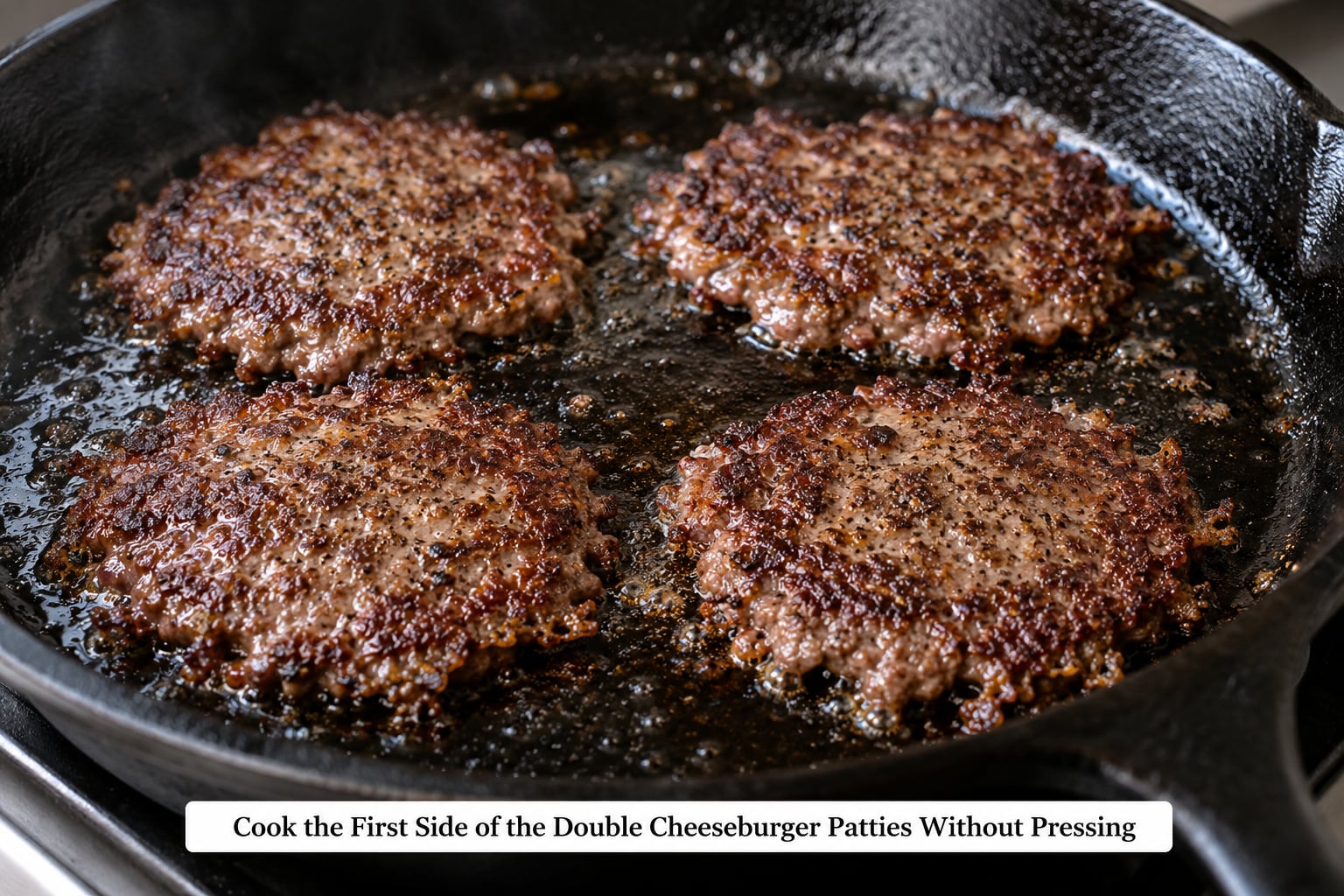
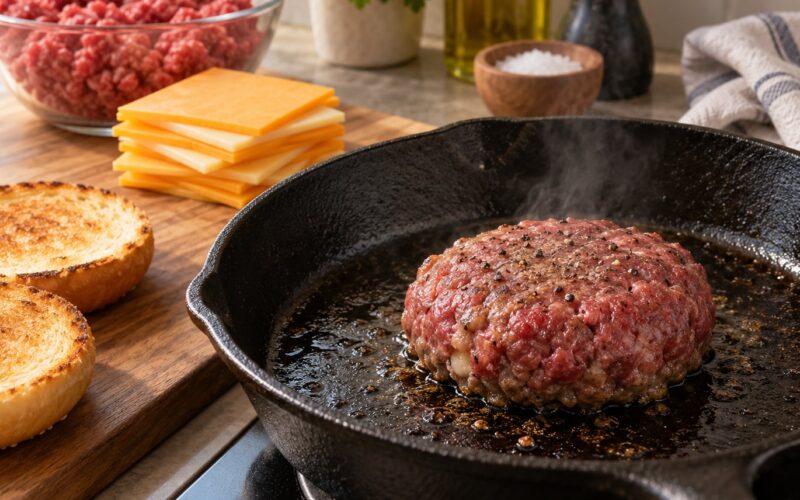
Heat the cast-iron skillet over high heat for three to five full minutes, until a drop of water skitters and evaporates almost instantly, or until the pan smokes faintly. Add the oil, then lay all four patties down at once. They should hiss loudly and steam within a few seconds. If they do not, the pan is not ready; pull them off, wait, and try again.
Leave them alone for 2 to 3 minutes. Do not press them, do not move them, and do not flip them early. The crust forms during this undisturbed contact, and every second you spend shifting the meat costs you browning. You are looking for a deep brown surface and a good lift of rendered fat around the edges.
4. Flip and Cook the Burgers Through
Slide the wide spatula fully under each patty and turn them over in one confident motion. A single flip is the rule that keeps the crust attached. Flipping repeatedly is the most common reason a home burger comes out grey and pale, because each turn tears the browning off the surface.
Cook the second side for 1 to 2 minutes if the pan is very hot, or closer to 3 on a medium flame. If the outsides darken before the centers cook, move the patties to a cooler part of the pan, or lower the heat, and give them another minute.
Check the temperature at the thickest part of a patty, pressing the probe in from the side. Pull them off the heat at 160°F (71°C). Thin smash-style patties go from done to dry fast, so check early and take them off while they still feel springy.
5. Add Cheese and Melt It
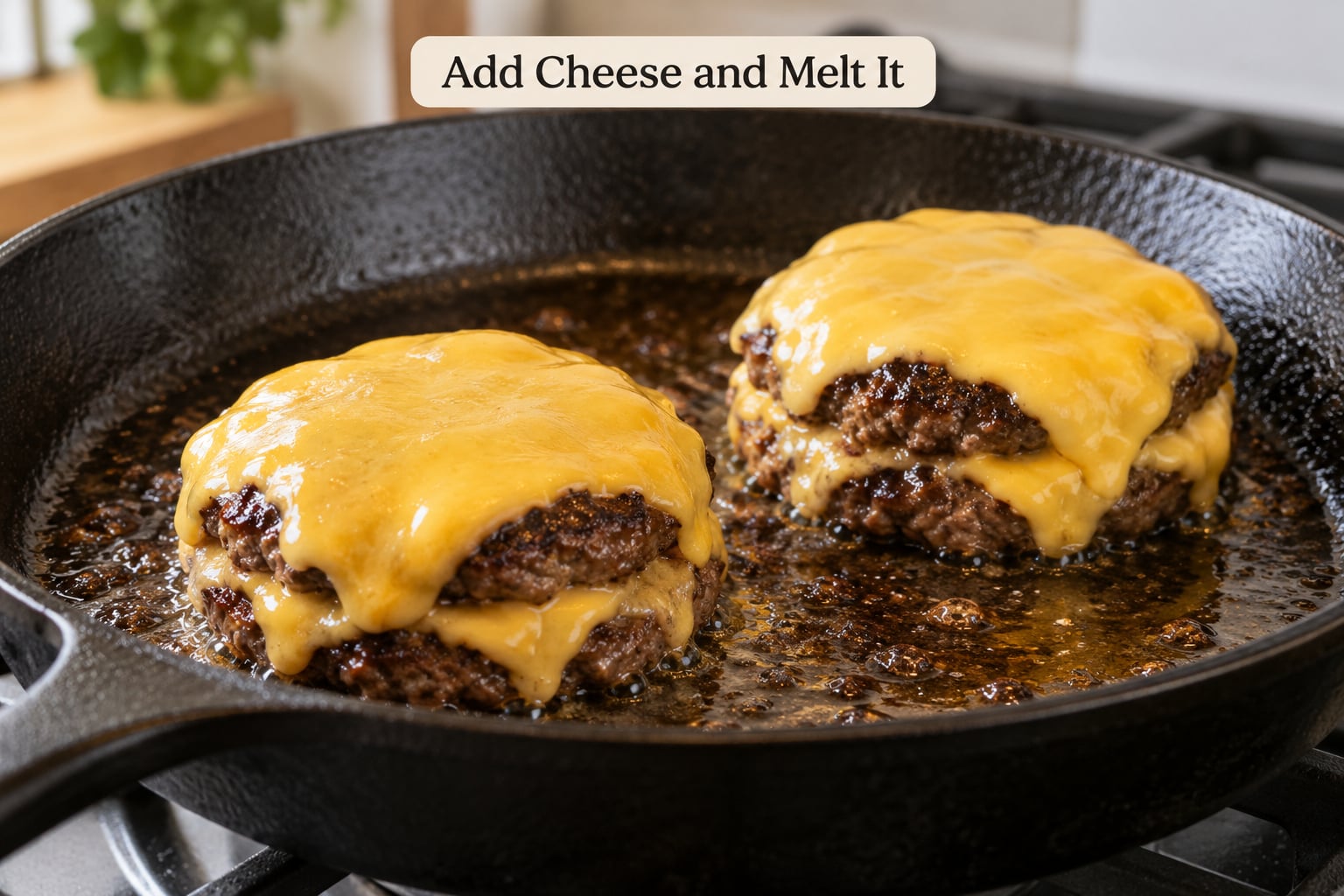
Lay one slice of cheese on each patty, right away, while the surface is still hot enough to melt it in seconds. Then either drop a lid or a sheet of foil over the skillet, or stand there and watch it. Thirty to sixty seconds of trapped heat is usually all it takes for the slice to go from rigid to a soft sheet draping over the edges.
If you skipped the cheese, you can also finish the patties under a hot broiler for about a minute. Keep an eye on it; cheese goes from melted to scorched fast under direct heat.
6. Toast the Buns and Build the Burgers
Spread butter or a little oil on the cut faces and toast them in the same skillet for 30 to 45 seconds until golden. A copycat fast-food style double uses a soft steamed bun instead, which is a matter of taste, but a toasted face gives you a structure that survives two patties.
Build from the bottom up: sauce on the bottom bun, then the first patty and its cheese, then the second patty and its cheese, then lettuce, tomato, or onion if you want them. Condiments like pickles and extra sauce work better on the bottom bun, where they press into it instead of letting the top slide around.
To keep a double from collapsing in your hands, keep the meat from wider than the bun, put the taller, crumplier toppings at the bottom, and press a wooden skewer through the whole stack for anything that has to travel.
7. Rest and Serve Immediately
Let the patties sit for 2 to 3 minutes after they leave the heat. The juice that runs out during cooking settles back into the meat, which is what keeps the first bite from being dry.
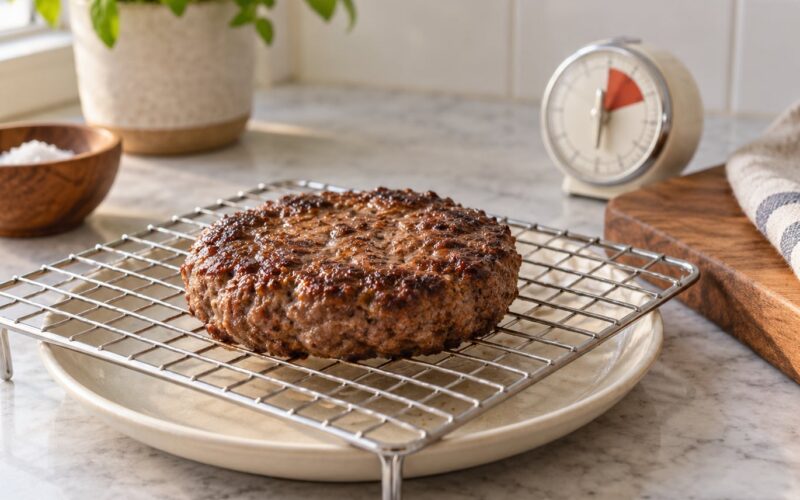
Serve the burgers straight away while the cheese is still glossy. If you are cooking for more than two people, rest the patties on a wire rack set over a tray rather than stacking them on a plate, where the bottom burger steam-soaks the bun underneath it.
Common Mistakes
Almost every disappointing double cheeseburger traces back to one of six things:
- Grey, boiled-looking patties. The pan was not hot enough or you crowded it. Preheat cast iron for a full three to five minutes and cook four patties at a time, not six. Watch for a loud hiss the moment they land.
- No crust at all. You flipped more than once, or you pressed with the spatula. One flip, no pressing, and then leave the patty alone until the timer says so.
- Dry, shrunken patties. Usually lean beef, or patties cooked past 160°F. Use 80/20 and pull them off the heat on the first check.
- Patties breaking apart in the pan. The meat was overworked or handled too much, or the patties were too thin for the pan. Mix gently, keep them a quarter inch thick, and use a wide spatula that slides fully underneath.
- Soggy bun. You assembled too early. The bottom bun steams from the patty and goes soft within minutes, so build right before serving, not while the meat rests.
- Cheese sliding off. It was added too late, off the heat, or without any cover. Add cheese to the patty while it is still on the heat and cover the pan for under a minute.
One more problem is specific to doubles: a burger that is too tall to eat. Two patties plus two cheese slices plus toppings is already a serious stack. Resist the urge to load it with four condiments and a full layer of onions, or the first bite takes the bottom half with it.
Tips for Juicy Double Cheeseburgers
Use the flat griddle when you are cooking for a group. A cast-iron skillet takes four patties at once; a rectangular griddle takes eight or ten, and the same 2 to 3 minutes per side applies. Gas and charcoal grills work too, with the lid closed for the cheese melt at the end.
Grill with the lid open for the sear and closed for the melt. Closing the lid from the start traps steam and steam is the enemy of browning, but closing it for the last thirty seconds with the cheese on is exactly how you get a melt on a grill.
Try a different cheese for a different burger. Cheddar brings sharpness, Swiss brings nuttiness and a clean melt, pepper jack adds heat, and provolone melts like American without the sharpness. Two slices per burger is standard; a single slice of something bold is a different move.
Make the burger sauce a minute before you cook. Three tablespoons of mayo, one of ketchup, one of sweet pickle relish, and a spoonful of pickle brine gives you the sweet-sour-creamy profile of a drive-through burger, and it takes no cooking at all. Thin it with a teaspoon of water or extra brine if you want it to run over the patties.
Add onions two ways. Quick-pickled raw onion slices, or dehydrated onions soaked in warm water for ten minutes, give that sharp onion flavor fast. For a pub-style double, caramelize sliced onions separately in the same pan; they need 15 to 20 minutes and a splash of water, and they are worth the wait.
Avoid cross-hatch grill marks. The diagonal lines come from moving the patty during the sear, and moving the patty means losing the crust. Plain grill marks from a stationary patty are enough.
For a crowd, form the patties up to a day ahead and refrigerate them on a tray, never stacked. Season them at cook time so the salt does not pull water out of the beef overnight. Let them come out of the fridge 15 minutes before they hit the pan so they do not shock and grey.
Frequently Asked Questions
How hot should a cast iron skillet be for burgers?
Preheat it over high heat for three to five full minutes before the oil goes in. A drop of water should skitter across the surface and disappear almost immediately, and the pan may smoke faintly. Add the beef only when it sizzles loudly within a few seconds of landing. A warm pan steams the meat instead of browning it, which is the single biggest reason home patties come out grey.
Do you grill hamburgers with the lid open or closed?
Open for the sear, closed for the melt. The lid traps steam, and steam keeps the surface wet, so a closed lid from the start costs you the crust. Cook the patties uncovered for 2 to 3 minutes a side, then close the lid after the cheese goes on and give it 30 to 60 seconds. On a cast-iron skillet, the same trick works with a lid or a sheet of foil.
What is the difference between a double cheeseburger and a quarter pounder?
A double cheeseburger uses two thin patties, usually about 2 oz each, stacked together in one bun with two slices of cheese. A quarter pounder is a single thicker patty of 4 oz or more. The double cooks faster and stays juicier because the meat is thinner, while the quarter pounder gives a more substantial, pub-style bite. They are built and cooked differently, so a technique that works for one often causes grey meat on the other.
What is the best cheese to melt on a burger?
American cheese melts the most reliably, which is why it is the default for a fast-food style double. Its emulsified salts let it soften into a smooth sheet that clings to the patty instead of sliding off. Cheddar, Swiss, and provolone all melt well too, but sharper cheeses need the lid or foil trick for the final 30 to 60 seconds. Pepper jack is the pick if you want heat.
How do I stop my double cheeseburger falling apart?
Handle the beef gently, mix it just enough to season, and use a wide thin-edged spatula that slides fully under each patty. Too-thick patties break when you flip them, so keep them about a quarter inch thick. For the assembled burger, keep the meat from wider than the bun and put taller toppings at the bottom. A wooden skewer through the center holds the stack together if it has to travel.
How hot should the internal temperature of a burger be?
The USDA safe minimum internal temperature for ground beef is 160u0026deg;F (71u0026deg;C), measured at the thickest part of the patty. Check it with an instant-read thermometer rather than judging by color, because thin patties brown long before the center is done. Pull the patties at 160u0026deg;F and they will finish cooking off the heat, which is also how you avoid a dry burger.
Conclusion
Start by heating the skillet properly, because that single habit decides whether the burger works. Preheat cast iron over high heat for three to five minutes, lay the patties down, and let each one sit undisturbed for 2 to 3 minutes.
Everything after that is repetition: 80/20 ground chuck shaped thin and handled gently, one flip and only one, cheese added while the patty is still on the heat, and 160°F (71°C) on the thermometer before the patties leave the pan. Rest the beef for two minutes, toast the buns, stack two patties with sauce, and serve it straight away while the cheese is still glossy.