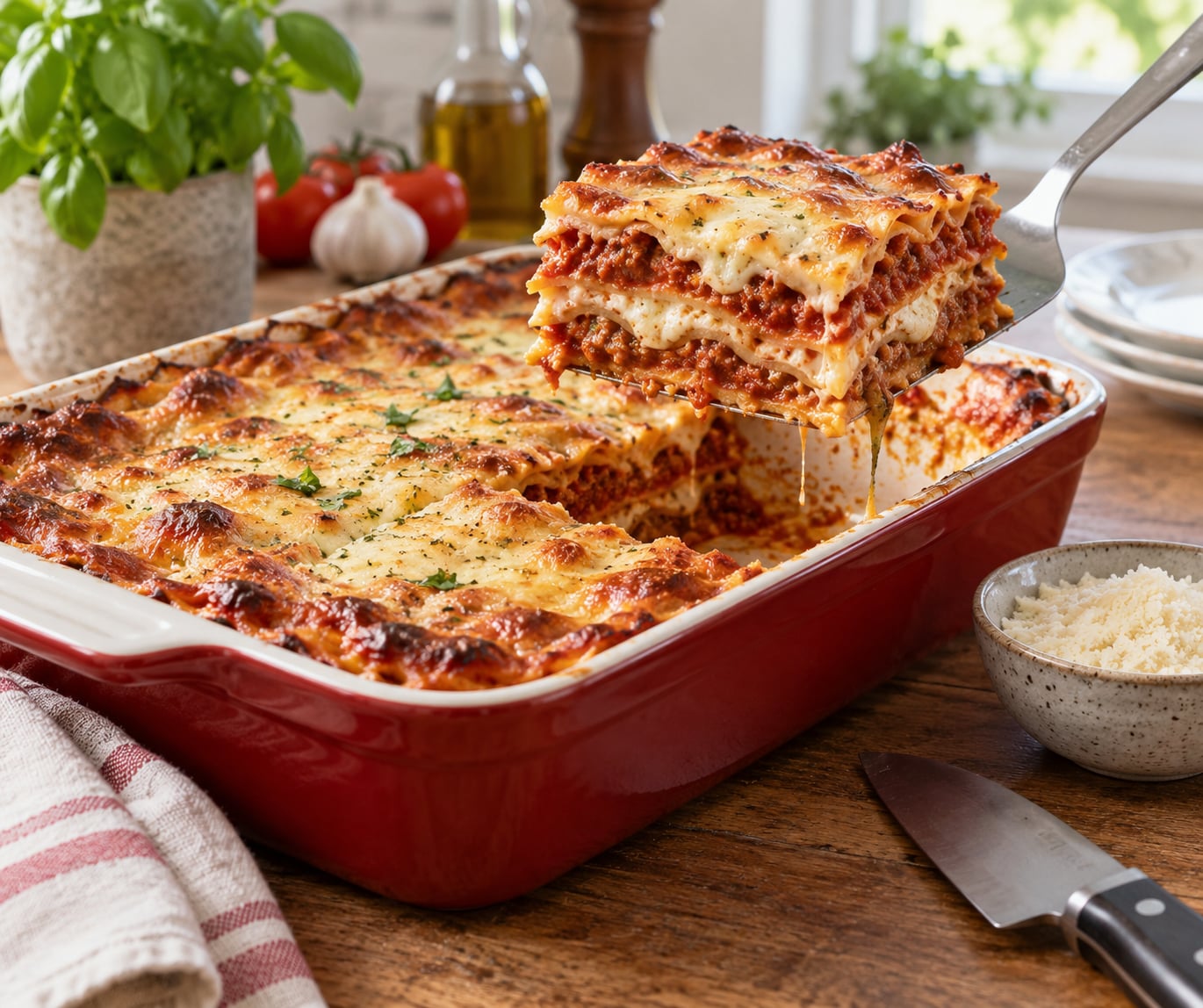
Lasagna layers slide for two reasons: there is too much free liquid between them and the pasta is over-hydrated, and the dish gets cut before the cheese and starch have set. Fix those two things and the same recipe that came out as a pile of noodles last Sunday comes out of the oven as a tall, clean square.
So how to make lasagna layers that do not slide comes down to moisture control before assembly and patience after the bake. Twenty minutes of prep you would have skipped anyway, then twenty minutes of rest you normally lose to slicing too early.
The whole job takes about two hours, most of it unattended, and the failure is a technique problem rather than a skill one.
- Reduce the water before you assemble. Simmer the sauce uncovered, drain the ricotta, salt and drain any vegetables, and drain browned meat separately.
- Build one even layer at a time. Thin sauce, noodles top and bottom, a set filling, and press every layer flat to kill air pockets.
- Rest the finished dish 15 to 20 minutes. Still hot enough to eat, firm enough to cut. It stays hot for roughly an hour after that.
Table of Contents
- What You Need
- Step-by-Step: How to Make Lasagna Layers That Do Not Slide
- Prepare the Filling and Sauce
- Choose and Treat the Noodles
- Build Even Layers
- Bake, Chill, and Cut
- Common Mistakes
- Tips for the Cleanest Lasagna Slices
- Frequently Asked Questions
- Why are my lasagna layers sliding apart?
- How long should lasagna rest before cutting?
- Should I boil the noodles before assembling lasagna?
- How can I make a watery lasagna sauce thicker?
- Can I assemble lasagna the night before baking?
- How do I keep leftovers from becoming soggy?
- Conclusion
What You Need
The ingredient list is familiar. What actually decides whether the layers hold is the thickness of the sauce, the stiffness of the noodle sheets, and the depth of the dish.
- 12 to 16 sturdy lasagna sheets. No-boil or no-bake extra-wide sheets from the box, or classic boil-type sheets. Both work if you treat them differently. Soft fresh pasta and thin gluten-free sheets are the two I avoid for a layered bake.
- Sauce thick enough to hold a spoon. Two 24-ounce jars of tomato sauce is a working amount for a deep 9×13. Jarred marinara is fine as long as you simmer it down first.
- 15 ounces whole-milk ricotta, 2 eggs, 1 cup shredded mozzarella, half a cup grated parmesan. The eggs are the binder. Cheese alone melts into a layer that pushes around instead of setting.
- Filling of roughly even thickness. One pound of ground beef or Italian sausage, browned and drained, or a cooked vegetable layer. Spinach, zucchini and eggplant all work if you take the water out first.
- A deep baking dish, glass or ceramic, about 3 inches deep. A deep 9×13 holds three or four layers and gives you a slice with height. A shallow 9×12 gives you two thin ones, and a two-layer lasagna has no interior to hold together.
- Foil, a very sharp chef’s knife, a wide spatula, and a colander. The knife matters more than people expect; a dull blade tears the layers instead of dividing them.
- Optional: a rimmed sheet pan and two loaf pans of dry beans. The sheet pan catches drips if the bottom layer bubbles, and the loaf pans pressed on top of the foil stop the cheese from doming.
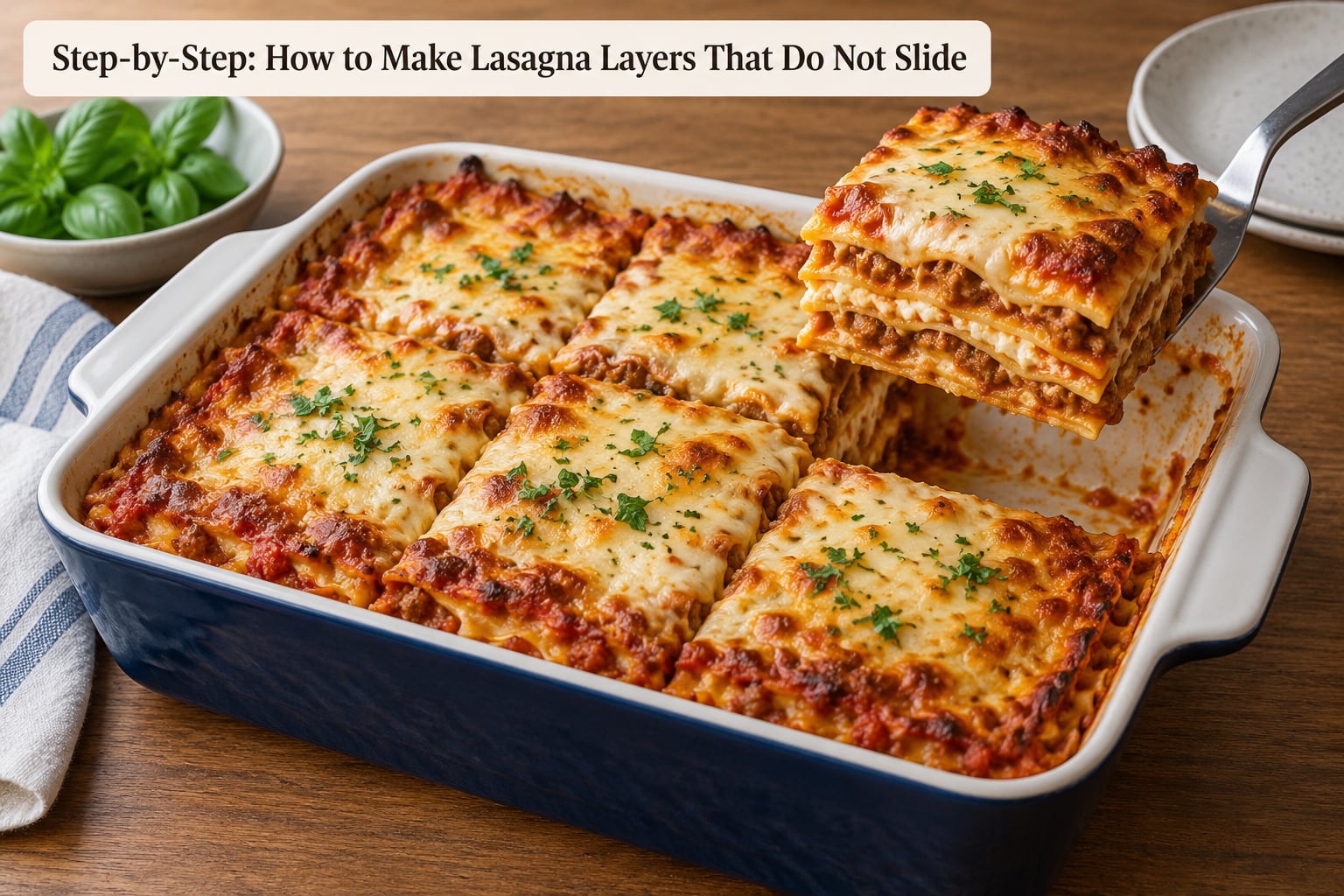
Step-by-Step: How to Make Lasagna Layers That Do Not Slide
Prepare the Filling and Sauce
Reduce everything watery before a single noodle goes in the pan. This is the step that decides the outcome, and it takes the least time of anything here.
Brown the meat in a skillet, then lift it out and drain it. Rendering fat and the water clinging to browned crumbles are what turn a good sauce into a puddle, and a cook on the Fluther thread drains the meat separately for exactly this reason. Put the meat back into the sauce only after the fat is gone.
Simmer the sauce uncovered for 20 to 30 minutes until it thickens enough that a spoon dragged through it leaves a clean line. If it is still thin after 30 minutes, stir in two tablespoons of tomato paste and give it another 10. A sauce that looks slightly too thick going into the pan comes out right, because the noodles drink from it during the bake.
Drain whole-milk ricotta in a fine-mesh strainer set over a bowl for 30 minutes, and discard what collects. Beat two eggs into the drained ricotta and stir in the parmesan. That egg-bound ricotta is the structure of the whole dish: it coagulates in the oven and grips the noodle above and below it, so the layer stays a layer instead of sliding off as one sheet.
Vegetables need the same treatment. Salt zucchini, eggplant or spinach in a colander for 20 to 30 minutes, then pat them dry, or cook them in a hot dry pan until the water is gone. Mushrooms go in dry with no salt at all; they release more than you would guess.
Choose and Treat the Noodles
Pick the sheet that matches how you want to handle the bake, then cook or soak it exactly to the point where it is still too firm to eat. It finishes in the oven, and a sheet that is already tender when it goes into the dish has nothing left to give.
| Noodle type | Moisture it needs | Layer strength | Pick it when |
|---|---|---|---|
| No-boil / no-bake sheets | Brushed or spooned with sauce or bechamel before assembly | Strongest, since the sheet is dry and never waterlogged | You want tall, clean slices and you are layering in the pan |
| Classic boil-type sheets | Pre-boiled briefly and drained very dry | Good, and more forgiving about timing | You like the texture, or you are rolling the sheets around a filling |
| Fresh pasta sheets | Nothing, they are already hydrated | Weak; they tear and shrink as they bake | Roulade style only, not for a layered dish |
For boiled sheets, cook them about 60 to 90 seconds less than the box says, until they are pliable and still noticeably firm. Pull them out, let them drain in the colander for a full minute, and lay them flat on a clean towel rather than piling them, which is what makes them stick together. Do not rinse them, because the surface starch is part of what bonds the layers, and save a cup of the water in case the sauce needs loosening.
For no-boil sheets, the moisture comes from the sauce instead. Spoon a thin layer of sauce directly onto the dry sheet as you lay it in the pan, or brush it with bechamel. Dry sheets in a dry pan will not soften no matter how long they bake, and you will end up with a crisp top layer nobody asked for.
Whichever you use, pat the surface dry before assembly. A wet sheet spreads its sauce into a puddle instead of holding it.
Build Even Layers
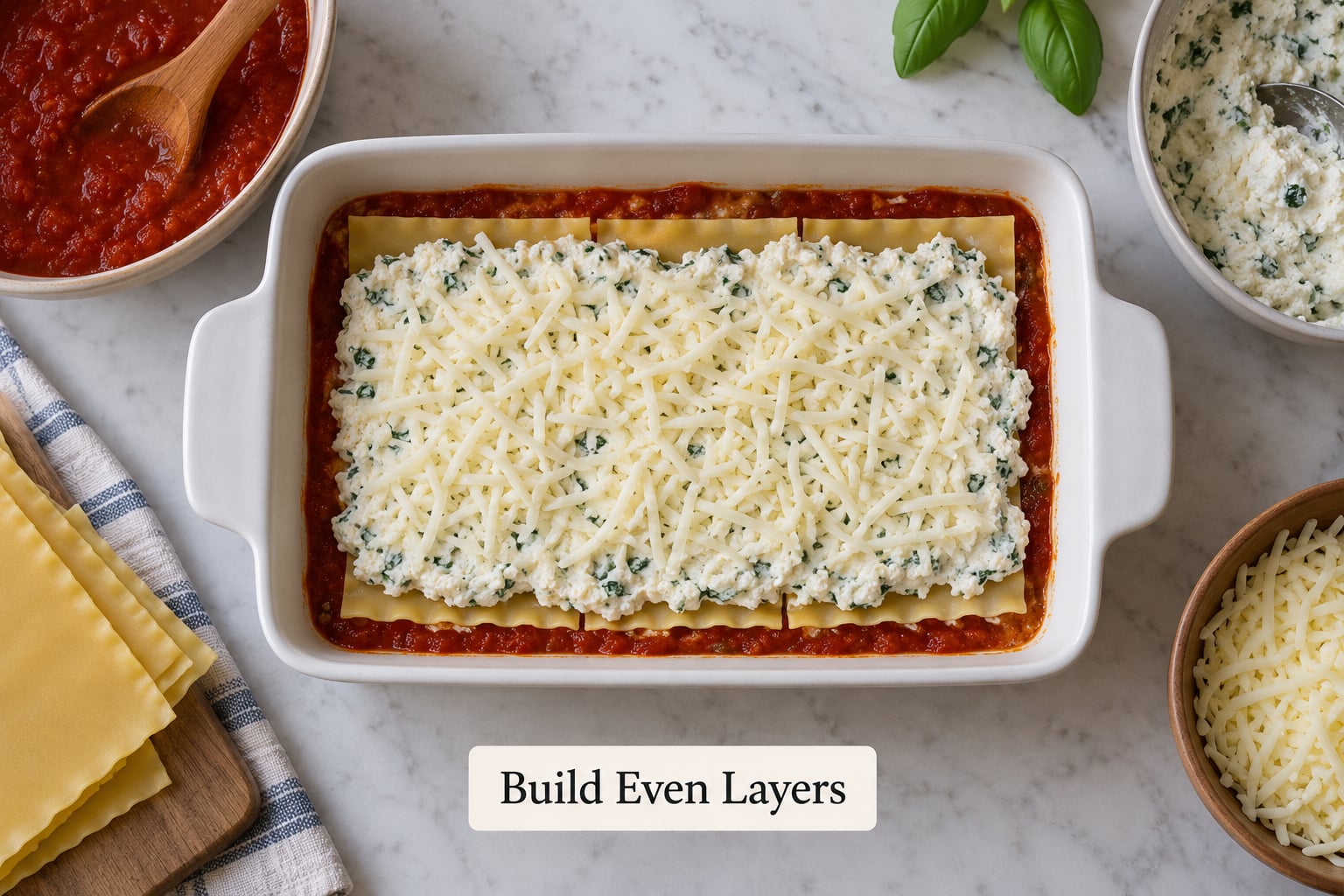
Layer from the pan up in this order, and keep every layer the same thickness so the slices come out square.
- Spread a thin layer of sauce on the bare pan bottom. A third of a cup, enough to coat the glass and stop the first sheet from baking onto it. Skimp here and the bottom noodles fuse to the pan and tear when you try to lift the first slice.
- Lay down the first noodle layer. Press it flat with your palm so it touches the sauce everywhere. Air pockets are what turn into gaps and separated sheets later.
- Add a thin, even layer of sauce. Reach the edges. Sauce is what carries moisture to the dry pasta, and a bare edge dries out and curls.
- Add the ricotta, then the meat or vegetables. Spread the ricotta with the back of a spoon to the same thickness across the whole pan, and scatter the meat evenly rather than spooning it in mounds.
- Repeat those four steps for as many layers as your dish holds, three or four in a deep 9×13.
- Turn the noodle direction on each new layer. Run the second layer at right angles to the first, the third back the same way as the first. The overlapping seams land in different places each time, and the layer has far less room to split along a straight line. It costs you nothing and it is the single most useful trick in the thread on Fluther about whether there is a right way to layer a lasagna.
- Finish with a noodle layer, then sauce and cheese on top. The top sheet needs sauce on it or it dries and crisps. Finish with mozzarella and a final scatter of parmesan.
Press the whole pan gently with your hands after the last layer, then leave about half an inch of headroom at the rim. Sauce that bubbles over the side in the last 15 minutes is sauce you lose, and a sticky rim is sauce that welds the top layer to the foil.
Cover the dish with foil, spritz the underside with cooking spray so the top cheese does not tear off when you peel it back, and tent it loosely with the edges turned up so steam can escape.
There is one variation worth knowing, used by cooks who find cheese slides off noodles more often than sauce slides onto them. Put the ricotta down first and ladle sauce over the top instead of spreading sauce first. Slick noodles give the sauce something to grip.
Bake, Chill, and Cut
Bake at 375 F with the foil on for 30 minutes, then pull it back and bake 15 to 20 minutes uncovered. The uncovered stretch matters more than it looks: it lets surface moisture evaporate and sets the top cheese, which is the crust that holds the first slice together.
It is done when the center bubbles slowly and the cheese looks set rather than wet, at 165 F in the middle if there is meat in the dish. A deep pan running more than three layers adds 10 to 15 minutes. A watery layer will not fix itself no matter how long it bakes, so if you are seeing a puddle at the edge, that is a sauce problem from step one.
Now leave the pan alone on the counter for 15 to 20 minutes. This is the part everyone cuts short. The starch in the noodles and the egg-bound ricotta are still finishing their set as they cool, and the fat in the cheese solidifies on the way down, which is what bonds layer to layer. Straight out of the oven it is a loose stack that flattens the moment the knife goes in.
Twenty minutes is enough, and the dish is still properly hot when you cut it, staying that way for about an hour. For a tall lasagna or a cold room, forty-five minutes is the number one cook on that Fluther thread uses, and it is the right call if you are nervous.
Wipe the knife blade between every cut and push straight down without sawing, all the way to the bottom of the pan in one motion. Then slide a wide spatula under the portion, supporting it from underneath, and lift. Pulling from the side shears the layers apart.
Get leftovers into the fridge within two hours of the oven, and eat them within three to four days.
Common Mistakes
Each of these has a specific cause, and each one shows up in the pan as a recognizable symptom rather than a vague bad result.
It falls apart when you cut it. Almost always cut too early, or cut with a dull knife that tears rather than divides. Rest 15 to 20 minutes, sharpen the blade, and cut straight down in one motion.
A watery puddle spreads across the plate. The sauce went in thin. Simmer it uncovered until it coats a spoon, and remember it should look a little too thick before assembly, since the pasta drinks from it.
The layers merge into one thick mass. Too much sauce between layers, or too few of them. Sauce that spreads on its own pushes the cheese layers together. Use a thinner sauce per layer and add a layer instead of pouring more.
The top sheet goes dry and crisp. Nothing on top to hydrate it. Spoon sauce across the final noodle layer before the cheese, and remember no-boil sheets need sauce on them before assembly or they never soften.
The middle is soggy while the top is fine. Overcooked noodles, or a filling that released water in the oven. Pull boiled sheets 60 to 90 seconds early and pre-drain the ricotta and any vegetables.
It slumps when lifted onto the plate. A wide portion from a shallow dish has nothing holding the sides. Cut squares from the center of the pan rather than from an edge, and use a three-layer slice rather than a two-layer one.
The layers slide apart as they bake. Usually the pan is overfilled or the sauce is too thin, so the stack has nowhere to go. Leave headroom and thicken the sauce.
Tips for the Cleanest Lasagna Slices
Pan geometry decides how many layers you can build, and it is the part of this most people guess at. Extra-wide sheets in a 10×15 pan run about 13, which is four across with one cut to fill a short end; a 9×12 cake pan takes about 9.
| Dish | Extra-wide sheets per noodle layer | Layers to aim for | Note |
|---|---|---|---|
| 9×12 standard | 3 | 2 to 3 | Shallow and wide, gives low flat slices |
| 9×13 deep | 3 to 4 | 3 to 4 | The best balance of height and ease of cutting |
| 10×15 | 4 plus 1 to fill the short end | 3 to 4 | About 13 sheets per layer |
| 12×18 sheet pan | 6 | 2 to 3 | Party slices, cut into squares rather than bars |
| Individual ramekins | 1 sheet cut to fit | 2 | Set overnight in the fridge for the firmest lift |
For the cleanest slices after baking, mark the whole pan with a sharp knife before you cut the first one. It is much easier to run the blade straight down a scored line than to eyeball a square, and that pressure is what turns a wedge into a wobble.
To transport portions, cut the lasagna a day ahead, refrigerate the pieces in a sealed container, and carry the container on a flat surface. Reheat them covered at 350 F for 20 to 25 minutes rather than uncovered, so the steam does not dry the edges.
To reheat a whole lasagna without it collapsing, cover it loosely with foil and warm it at 350 F until the center hits 165 F. Foil keeps the cheese surface from tightening into a shell while the inside reheats, which is what makes reheated slices fall apart on the plate.
If you assemble ahead, cover the finished dish and refrigerate it for up to 24 hours, then add 10 minutes to the covered bake time. Several cooks on that Fluther thread prefer lasagna that has rested overnight, and the structure is noticeably firmer the next day.
For a deeper dish, keep the same layer order and add a layer rather than pouring in more sauce. For ramekins, the overnight fridge set is the difference between a single portion that holds its shape and one that arrives as a spoonful of filling.
Frequently Asked Questions
Why are my lasagna layers sliding apart?
Three causes account for almost every case: sauce that was not reduced before assembly, pasta sheets that were overcooked until they had no structure left, and cutting the dish before the cheese and starch set. Simmer the sauce uncovered, pull boiled noodles out firm, and rest the finished dish 15 to 20 minutes before the knife goes anywhere near it.
How long should lasagna rest before cutting?
Fifteen to twenty minutes on the counter is the standard and it is enough for the egg-bound ricotta and the noodles to finish setting. The lasagna is still hot at the end of it and stays hot for about an hour. A deep or tall lasagna benefits from 30 to 45 minutes, which is the longest rest recommended on the Fluther thread.
Should I boil the noodles before assembling lasagna?
Only if you are using classic boil-type sheets, and then only until they are still too firm to eat, roughly 60 to 90 seconds under the box directions. No-boil sheets are used dry from the package, but they need sauce or bechamel brushed onto them during assembly or they never soften. Both types work. Overcooking the noodles is what makes the layers give up.
How can I make a watery lasagna sauce thicker?
Simmer it uncovered for 20 to 30 minutes until a spoon dragged through the pan leaves a clean line. If it is still thin, stir in two tablespoons of tomato paste and give it another 10 minutes. Aim for a sauce that looks slightly too thick going into the dish, since the pasta sheets absorb a good part of it during the bake.
Can I assemble lasagna the night before baking?
Yes, and the structure is often better for it. Cover the assembled dish and refrigerate for up to 24 hours, then add about 10 minutes to the covered baking time. Many cooks in the Fluther thread say lasagna is more sliceable the next day. Keep the dish cold rather than at room temperature while it waits.
How do I keep leftovers from becoming soggy?
Let the dish set for 20 minutes before cutting any leftovers, refrigerate them within two hours of baking, and eat them within three to four days. Reheat portions covered at 350 F for 20 to 25 minutes. Covered reheating matters more than anything else, because uncovered heat dries the edges until the layers crack off each other on the plate.
Conclusion
Do one thing first: get the water out before assembly. Simmer the sauce uncovered, drain the ricotta, salt and drain the vegetables, and drain the meat. Layers slide because of loose liquid, and that liquid is the only thing you cannot fix after the dish is in the oven.
Then give it fifteen to twenty minutes. Not five, and not straight from the oven, because the slice you lift at minute five is the one that arrives as spaghetti.
Everything between those two points is technique: sauce on the bare pan bottom, noodles first and last, an egg-bound ricotta layer, a cross-cut direction change on each new layer, and half an inch of headroom. Do those and how to make lasagna layers that do not slide stops being a question you search for.