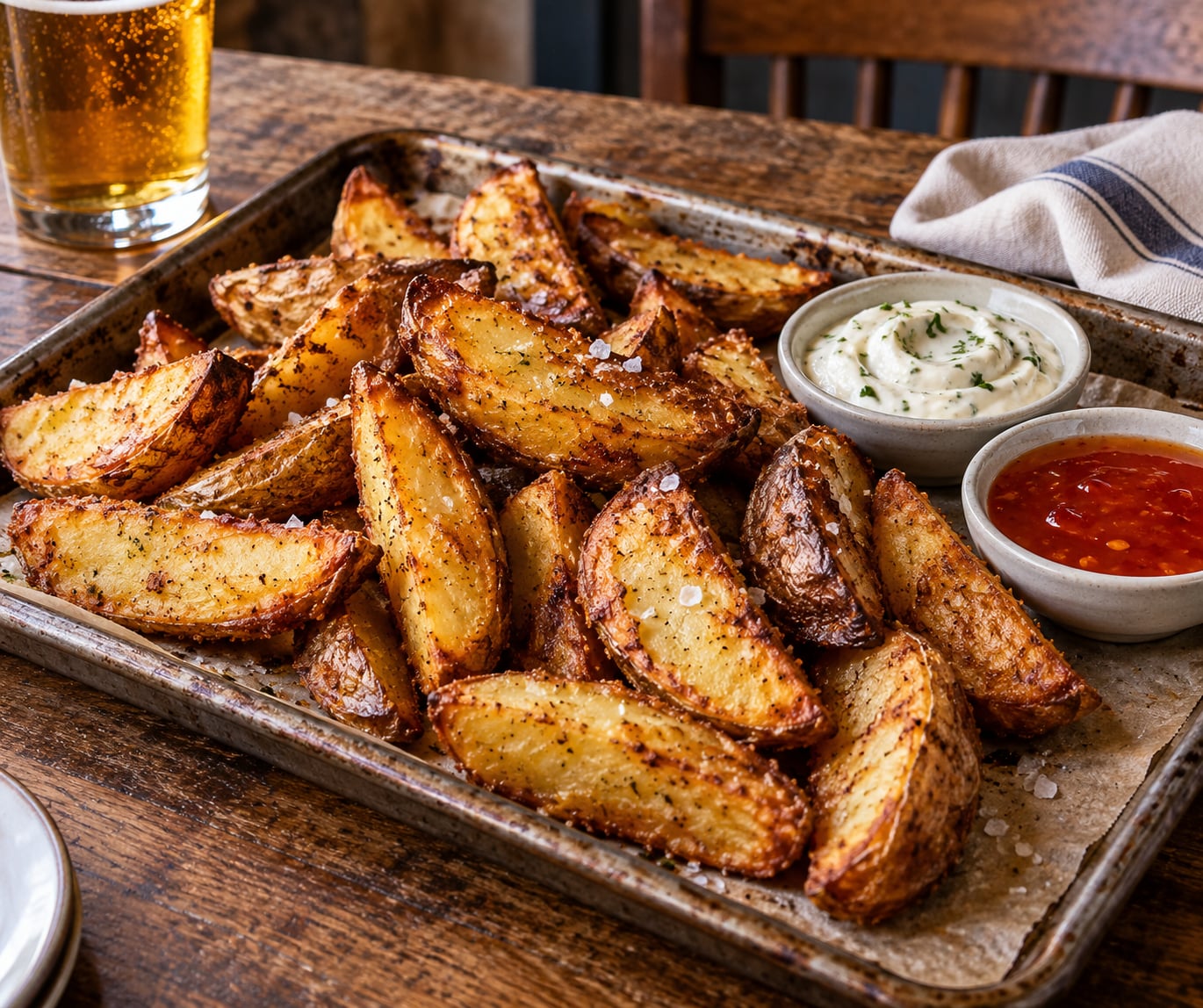
Pub style potato wedges are thick, skin-on wedges tossed in oil and a paprika-based seasoning, then baked or air fried at high heat until the outside is crisp and deeply seasoned and the inside stays fluffy. To make pub style potato wedges at home you par-bake them, dry them well, coat them lightly, and give them a single layer on a hot tray. From start to finish it takes about 45 minutes in a standard oven, plus a short air fryer version if you want it faster.
The pub version is served as a bar snack next to fried food, by default with sour cream and sweet chilli sauce. What you are chasing is that specific texture: a hard, shaggy crust you can hear when you bite, and a middle that collapses like a baked potato. Three things decide whether you get it, and all three are free: no surface starch, no steam, and enough room on the tray.
A note on the soaking argument before we start, because it is the most argued-over step in this whole recipe. It works, but it is optional. More on that further down.
Table of Contents
- What You Need for Pub Style Potato Wedges
- Which potato gives the crispest wedges?
- Step-by-Step
- How to make pub style potato wedges crispy in the oven
- Oven temperature: which one to use
- Can you make pub style potato wedges in an air fryer?
- Feeding a crowd
- How to season pub style potato wedges
- Does a coating help?
- Common Mistakes
- Frequently Asked Questions
- What is the best potato for pub style wedges?
- Do potato wedges need to be soaked before baking?
- What temperature and time should I use for oven-baked pub wedges?
- Can I make pub style potato wedges in an air fryer?
- What sauce goes best with pub style potato wedges?
- How do I keep baked potato wedges crispy?
What You Need for Pub Style Potato Wedges
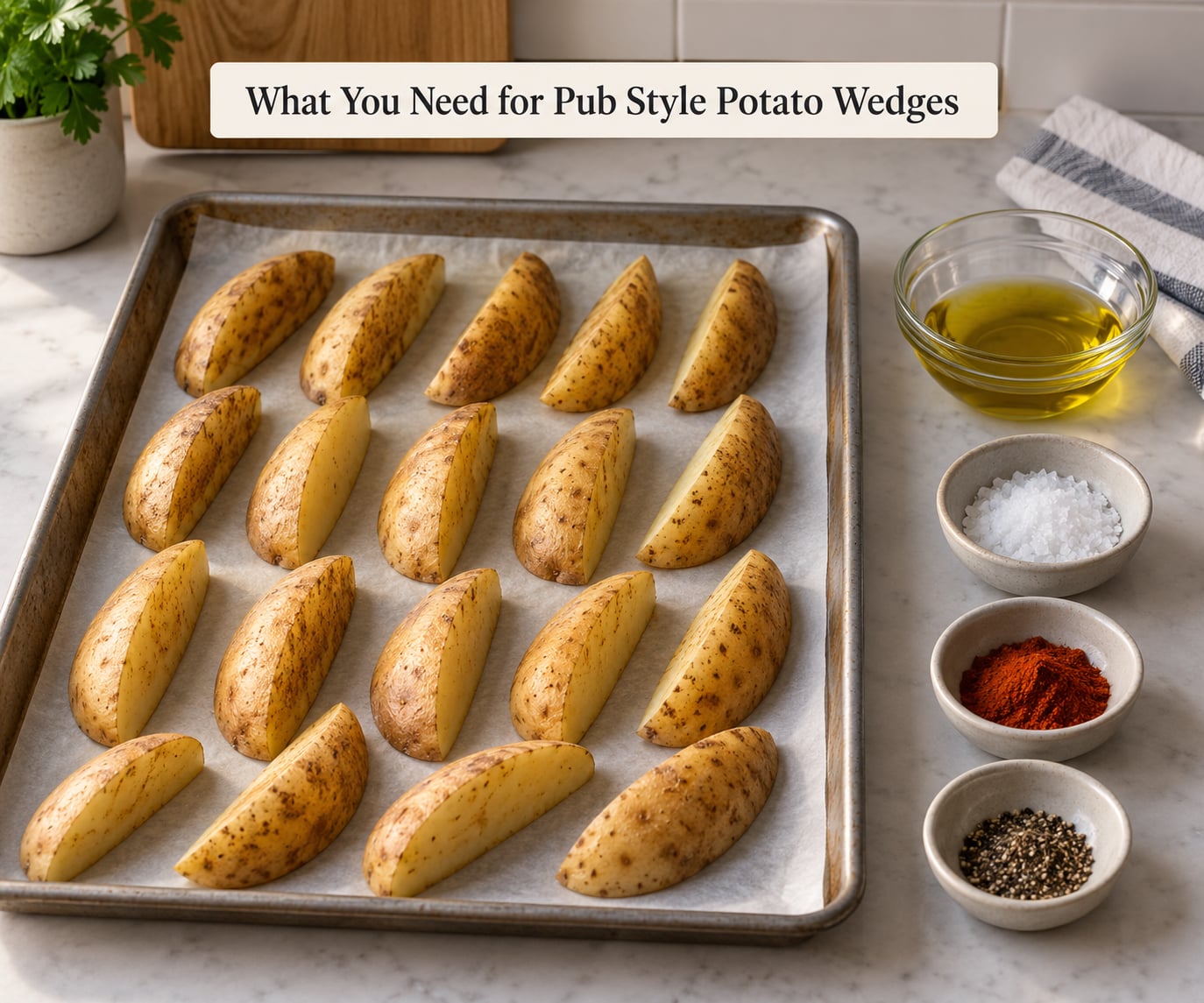
The ingredient list is short enough to buy in one trip, and most of it lives in the cupboard.
- 1 kg (2 lb) floury potatoes, about 5 medium or 4 large. Russet, Maris Piper, or King Edward work best. Yukon Gold is fine if that is what you have.
- 2 tablespoons olive oil or sunflower oil, plus a little more for the tray
- 1 teaspoon fine salt, plus flaky salt or Maldon for the top just before serving
- 1 teaspoon smoked paprika
- 1 teaspoon garlic powder and 1 teaspoon onion powder
- 1/2 teaspoon black pepper, freshly ground if you have it
- 2 tablespoons cornstarch, optional, for a heavier crust
- Sour cream and sweet chilli sauce for dipping, plus a pinch of chives if you are feeling fancy
You also need a rimmed baking sheet, a wire rack if you own one, a sharp knife, and a potato peeler you only use for the optional first step. A convection oven helps, but it is not required.
Leave the skins on. That is not a health point, it is a texture point. The skin is the outer shell that holds the wedge together through the par-bake, and it browns into the crisp edge you are aiming for.
Which potato gives the crispest wedges?
Look for a floury, high-starch potato. Waxy potatoes hold their shape but hold water too, and wet potatoes steam instead of brown.
| Potato | Starch | How it behaves | Verdict |
|---|---|---|---|
| Russet / Maris Piper / King Edward | High | Fluffy inside, shaggy crust, holds shape through par-baking | Best all-round choice |
| Yukon Gold | Medium | Buttery, creamier centre, good colour | Very good, slightly less crisp |
| Red potatoes (Red Bliss) | Medium-low | Skin-on colour, holds shape, 8 wedges per potato | Good for appearance, softer crust |
| New potatoes / waxy salad potatoes | Low | Waxy, moist, browns unevenly | Avoid for this recipe |
The cut matters as much as the variety. Halve each potato lengthways, then cut each half into three or four wedges. Aim for a thick wedge with one flat side, about 2 cm (3/4 inch) wide at the top. Thin fries go soft because there is not enough interior left to push back against the crust.
Lay the cut faces down on the tray when they go in. That flat face sits on hot metal and browns directly, which is the fastest route to a crisp base and the reason wedges stick less than you expect.
Step-by-Step
Eight steps, one tray, and about 15 minutes of actual work spread across 45 minutes of oven time.
- Preheat the oven to 220C / 425F. Put the empty baking sheet inside to heat up.
- Scrub the potatoes, leave the skins on, and cut into thick wedges lengthways.
- Par-bake the wedges cut side down on the hot sheet for 15 minutes, until just fork-tender.
- Pull the tray out and turn every wedge over, cut side up. Let them sit 10 minutes to dry.
- Toss the wedges with olive oil, then dust with the salt, paprika, garlic, onion powder and pepper.
- Shake the tray so no wedges touch, and roast for 25 minutes until deep golden and firm.
- Turn the oven to broil and give them 3 to 5 more minutes until the edges crackle.
- Scatter over flaky salt, rest 3 minutes, and serve straight away with sour cream and sweet chilli.
How to make pub style potato wedges crispy in the oven
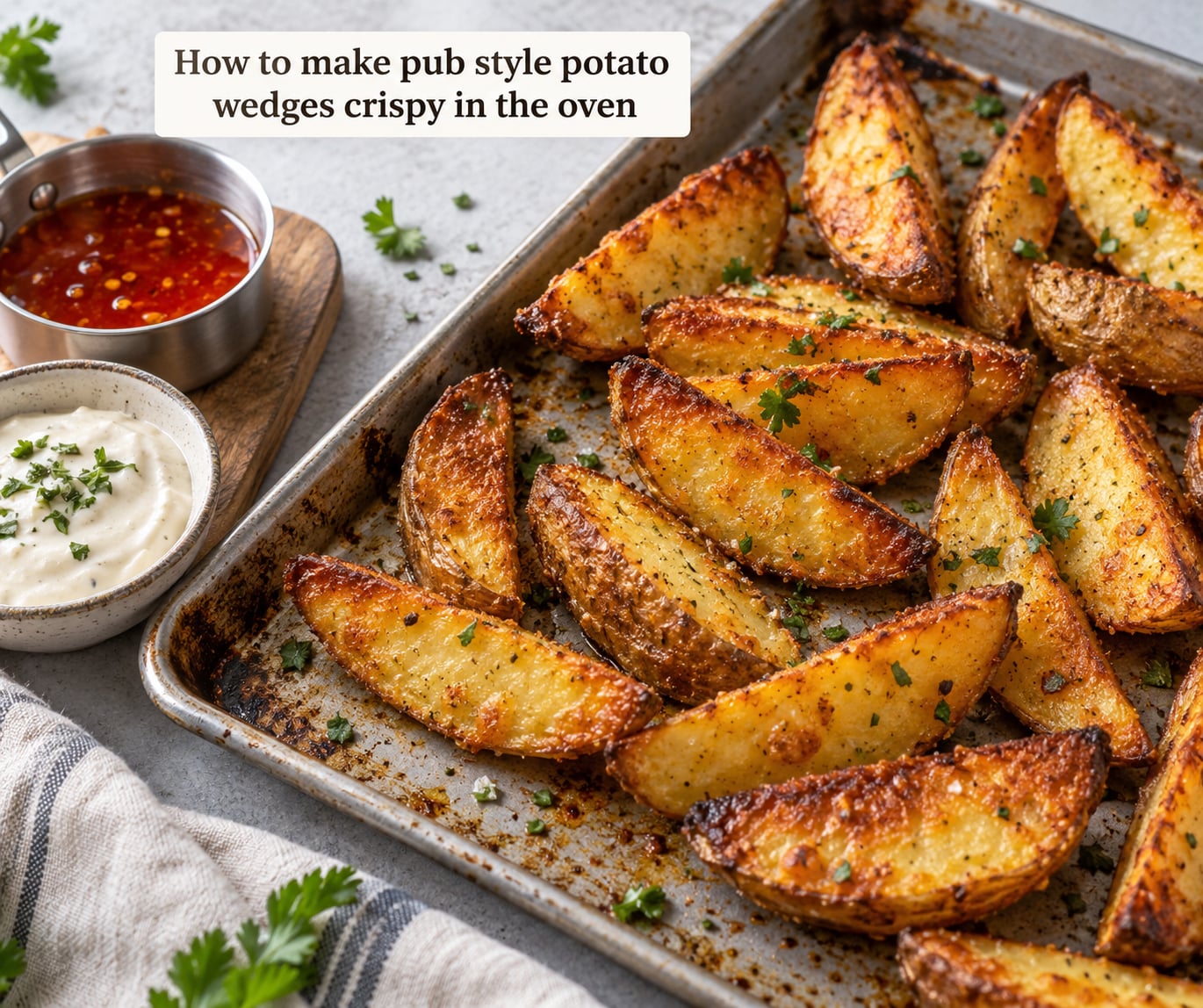
The crispiest version goes through a short par-bake first, and this is the step most home recipes skip. Fifteen minutes on a preheated sheet drives off moisture and starts gelatinising the surface starch, so the wedge arrives at the final stage already partway to a crust.
Then it dries. A hot tray does two jobs at once: it stops the wedges sliding around and it starts cooking the cut face against hot metal. Ten minutes out of the oven, undisturbed, lets the surface water go. If you tip them into a bowl and towel them instead, you get the same result in less time.
Coat them in oil by hand, not by drizzle. Rub each wedge with a little oil so it coats evenly, then add the seasoning and toss again. Oil applied first is what makes the dry seasoning stick; seasoning first slides off.
Use exactly 2 tablespoons of oil for 1 kg of potato. This is where most soggy wedges come from. Excess oil pools in the tray, the tray fills with oil instead of air, and the wedges poach in their own fat before the surface ever gets hot enough to brown.
Oven temperature: which one to use
| Temperature | Time after par-bake | Result |
|---|---|---|
| 200C / 400F | 30-35 min | Even colour, softer crust. Fine for a busy weeknight. |
| 220C / 425F | 25 min + broil | The balance I use. Crisp base, colour on the flat faces, no burnt tips. |
| 230C / 450F | 20 min + broil | Fastest and crispest, but watch the thin tips. Slice wedges even or they burn before the middle cooks. |
If you are using a fan oven, drop the temperature by 15C / 20F. Fan ovens brown the cut faces faster and dry the surface out sooner, so the wedges reach deep golden a few minutes early.
Can you make pub style potato wedges in an air fryer?
Yes, and they are arguably better than the oven version because the basket gives you a smaller space to crisp in. Par-boil the same way, then toss with oil and seasoning and air fry at 200C / 400F for 20 to 25 minutes, shaking the basket twice.
Overstuffing the basket is the one thing that ruins them. Air fried wedges need a single layer with the pieces not touching, which usually means two or three batches for a kilo. Two batches done properly beat one crowded batch every time, because a full basket drops the temperature and the wedges steam.
Feeding a crowd
For game day, par-bake the whole batch, season it, and bake everything together on two trays rather than one deep pile. To hold finished wedges while guests arrive, spread them on a rack over a baking sheet and put them in a 150C / 300F oven, uncovered.
Do not cover them. Steam trapped under foil or a lid softens the crust within about ten minutes, and that is the whole point of the batch. Fifteen minutes is the realistic holding window at that temperature; after that, refresh them under the broiler for two minutes.
How to season pub style potato wedges
Pub style seasoning is paprika-led, garlic-forward and never heavy on salt, because the wedges are salted for dipping. A generous teaspoon of smoked paprika is the signature, and a pinch of cayenne in with it gives you the back-heat that pub wedges are supposed to have.
For 1 kg of potato, combine 1 teaspoon smoked paprika, 1 teaspoon garlic powder, 1 teaspoon onion powder, 1/2 teaspoon black pepper, 1/2 teaspoon salt, and 1/4 teaspoon cayenne. Add the cayenne last so you can taste before committing.
Add the salt with the oil, not at the end. Salt applied to a dry surface pulls moisture out of the wedge and undoes the drying you just did. Flaky salt goes on after baking instead, for the crunch and the look.
Does a coating help?
| Coating | Result | Notes |
|---|---|---|
| None | Clean, potato-forward crunch | Best starting point. Add the oil and seasoning only. |
| Cornstarch | Hardest, glassiest crust, more shatter | Gluten-free, 2 tablespoons per kg. Toss in the oil, then dust before baking. |
| Semolina | Sandy, grainy texture | Griddle-style rather than pub-style, but it works. |
| Plain flour | Duller, thicker shell | Not gluten-free and no better than cornstarch here. |
Cornstarch is the one worth keeping in the cupboard. It costs nothing, it is gluten-free, and it turns the outside from crunchy to genuinely hard, which is the texture people mean when they say pub wedges.
Three variations worth trying: swap half the paprika for Cajun seasoning and serve with a ranch dip; finish with grated Parmesan and dried oregano in the last 8 minutes for a loaded-fries feel; or use sweet potato wedges at 200C / 400F for 25 minutes, since they need lower heat and a longer bake than white potatoes.
Common Mistakes
Almost every disappointing batch comes down to moisture, crowding or uneven cuts. Here is what to change.
| Problem | Cause | Fix |
|---|---|---|
| Soggy, pale wedges | Crowded tray, so air cannot circulate and the wedges steam | Two trays instead of one, cut faces down, space between every wedge |
| Soft exteriors, burnt tips | Wedges cut to wildly different thicknesses | Halve lengthways, then cut each half into an even number of pieces |
| Sticking to the tray | No oil on the cut face, or a crowded pan | Light oil on the sheet, cut faces down in the par-bake |
| Seasoning falls off in the oven | Seasoning added before the oil, or potatoes still wet | Oil first, dry wedges, then seasoning |
| Wedges greasy and limp | Too much oil pooling in the tray | 2 tablespoons per kilo of potato, no more |
| Soft all the way through | Waxy or new potatoes | Switch to russet, Maris Piper or King Edward |
| Wedges fine at 20 minutes, ruined at 35 | Oven too cool for the volume | Move up to 230C / 450F and cut the bake time |
Two more that come up constantly. Do not put wedges back in the oven after they have sat, even briefly, because the crust reabsorbs moisture and will never fully recover. And do not skip the drying gap, even though it feels like dead time. Ten minutes of air is the difference between a crust that shatters and one that bends.
One more myth to retire: the phrase rinse the potatoes until the water runs clear. Washing off surface starch helps a little and it is a fine five-minute step, but an overnight soak is a much bigger commitment than most people need. If you soak, add a teaspoon of baking soda to the water, which is a genuine boost and costs nothing. Then dry them properly, which matters more than the soak itself.
Frequently Asked Questions
What is the best potato for pub style wedges?
A floury, high-starch potato wins. Russet, Maris Piper and King Edward are the top choices because their starch makes a shaggy crust and their dry flesh pushes back against the coating, so the centre stays fluffy instead of wet. Yukon Gold is a good second, giving a creamier middle and nice colour. Skip new potatoes and waxy salad varieties, which hold too much water and steam before they brown.
Do potato wedges need to be soaked before baking?
No, but it helps. Soaking in cold water draws out surface starch, and starch is what traps moisture and makes wedges go soft. A five-minute rinse is enough for most home cooks. If you have time, an hour-long soak with a teaspoon of baking soda gives a noticeably harder crust. Either way, dry the wedges thoroughly afterwards, because wet potatoes will not crisp at any temperature.
What temperature and time should I use for oven-baked pub wedges?
220C / 425F is the sweet spot. Par-bake thick wedges cut side down on a preheated sheet for 15 minutes, then roast for about 25 minutes, then broil for 3 to 5 minutes to set the edges. At 200C / 400F allow 30 to 35 minutes for a softer crust, and at 230C / 450F drop to about 20 minutes plus the broil. Drop the temperature by 15C for a fan oven.
Can I make pub style potato wedges in an air fryer?
Yes, and the small basket is an advantage. Par-boil the wedges first, toss with oil and seasoning, then air fry at 200C / 400F for 20 to 25 minutes, shaking the basket twice. Keep them in a single layer with no touching, which usually means two or three batches for a kilo of potatoes. A crowded basket drops the temperature, and the wedges steam instead of crisping.
What sauce goes best with pub style potato wedges?
Sour cream with sweet chilli sauce is the classic pub pairing and the one to serve first. Both are shop-bought, both take ten seconds, and the hot-cold-sweet contrast is what the wedges are designed for. Garlic aioli, ranch, or a mayo and barbecue sauce mix are the next best options. A thick, cold dip also helps, because thin sauces run off and the underside of the wedge stays soft.
How do I keep baked potato wedges crispy?
Serve them within a few minutes of coming out of the oven, on a wire rack rather than a plate, and leave them uncovered. Steam is the enemy, so never cover wedges or hold them in a sealed container. For a party, spread them on a rack over a baking sheet in a 150C / 300F oven, uncovered, for up to about 15 minutes. If they go soft, a two-minute broil brings most of the crust back.
Start the oven first and let the tray heat up with it. That is the whole trick in one move. Cut thick wedges, par-bake them cut side down for 15 minutes, dry them for 10, coat them with 2 tablespoons of oil and the paprika blend, then roast at 220C / 425F until the flat faces are deep gold. Flaky salt, sour cream, sweet chilli sauce, and get them to the table while they still crunch.