Most people burn wings because they treat them like steaks: straight over the flames, sauced early, flipped every minute. How to grill chicken wings without burning them comes down to order of operations. Cook indirect at 350-400F until the meat is nearly done, sear direct for three to five minutes, then glaze. From patting the wings dry to resting them, the whole method takes about 40 minutes and is beginner-friendly if you have a grill thermometer.
I have ruined more batches of wings than I care to admit, and almost every ruined batch failed at the same two moments: too much sugar too early, and too much heat too soon. Fix those two things and the rest is just watching a thermometer.
Table of Contents
- What You Need
- Step-by-Step: How to Grill Chicken Wings Without Burning Them
- 1. Prepare the Wings for Even Cooking
- 2. Set Up a Two-Zone Grill
- 3. Start the Wings Over Indirect Heat
- 4. Move the Wings to Direct Heat
- 5. Add Sauce at the Right Time
- 6. Check Temperature and Rest the Wings
- Temperature and Time by Grill Type
- Common Mistakes
- Frequently Asked Questions
- How long does it take to grill wings on the grill?
- Do you grill chicken wings with the lid open or closed?
- Should I put oil on my chicken wings before grilling?
- Is 30 minutes at 350 enough to cook chicken?
- How to grill chicken wings without burning them on a charcoal grill?
- Why are my grilled chicken wings chewy instead of crispy?
- Conclusion
What You Need
You do not need a special pan or a fancy rub. You need a grill that gives you two temperatures, a thermometer, and about half an hour of patience.
- An instant-read thermometer. A cheap leave-in probe is fine, but a hand-held one you can pull and re-read fast is better for thin meat like a wing.
- Tongs with a scalloped or flat edge so you can lift a wing without tearing the skin off it.
- Paper towels. Drying the skin is the single highest-return thing you can do, and it costs nothing.
- A neutral oil such as canola or avocado, and kosher salt and black pepper.
- Your sauce or dry rub. Have it measured and within arm’s reach before the wings go on.
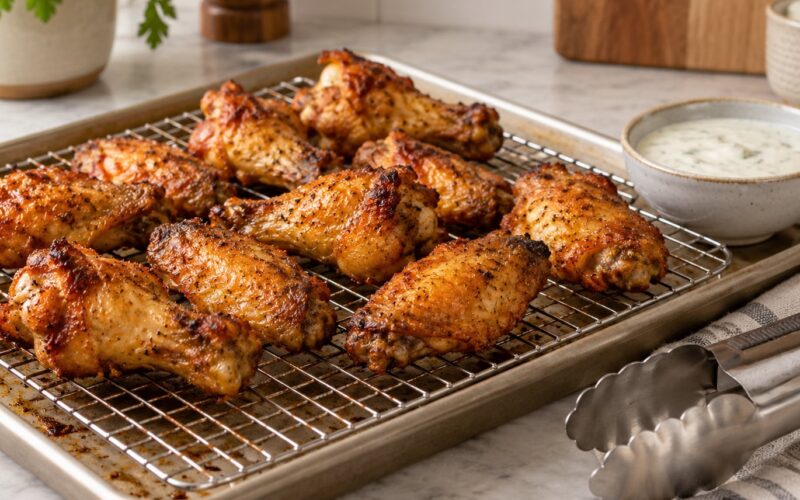
- A wire rack over a platter so finished wings do not steam each other into soft skin.
If you plan to cook three pounds or more, add a second platter and cook in batches. Crowding drops the grill temperature faster than the lid can bring it back.
Step-by-Step: How to Grill Chicken Wings Without Burning Them
The method has two phases. Phase one is indirect heat with the lid closed, which cooks the meat and renders the fat without browning the skin. Phase two is direct heat, which is only there to crisp. Everything in between is prep.
1. Prepare the Wings for Even Cooking
Pat every wing dry with paper towels, both sides, and let them sit on the towels for ten minutes if you have the time. Skin that is wet steams instead of browns, and the moisture that eventually beads up and drips is what starts most flare-ups.
Trim the wing tips if you want to, since they scorch before the flats are done. Then season lightly with oil, kosher salt and pepper, keeping the coat thin. A heavy coat of oil on the skin is a direct invitation to flare up, so wipe off anything that runs off the meat.
Give the wings room on the grate as well. A single layer with no wings touching lets hot air and smoke move around them; anything sitting in a neighbour’s shadow cooks unevenly and stays pale. A grill basket keeps small flats from falling between the bars.
2. Set Up a Two-Zone Grill
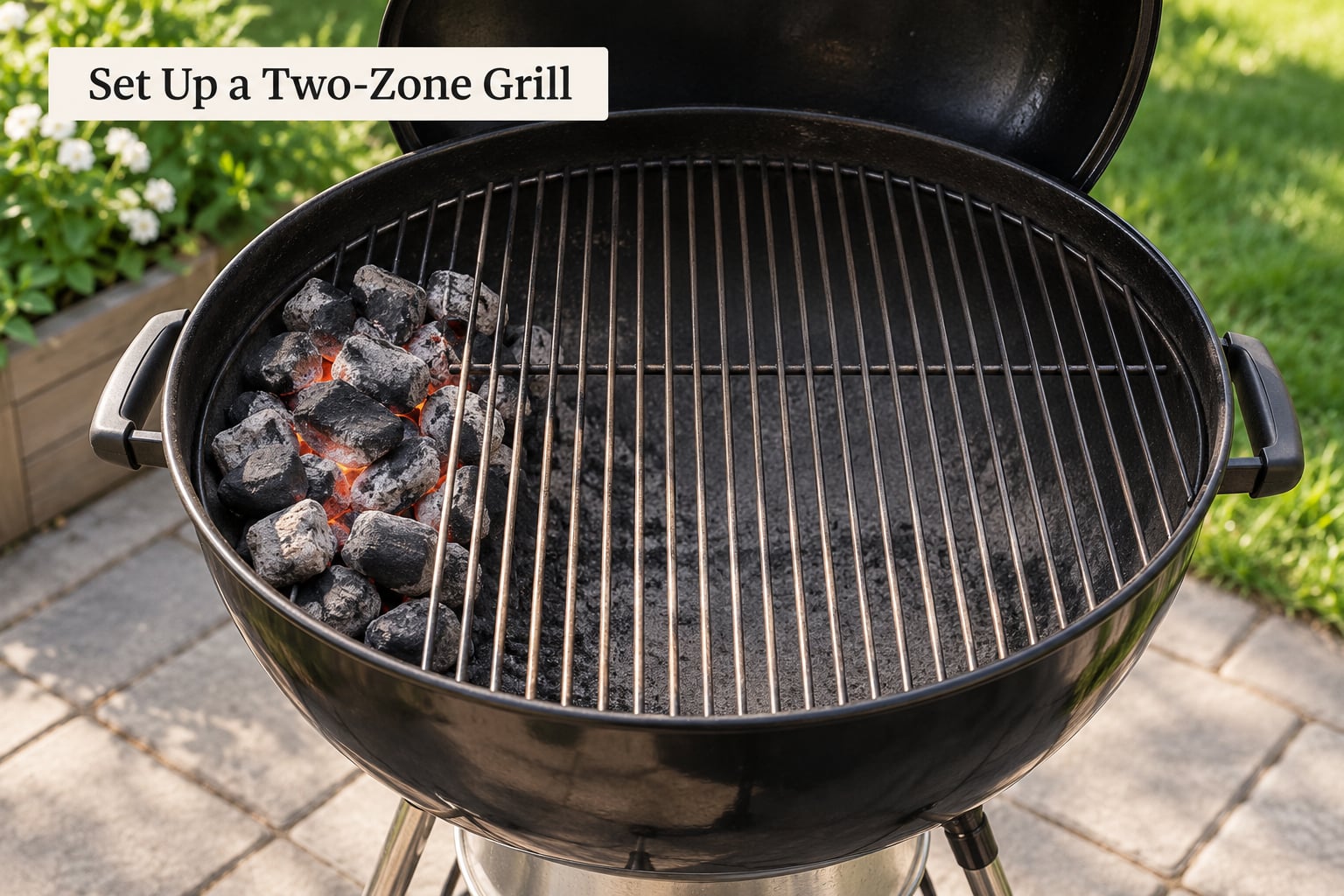
A two-zone fire is simply a grill with one hot side and one cool side. The cool side is your cook zone and the hot side is your sear zone.
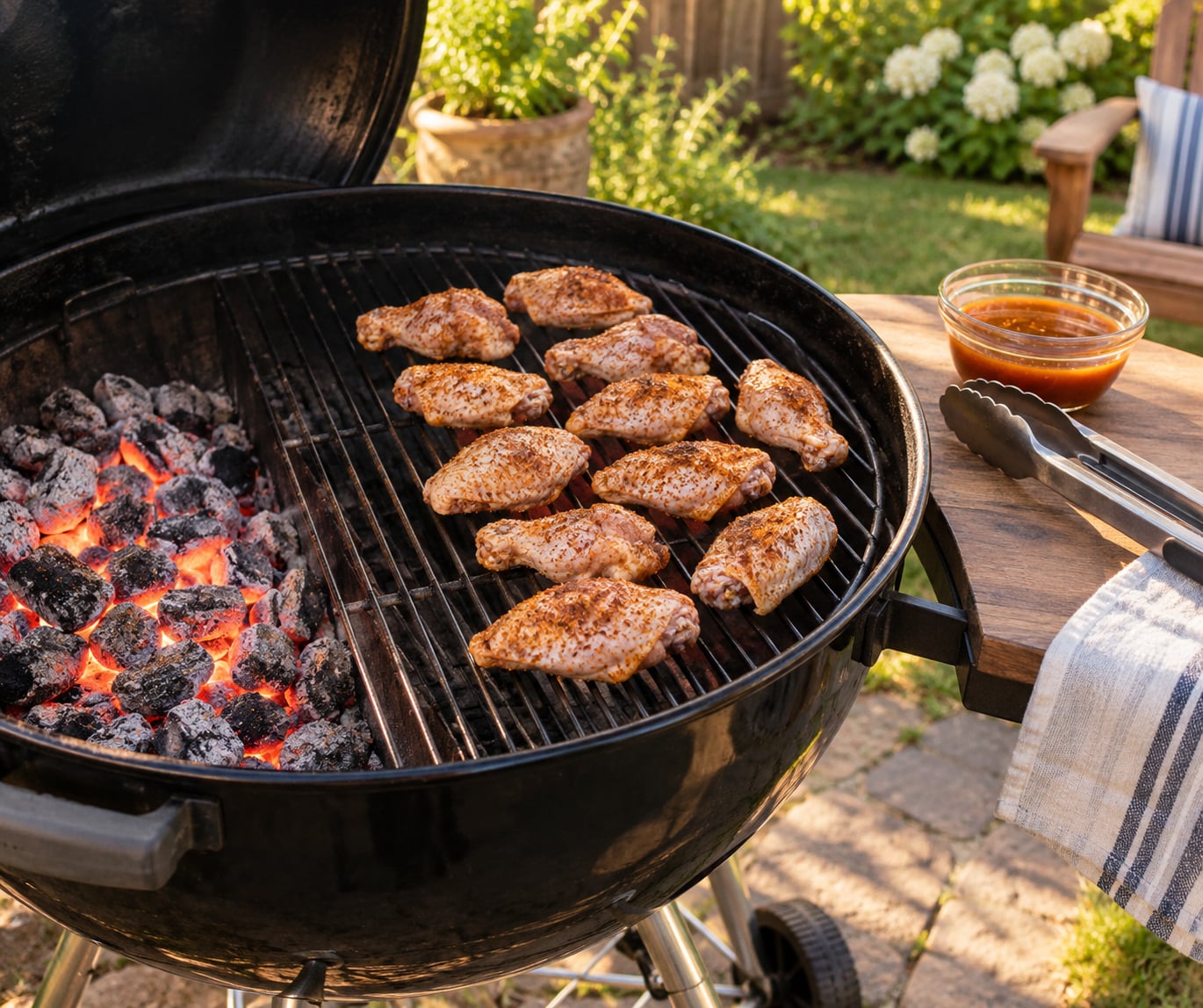
On a charcoal grill, tip the coals into a single pile on one side of the kettle and let them burn down for 15 to 20 minutes. Put an empty grill grate over the side with no coals underneath, close the lid and let the temperature settle. You want that cool zone sitting between 350F and 400F, so check with the lid closed rather than guessing.
On a gas grill, light one or two burners and leave the others off, or light all of them and then turn one down low for the same effect. Put the wings on the unlit side. If you have a smoker box or a Vortex-style pan, the ring of indirect heat around the pan does the same job and works well at a hotter grill temperature.
Check the cool zone with the lid closed, then again with the lid open. A zone that reads 375F closed can drop to 340F the moment you start moving food around it, and that swing is what dries the skin out.
3. Start the Wings Over Indirect Heat
Lay the wings on the cool side skin side down, close the lid and let the grill do the work. Most flats and drumettes need 20 to 30 minutes here, depending on size and how cool your cool side actually is. Larger wings can run to 45 minutes on a low charcoal fire.
Turn them at about the ten-minute mark, and again near the twenty-minute mark. That is two turns, not twenty. Flipping constantly cools the skin, slows the fat rendering and is the reason a lot of grilled wings come out pale and leathery instead of crisp.
Keep the lid closed the whole time if you can. An open lid on the indirect phase lets heat escape, slows the cook and keeps the skin soft. You are not trying to brown anything yet, so nothing is gained by watching.
4. Move the Wings to Direct Heat
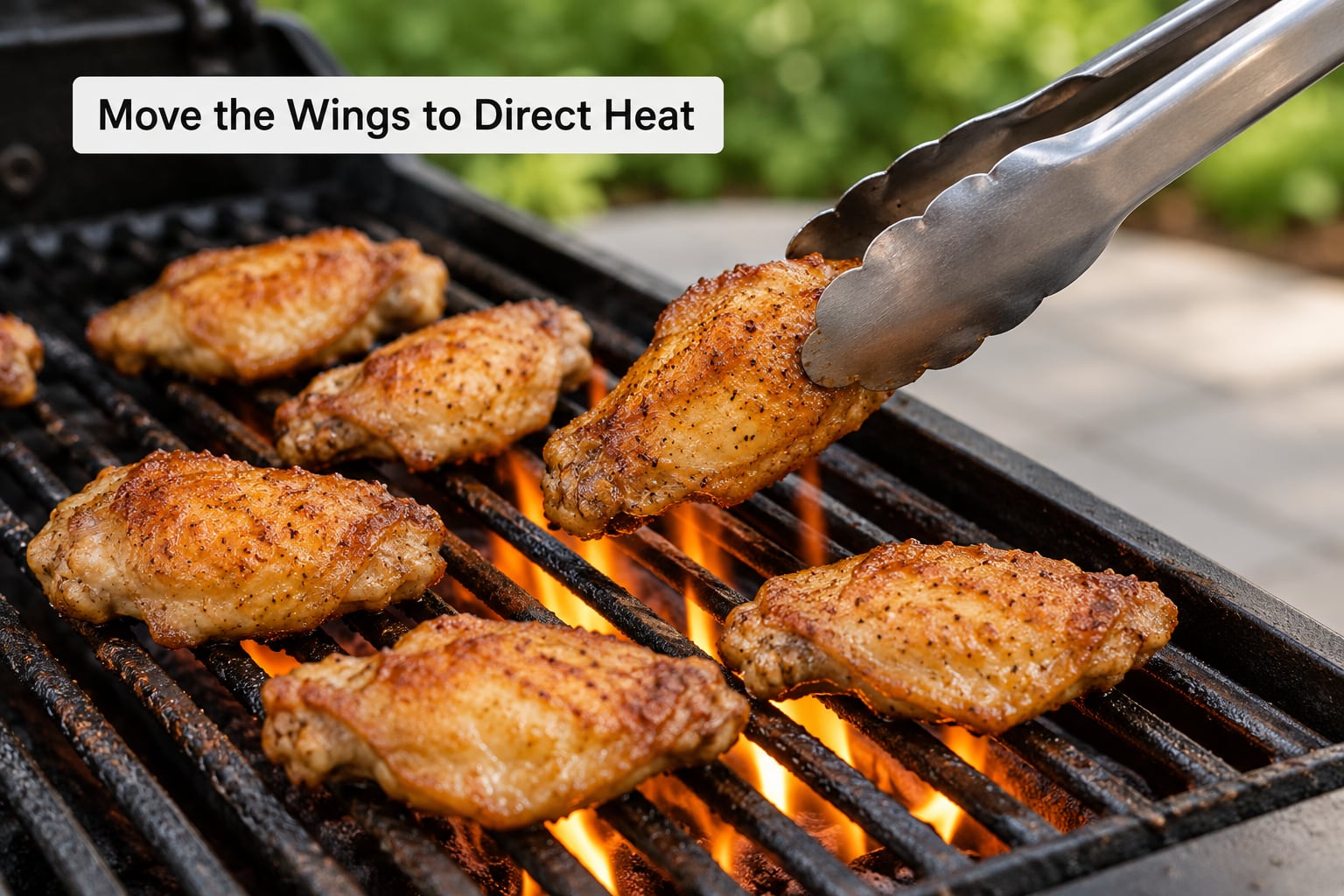
The wings are ready for the hot side when the thickest part of a drumette feels firm and the meat pulls back slightly from the bone. Take a temperature reading first. If you are already at 160F, you barely need this phase at all.
Move the wings to the direct side and stand over them. Give each side three to five minutes, moving them along the grates rather than just flipping in place so no wing parks over the same hot spot twice. The skin should turn deep amber and a little crisp at the edges, not black.
The instant you see black creeping past the brown, pull that wing off the heat. Sugar-free seasoning still burns at grill temperature, and the difference between well done and ruined is about thirty seconds at this stage.
5. Add Sauce at the Right Time
Sauce goes on in the last three to five minutes, after the meat is essentially cooked through. Most BBQ sauces are 20 to 30 percent sugar, and sugar goes from caramelised to black in well under a minute once it hits a grill surface.
Use a light coat rather than a glaze, and put it on with the lid open so the sauce thickens and sets instead of soaking into the skin. Turn the wings once halfway through that final window, and pull them the moment the sauce bubbles and looks glossy.
A dry rub behaves differently. Spice-heavy rubs with brown sugar or honey also burn early, so either mix them in only for the final minutes or leave them off and let the sauce do the sweet work. Salt, pepper, garlic and paprika will not scorch.
6. Check Temperature and Rest the Wings
Pull a wing from the thickest part and read the temperature in the meat, not touching bone. The USDA safe minimum internal temperature for poultry is 165F, and most wings finish between 165F and 175F. Above 180F they start tasting like jerky.
Rest them on the wire rack for five minutes before serving. Resting lets the juices redistribute instead of running out onto the platter, and the rack keeps the undersides from steaming soft.
If you are cooking a big batch for a party, do not hold finished wings in a low oven for an hour. Set them over a warming tray with a splash of water in the pan, or hold them in a single layer and bring them out in waves. Skin that sits in steam goes soft, and no amount of sauce hides that.
Temperature and Time by Grill Type
Same wings, different grill, different clock. Here is what I aim for on each.
- Gas grill: burners on high, wings on the unlit side at 350-400F for 20 to 30 minutes, then 3 to 5 minutes per side over direct heat. Gas runs hot, so check early.
- Charcoal grill: banked coals, cool zone at 350-400F for 25 to 40 minutes, then a short direct sear. If your cool zone is under 300F, add a handful of unlit coals and give it ten minutes.
- Pellet grill: run at 400-450F with wings on the grate, not the shelf, for 30 to 40 minutes, turning at 15 and 25 minutes. Pellet renders fat fast and dries the wings quickly at that temperature.
- Smoker at 250-275F: works, but plan on 2 to 3 hours. Finish at 350F for 15 to 20 minutes to crisp, the way a lot of barbecue pitmasters do it.
Common Mistakes
Every burned batch I have seen traces back to one of five things.
Saucing too early. The fix is simple and it is the one most cooks skip: no sugar on the wings until the last three to five minutes, and a light coat rather than a thick glaze. If you want sweet flavour without the risk, glaze half the batch and leave the other half dry-rubbed.
Cooking the whole time over direct heat. One side renders and browns while the other side stays raw, and you end up turning constantly to catch up. Move the wings to the indirect side for the first 20 to 30 minutes. Direct heat is a finishing tool, not a cooking method.
Overcrowding. Wings packed together cook in their own steam, never brown, and the pile keeps dropping the grill temperature. Cook in batches of a single layer with air moving between them.
Flipping every thirty seconds. Constant turning stops fat rendering, cools the skin and dries the meat. Two turns on the indirect phase, one on the sear, then done.
Ignoring the thermometer. Colour on the outside means nothing, because the surface browns long before the centre is safe to eat. Probe the thickest part of a drumette and cook to 165F. This is also how you learn where your grill’s hot spots are.
One more worth naming: oil on the grates and oil on the wings are different things. Oiled grates prevent sticking. Oiled wings drip fuel onto the coals and cause the flare-ups that scorch a whole batch in under a minute. Thin coat on the meat, clean grates.
If the wings are already burning while you read this, move them off direct heat immediately, close the lid over the indirect side for five minutes to recover the interior, then return only the wings that still need colour.
Frequently Asked Questions
How long does it take to grill wings on the grill?
Most wings take 25 to 40 minutes total on a two-zone grill. Spend 20 to 30 minutes on the indirect side with the lid closed, then 3 to 5 minutes per side over direct heat to crisp the skin. Flats cook faster than drumettes, and a charcoal grill running cooler than 350F will add 10 to 15 minutes. Always confirm 165F internal before serving.
Do you grill chicken wings with the lid open or closed?
Closed for the indirect phase, open for the final few minutes. The closed lid traps heat so the cool zone holds 350-400F and the meat cooks evenly without drying out. Opening the lid during that phase slows the cook and keeps the skin soft. Once you sauce, crack or open the lid so the sugar thickens into a glaze instead of steaming into the skin.
Should I put oil on my chicken wings before grilling?
Only a very thin coat. Oil helps the skin brown evenly and stops it sticking, but excess oil drips onto the coals and causes flare-ups that scorch a whole batch in under a minute. Pat the wings dry first, then wipe off anything that runs down the meat. Oil your grill grates instead, and let the wings sit skin side up for a few minutes to absorb it.
Is 30 minutes at 350 enough to cook chicken?
Often yes, but temperature beats time every time. Thirty minutes at 350F will cook most flats and drumettes, yet a large drumette on a charcoal grill at 300F may need another 10 to 15 minutes, while a small flat can dry out by then. Probe the thickest part of a drumette and take it off at 165F, which is the USDA safe minimum internal temperature for poultry.
How to grill chicken wings without burning them on a charcoal grill?
Bank the coals on one side and let them burn down 15 to 20 minutes. Put the wings on the empty side, where the temperature should settle between 350F and 400F with the lid closed, and cook them there for 25 to 40 minutes. Only then move them over the coals for a 3 to 5 minute sear per side, and add sugary sauce in the last 3 to 5 minutes.
Why are my grilled chicken wings chewy instead of crispy?
Three usual causes. The skin was wet when it hit the grates, so it steamed rather than browned. The wings spent too long on indirect heat, which dries the meat without crisping the skin. Or they were flipped every few seconds, which stops fat from rendering. Pat them dry, keep the indirect phase to 20 to 30 minutes, and turn only two or three times across the whole cook.
Conclusion
Start with the fire, not the wings. Bank the coals or light two burners, put the thermometer on the empty side, and hold that zone between 350F and 400F. Pat the wings dry, cook them there with the lid closed, give them three to five minutes per side over direct heat, and hold the sauce for the last three to five minutes. That order is the whole difference between wings with crisp skin and charcoal.