If you want the short version: plan on about 10 bone-in wings or 8 boneless wings per adult for a party. That covers wings served as the main dish. If wings are one appetizer among several, drop to roughly 6 bone-in or 5 boneless wings per adult, then add a buffer.
The reason hosts get this wrong is that wings get eaten in handfuls, not one at a time. An under-order empties the platter in the first fifteen minutes of a watch party, and an over-order becomes a fridge full of leftovers. Here is how to land on a number you can trust.
Table of Contents
- How Much Wings Per Person for a Party?
- Wings Per Person at a Glance
- What Changes the Amount You Need?
- How to Calculate Wings for Your Guest List
- How to Choose the Right Wing Style
- How Much to Order for Sauces, Sides, and Buffets
- How to Keep Wings Fresh and Serve Them Safely
- Frequently Asked Questions
- How many wings should I order for 10 adults?
- Are boneless wings better for a party than bone-in wings?
- How many wings per person should I order for children?
- How much wings do I need for a game-day party with other appetizers?
- Should I order extra wings for a party?
- Can I prepare wings ahead of time for a party?
- Conclusion
How Much Wings Per Person for a Party?
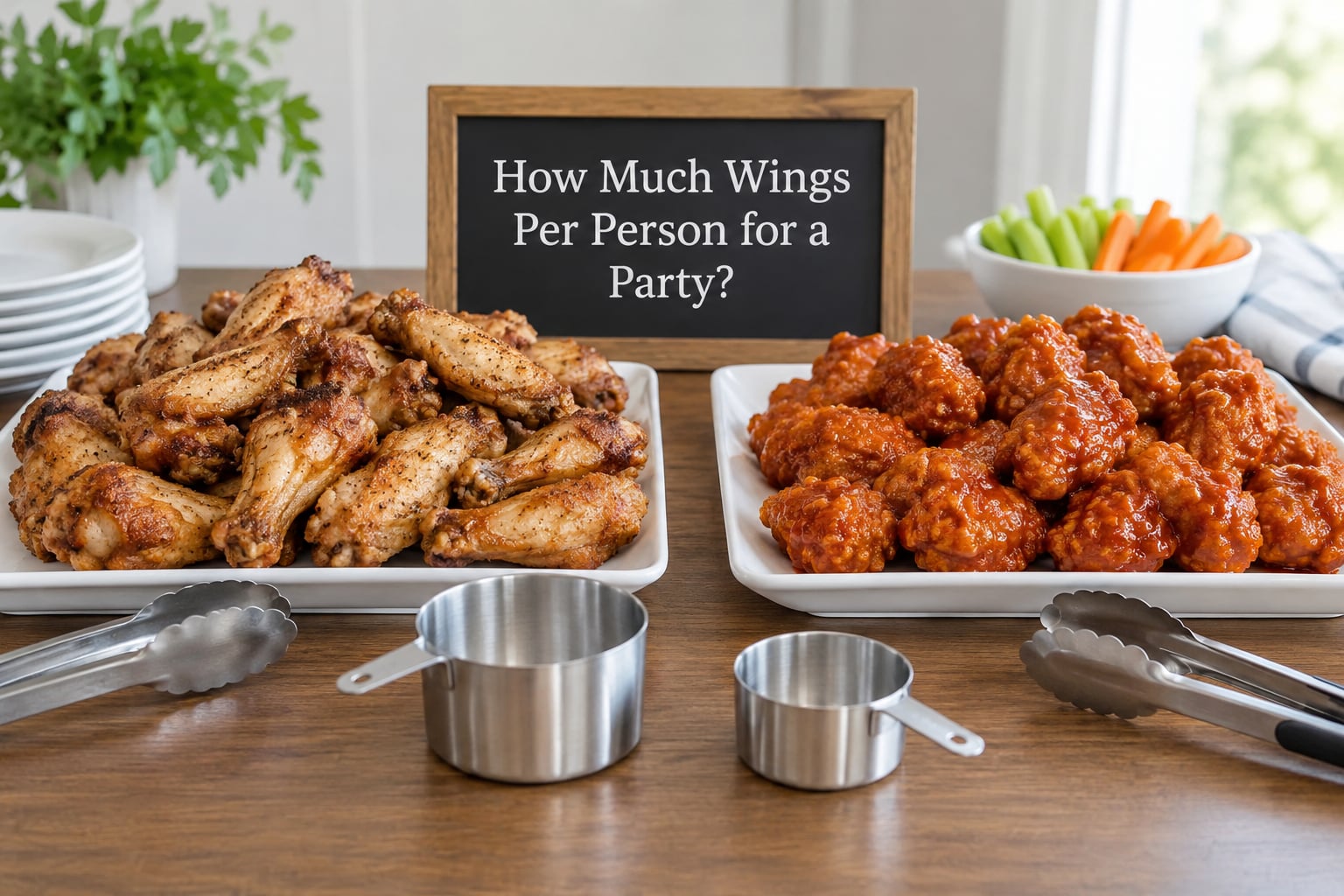
Here is the direct answer to how much wings per person for a party. Adults eating wings as part of a meal need 10 to 12 bone-in wings each, or 8 to 10 boneless pieces. Adults grazing need about 6 bone-in wings or 5 boneless pieces. Children usually need half that, roughly 5 to 6 bone-in wings.
Boneless pieces are physically larger than drumettes and flats, so fewer of them fill the same amount of space. Ten bone-in wings is about the same portion as eight boneless pieces, and that is the conversion most restaurants use when they quote per-person numbers.
For a game day spread with nachos, sliders and a salad, use the lower figure. For a Super Bowl party where wings are the meal, use the higher one and add seconds into the plan. People eat far more wings than they plan for when the game goes to overtime and the food is the only thing on the coffee table.
Add 10 to 20 percent on top of any number. Guests who were watching the food rather than eating it will show up at halftime, and the tray being empty is a worse look than the box having four wings left in it.
Wings Per Person at a Glance
| Guest type | Bone-in wings | Boneless pieces | Use this when |
|---|---|---|---|
| Adult, appetizer service | 6 | 5 | Several other foods on the table |
| Adult, main meal | 10 to 12 | 8 to 10 | Wings are the meal or nearly the meal |
| Child, ages 4 to 10 | 5 to 6 | 4 to 5 | Mixed adult and child guest list |
| Buffet with two sauces | 8 | 7 | Self-serve line, guests help themselves |
| Passed appetizers | 4 to 5 | 4 | Server brings small plates around |
Here is the math for 12 adults with wings as the main dish. Twelve multiplied by 10 bone-in wings gives 120 wings, and 120 divided by roughly 9 pieces per pound comes to about 13 pounds of raw wings. Add 15 percent for seconds and you are buying 15 pounds, which is two 40-ounce bags or three 5-pound bags depending on how they are sold at your store.
What Changes the Amount You Need?
Wing size is the first variable. A whole wing includes the tip and one flat and one drumette, so a pound of whole wings holds about 4 to 5, while a pound of split flats and drumettes holds 8 to 10, and a pound of boneless pieces holds 16 to 20. This is the trap that makes pack math confusing. The same bag can mean twice the pieces depending on how the bird was cut.
Bone-in wings feel like more food than boneless pieces of the same weight, so guests pick up fewer of them. The reverse also matters: boneless wings are messier to eat, so at a party where people are standing up and talking, a few more pieces per person gets eaten.
Service style changes the total too. Wings passed on small plates get sampled by everyone, so a single piece per guest can feel generous. Wings in a bowl on a table get double-dipped and revisited, which is where the 10-to-12 number comes from.
Sauces matter only in one way: a wet sauce makes people thirsty, and thirsty guests eat more. Dry-rubbed wings with a cooling dip on the side usually produce a smaller total than a tray tossed in buffalo sauce.
Finally, count what else is being served. Wings alongside a full spread of nachos, queso and sliders are an appetizer. Wings next to a salad are the meal. The gap between those two scenarios is roughly a third of your total order, which is usually the most money a host can save or overspend.
How to Calculate Wings for Your Guest List
Three steps, and the whole calculation takes about a minute.
Step one: split the list. Count adults and children separately. Adults get the adult number, children get half of it, and anyone you know is a light eater gets three quarters. Kids who have not finished a full plate of anything get counted as light eaters, not as children.
Step two: pick the serving role. If wings are the meal, use 10 to 12 bone-in wings per adult. If they are one of five or six foods, use 6. Write the number down before you start multiplying, because this is where people fudge the numbers.
Step three: multiply and round up. For 20 adults at 6 wings each, you need 120 pieces. For 25 adults plus 10 children at 6 and 5 wings, you need 200 pieces. Then add your buffer of 10 to 20 percent and round up to whatever package size you actually buy.
Package sizes force the rounding. A 5-pound bag of split wings is roughly 45 pieces, so two bags cover about 90 people at appetizer portions and about 38 at meal portions. Buying three bags and having a sealed one in the freezer beats buying two and improvising.
Counting pieces also helps when you order from a wing shop. A tray of party wings is usually quoted by the piece, so the piece count you calculated is the number you ask for. That sidesteps the mental conversion most hosts get wrong at the counter.
How to Choose the Right Wing Style
Bone-in wings are the traditional choice and they read as more generous on a platter. A whole wing looks substantial, which matters for a party where you want the food to feel abundant, and the frame gives people something to hold while they talk.
Boneless wings win on ease. There is no picking bones out of your teeth at a party where half the guests are wearing nice clothes, and children eat them without supervision. The pieces are breaded and sauced the same way, so the flavor difference is small. The trade is that a pound of boneless yields far more pieces, which makes an over-order cost more.
Mixed platters are the practical middle. Order half bone-in and half boneless and the bone-in satisfies the guests who want the experience while the boneless handles the mess-averse crowd and the kids.
Traditional versus boneless-style is a smaller decision than it sounds. Both are split pieces of chicken breast or thigh, just trimmed into a wing shape. Boneless-style pieces are often larger and take on sauce better, so they carry a bit more flavor per bite.
For casual parties and game-day spreads, the deciding factor is logistics. Wings need to be cooked, sauced and held at temperature, and a house with two sheet pans and one oven is better served by boneless, which cook faster and hold their sauce without going soft.
How Much to Order for Sauces, Sides, and Buffets
Scale the sides to the pounds of wings, not to the guest count, and the math gets simple. Plan about half a cup of buffalo sauce for every 2 pounds of wings, and 2 to 3 ounces of dipping sauce per pound if you are also setting out ranch or blue cheese.
For a 15-pound wing order that is roughly 7 to 8 cups of sauce, or about a gallon. Buy sauce by the bottle and pour it into squeeze bottles, because people do not respect the limit of a small ramekin when the tray is two feet away.
Give guests something to dip and something to cut the richness. One to two ounces of celery and carrot sticks per guest works, which is about 1 pound of raw vegetables for every 10 people. That also solves the gluten-free and no-dairy guests at the same table, since wings fried in a shared fryer are not safe for a strict celiac guest.
Now adjust the wings themselves. When wings are one appetizer among several, take the appetizer number and cut another 10 percent if you also served a pasta salad or a tray of sliders. When wings are the meal, add 2 pieces per adult instead of a percentage, because seconds are real on a wings-led spread.
A buffet line needs more than a plate of wings on a good day. Plan one tray per 25 to 30 guests for appetizer service and one per 15 to 20 for a meal, so 30 adults eating wings as dinner need two full trays. Refill in smaller batches rather than putting everything out at once, since wings that sit out lose their crisp skin and pick up a lukewarm smell.
Passed appetizers work differently. A server brings small plates and each guest takes one or two pieces, so budget 4 to 5 pieces per guest for the whole evening, not per hour.
Most wing shops will not mix flavors inside a single large box, so a 20-guest order across three sauces means three separate orders. Decide the flavors first, then split the total piece count evenly between them, and add one extra box of plain or the most popular sauce for the people who arrive late.
How to Keep Wings Fresh and Serve Them Safely
Cook wings to an internal temperature of 165°F, or 74°C, measured at the thickest part. Poultry has to reach that temperature for food safety, and a food thermometer is the only reliable way to know.
Plan the cooking around your cooking capacity, not just your appetite. One sheet pan holds about 12 to 15 split wings in a single layer without steaming them, and wings take roughly 40 minutes at 400°F. Ten pounds of wings is four or five pan rounds, so a 20-pound order is a two-hour job that has to start before guests arrive.
For air fryer hosts, a typical basket holds 8 to 10 pieces per round at 400°F for about 12 to 15 minutes. A 15-pound order is a dozen rounds, which is why an air fryer alone is a stretch for more than about 20 guests.
Keep cooked wings above 140°F until you serve them, and do not leave them sitting on a counter at room temperature for more than two hours. Use a warming tray at a low setting, or hold them in the oven at its lowest temperature with the door cracked.
Refrigerate leftovers within two hours and use them within three to four days. Reheat them in a hot oven or air fryer rather than a microwave if you want the skin back, and bring the internal temperature to 165°F again. Reheated wings crisp in about eight minutes at 450°F, which makes day-two wings a genuine lunch rather than a leftover obligation.
Frequently Asked Questions
How many wings should I order for 10 adults?
Order 100 to 120 bone-in wings for 10 adults if wings are the main dish, or about 60 if they are one appetizer among several. At roughly 9 split pieces per pound, that is 11 to 13 pounds for a meal and about 7 pounds for appetizer service. Add 10 to 20 percent for seconds, then round up to the nearest bag or tray size your seller sells.
Are boneless wings better for a party than bone-in wings?
Boneless wings are easier to eat standing up and suit children and guests in nice clothes. Bone-in wings look more generous on a platter and a pound yields only 8 to 10 pieces against 16 to 20 for boneless, so bone-in gives you more control over cost. For a mixed crowd, order half of each and let the room sort itself out.
How many wings per person should I order for children?
Plan 5 to 6 bone-in wings or 4 to 5 boneless pieces per child, roughly half the adult portion. Children aged four to ten are usually the hungriest guests at the table, so count them as half a person rather than a third. A child who rarely finishes a full plate of anything gets counted as a light eater instead, at about 3 to 4 pieces.
How much wings do I need for a game-day party with other appetizers?
Use 6 bone-in wings or 5 boneless pieces per adult when nachos, sliders and dips are also on the table, and half that for children. For 20 adults and 10 children that is about 175 pieces, or roughly 20 pounds of raw wings. If wings turn out to be the only food people touch, keep a tray in the freezer for a second round.
Should I order extra wings for a party?
Yes, add 10 to 20 percent over your calculated total. Hosts across cooking forums describe leftovers as perfectly acceptable while running out before the game ends as the real failure. If you buy sealed extra bags, freeze them on the day of the party rather than the day you cook, and you get a free meal for later with none of the packaging waste.
Can I prepare wings ahead of time for a party?
Yes. Cook wings a day ahead, cool them uncovered in the refrigerator, then toss in sauce and bake at 450u0026deg;F for 8 to 10 minutes just before guests arrive. Hold them above 140u0026deg;F until serving and refrigerate leftovers within two hours. Sauced wings reheat better than plain ones, which is worth remembering when you are planning two sauce batches.
Conclusion
Count your adults and children separately, decide whether wings are the meal or an appetizer, and multiply by 6 for appetizer service or 10 to 12 for a meal. Add 10 to 20 percent, round up to a package you can actually buy, and start cooking early enough to finish every round before guests arrive.