Most home grillers get a medium burger in 4 to 6 minutes per side on a medium-hot grill, so 8 to 12 minutes total, and they pull it off the heat at 145°F because the patty keeps cooking as it rests. The time is only a guide, though. Patty thickness, starting temperature and grill type move that number around more than people expect.
A quarter-pounder cooks in a fraction of the time a thick backyard patty needs, and a cold patty straight from the fridge takes noticeably longer than one that has sat out 20 minutes. That is why every good guide ends the same way: set a time, but let an instant-read thermometer decide when the burger is done.
This guide covers how long to grill burgers for medium on both gas and charcoal, how to build a two-zone fire, and what to do when the middle is still raw. It takes about 15 minutes of cook time and about 10 minutes of grill preheating.
Table of Contents
- What You Need
- Step-by-Step: How Long to Grill Burgers for Medium
- Prepare the Burgers for Even Cooking
- Set Up a Two-Zone Grill
- Grill Thin Burgers for 3 to 5 Minutes per Side
- Grill Standard Burgers for 4 to 6 Minutes per Side
- Grill Thick Burgers for 6 to 8 Minutes per Side
- Check Doneness and Rest the Burgers
- Grill Time and Temperature by Doneness
- Time by Patty Thickness
- Gas Grill vs Charcoal Grill
- Common Mistakes
- Troubleshooting
- Frequently Asked Questions
- How long should a burger cook on each side for medium doneness?
- What internal temperature is a burger cooked to medium?
- How can I tell if a burger is done without cutting it open?
- Should I close the grill lid while cooking burgers?
- Why are my burgers always overcooked?
- How long does it take to grill frozen burgers?
- Conclusion
What You Need
You do not need a specialty tool beyond a thermometer. The rest is gear most people already own.
- A grill. Gas or charcoal both work. You need a grill surface in the 375°F to 450°F range, which is medium-high heat on most gas dials.
- An instant-read thermometer. A cheap digital probe thermometer is the single most useful tool here. A leave-in probe works too if you are cooking a whole batch.
- Tongs with a wide, flat edge. A spatula also works, but thin patties slide off tongs more often than people expect.
- A sturdy plate or tray. Burgers release a surprising amount of juice when they hit a platter. A rimmed sheet pan catches it.
- Oil for the grates. A paper towel and a small amount of high-smoke-point oil, or a spray bottle kept away from the coals.
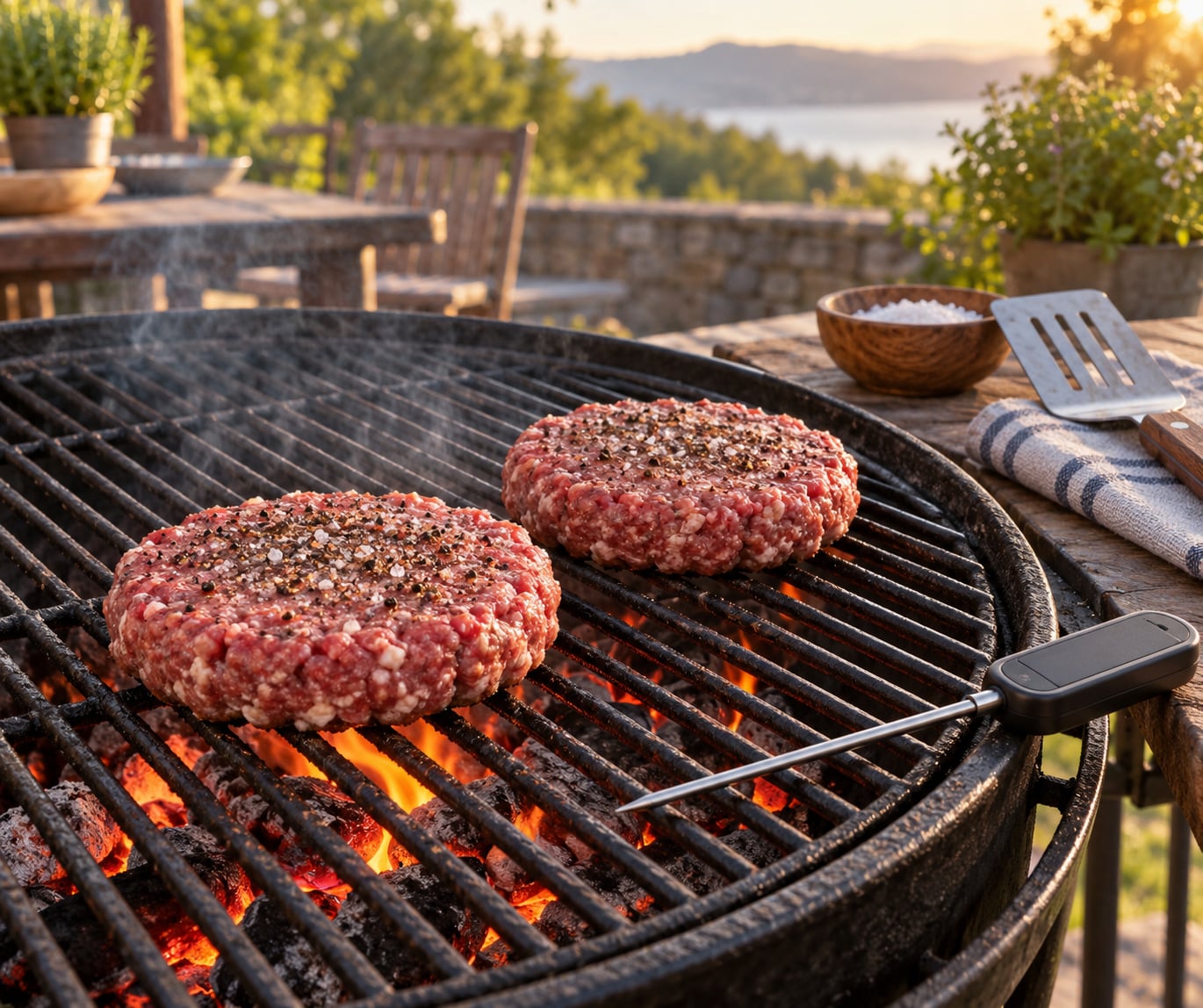
- Coarse salt and pepper. Season right before the patty hits the grate.
- Optional extras: a wire rack set on a tray to rest the burgers, cheese slices, and a wood chip box if you want smoke flavor.
Skip the fancy presses and the grill baskets. A sturdy spatula, tongs and a thermometer cover the whole job.
Step-by-Step: How Long to Grill Burgers for Medium
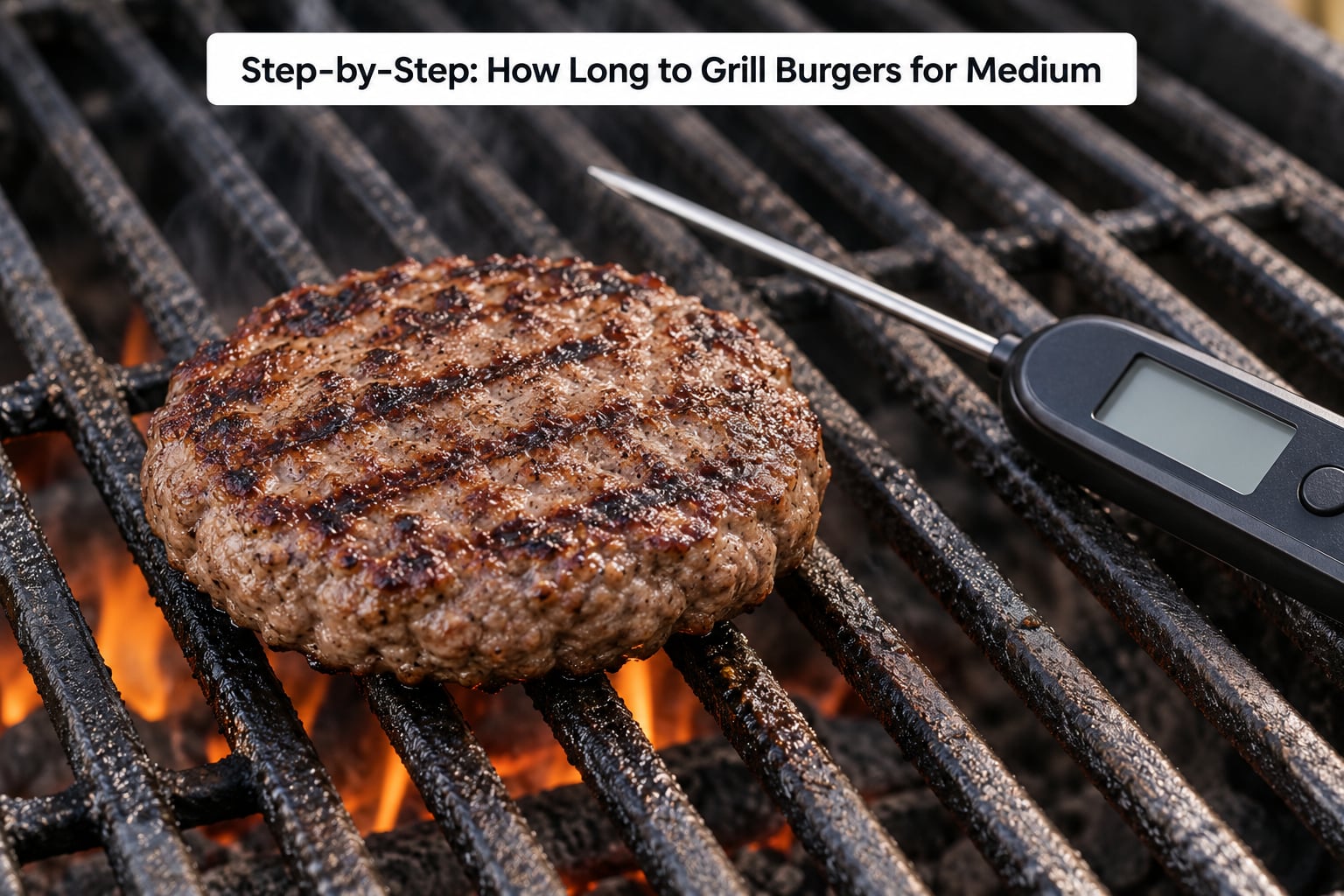
Medium doneness means a warm pink center with clear juices still in the meat, which lands between 140°F and 145°F internal. Here is the method that gets you there without cutting into a burger to check.
Prepare the Burgers for Even Cooking
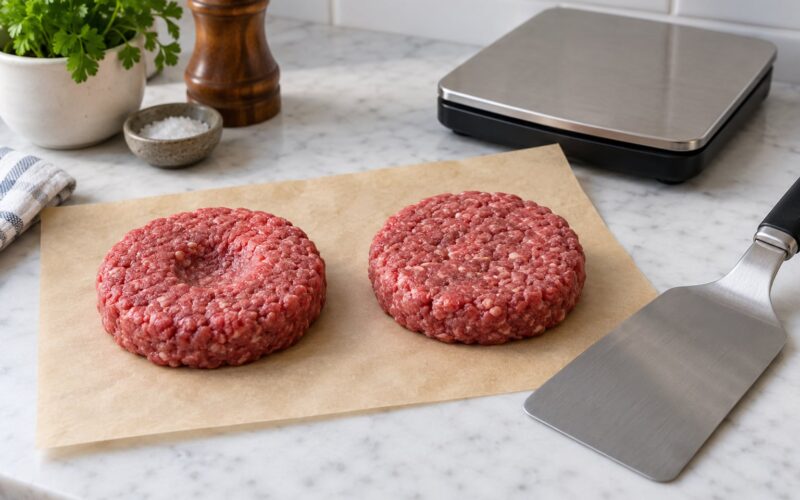
Shape the patty so its thickest point is at the center and the edges taper slightly. A patty that is perfectly flat cooks with a raw ring in the middle, because the edges hit the grate first and pull heat away.
Press a shallow dimple into the center with your thumb. The dimple evens out as the patty cooks, and a domed center is the reason so many burgers end up overdone outside and raw inside.
Pat the surface dry and season right before grilling. Salt draws moisture out of the surface, so seasoning a patty 20 minutes early gives you a dull crust that sticks less well.
Let the patties sit at room temperature for 15 to 20 minutes while the grill heats up. A fridge-cold patty needs extra time on the outside before the center catches up.
Set Up a Two-Zone Grill
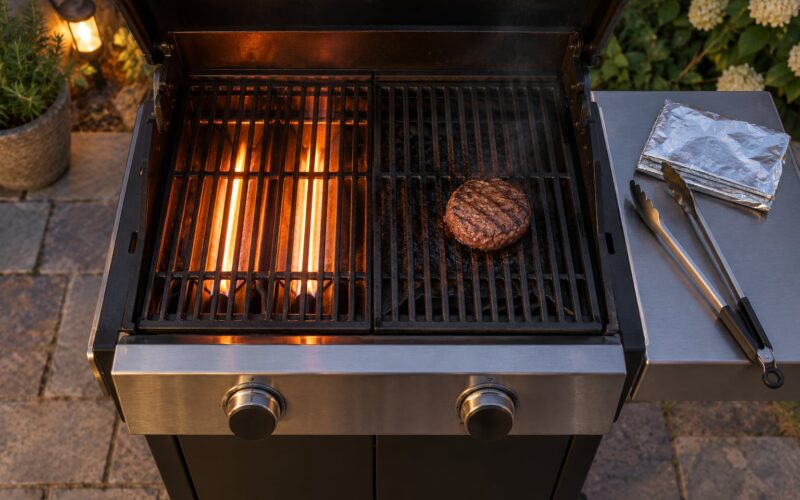
Push all the charcoal to one side, or turn the burners on one side of a gas grill only. That gives you a hot direct zone for searing and a cooler indirect zone for finishing thick patties without charring the outside.
Preheat with the lid closed until the grate reads 400°F to 450°F if you have an infrared thermometer. Lid thermometers on gas grills are well known to read low, sometimes by 50°F or more, so treat them as a rough check rather than the truth.
Brush the grates with oil once the grill is hot. A sticky patty is almost always a dry patty that grabbed a dry grate.
Grill Thin Burgers for 3 to 5 Minutes per Side
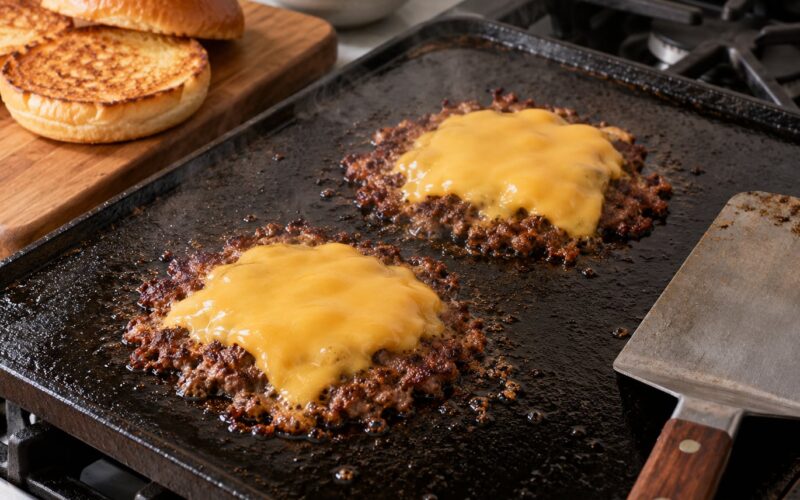
Quarter-inch patties, the ones used for smash-style burgers, cook fast. Lay them down and give them 3 to 4 minutes on the first side, then flip once and give them another 1 to 2 minutes.
These patties are done long before the clock suggests. Check at the 2-minute mark with your thermometer, because a thin patty can jump from medium to well-done in under a minute.
For a classic thin smash patty, press it down once in the first 15 seconds so it makes full contact with the grate. Do not keep pressing it, or all the fat and juice goes onto the coals.
Grill Standard Burgers for 4 to 6 Minutes per Side
A half-inch to three-quarter-inch backyard patty is the most common case, and it lands at 4 to 6 minutes per side over direct heat. Sear the first side uncovered for about 4 minutes until you see a browned crust and released juices.
Flip once and cook the second side for another 3 to 5 minutes, watching the color change from pink to brown on the surface. The center should still look pink when you cut into it, but read the thermometer first.
Do not press the patty while it cooks. Pressing squeezes out the juices that make the burger juicy, and the drippings are what cause flare-ups and bitter char on the outside.
Grill Thick Burgers for 6 to 8 Minutes per Side
Patties at three-quarter inch and thicker need more heat management than a timer. Sear the first side over direct heat for 3 to 4 minutes, then move the patty to the indirect zone and finish it with the lid closed.
Expect 6 to 8 minutes total on the indirect side for a thick patty, with the internal temperature checked at the 6-minute mark. The lid turns the grill into a convection oven, which is what keeps the outside from burning while the center catches up.
A one-inch patty can take 12 to 16 minutes all told. Check temperature once, halfway through the second half of cooking, and then at the end rather than cutting repeatedly and leaking juice.
Check Doneness and Rest the Burgers
Insert the thermometer into the thickest part of the patty from the side, avoiding the grate. For medium, read 145°F, then account for carryover cooking, which adds roughly 5°F to a standard patty during the rest.
That is why you pull at 145°F even though the USDA safe minimum internal temperature for ground beef is 160°F. Cooking burgers pink carries a real food safety risk from bacteria in the meat, so if you are serving kids, older guests or anyone pregnant, cook to 160°F and serve them well-done patties.
Rest the burgers 2 to 3 minutes on a rack before serving. The rest lets the juices redistribute instead of running out the bottom, and it finishes the carryover cooking without you going back to the grill.
Grill Time and Temperature by Doneness
Cook times below assume a standard three-quarter-inch patty at 400°F to 450°F. The pull temperature is what you read on the thermometer, and the carryover column is what adds during the rest.
| Doneness | Pull off the grill | After rest | Total cook time | What it looks like |
|---|---|---|---|---|
| Rare | 125°F | 130°F | 5-7 min | Cool red center, very soft |
| Medium-rare | 130°F | 135°F | 7-9 min | Red-pink center, juices running |
| Medium | 145°F | 150°F | 8-10 min | Warm pink center, springy |
| Medium-well | 155°F | 160°F | 10-12 min | Faint pink, firmer |
| Well-done | 160°F+ | 165°F | 12-14 min | Brown throughout, dry if overcooked |
Medium sits between medium-rare and medium-well, and the difference is about 10°F either way. Most home cooks overshoot medium because they chase color instead of temperature, and by the time the center looks brown the patty has already passed the 160°F mark where it starts losing moisture.
Time by Patty Thickness
This chart is the fastest answer to how long to grill burgers for medium, assuming a grill at 400°F to 450°F and a single flip.
| Patty thickness | First side | Second side | Total time | Medium internal temp |
|---|---|---|---|---|
| 1/4 inch (thin smash) | 2-3 min | 1-2 min | 3-5 min | 145°F pulled |
| 1/2 inch (quarter pounder) | 4 min | 3 min | 7-8 min | 145°F pulled |
| 3/4 inch (standard) | 4-5 min | 4-5 min | 8-10 min | 145°F pulled |
| 1 inch (thick) | 4 min direct | 6-8 min indirect | 10-16 min | 145°F pulled |
Gas Grill vs Charcoal Grill
Charcoal reaches cooking temperature more slowly, often taking 15 to 20 minutes, and it drops in temperature every time you open the lid. Gas heats in about 10 minutes and recovers faster, so it is the easier grill for hitting a consistent medium.
On charcoal, cook thin patties over the hottest part of the coals and move thick patties to the far side where the heat is indirect. Keep the lid on between flips so you do not lose the temperature you built up.
Common Mistakes
Most overcooked burgers come from the same handful of habits. Here is what goes wrong and how to fix it.
- Cooking the whole patty over direct heat. The outside burns before the center is done. Sear on the hot side, then finish thick patties on the cool side with the lid down.
- Pressing the patty. It squeezes out juice and causes flare-ups. Press once at the start for a thin patty if you want contact, then hands off.
- Flipping repeatedly. Every flip resets the crust and starts the clock again. One flip is enough for burgers up to an inch thick.
- Seasoning too early. Salt on the surface for 20 minutes dries the outside and ruins the crust. Season just before grilling.
- Cutting to test doneness. Every cut leaks juice and lets heat escape. Use an instant-read thermometer instead, or check one sacrificial patty if you are cooking a batch.
- Treating the timer as the answer. Times are estimates. Temperature is the only reliable signal, so probe every patty or at least one per batch.
- Trusting a lid thermometer. They read low. An inexpensive infrared thermometer aimed at the grate is a better read on what the patty is actually sitting on.
Troubleshooting
| Problem | Likely cause | Fix |
|---|---|---|
| Raw center, burnt outside | Patty stayed over direct heat | Move to the indirect zone, close the lid, check temperature at 6 minutes |
| Burger is dry | Pressed, flipped too often, or cooked past 160°F | Stop pressing, flip once, pull at 145°F, rest 3 minutes |
| Sticks to the grate | Dry patty surface or dry grates | Oil the grates, pat the meat dry, wait for the grate to get hot |
| Flare-ups | Fat and juices dripping onto the heat | Move the patty to the indirect side for a minute |
| Uneven cooking | Domed center, no two-zone fire | Dimple the center, build a two-zone fire, lower the heat to 375°F for thick patties |
One tip ties it together: if the burger is not right on the first try, note the thickness, the grill temperature and the internal temperature you read. Three data points per cook and you will have your own timings after two or three burgers.
Frequently Asked Questions
How long should a burger cook on each side for medium doneness?
For a standard half-inch to three-quarter-inch patty, cook 4 to 6 minutes per side on a grill at 400-450F. Thin quarter-inch patties need only 3 to 4 minutes a side, and thick one-inch patties need 6 to 8 minutes a side, usually finished over indirect heat with the lid closed. Flip once, then confirm 145F with an instant-read thermometer.
What internal temperature is a burger cooked to medium?
Medium is 140-145F measured at the thickest part of the patty. Because the burger keeps cooking after it leaves the grill, pull it at about 145F so it finishes near 150F during a 2 to 3 minute rest. The USDA safe minimum for ground beef is 160F, so serve well-done patties to children, older guests and pregnant guests.
How can I tell if a burger is done without cutting it open?
An instant-read thermometer is the only reliable method. Insert the probe into the thickest part from the side, avoiding the grate, and read it in seconds. Color and the touch test are rough guides only, since meat color is not a safety signal and juices running clear can happen well before the center is cooked through.
Should I close the grill lid while cooking burgers?
Leave the lid open for the first sear so the crust browns and dries. Close it for the second half when cooking thick patties, since the trapped heat cooks the center evenly and keeps the outside from burning. On charcoal, closing the lid between flips also stops the long cool-down that makes times unpredictable.
Why are my burgers always overcooked?
Three habits cause most overcooked burgers: pressing the patty with a spatula, flipping it several times, and cooking over direct heat until the outside looks done. A domed center is a fourth culprit, since the middle cooks last and the outside burns first while you wait. Dimple the center, sear then move to indirect heat, and pull at 145F.
How long does it take to grill frozen burgers?
A frozen patty needs about 50 percent more total time than a thawed one, and it must go through a thaw cycle to cook evenly. Thaw them in the refrigerator overnight for the best result. If you must cook from frozen, press a shallow dimple in the center to let heat reach the middle, grill over medium heat rather than high, and verify the internal temperature.
Conclusion
Start with thickness, not the clock. Measure or eyeball your patty, pick the matching row in the timing chart, and use a two-zone fire so the outside browns while the center catches up.
Then how long to grill burgers for medium comes down to this: 4 to 6 minutes per side for a standard patty, one flip, no pressing, and pull it at 145°F. Always verify doneness with a thermometer, and remember the USDA safe minimum internal temperature for ground beef is 160°F before serving anyone at higher risk.