You rest burgers after cooking so the juices stay in the patty instead of running out onto the cutting board. Heat contracts the muscle proteins and pushes liquid toward the outside of the meat. Give the burger three to five minutes off the heat and the fibres relax, that liquid moves back in, and the patty slices cleanly and eats tender.
The honest version: the payoff is smaller than it is for a steak. A burger is mostly emulsified fat and loose ground muscle, not a dense whole-muscle cut, so there is less liquid to move around in the first place. Resting helps, it just does not perform miracles.
Below is what actually happens, how long to wait for the size of patty you are cooking, and what to do with that window so it does not go to waste.
Table of Contents
- What Does Resting a Burger Do?
- How Long Should You Rest a Burger?
- Why Rest Burgers After Cooking Instead of Serving Them Immediately?
- Should You Cover a Burger While It Rests?
- Does Resting a Burger Make It More Cooked?
- How to Rest Burgers Without Making Them Cold or Soggy
- Frequently Asked Questions
- Why rest burgers after cooking instead of cutting them right away?
- How long should a burger rest before serving?
- Should I cover my burger with foil while it rests?
- Does resting a burger continue cooking the inside?
- What internal temperature should a ground beef burger reach?
- Do frozen or smashed burgers need a different resting time?
- The Best Way to Rest Your Burger
What Does Resting a Burger Do?
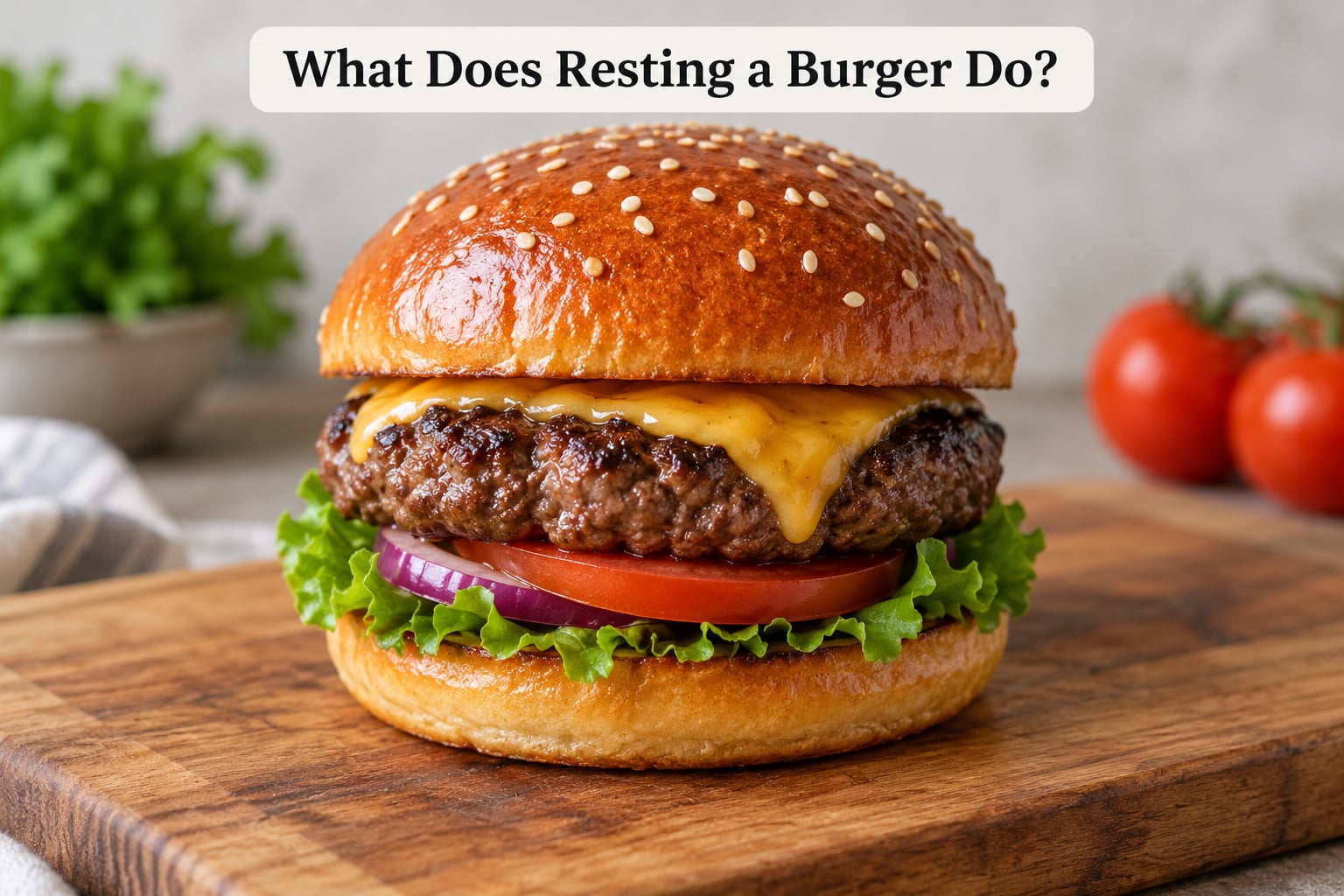
Resting means leaving the patty off the heat, on a warm surface, untouched, for a few minutes before you slice or dress it. That is the whole technique. If someone tells you to rest a burger, this is what they mean.
Three things are happening during those minutes, and only one of them matters much for a burger.
Juice redistribution. Cooking drives moisture out of the meat. Part of it evaporates off the hot surface, and part gets squeezed toward the outside and the cut face. As the patty cools, that liquid seeps back through the meat instead of pooling under it. Cut too early and you are pouring the best flavor in the burger onto the board.
Fiber relaxation. Myosin and the other muscle proteins tighten under heat and stay tight as long as the meat is hot. Cooling lets them relax, which is why a rested patty feels tender rather than springy. This effect is real but modest, because ground beef fibers are already short and mixed up from grinding.
Carryover cooking. The patty keeps cooking after you remove it. The center climbs several degrees while the surface starts to lose heat, and the fibers tighten again slightly. More on that below, because it changes how you time the rest.
What resting does not do is fix a patty that was overworked, pressed flat under a spatula, or made from a lean 90/10 blend. Those problems happen before the heat goes on.
How Long Should You Rest a Burger?
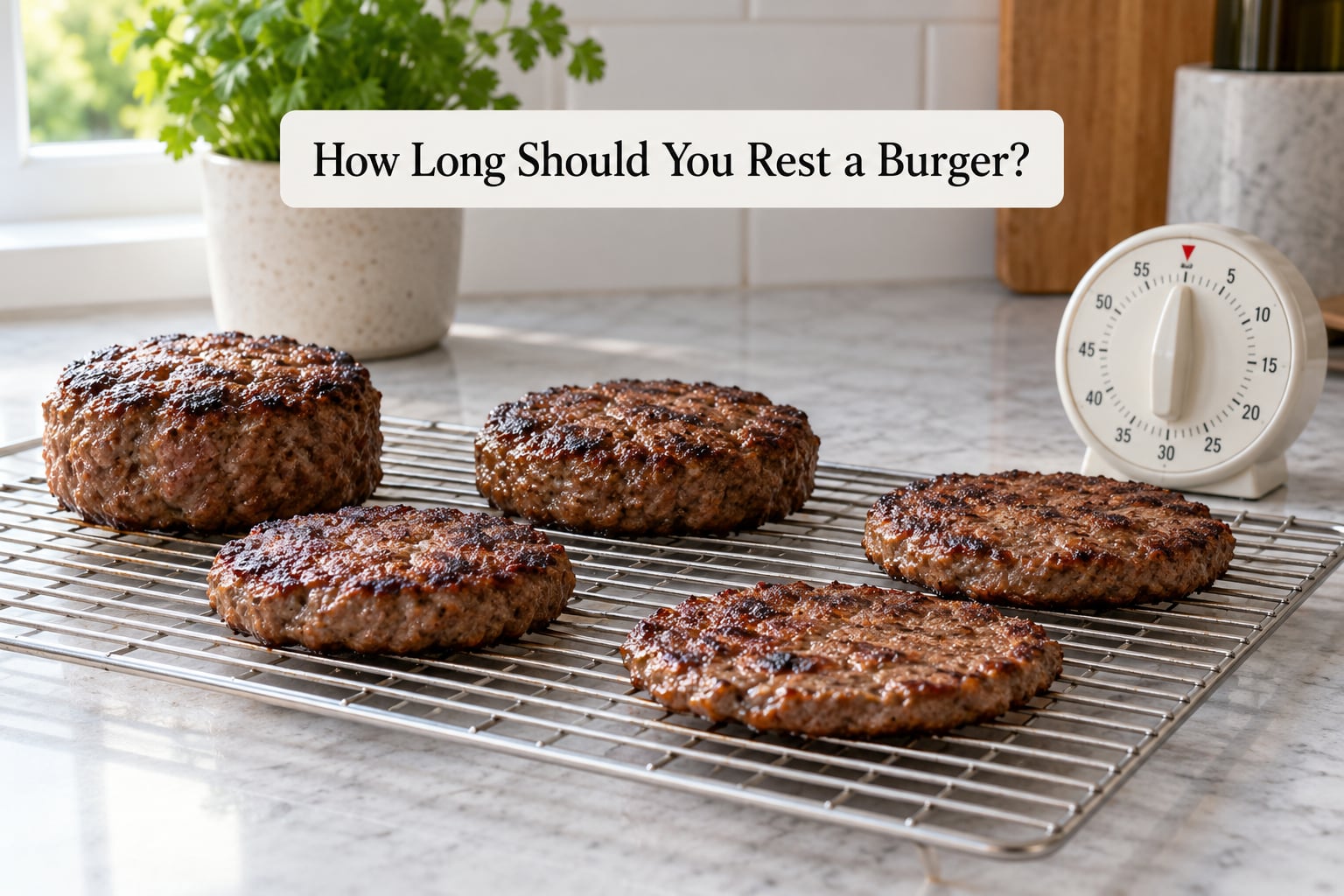
Start the timer the moment the patty comes off the heat, not when you plate it. Three to five minutes covers most home cooking. Thin patties need less because they lose heat fast, and thick ones can use a little more.
| Patty | Approximate thickness | Rest time | Notes |
|---|---|---|---|
| Thin or small patty | 1/4 inch | 60 to 90 seconds | Loses heat almost immediately. Rest it while you toast the bun. |
| Smash burger | 1/8 inch | 30 to 60 seconds | There is no practical window. Build it right away. |
| Standard quarter pounder | 3/8 inch | 3 to 4 minutes | The everyday case. This is the number most recipes mean. |
| Thick third pounder | 1/2 inch | 5 minutes | Hold it under a loose foil tent so the edges do not go cool. |
| Double or stuffed patty | 3/4 inch or more | 5 to 7 minutes | Two patties stacked rest more like a thick roast than a thin one. |
| Smoked or pellet-grilled patty | Varies | 3 to 5 minutes | Low-and-slow patties hold their moisture well, so a short rest is enough. |
A useful shortcut: rest for roughly the same number of minutes as the patty is thick in quarter-inch increments, doubled. A half-inch patty lands near five minutes, a quarter-inch patty near two. Nobody times burgers that precisely, and nobody needs to.
Why Rest Burgers After Cooking Instead of Serving Them Immediately?
Because the first cut decides what the rest of the meal tastes like. Here is the sequence, in order, when you pull a patty off the grill at 160 degrees and slice it straight away.
First, the cut face is the softest, most permeable surface in the patty, and it is at its hottest. Cut it and you open a channel straight to the center. The liquid that was still working its way back through the meat runs down the knife and out onto the board.
Second, the fibers are still contracted, so the meat resists the blade. You saw more than you meant to, the surface tears, and the patty crumbles at the edges rather than splitting cleanly.
Third, the patty now has less liquid in it, and the bun soaks up what is left instead of staying dry on the bottom. The whole burger tastes drier than the same burger cut after four minutes, even though the two patties were cooked identically.
Now the rested version. Same cook, same temperature, four extra minutes. The fibers have loosened, the juice has settled back through the patty, and the cut runs straight through. A few more milliliters stay in the meat, and they go into the bun with the burger instead of onto the board.
That difference is small on paper and obvious in the mouth. It is also the entire reason restaurants rest burgers between the grill and the pass.
Should You Cover a Burger While It Rests?
Cover it loosely, or not at all. What you want to avoid is a sealed packet, because trapped steam softens the crust and the patty steams in its own moisture.
| Method | Moisture | Crust | Best for |
|---|---|---|---|
| Loose foil tent | Keeps edges from drying | Stays crisp if the foil does not touch it | Thick patties, burgers waiting more than four minutes |
| Fully wrapped in foil | Highest, but the steam works against you | Goes soft and wrinkly | Reheating a cooked patty, not a first rest |
| Uncovered on a rack | Surface dries slightly | Crispest result | Short rests, smash burgers, patties served within two minutes |
| Warm shallow plate or board | Holds heat well | Fine, as long as nothing pools underneath | Standard quarter-pounders, a single-burger meal |
If you use foil, tent it so the patty sits on a rack inside the tent, not on a foil plate. Air has to circulate under the meat or you get condensation and a damp bottom crust.
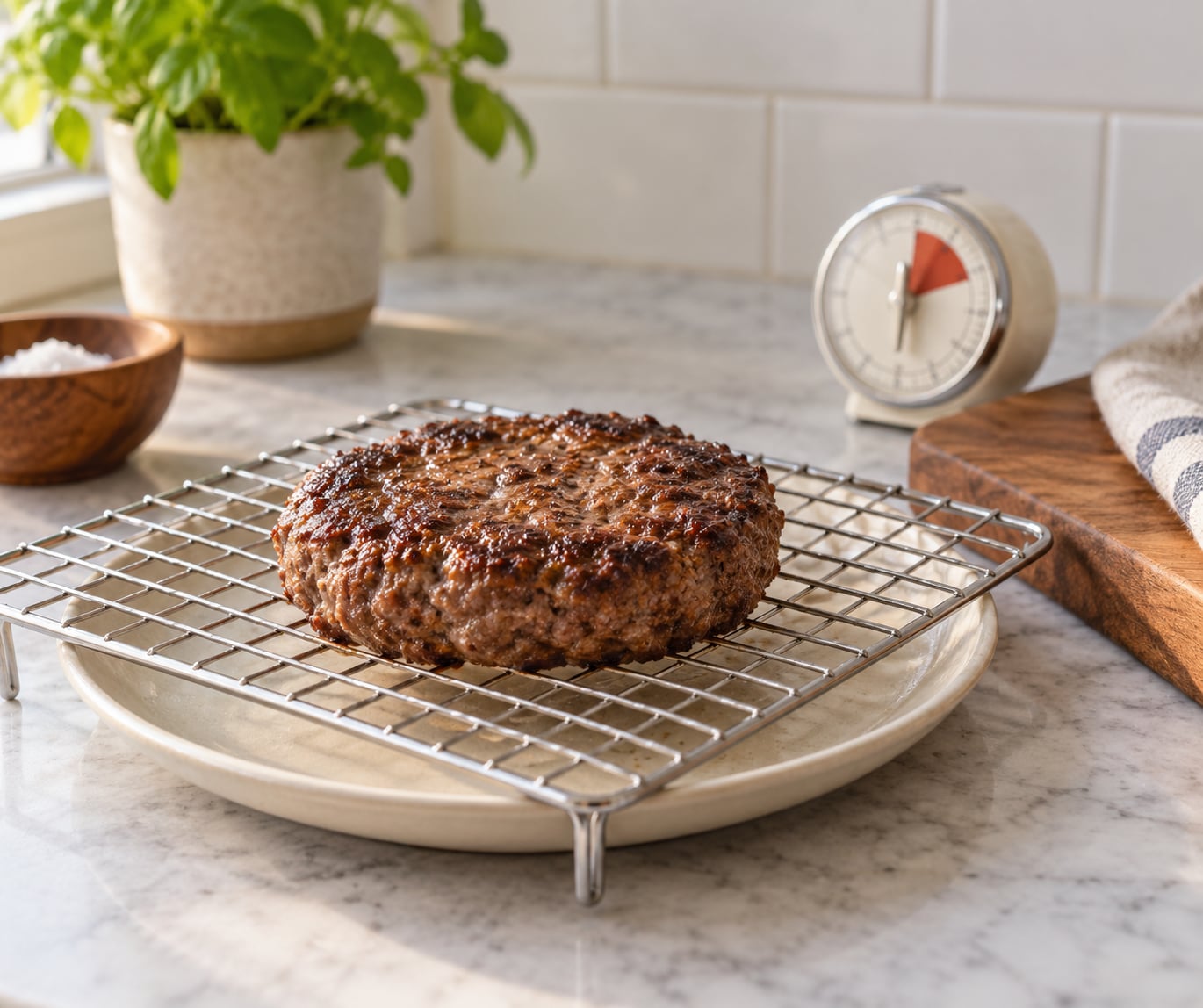
A wire cooling rack is the best surface. It lifts the patty off the counter so juices and steam escape downward instead of soaking back into the underside. A warm plate is second best, as long as it is not a flat cutting board sitting in a puddle.
Home cooks asking about resting in foil usually want to keep the patty hot through a long hold. A tent works for that. Wrapping tight is the mistake, and it is the same mistake people make with steaks.
Does Resting a Burger Make It More Cooked?
Yes, slightly, and that is called carryover cooking. The center of a hot patty is the hottest part of it, and once the surface stops taking heat from the fire, that trapped center keeps cooking the surrounding meat. A burger pulled at 155 degrees can finish around 158 to 160 during a four-minute rest. A burger pulled at 160 will land closer to 163.
This matters for two reasons. Pull slightly under your target and let the rest finish the job, and use a thermometer rather than judging by color.
Color is unreliable on ground beef. Lean blends brown well before they are safe, and charcoal and blackened edges do not tell you anything about the center. Push an instant-read thermometer into the thickest part of the patty, away from the grate, and read the number.
| Doneness | Pull at | Approximate center after a 4-minute rest | Comment |
|---|---|---|---|
| Rare | 125 to 130 F | 130 to 135 F | Below the safe minimum for ground beef. Worth knowing what you are ordering. |
| Medium-rare | 130 to 135 F | 135 to 140 F | Still under the USDA minimum of 160 F. |
| Medium | 140 to 150 F | 145 to 155 F | Pink in the center and how most diners order a burger. |
| Medium-well | 155 to 160 F | 160 to 165 F | The safe and practical target for home cooking. |
| Well-done | 170 F and up | 170 F and up | Dry, and the main reason resting matters less for it. |
Food safety is not a style preference for ground meat. The USDA puts the safe minimum internal temperature for ground beef at 160 F, and cooked patties held longer than two hours at room temperature should be discarded. The danger zone sits between 40 F and 140 F, so a rest of three to five minutes is nowhere near it.
For long cooks, hold finished patties at 140 F or warmer rather than on the counter. A warm oven set to its lowest setting with a pan of water is the usual home workaround.
How to Rest Burgers Without Making Them Cold or Soggy
Serve one burger at a time and the whole problem is easy. Cooking a batch for a group is where technique decides whether the patties are still good after eight minutes.
1. Pull at the right temperature. Aim for 155 to 160 F on the thermometer. A hot cast iron pan sears hard, and a patty can climb 10 degrees in the two minutes between the grill and the plate.
2. Move it off the grill immediately. Do not leave finished patties sitting on a hot grate. That is a radiant heat source, and the bottom crust keeps cooking while you work on the next one.
3. Use a warm shallow rack or plate. Set the plate in a low oven for a few minutes while you finish cooking, so the patty arrives at the resting surface hot rather than room temperature.
4. Keep it flat and single. Stack nothing on it, and do not stack patties on each other. A double burger should be built as two separate patties that each get their own time.
5. Tent loosely at four minutes, not before. Below four minutes, uncovered is better. Past four minutes, a loose foil tent keeps the edges from going cool without steaming the crust.
6. Use the window instead of wasting it. This is the part most guides skip. Toast the buns, render the bacon, melt the cheese. A slice of cheese laid on a rested patty melts into it rather than sliding off a wet surface, and bacon finished in the same pan comes out crisp while the patty waits.
7. Slice last, and slice in one motion. A serrated knife saws and tears. A sharp chef’s knife drawn straight down through the patty keeps the surface intact and the juices in.
Two habits undo the whole thing. Pressing the patty with a spatula while it cooks squeezes out liquid before resting even starts, and slicing on a flat wooden board traps steam underneath so the bottom crust goes soft. Neither is fixable afterward.
If you are reheating a cooked frozen patty, an air fryer at 350 F for 3 to 5 minutes with a flip halfway is the usual method. Refreezing a cooked patty is worth avoiding, because the second freeze pulls more moisture out than the first. That is a reheating question rather than a resting one, but the same crust rule applies: get it hot fast and get it served.
Frequently Asked Questions
Why rest burgers after cooking instead of cutting them right away?
Heat contracts muscle proteins and pushes liquid toward the outside of the patty. Cut immediately and the first slice opens a channel to the center, so that liquid runs out onto the board instead of moving back through the meat. A short rest lets the fibers relax and the juice settle, so the patty slices cleanly, holds together in the bun, and tastes noticeably juicier. The benefit is real but modest, since ground beef has less liquid to redistribute than a steak.
How long should a burger rest before serving?
Three to five minutes is the working range for a standard quarter-pound patty. Thin patties cooked to a quarter inch only need 60 to 90 seconds, a thick half-inch third pounder can take the full 5 to 7 minutes, and a smash burger has no practical rest window at all. Start the timer when the patty comes off the heat, not when you plate it, and put the pan of bacon on during the wait.
Should I cover my burger with foil while it rests?
Tent it loosely if the patty is thick or the rest runs past four minutes, and leave it uncovered for shorter rests. Wrapping a patty tight in foil traps steam, and the crust goes soft and wrinkly while the underside steams. Keep the foil off the surface by tenting it over a rack so air circulates underneath. A wire cooling rack with no cover gives you the crispest result for a brief rest.
Does resting a burger continue cooking the inside?
Yes, that is carryover cooking, and it is measurable. A patty pulled off the grill at 155 F typically finishes around 158 to 160 F over a four-minute rest, and one pulled at 160 F lands closer to 163. The center is the hottest part of the patty and keeps cooking from its own retained heat. Pull a few degrees under your target, then confirm with an instant-read thermometer before serving.
What internal temperature should a ground beef burger reach?
The USDA sets 160 F as the safe minimum internal temperature for ground beef, and no amount of resting changes that standard. Color is not a reliable guide: lean blends brown long before they are safe, and char on the edges tells you nothing about the center. Push an instant-read thermometer into the thickest part of the patty. Many home cooks pull at 155 to 160 F and let carryover cooking finish the job during the rest.
Do frozen or smashed burgers need a different resting time?
Thin and smashed patties need much less time than thick ones. A smash burger is often done in 90 seconds, so give it 30 to 60 seconds at most and build it immediately. A frozen patty reheated in an air fryer at 350 F for 3 to 5 minutes with a flip is a reheating method rather than a cook, and the same crust rules apply: serve it straight from the hot basket.
The Best Way to Rest Your Burger
Pull the patty at 155 to 160 F on the thermometer, not by color. Move it off the grate right away onto a warm wire rack or shallow plate, keep it flat with nothing on top, and leave it untouched. A quarter-inch patty needs about three minutes, a half-inch patty about five, and a smash burger about one.
That is why rest burgers after cooking, in one sentence: the wait is what keeps the juice in the meat and the crust on the patty, and it costs you nothing but a few minutes you would have spent waiting on the grill anyway.