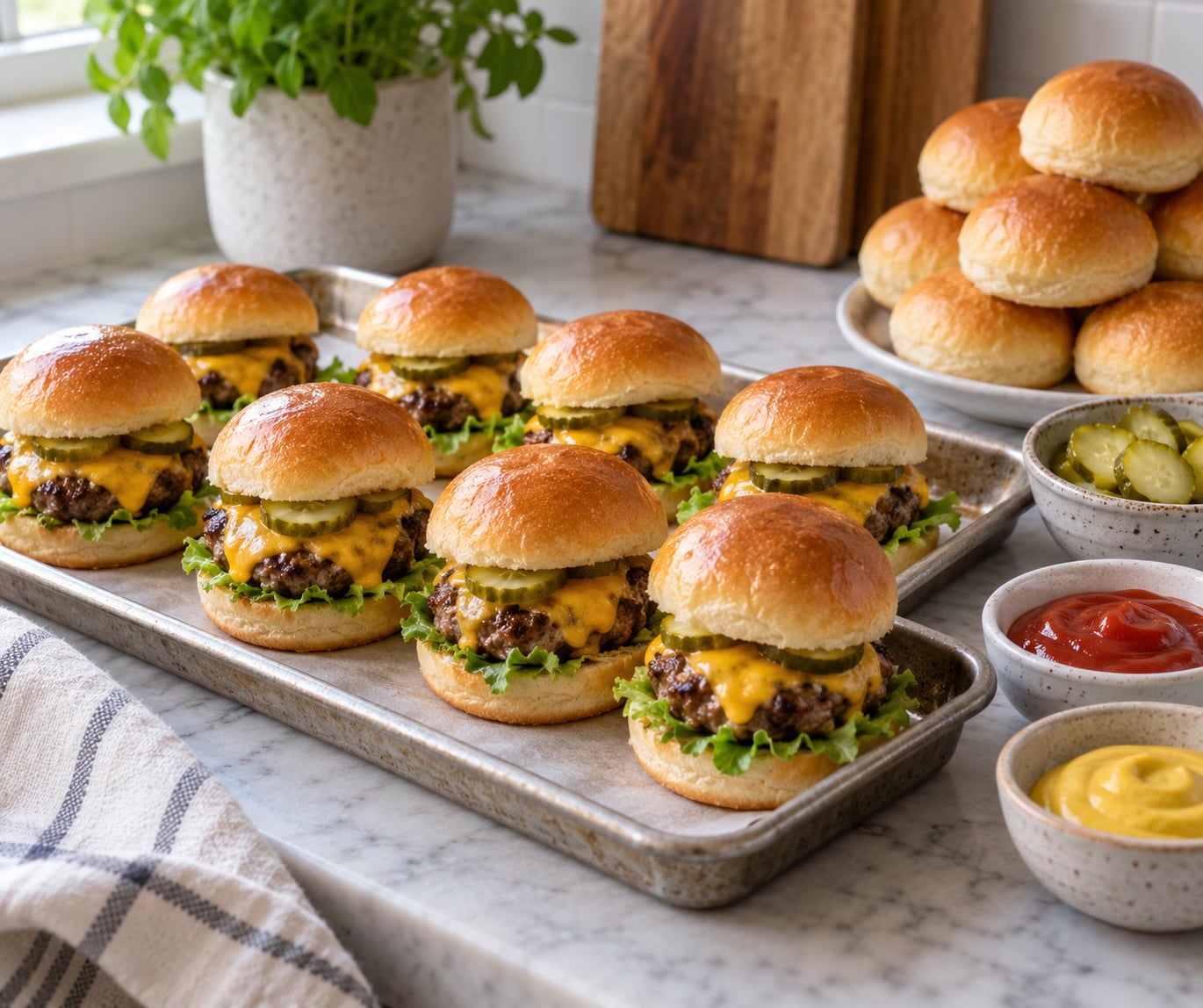
Party sliders are small sandwiches built on mini rolls, usually Hawaiian sweet rolls, filled with seasoned ground beef, ham or pulled pork and melted cheese. The crowd-proof method skips individual patties: press one seasoned layer of meat into a 9×13-inch pan, bake it at 400°F for 10 to 15 minutes, add cheese for 1 to 2 minutes, then cut the cooked slab into squares and set each square on a bun.
That is the whole trick. The pan does the work of a griddle, the oven does the work of searing a dozen patties one by one, and cutting the slab after baking keeps the filling in one piece instead of letting it fall apart on a tray.
Getting the hang of how to make sliders for a party is mostly a planning problem rather than a cooking problem. Decide how many guests are coming, get the buns and meat counted the night before, and the actual cooking is one pan and about fifteen minutes of oven time.
For the batch below: 24 sliders, about 20 minutes of prep, 12 to 15 minutes in the oven, and they hold warm for roughly an hour. Every quantity scales straight up to 48.
Table of Contents
- What You Need to Make Sliders for a Party
- For 24 sliders
- How much to buy for your guest count
- What you can get done early
- Choosing your buns
- Step-by-Step: Classic Beef Party Sliders
- 1. Prep the base
- 2. Mix the meat
- 3. Press and bake
- 4. Melt the cheese
- 5. Slice and assemble
- How to make sliders for a party without last-minute stress
- Five filling variations for a crowd
- Common Mistakes
- Tips for scaling up
- Frequently Asked Questions
- How many sliders should I make per guest?
- Can I make slider patties ahead of time?
- What is the best way to keep sliders warm without drying them out?
- Can I bake slider patties instead of pan-frying them?
- How do I stop slider buns from getting soggy?
- Can I make sliders with chicken or vegetarian ingredients?
- Conclusion
What You Need to Make Sliders for a Party
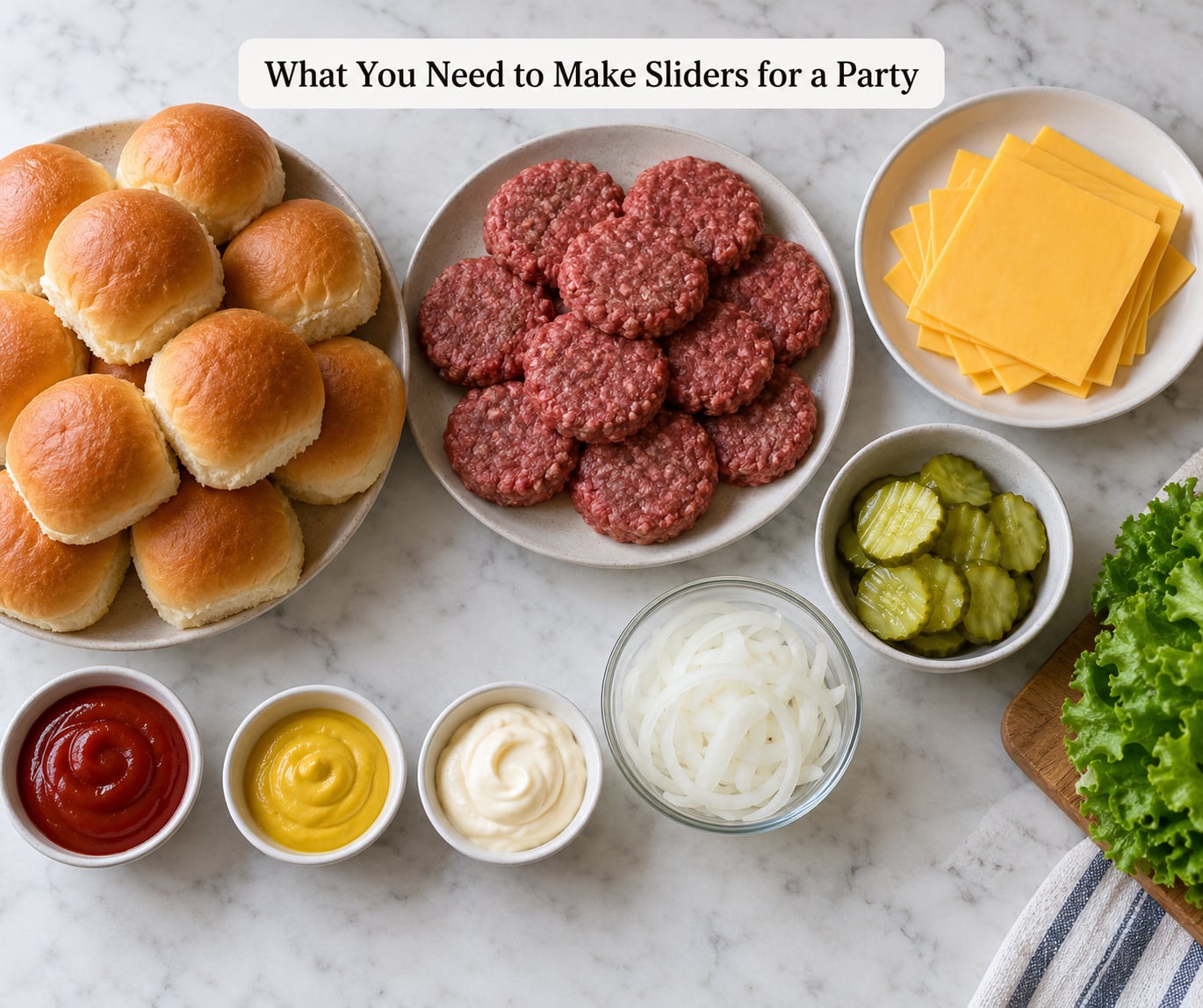
You need a 9×13-inch pan, small rolls, ground beef, sliced cheese and a sauce, plus a serrated knife and a foil pan or sheet pan for holding finished sliders. Nothing here is specialty equipment.
For 24 sliders
- 24 slider buns – Hawaiian sweet rolls, dedicated slider buns, or small dinner rolls
- 2 pounds ground beef – 80/20 gives you the juicier result most people expect from a party
- 1 small onion, diced – cooks down into the meat and adds moisture
- 2 eggs – binder, so the slab holds together when you cut it
- 1/2 cup breadcrumbs – keeps the texture loose instead of bouncy
- 2 tablespoons Worcestershire sauce
- Salt and black pepper
- 6 to 8 slices cheese – American, cheddar, Swiss or provolone, sliced thin
- Toppings – dill pickle chips, ketchup, yellow mustard, caramelized onions, shredded lettuce, BBQ sauce
How much to buy for your guest count
Plan two to three sliders per adult and one to two per child, then round up. Guests arriving hungry, or a party running long, push the number higher. Kids usually eat one and then come back for a second twenty minutes later.
- 6 guests: 12 rolls, 1 lb ground beef, 3 to 4 cheese slices, 1/4 cup sauce
- 12 guests: 24 rolls, 1.5 to 2 lb ground beef, 6 to 8 cheese slices, 1/2 cup sauce
- 24 guests: 48 rolls, 3 to 3.5 lb ground beef, 12 to 16 cheese slices, 1 cup sauce
- 40 guests: 80 rolls, 5 to 5.5 lb ground beef, 20 to 24 cheese slices, 1.5 cups sauce
One 9×13-inch pan holds about 12 baked squares, so 24 sliders means two pans or a second oven rack. If you are going past 36, cook in batches rather than crowding, because a jammed pan steams instead of browning.
What you can get done early
- The night before: buy everything, dice the onion, and mix the meat with the binder, seasoning and Worcestershire. Refrigerate it covered.
- The morning of: soften the butter for the buns, chop the pickles and onions, and shred any cheese you are melting by hand.
- Thirty minutes out: the only thing that genuinely has to happen last is assembling, because moisture in the sauce is what makes buns go soft.
Choosing your buns
Hawaiian sweet rolls are the standard for a reason: they are soft, slightly sweet and small enough that two make a comfortable mouthful. Dedicated slider buns are a close second and sometimes easier to find. Small dinner rolls work, but check that they are genuinely mini, because a regular dinner roll next to a slider filling turns the whole thing into a sandwich you have to hold with two hands.
Whatever you pick, buy one more package than you think you need. Extra rolls are the most useful thing in the kitchen during a party, since they let you send someone home with the leftovers.
Step-by-Step: Classic Beef Party Sliders
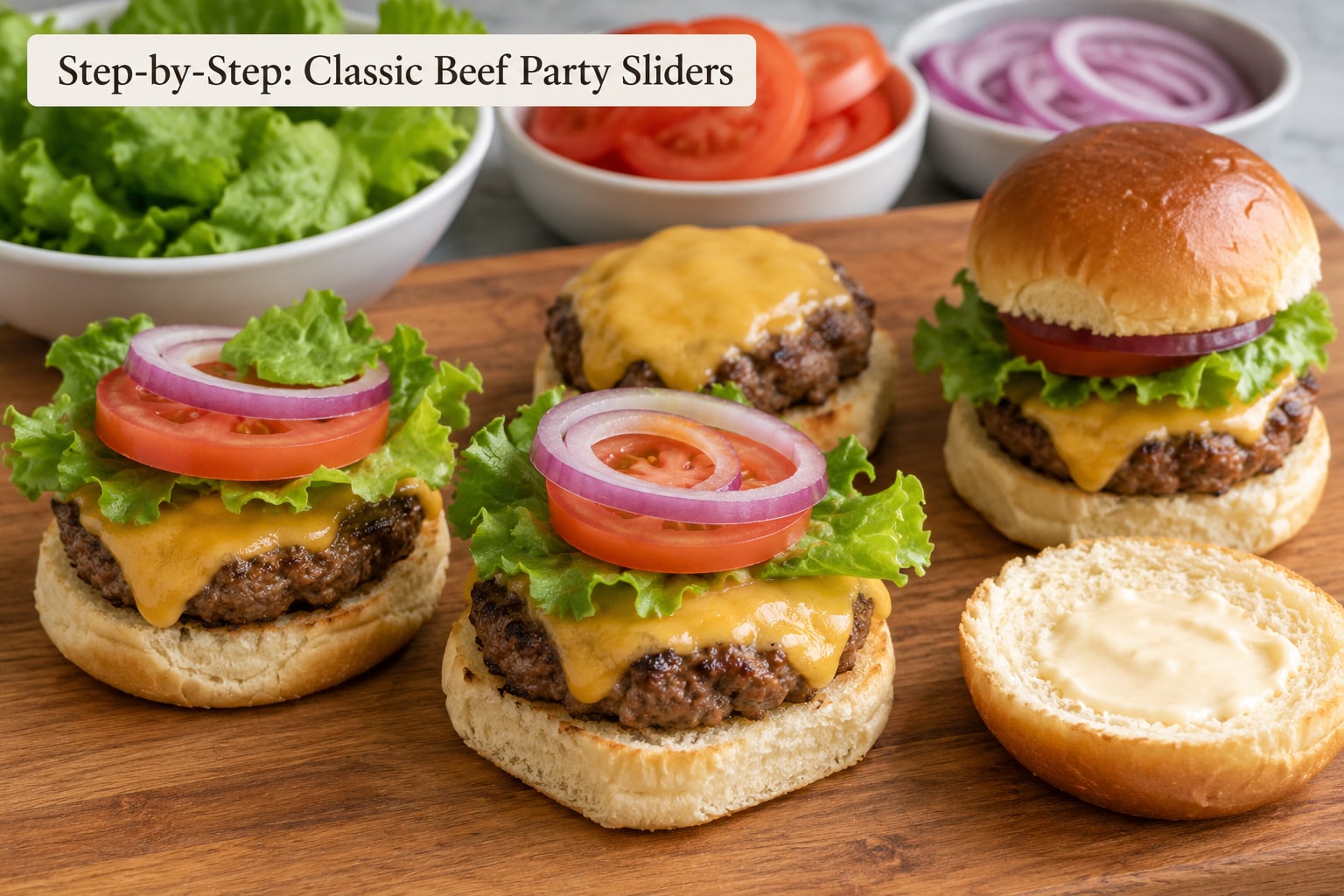
Prep the base, mix the meat, press and bake, melt the cheese, then slice and assemble. The whole sequence runs about 35 minutes start to finish, and nearly all of it is hands-off.
1. Prep the base
Heat the oven to 400°F. Take a serrated knife and slice the whole block of rolls horizontally, cutting through all of them at once, so you get one solid sheet of bottom halves and one solid sheet of tops. Pull the tops off and set them aside, then lift out all but a dozen or so of the bottom halves so the meat has a shallow well to sit in.
Pat the bottoms dry with a paper towel. If you want to go the extra step, toast them cut-side down in a dry skillet for two minutes until golden, and drain them on a towel. That single step is the best defense against a soggy slider.
2. Mix the meat
Combine the ground beef, diced onion, eggs, breadcrumbs, Worcestershire, a good pinch of salt and several grinds of pepper in a large bowl. Mix with your hands until it looks like it holds together when you squeeze a portion, about a minute.
Overmixing is what makes slider meat rubbery. Stop as soon as the binder is evenly distributed.
3. Press and bake
Press the mixture into the 9×13-inch pan in an even layer about half an inch thick, pressing it into the wells of the bun bottoms and up the sides. A damp hand or the back of a spatula makes this easier than it looks.
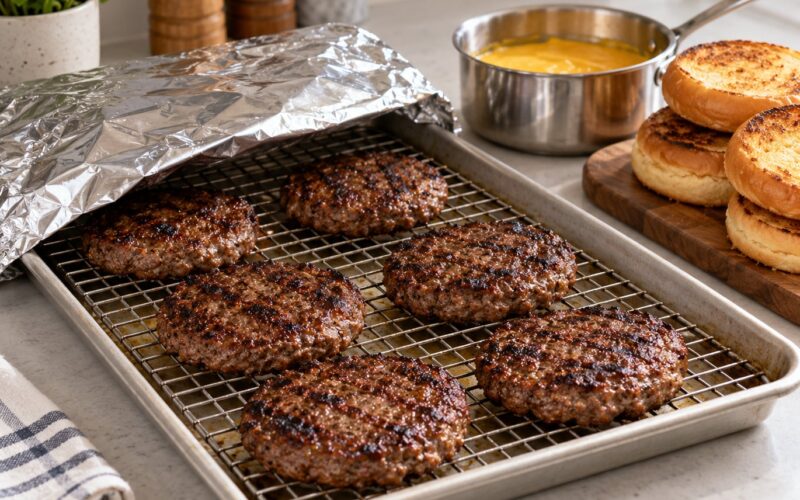
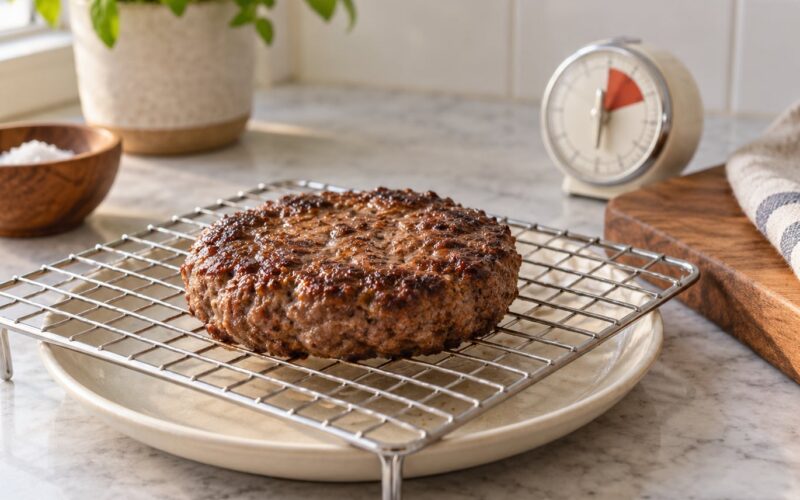
Bake at 400°F for 12 to 15 minutes, until the top is browned in patches and the internal temperature in the thickest part reaches 160°F. That is the safe minimum for ground beef, and it is also the point where the juices have stopped running.
4. Melt the cheese
Lay the cheese slices over the meat so they overlap slightly, and return the pan to the oven for 1 to 2 minutes, just until the cheese melts and blisters in a few spots. Pull it out the moment it bubbles, because cheese that sits too long turns rubbery and slides off the meat.
5. Slice and assemble
Let the pan sit for three minutes. Then run a long serrated knife through the whole pan in both directions, cutting the meat-and-cheese layer into squares that match the buns underneath.
Lift each square out with a thin spatula and set it on a bottom half. The cut edges should sit flush with the bun edges so nothing overhangs and tips when someone picks it up.
Add toppings, cap with the top half, and serve. If you are not serving immediately, leave the tray in the oven turned off with the door cracked for up to about an hour.
How to make sliders for a party without last-minute stress
Make the patties the night before, keep them flat, and assemble only when guests are about to eat. The single biggest source of party stress is not the cooking, it is trying to build 48 sandwiches while people are waiting on the kitchen counter.
For a slow, calm service, the sheet-pan slab is not the right format. Press the meat into parchment-lined pans, chill them flat in the refrigerator, and bake or skillet them in rounds of 12.
A workable order of operations: mix and press the meat the night before, set out every topping in its own bowl with its own spoon in the morning, and give yourself a running start by toasting all the bun bottoms an hour before guests arrive. What is left at serving time is scoop meat, add sauce, add top, cap.
Label everything. On a crowded counter, one unlabeled bowl of pickles and another of caramelized onions are a coin flip at 7pm, and half your guests will find out the difference by eating the wrong one.
If you are feeding people at another house, assemble the sliders in the pan, cover it with foil, and cut along the seams at the serving table. Sliders that have been cut and stacked in a container for two hours in a car are not the same food as sliders that were cut five minutes ago.
Five filling variations for a crowd
The beef slab is the default, but a party table looks better with two or three fillings side by side. None of these change the method, only what goes in the pan and how long it cooks.
- Ham and cheese. Layer deli ham and Swiss or provolone on the bun bottoms, skip the raw meat entirely, cover with foil and bake at 350°F for 8 minutes, then uncover and bake 8 to 10 minutes more until the cheese browns. This is the fastest version and the one kids eat fastest.
- Buffalo chicken. Shredded chicken tossed with Buffalo sauce and a little ranch, warmed through in a skillet until it reaches 165°F, then topped with celery slaw and a drizzle of blue cheese dressing. Add the slaw after baking so it stays crunchy.
- Pulled pork. Pork shoulder cooked until it shreds, mixed with barbecue sauce, piled into the buns and returned to the oven for 10 minutes to set. The sauce goes on the meat, not the bun, which is the one case where you want it generous.
- Sloppy Joe. Ground beef simmered loose with diced peppers and tomato sauce until thick, then spooned into the buns. Tastes better the next day, so this one genuinely benefits from being made ahead.
- Vegetarian. A veggie or black bean patty baked straight from the pan, or skip the patty entirely and use pulled mushrooms, shredded jackfruit in barbecue sauce, or grilled halloumi with caramelized onions.
Common Mistakes
Patties that are too thick. A half-inch layer is the target. Anything thicker takes longer, dries out at the edges and leaves you with one raw middle and two overcooked sides. Press it flat and even, and tap the pan on the counter to settle the meat into the corners.
Uneven cooking. Uneven cooking comes from one pan running hotter than the other, or from a pan stuffed past the edges. Rotate your pans halfway through the bake. If you are using two racks, swap their positions at the halfway mark.
Dry meat. Dry meat means the fat went out. Use 80/20, keep the diced onion in the mix, and pull the pan the moment the internal temperature hits 160°F. Ground beef does not benefit from ten extra minutes in a hot oven.
Soggy buns. This is the number one party failure, and the fixes are mechanical. Sauce goes on the bottom bun only, never the top, because the top bun is what a guest presses down on. Drain cooked meat on paper towels. Toast the cut side of the bottom bun. And if you are holding assembled sliders for more than 20 minutes, put a sheet of parchment between layers rather than stacking them bun-to-bun.
Overcrowded pans. Raw meat needs space to brown. When the pieces touch, the moisture has nowhere to go and the bottom of the slab steams grey instead of browning. Cook in batches; two pans in a 400°F oven take about as long as one.
Toppings released too early. Pickles and tomatoes give up water fast. Drain them on a towel, add them last, and hold wet toppings back until you are assembling. Shredded lettuce goes on at the very end or not at all.
Sliders sitting too long. Assembled sliders go soft from the inside out, and the clock starts the moment sauce hits bread. Build in waves of a dozen and bring out the next batch as the first one thins.
Tips for scaling up
- Season the meat in batches rather than one huge bowl, and mix each batch by hand to the same texture.
- Two pans on two racks beat one overloaded pan every time.
- Deli meat fillings bake faster than raw beef. Cover the pan with foil for the first 8 minutes at 350°F, then pull the foil off and bake another 8 to 10 minutes until the cheese browns.
- Freeze raw patties flat on a tray, then bag them. They bake from frozen at 400°F for about 20 minutes with no thawing first.
- Buy buns, beef and cheese in the same trip. Running out of one ingredient two hours before a party is the only failure mode that cannot be cooked around.
Frequently Asked Questions
How many sliders should I make per guest?
Plan two to three per adult and one to two per child, then round up. Sliders are small and people tend to eat more of them than they expect, especially once other food is on the table. For a party where sliders are the main event, go with the higher number. If you are serving a full spread of sides and mains, the lower end of that range is usually enough.
Can I make slider patties ahead of time?
Yes, and it is the change that makes a party go smoothly. Mix and press the patties the night before, keep them flat and covered in the refrigerator, and bake them the day of the party. They also freeze well: press them onto a tray to set, bag them, and bake from frozen at 400 degrees for about 20 minutes when you need them.
What is the best way to keep sliders warm without drying them out?
Put the tray in the oven with the heat off and the door cracked, no hotter than 170 degrees, and check it every 20 minutes. For longer holds, a warming tray set low works the same way. The bun is what dries out, not the meat, so keep sliders loosely covered with foil rather than sealed airtight, and avoid a hot oven entirely.
Can I bake slider patties instead of pan-frying them?
Baking is actually the easier method for a crowd. Press the seasoned meat into a 9×13-inch pan, bake at 400 degrees for 12 to 15 minutes until it reaches 160 degrees internally, then add cheese for 1 to 2 minutes. A skillet gives you better browning on a single patty, but it means batches, and batches are the enemy at a party.
How do I stop slider buns from getting soggy?
Put sauce on the bottom bun only and keep it to a thin layer. Drain cooked meat on paper towels, toast the cut side of the bottom bun in a dry pan for two minutes, and add wet toppings like pickles at the last possible second. If you must hold assembled sliders, put parchment paper between layers instead of stacking them bun to bun.
Can I make sliders with chicken or vegetarian ingredients?
Yes, and it is worth doing at least one vegetarian batch every time. Shredded chicken tossed with Buffalo sauce, barbecue sauce or a cream-based dressing works the same way as beef and adds a different flavor to the table. For a meat-free version, use a veggie or black bean patty, or skip the patty entirely and go with pulled mushroom, shredded BBQ jackfruit or grilled halloumi.
Conclusion
Start by deciding your number. Count two to three sliders per adult and one to two per child, buy rolls and meat to that figure the day before, and mix the meat with the onion, eggs, breadcrumbs and Worcestershire that night so it is ready to press.
Then pick your topping combination, set out every topping in its own bowl, and assemble in waves of a dozen once guests are eating. If you remember one thing about how to make sliders for a party, make it this: sauce on the bottom bun only, and keep assembly as close to serving as you can.