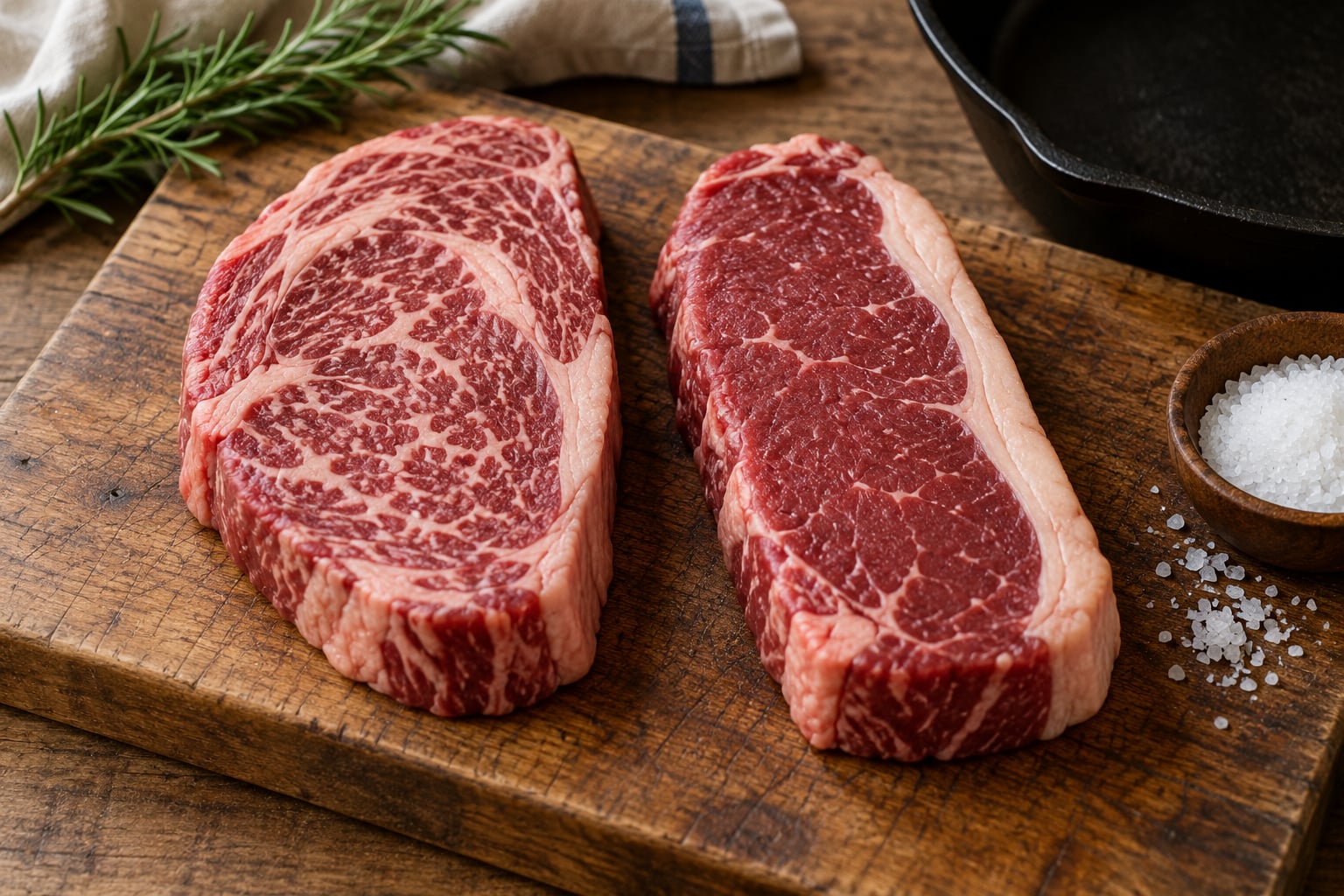
Ribeye comes from the rib primal and is loaded with intramuscular fat; New York strip comes from the short loin and carries a fat cap along one edge instead. The difference between ribeye and New York strip, in plain terms, is fat and muscle composition, and it decides flavor, tenderness, cost and how each steak behaves over fire.
Pick ribeye when you want richness and a forgiving cook. Pick New York strip when you want a leaner, firmer bite and cleaner beef flavor. Everything else follows from that one decision, so here is the comparison laid out piece by piece.
Table of Contents
- What Is the Difference Between Ribeye and New York Strip at a Glance?
- Where the Cuts Come From
- The ribeye comes from ribs 6 through 12
- The New York strip comes from the short loin
- Ribeye vs. New York Strip: Flavor and Marbling
- What marbling actually does
- How the two read on the palate
- Ribeye vs. New York Strip: Texture and Tenderness
- Fat, Edge Fat, and Grilling Results
- Ribeye on the grill
- New York strip on the grill
- Resting behaves the same way
- Which Steak Is Easier to Cook?
- Cooking a ribeye so it stays tender
- Cooking a New York strip over a grill
- Which cut tolerates mistakes
- Ribeye or New York Strip for Game Day and Parties?
- Price, Availability, and Serving Size
- Which Should You Choose?
- Buy ribeye if you are cooking for a special occasion
- Buy New York strip if you want more steak for the money
- Frequently Asked Questions
- Is New York strip the same as strip loin?
- Which steak is more tender, ribeye or New York strip?
- Is ribeye healthier than New York strip?
- What temperature should I cook ribeye and New York strip to?
- Which steak is better for a steak-and-potatoes dinner?
- How do I choose a good ribeye or New York strip at the butcher shop?
- Conclusion: Start With the Texture You Want
What Is the Difference Between Ribeye and New York Strip at a Glance?
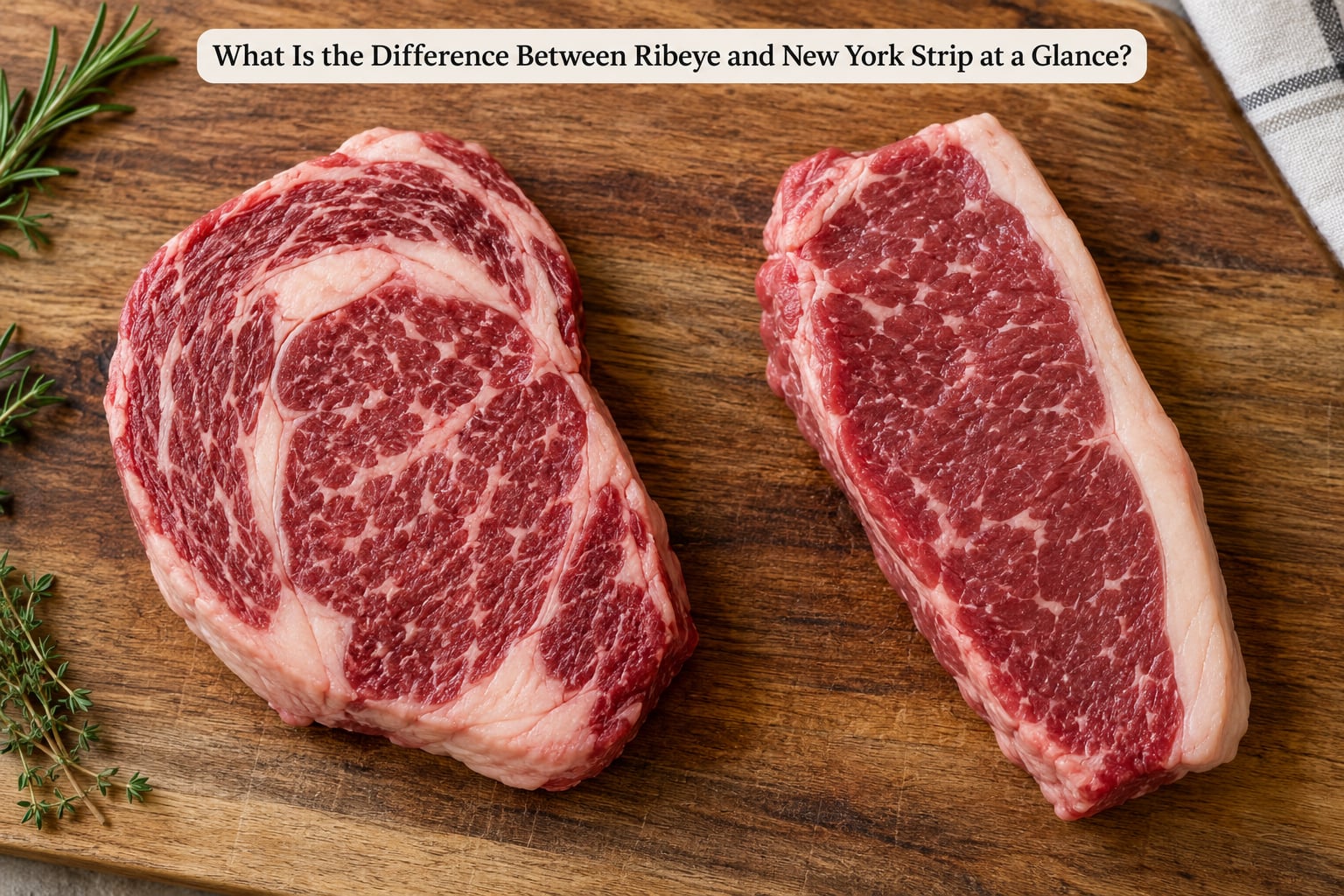
The fastest way to see the difference between ribeye and New York strip is side by side on a butcher paper wrap. One is marbled through the muscle, the other is marbled along the edge.
| Criterion | Ribeye | New York Strip |
|---|---|---|
| Primal section | Rib primal, ribs 6 through 12 | Short loin, directly behind the ribs |
| Muscles involved | Longissimus dorsi plus the spinalis dorsi cap | Longissimus dorsi, the same long back muscle, no cap |
| Marbling | Heavy, intramuscular, throughout the eye | Light to moderate, mostly near the eye |
| External fat | Thin cap on the outside, plus fat between muscles | Noticeable fat strip down one edge |
| Flavor | Rich, buttery, creamy from rendered fat | Clean, beef-forward, more consistent |
| Texture | Tender, soft, almost custard-like in good grades | Firm, springy, with a real chew |
| Forgiveness | Hard to ruin, stays juicy when pushed | Rewards precision, dries out fast past medium |
| Best cooking method | Cast iron pan or reverse sear | Direct-heat grill |
| Grill behavior | Fat renders and drips, causing flare-ups | Fat edge bastes the top edge, fewer flare-ups |
| Typical cost | Higher per pound because more fat is trimmed | Lower per pound, more edible ounces per steak |
| Approximate nutrition, 4 oz raw | About 21 g protein and 20 g fat | About 24 g protein and 12 g fat |
| Best for | Rich indulgence, guests, special occasions | Everyday grilling, feeding a group |
Read that table twice and the rest of this guide explains why each line reads the way it does.
Where the Cuts Come From
Both steaks are long muscles that run along the animal’s back, one behind the other. Ribeye sits higher on the rib section; New York strip is the same muscle sliced just behind it, out of the short loin.
The ribeye comes from ribs 6 through 12
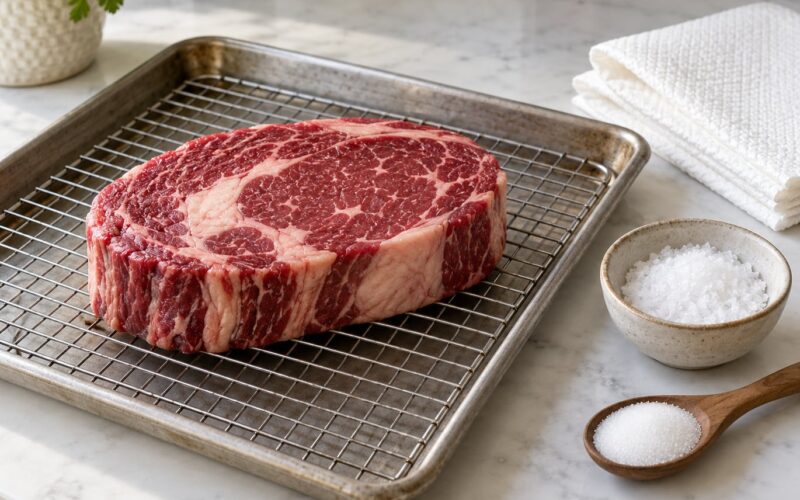
The ribeye is the eye-shaped longissimus dorsi from the rib primal, and it arrives with a bonus muscle attached to its top side. That bonus is the spinalis dorsi, the cap, a small muscle that butchers often leave on for a bone-in rib steak or cut away for a boneless one.
The cap is tender and heavily marbled on its own, which is why many people argue a bone-in ribeye tastes better than a boneless. The bone contributes aroma and a small amount of conduction heat, though the flavor difference is smaller than the price difference.
The New York strip comes from the short loin
The New York strip is the longissimus dorsi taken from the short loin, the section between the last rib and the sirloin. It is the identical long back muscle you eat as ribeye, minus the cap. That single missing cap is most of the story: no extra fat, no extra tenderness, no extra flavor.
Naming causes more confusion than any other steak question. NY strip, New York strip, strip steak and strip loin all describe the same cut in most cases. Kansas City strip usually means the same muscle with the rib bone left attached, sometimes with the tail of the short loin included. If the label says top sirloin, it is a different muscle from a different part of the loin.
Ribeye vs. New York Strip: Flavor and Marbling
Ribeye wins on richness; New York strip wins on a clean, meaty bite. The reason is marbling, which is fat deposited inside the muscle rather than along its outside.
What marbling actually does
Marbling melts during cooking and bastes the surrounding meat from the inside. That is why a well-marbled steak tastes buttery and stays moist at the same time the exterior is browned. It is also why a steak with generous marbling feels luxurious rather than merely beefy.
Ribeye carries enough of that marbling to change the character of the meat. New York strip, coming from a region of the loin that is naturally leaner, carries only a light to moderate amount. The fat you see on a strip is mostly external: that strip down one long edge.
How the two read on the palate
A cooked ribeye leans toward dairy and fat, almost like a well-made burger or a browned butter sauce. A New York strip tastes more like the classic steakhouse experience people picture, with a consistent salt-and-beef savoriness from end to end of the muscle.
Neither is objectively more flavorful. They are flavored differently, and the ribeye’s richness comes from fat rather than from a more concentrated meat flavor.
Ribeye vs. New York Strip: Texture and Tenderness
Ribeye is the more tender cut. New York strip is firmer, denser and gives your teeth something to work against, and plenty of people actively prefer that.
The spinalis dorsi cap adds a soft, almost gelatinous quality to a ribeye, and the marbling keeps the eye moist through the cook. Grade matters too. A Prime ribeye, which must show abundant marbling in the ribeye portion, is noticeably softer than a Select ribeye of similar thickness.
The New York strip has no cap and less intramuscular fat, so its texture stays uniform from the first bite to the last. It has a satisfying chew that holds up to a sharper sauce, and it slices cleanly across the grain without falling apart.
Ask ten cooks and you will get ten opinions here. My own rule is that ribeye is the choice when tenderness is the point, and New York strip is the choice when texture is part of the pleasure.
Fat, Edge Fat, and Grilling Results
Marbling is internal, the fat cap is external, and the two cuts distribute their fat differently. On a grill that difference is visible in the first three minutes.
Ribeye on the grill
The fat inside and around a ribeye renders hard over direct heat and drips into the fire. That gives you flare-ups, and it also gives you a very good browned crust. If you grill a ribeye over a single blazing zone, the outside can scorch while the center is still cold.
Set up two zones. Sear hard over direct heat for a short blast, then move the steak to indirect heat to finish. The rendered fat keeps working in the background, so an eight-minute finish will not dry it out.
New York strip on the grill
The New York strip’s fat cap sits along one edge and does most of the basting as the meat lies flat or stood on its side. You get fewer flare-ups, a more predictable cook, and a hotter crust with less charring.
Leave the fat cap on unless you dislike it. It seasons the top edge during the cook and gives you a place to grab with tongs. Trim only if it is thicker than you want and will not render in the time you are cooking.
Resting behaves the same way
Both cuts need rest time after the heat comes off, because carryover cooking keeps raising the internal temperature. Rest a steak on a wire rack so juices run off the meat instead of pooling under it. Ribeyes can use a longer rest, around 8 to 10 minutes, and strips are fine with 5 to 7.
Which Steak Is Easier to Cook?
The ribeye is easier to cook, because its fat buys you forgiveness. The New York strip is not harder, but it punishes inattention faster, and it rewards a cook who watches a thermometer.
Both cuts can be grilled, pan-seared in cast iron or broiled. A digital instant-read thermometer is the single most useful tool here, since appearance and thickness lie to you constantly.
Cooking a ribeye so it stays tender
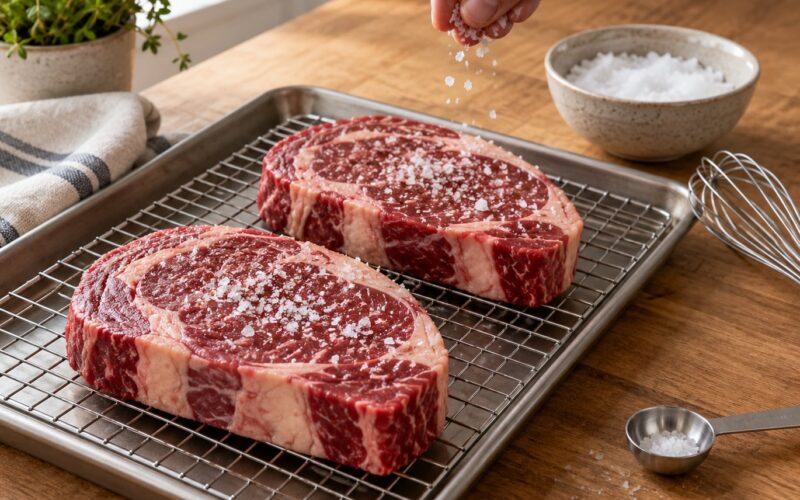
Start by bringing the steak to room temperature for 30 to 45 minutes if you have time. Season both sides generously with kosher salt about 40 minutes ahead; the salt draws on the surface and then reabsorbs. If you season right before cooking, you are only seasoning the outside.
For a reverse sear, heat the oven to 225°F (107°C) and roast the ribeye until an instant-read thermometer reads about 10 to 15°F below your target. For medium rare, that means pulling it around 120°F (49°C). Then hit a ripping hot cast iron pan with a thin film of oil and sear 60 to 90 seconds per side until deeply browned. Butter, garlic and a sprig of thyme in the pan for the last 30 seconds, then rest.
Cooking a New York strip over a grill
Salt the strip 20 to 30 minutes ahead. Set up a two-zone fire and let the direct side get properly hot, which takes longer than most people allow.
Sear 2 to 3 minutes per side to build a crust, then move the steak to indirect heat. Pull it based on the thermometer, not the clock, because a strip cooked past medium loses moisture fast. For medium rare, pull at 125°F (52°C) and let carryover finish it at about 130°F (54°C).
| Doneness | Pull temperature | Finished temperature |
|---|---|---|
| Rare | 120°F (49°C) | 125°F (52°C) |
| Medium rare | 125°F (52°C) | 130°F (54°C) |
| Medium | 135°F (57°C) | 140 to 145°F (60 to 63°C) |
| Medium well | 150°F (66°C) | 155°F (68°C) |
| Well done | 160°F (71°C) | 165°F (74°C) |
Under the USDA, the safe minimum internal temperature for whole cuts of beef is 145°F (63°C) followed by a three minute rest. Most cooks serve both cuts well below that on purpose, so a thermometer is how you choose your own comfort level rather than how you satisfy the rule.
Which cut tolerates mistakes
Overcook a ribeye a few degrees and it stays juicy, because the fat keeps rendering and keeps the muscle basted. Overcook a New York strip a few degrees and it turns from firm to chewy in a way that no amount of resting fixes.
Flare-ups are the mirror image. A marbled ribeye over an open fire can char the outside before the center catches up, while a strip’s fat edge gives you a much calmer cook. If your grill has one weak zone, that favors the strip.
Ribeye or New York Strip for Game Day and Parties?
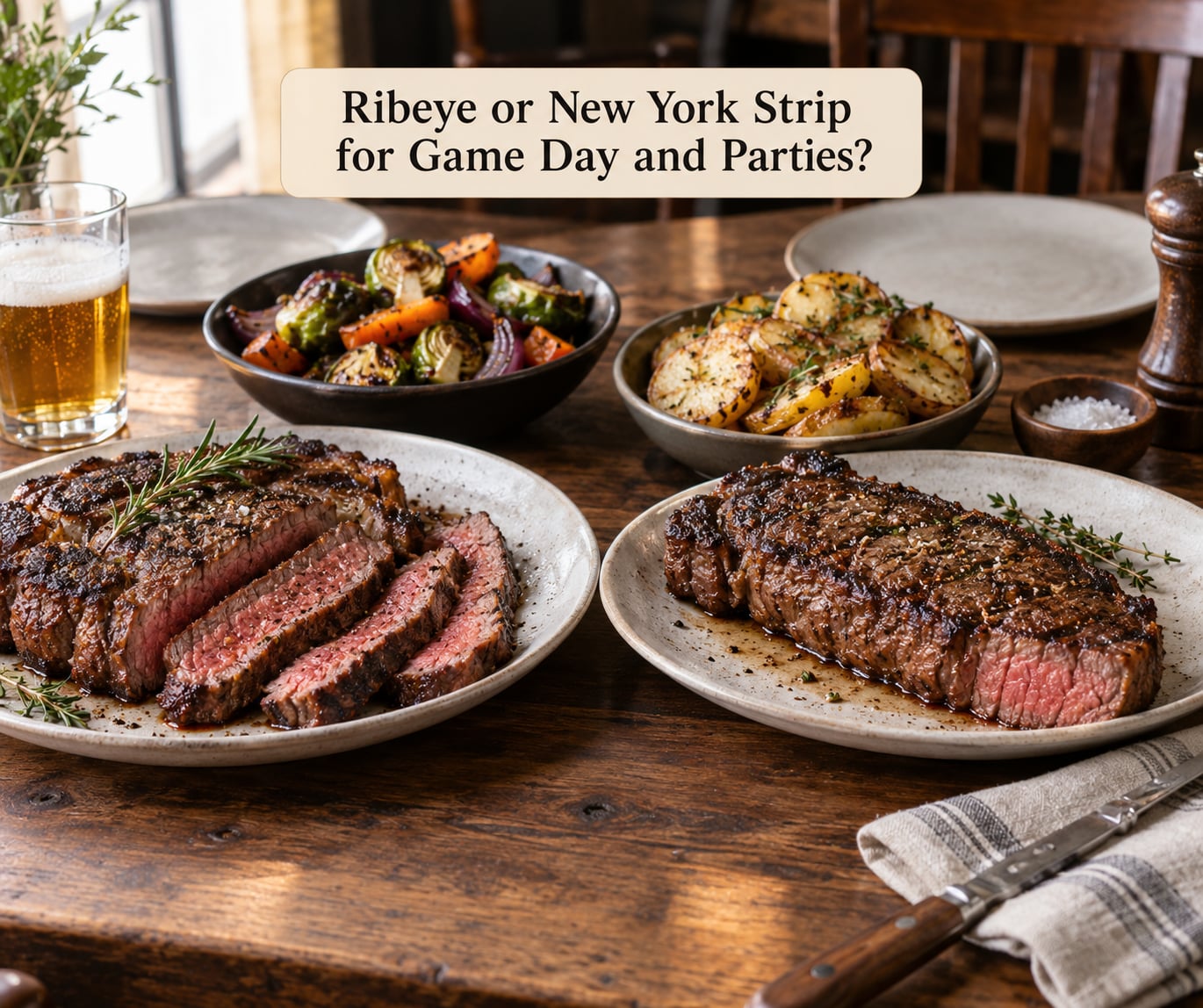
For a party, New York strip feeds more people for less money and gives you a sliceable steak that holds its texture on a platter. For a dinner where the steak is the event, ribeye makes the table go quiet.
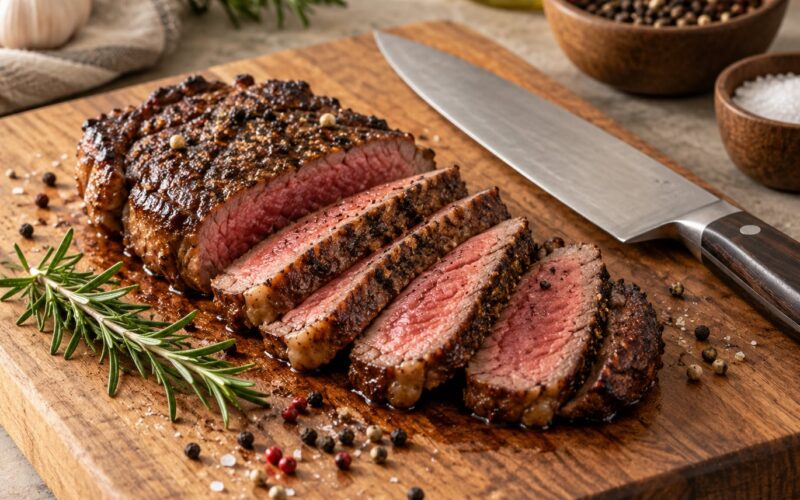
Slicing is where the strip wins a hosting gig. Cut it against the grain into even slices and fan them on a warm platter; each guest spears a piece with a fork and the whole thing stays tidy. Ribeye is more awkward because it wants to be served in slabs, thick, straight off the board.
Sides should match the cut rather than fight it. A ribeye, with its richness, wants cut acidity: grilled asparagus, a sharp chopped salad, roasted mushrooms, or a béarnaise-style butter sauce. A New York strip, with its firmer bite, handles heavier starch, so steak-and-potatoes, thick-cut chips, or a peppercorn pan sauce all work well.
For drinks, a heavily marbled ribeye is happy with a full-bodied red with enough tannin to cut the fat, such as a Cabernet Sauvignon or a Syrah. A New York strip leans toward something brighter, so a medium-bodied red, a Bordeaux-style blend, or a malty brown ale suits it better.
Price, Availability, and Serving Size
Ribeye usually costs more per pound, and the reason is not marketing. A butcher trims away more fat and connective tissue before a ribeye reaches the case, so more of what you paid for ends up in the bin.
New York strip is leaner, which means less trim waste and more edible ounces on each steak. That is why it is often the better value for a group, even though the sticker price per pound looks lower as well.
Cost also moves with USDA grade, and grade changes each cut differently. Select-grade strip is a lean, budget-friendly weeknight grill steak. Choice is the common supermarket middle. Prime means abundant marbling in a ribeye, which is where the extra money goes on that cut. Wagyu labeling is its own category with its own rules, and the flavor is more about buttery fat than about any grading system.
Sizing works the same way for both. A 12 to 16 ounce steak per adult is a normal restaurant portion and works for either cut. Because a strip loses less weight during cooking and a ribeye renders away more, a raw strip at 14 ounces usually plates more generously than a raw ribeye at the same weight.
Which Should You Choose?
Choose ribeye for richness and tenderness, and New York strip for a firmer bite, cleaner beef flavor and better value at the table. Beyond that, let your cooking setup make the call.
Buy ribeye if you are cooking for a special occasion
- You want marbling and buttery richness as the point of the meal.
- You are cooking on cast iron or doing a reverse sear rather than grilling hard.
- You are a beginner, or you cook steaks a few times a year, and you want a forgiving cut.
- You are buying the best grade you can find and want the marbling to show.
Buy New York strip if you want more steak for the money
- You are grilling for a group and need a steak that is easy to feed and easy to slice.
- You prefer a firm, beef-forward bite over a soft, fatty one.
- You are serving a starch-heavy meal such as steak and potatoes or a burger-style plate.
- Your grill is primitive and you want fewer flare-ups to manage.
If you can only buy one for a mixed crowd, a good ribeye will please the most people. If the grill is the main event and you want a classic steakhouse bite, the strip is the better order.
Frequently Asked Questions
Is New York strip the same as strip loin?
Yes, in most cases. New York strip, strip steak and strip loin all refer to the longissimus dorsi muscle from the short loin, the section just behind the ribs. Kansas City strip usually means the same muscle with a rib bone attached. Top sirloin is a different muscle from a different part of the loin, not a strip.
Which steak is more tender, ribeye or New York strip?
Ribeye is more tender, and it is not close. The ribeye carries a cap muscle called the spinalis dorsi plus heavy intramuscular marbling, which melt during cooking and keep the meat soft and moist. New York strip is leaner with no cap, so it stays firm and springy with a chew that some people prefer.
Is ribeye healthier than New York strip?
No, not in general. Per four ounces of raw beef, a ribeye runs roughly 21 grams of protein with about 20 grams of fat, while New York strip runs closer to 24 grams of protein with about 12 grams of fat. So the strip is leaner and higher in protein, and the ribeye is the richer, more caloric cut.
What temperature should I cook ribeye and New York strip to?
Both are best pulled with an instant-read thermometer and finished by carryover cooking. Medium rare is about 130°F (54°C) and medium is about 140 to 145°F (60 to 63°C). The ribeye tolerates more heat before turning chewy, while the strip dries out faster, so pull it a little earlier.
Which steak is better for a steak-and-potatoes dinner?
New York strip, usually. A firm, beefy strip holds up against heavy starches like baked potatoes, and its fat cap bastes the steak through the cook. Ribeye also works well, but its richness pairs better with cut acidity such as grilled asparagus or a sharp salad than with a rich potato dish.
How do I choose a good ribeye or New York strip at the butcher shop?
For ribeye, look for abundant, evenly dispersed marbling and a thick spinalis dorsi cap if you want tenderness. For New York strip, look for a good streak of fat down one edge and a deep red color without gray edges. Ask the butcher which grade the meat is and how it was aged, then choose the freshest cut rather than the largest one.
Conclusion: Start With the Texture You Want
Choose ribeye for richness and tenderness, or New York strip for a firmer bite and better value at the table. Buy the cut that matches how you cook, take it out of the fridge early, salt it, and pull it with a thermometer rather than a timer. Then decide tonight which one you are making first.