How to make smoked brisket for beginners comes down to four numbers: hold your smoker at 225°F, plan roughly one hour per pound of meat, wrap at an internal temperature of 160-170°F, and pull it at 195-205°F when the probe slides through without resistance. Give it a rest of at least one hour before you slice. A whole brisket is a long cook, usually 8-12 hours for a 10-12 pound packer, and the total process takes most of a Saturday.
Brisket has a reputation for being hard, and part of that is fair. It is a large, lean cut loaded with collagen, so there is no shortcut around low heat and time. But the actual mechanics are simple: trim it, season it, smoke it, wrap it, wait, rest it. Everything hard about brisket comes from guessing instead of measuring.
Quick answer: Smoke at 225°F, allow about 1 hour per pound, wrap in butcher paper when the internal temperature hits 160-170°F, finish at 195-205°F probe tender, then rest 1-3 hours in the wrap before slicing against the grain.
Table of Contents
- What You Need
- Step-by-Step: How to Make Smoked Brisket for Beginners
- 1. Choose and Trim the Brisket
- 2. Season the Brisket
- 3. Set Up the Smoker
- 4. Smoke Until the Bark Sets
- 5. Wrap the Brisket
- 6. Finish and Check Tenderness
- 7. Rest, Slice and Serve
- Common Mistakes
- Tips for Better Beginner Brisket
- Frequently Asked Questions
- How long does it typically take to smoke a brisket at 225?
- At what temperature do you wrap a brisket when you are smoking it?
- How do I know when my brisket is done?
- How long should brisket rest before slicing, and can I hold it in a cooler?
- How do I make smoked brisket for beginners as a first cook?
- Conclusion
What You Need
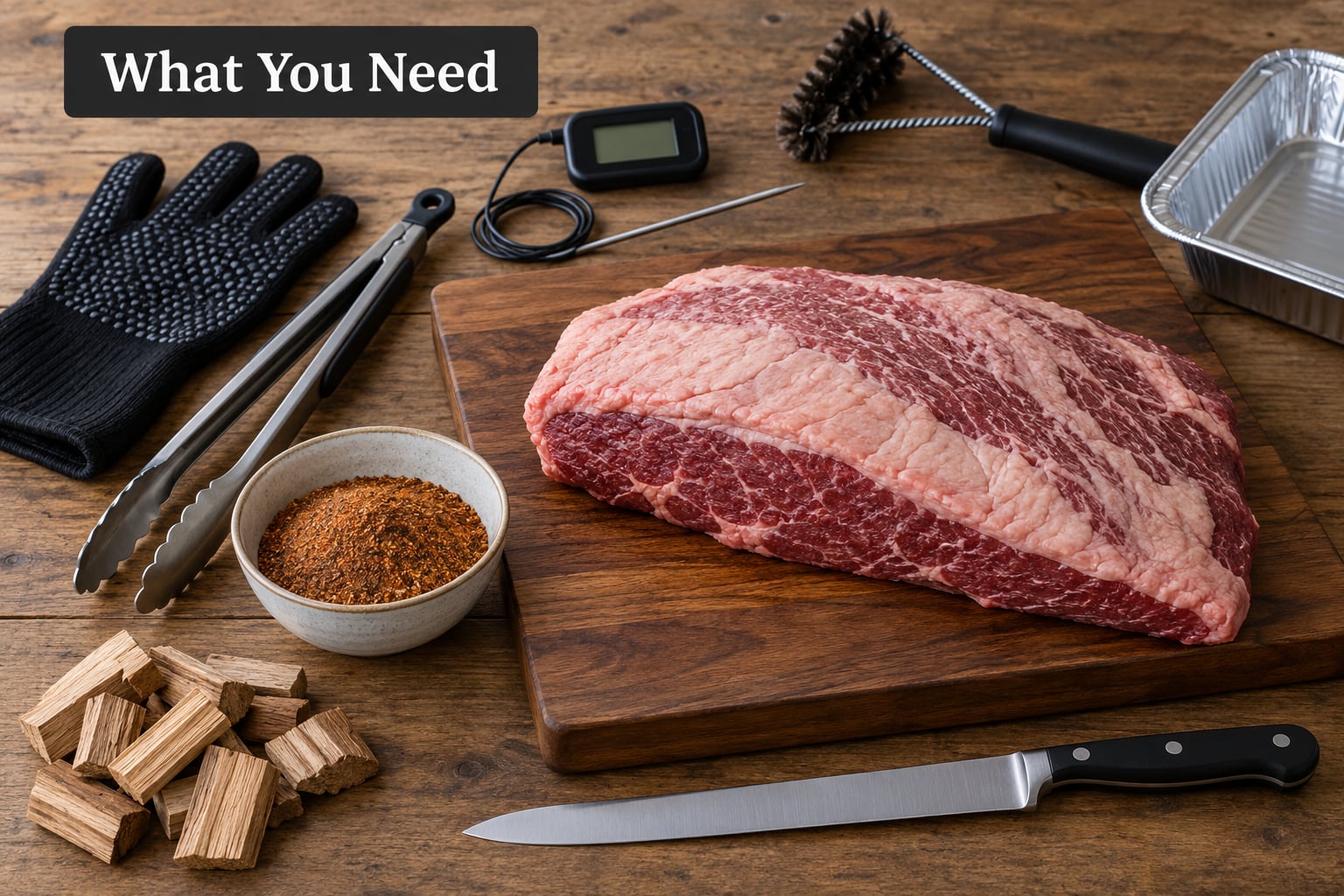
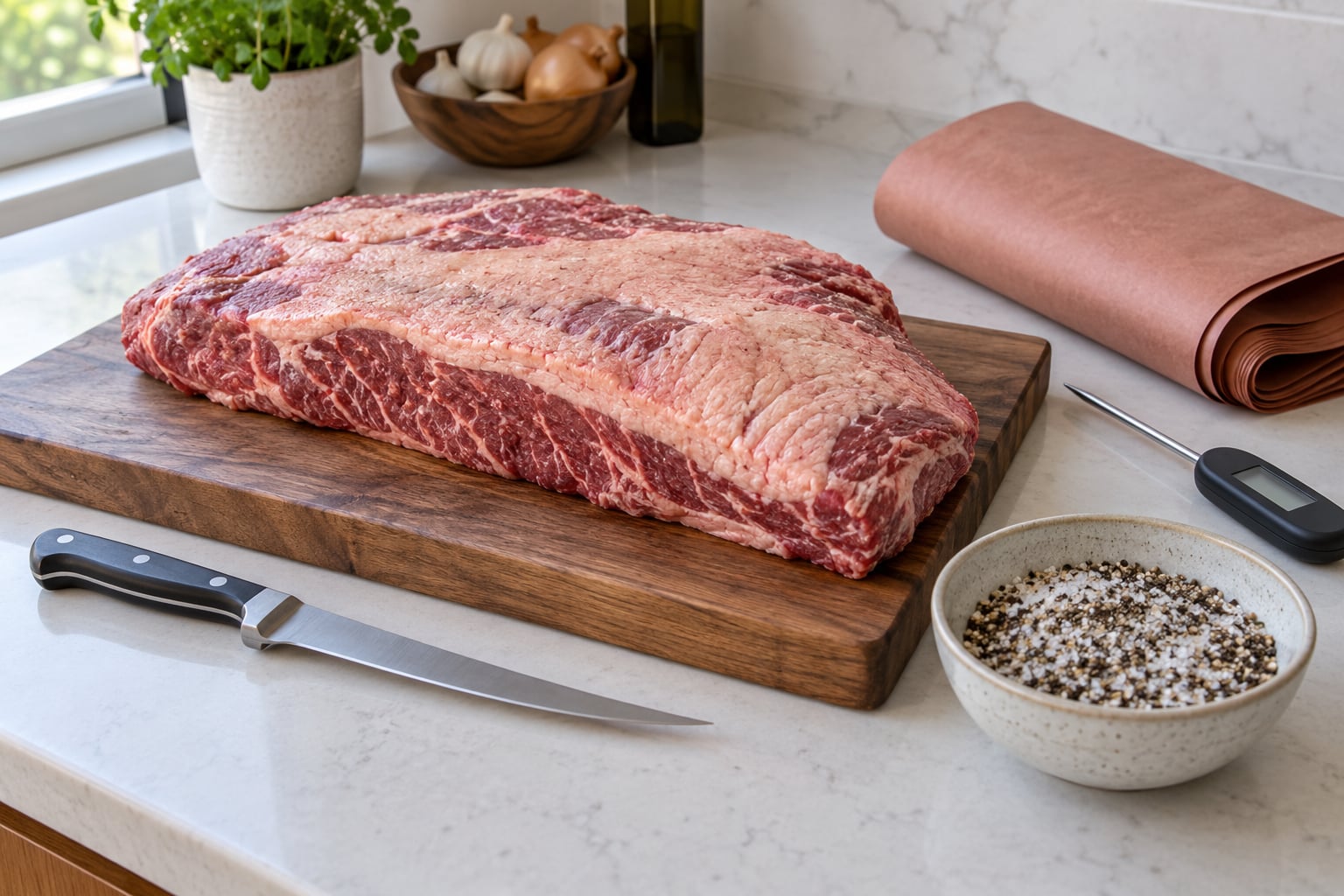
Start with an 8-12 pound packer brisket, sometimes called a whole brisket with the point attached. The flat portion is the muscle on one side and the point is the fattier section on the other. The point has more internal fat and stays juicy longer, so beginners should cook the whole thing rather than the flat alone.
You also need a smoker that holds 225°F for hours: an offset smoker, a pellet smoker, a kettle grill set up for indirect heat, or an electric smoker all work. Whatever you use, the only real requirement is a tight lid and enough fuel to last the cook.
Two thermometers matter more than the smoker itself. A leave-probe thermometer with a cable so the probe stays in the meat through the door is ideal. A cheap instant-read thermometer covers the rest of your cooking life, so buy both if you can. A single-probe thermometer reading from one spot is the most common reason beginners pull meat too early.
The rest of the kit is small: a sharp trimming knife, cutting board, heavy-duty gloves, a shallow water pan, butcher paper or heavy foil, a spray bottle with water or a simple spritz mix, and a dry rub. A 3-2-1 rub of salt, black pepper and garlic powder works fine for a first cook.
Step-by-Step: How to Make Smoked Brisket for Beginners
1. Choose and Trim the Brisket
Look for a packer brisket with a flat, even surface and a decent fat cap on top. If it is trimmed already, that saves time, but you pay for it in price per pound and you still want to check the edges.
Trim away the loose fat hanging over the sides and cut off the silver skin on the underside. That skin tastes nothing like smoke and blocks seasoning from bonding to the meat.
Leave about a quarter inch of fat cap on top, thick enough in the middle and thin enough at the edges. Beginners routinely trim every bit of fat and then wonder why their brisket dries out. The fat cap insulates the meat, feeds the smoke, and renders into the bark.
2. Season the Brisket
Pat the surface dry with paper towels and let it sit uncovered in the fridge for a few hours if you have time. A dry exterior is what turns into bark.
Rub seasoning on generously and press it into every surface, including the sides and the point end. There is no need for mustard as a binder on a first cook, and no need to soak the brisket in brine or an injection. Those techniques add moisture and flavor for experienced cooks, but they complicate a cook you are still learning.
Some cooks lightly spritz with water or a 50/50 water and apple juice mix every 45 to 60 minutes after the bark has set. Spritzing is optional. Too much of it softens the crust you worked to build.
3. Set Up the Smoker
Preheat for 45 minutes to an hour. A cold smoker meeting cold meat costs you an hour right off the front and leaves more room for temperature swings.
Build one fire on one side and cook the brisket on the side away from it. Keep a water pan if your smoker is dry or if you are worried about the lean flat section drying out, and keep it full. Water pan users split on whether it hurts bark crispness, and in my experience the bark difference is small next to the benefit of the flat staying moist.
Use post oak or hickory for a classic profile. Mesquite is stronger and adds a sharp note that can overpower a simple rub, so save it for later. Pellet smokers need no wood at all beyond what is in the hopper.
Place the brisket fat side down on the grate and insert the leave-probe into the thickest part of the flat, several inches in from the edge. Make sure the tip is in the meat, not floating in air, or you will chase a phantom temperature forever.
4. Smoke Until the Bark Sets
Hold the pit at 225°F and leave the brisket alone. Every time you open the door you add 20 to 30 minutes to the cook and push more fuel through the fire, which means more smoke than flavor. Use a remote thermometer or trust the one you placed.
Around 130 to 150°F you can start spritzing. Watch for a firm, darkened bark that no longer feels soft or tacky when you brush the surface lightly.
Here is the checkpoint list to keep nearby while you cook:
- Bark sets at 130-150°F — firm, dark, no longer tacky to the touch.
- The stall hits at 150-170°F — temperature flat for one to two hours.
- Wrap at 160-170°F — bark set, color still developing.
- Probe tender at 195-205°F — the probe slides in with almost no force.
- Safe minimum is 145°F — the USDA minimum for intact whole cuts.
- Rest for 1-3 hours — keep it wrapped at a 150-170°F holding temperature.
The temperature will climb to somewhere in the 130s and then stop. That pause is the brisket stall, and every beginner panics at it.
5. Wrap the Brisket
What is the stall? Between roughly 140°F and 170°F the collagen and moisture in the meat work against each other, and evaporative cooling holds the internal temperature flat even though the pit is steady at 225°F. It is not a malfunction and it does not mean your fire went out. A brisket can sit in the stall for two hours and come out great.
Many cooks choose to wrap right in the middle of the stall to power through it. Check that the bark has already set and darkened before you wrap; wrapping at 130°F peels bark and leaves you with pale, soggy meat. Wrapping too late at 190°F costs you bark color and adds nothing except a worried cook.
Use butcher paper if you want the bark to keep its texture, or heavy foil if you want softer bark and a faster finish. Lay the brisket on a large sheet, fold the sides up and over the meat, then roll the ends in tight. Wrap snugly but do not crush it, and add a splash of apple juice or a small cup of water inside if the flat looks dry.
Once wrapped, expect another 1 to 2 hours to reach 195-205°F. That is the answer to how long it takes to go from 165 to 200: usually well over an hour, sometimes close to two.
6. Finish and Check Tenderness
Start checking temperature at about 180°F, every 30 minutes or so. Once it passes 190°F, stop trusting the number and start testing with the probe.
Push the probe into the thickest part of the flat with very little force. If it meets resistance, it goes back in. If it slides through the way a probe slides through a block of butter, the collagen has converted and the meat is done.
The USDA minimum safe internal temperature for intact whole cuts is 145°F, but tenderness is a texture problem, not a temperature problem. Cutting into brisket at 165°F is the single most common beginner mistake on the board, and no amount of sauce rescues it.
Large packers often need more than 205°F to get tender, sometimes up to 210°F, because the point has thicker collagen than the flat. Check both sections separately.
7. Rest, Slice and Serve
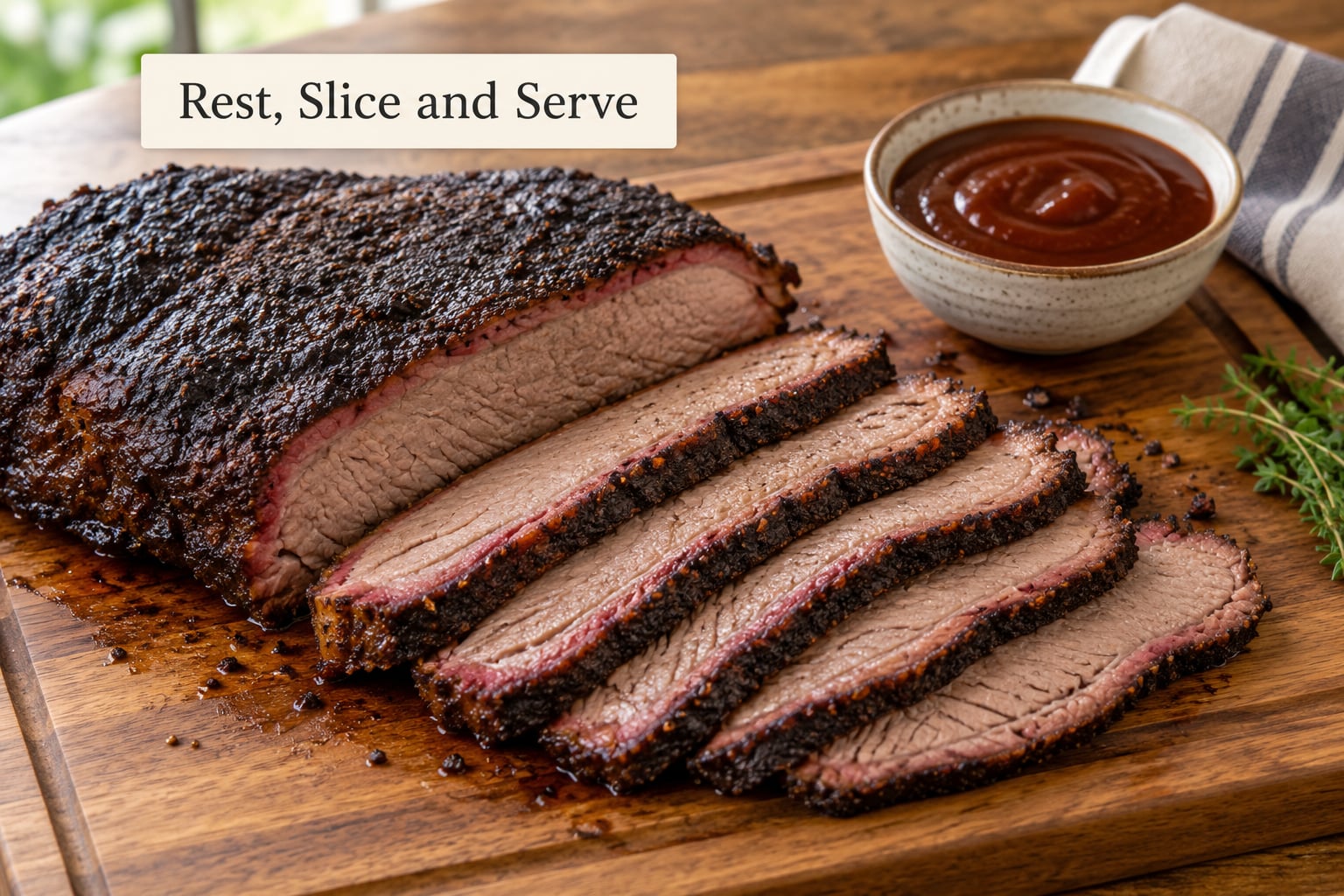
Rest the brisket in its wrap for at least one hour and up to three. Resting lets the muscle fibers relax and stops them from squeezing juice onto the cutting board when you cut. Skipping or rushing the rest is how a great cook ends up with dry meat.
If you need to hold it longer, put the wrapped brisket into a clean cooler with a couple of towels and it will stay in the 150-170°F range for several hours.
Slice against the grain. Find the grain by looking at the flat’s surface, then cut perpendicular to the grain lines, usually in long slices from the flat and thinner strips from the point. A sharp knife matters more than technique here.
For your first brisket, make a simple batch of barbecue sauce or buy one you already like and serve it on the side. Sauce is the last step, not part of the smoke.
Common Mistakes
- Opening the lid too often. Each opening drops the pit and adds time. Fix: check the probe reading, not the meat, and go easy on the door.
- Wrapping before the bark sets. Wrapping at 130-140°F peels the bark and turns it pale and soft. Fix: wait for firm, darkened bark first.
- Trimming away all the fat cap. The top fat insulates the flat and renders into the bark. Fix: leave about a quarter inch, thicker in the middle.
- Pulling at 165-180°F. Temperature alone does not mean collagen has broken down. Fix: start probe testing at 190°F and pull on texture.
- Skipping the rest. Slicing straight off the smoker bleeds juice everywhere. Fix: at least one hour in the wrap.
- Slicing with the grain. You end up chewing on long tough fibers. Fix: look for the grain direction, then cut across it.
- Starting with a cold smoker. Fix: preheat 45-60 minutes and let the brisket come to room temperature while the fire burns in.
Tips for Better Beginner Brisket
Use a leave-probe thermometer with a cable. It removes most of the guessing and lets you keep the door shut, which is the single biggest improvement most beginners make.
Keep an eye on fuel from the second hour onward. A long cook is mostly fuel management, and running out halfway is a common way first briskets get tough. Have a second bag of charcoal or a full pellet hopper ready.
Plan the day backwards. A 12 pound brisket can take 12 hours plus a 2 hour rest, so start early, not at noon. If the cook finishes early, rest it longer. If it runs late, an extra wrapped 30 minutes costs you nothing.
Add a small amount of wood roughly every hour and a half. More wood does not mean more smoke flavor, it means a fire you have to manage.
Save the sauce for the end, and try brisket flat leftovers cubed and tossed with a little barbecue sauce and onion as brisket bites the next day.
Leftover cooked brisket keeps in the refrigerator for three to four days. Reheat it in a pan with a splash of broth or wrapped in foil with a little apple juice until the center hits 165°F, and skip the microwave if you can.
Frequently Asked Questions
How long does it typically take to smoke a brisket at 225?
Most home briskets run 45 minutes to 1 hour 15 minutes per pound at 225 degrees F, which puts an 8 pound brisket at roughly 7 to 9 hours and a 12 pound at 10 to 13 hours. That estimate covers cook time only, not the rest. Add a leave-probe thermometer rather than relying on the clock, since a 13 pound brisket can finish well before or after the midpoint.
At what temperature do you wrap a brisket when you are smoking it?
Wrap between 160 and 170 degrees F internal, once the bark has set and darkened. Wrapping earlier, around 130-140, peels the bark and leaves it pale and soft. Wrapping later than about 180 does nothing for the cook but costs you bark color. Butcher paper keeps bark texture, and foil gives a softer finish at the cost of that texture.
How do I know when my brisket is done?
Use probe tenderness instead of a fixed number. At 190 degrees F or higher, push your thermometer into the thickest part of the flat with light pressure. If it slides through with almost no resistance, the meat is done. The USDA minimum for intact whole cuts is 145 degrees F, but collagen needs well above that, so pull in the 195 to 205 degree F range for most briskets.
How long should brisket rest before slicing, and can I hold it in a cooler?
Rest at least one hour and up to three hours with the brisket still wrapped. Resting lets the muscle fibers relax so they stop pushing juice out when you cut. For longer holds, put the wrapped brisket in a clean cooler with towels around it and it will stay in the 150 to 170 degree F range for several extra hours.
How do I make smoked brisket for beginners as a first cook?
Buy an 8 to 12 pound packer, trim off the silver skin, and season with a simple salt and pepper rub. Smoke at 225 degrees F fat side down until the bark sets, wrap at 160 to 170, finish at 195 to 205 probe tender, then rest an hour or more. Skip injection and brine on your first attempt so you have one less variable between you and a good result.
Conclusion
If you only remember three things from this guide: prepare a trimmed brisket with the fat cap still on, keep your pit at 225°F while you stop opening the lid, and watch the internal temperature through the wrap window to a probe-tender finish. After that, rest the meat properly before you cut it. That sequence is the whole method.
Make your first cook a small one. A trimmed packer with a simple rub tells you plenty without a full day of babysitting, and you can adjust the wood or the rub on the next one once you know how your smoker behaves. Brisket rewards patience more than any other cook on the barbecue, and it is very hard to ruin completely if you stop guessing and start measuring.