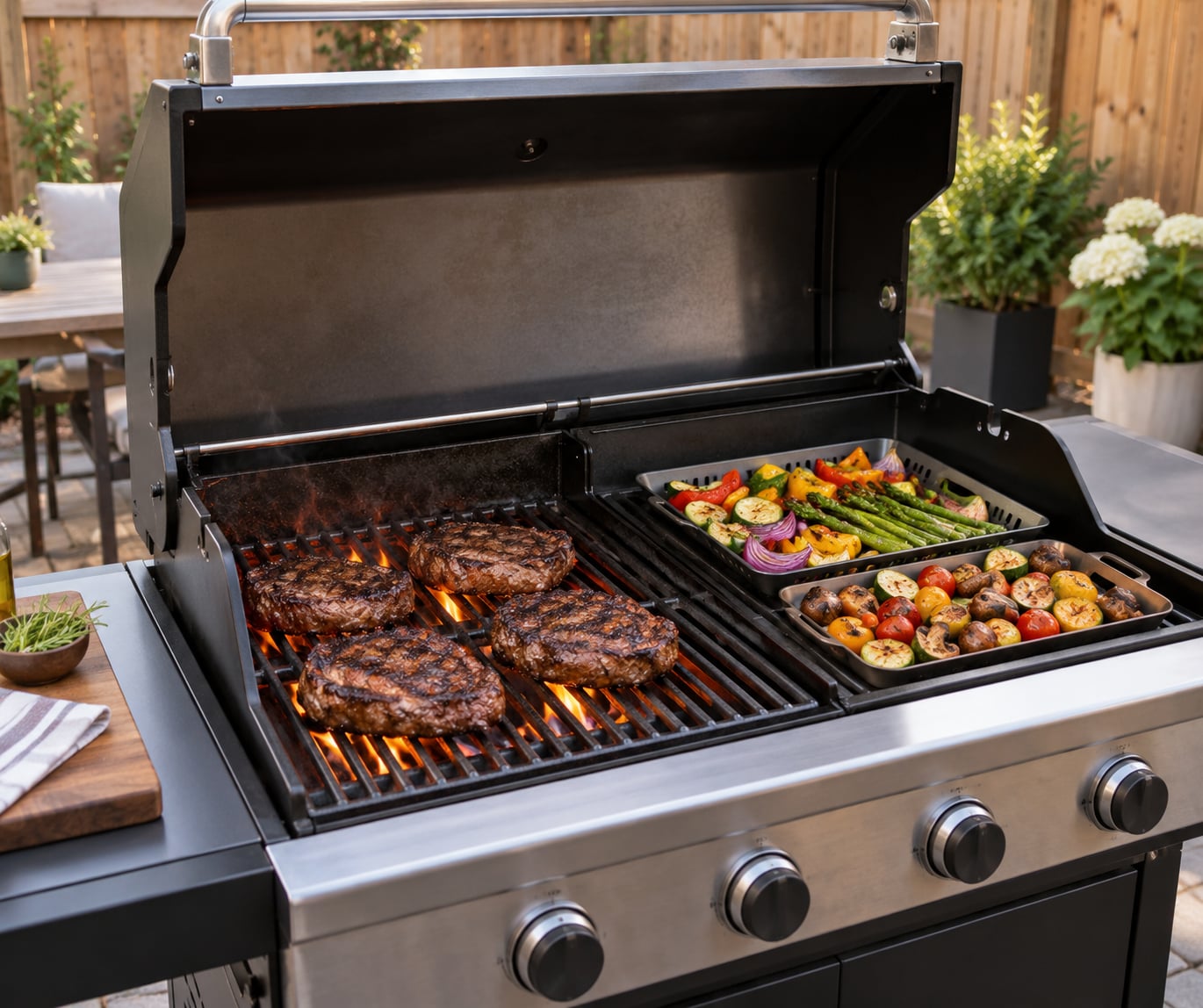
Two-zone grilling means splitting one grill into two zones: a hot zone of direct heat at 450-550F for searing, and a cool zone of indirect heat at 225-300F where no flame or coals sit under the food, so a thick steak or a whole chicken cooks through without charring on the outside. On gas you light the burners on one side and shut the rest off; on charcoal you push the lit coals against one wall and leave the other half empty.
It takes about five minutes on a gas grill and closer to twenty-five on charcoal, because the coals have to light and the grate has to heat first. Difficulty is low, but it only works if you check the temperature instead of trusting the look of it. Most home grills already have everything you need.
Table of Contents
- What You Need
- Step-by-Step: How to Set Up Two Zone Grilling on Any Grill
- How to Set Up Two Zone Grilling Safely
- On a gas grill
- On a charcoal grill
- On an electric grill and a kamado
- Choose the Right Zone for Each Food
- Common Mistakes
- Frequently Asked Questions
- Can you do two zone grilling on a gas grill?
- How do I set up two heat zones on a charcoal grill?
- What temperature should the direct and indirect zones be?
- Should I keep the grill lid closed while cooking on two zones?
- Which foods should go on the indirect side of the grill?
- How do I convert leftovers from two-zone grilling safely?
- Conclusion
What You Need
A grill that has two distinct ends. A three-burner gas grill, a kettle, or a kamado all work fine. What you do not need is a special attachment, and you certainly do not need a second grill.
Fuel depends on your grill. Gas goes on the side you want hot. Charcoal wants a chimney starter, because lighter fluid burns unevenly and leaves a taste in the meat that lingers for hours.
A dual-probe thermometer is the one tool worth spending money on. Dial thermometers mounted on a grill lid can read up to 50F off from what the air is actually doing, and a cheap dial on the grate tells you nothing. With two probes you can watch the hot zone and the cool zone at the same time.
A drip pan or water pan goes on the indirect side under the food to catch fat and keep the firebox clean. Heavy tongs, long-handled tongs for the flare-up zone, and heat-resistant gloves round out the kit.
Your grill’s manual matters more than any general advice here. Burner layout, damper design, and even the direction the lid hinges differ between manufacturers, so follow the instructions that came with your grill whenever they conflict with a generic method.
Step-by-Step: How to Set Up Two Zone Grilling on Any Grill
How to Set Up Two Zone Grilling Safely
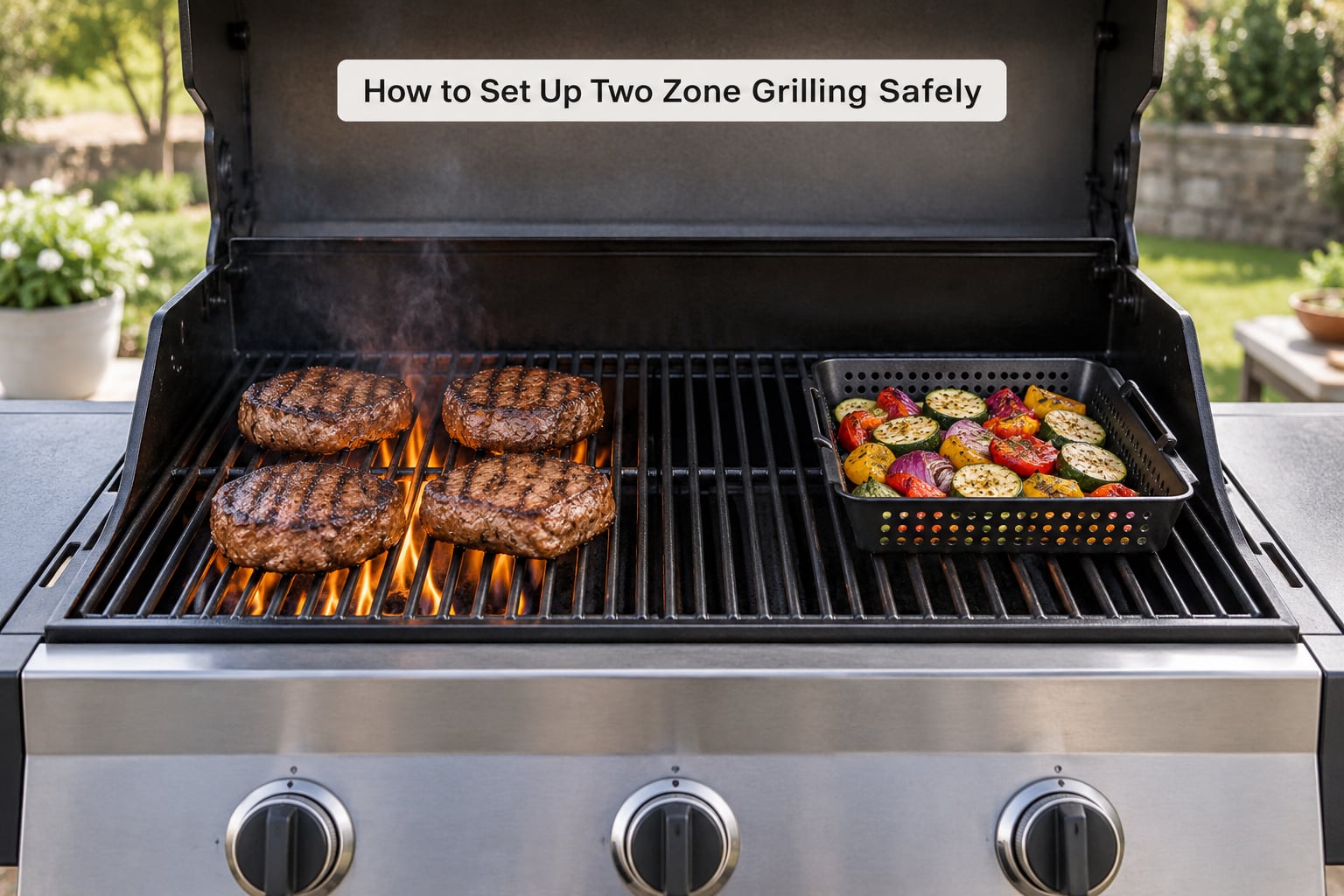
On a gas grill
- Clear the grate. Scrape off last night’s carbon so heat can rise straight through, and leave the middle of the cooking surface empty as a buffer between the two zones.
- Close the lid and ignite the burners on one side only. Turn them to high and leave every other burner off. On a four-burner grill, two end burners on high and the middle ones off gives you a wider cool zone.
- Preheat with the lid closed for ten to fifteen minutes on high. This matters more than people expect. With the lid off, thin fast-maturing food burns before the chamber stabilises.
- Check both zones. Leave one probe sitting over the lit burners and set the other on the far end of the grate. You are looking for 450-550F on the hot side and roughly 225-300F on the cool side.
- Drop the hot-side burner to medium or medium-high once the numbers land. A full-blast burner gives you a searing station, not a place to cook a whole steak to temperature.
If your grill has horizontal tube burners running across the width with only about six inches between them, treat the far third of the grate as your cool zone rather than the far half. Leave the burner under the food off entirely and keep a wide empty gap, or park a cast iron grate over the lit tubes to spread the heat.
On a charcoal grill
- Fill a chimney starter about two-thirds full of lump charcoal, which burns hotter and longer than briquettes.
- Light it and wait twelve to fifteen minutes until the coals are ashed over grey and the bottom is glowing. Do not rush this stage. Coal placed before it is fully lit smothers itself and gives up uneven heat.
- Empty the coals into a stack on one side of the firebox, or into a chimney basket set to one side. Leave the opposite half completely bare.
- Set a drip pan on the bare side once the coals settle. Leave the lid open for two to three minutes so the charcoal ignites properly, then close it.
- Set the intake damper roughly a quarter open and the exhaust damper partly open. Then open them a touch further if you need more airflow.
- Verify with your probe. A properly banked kettle reads 450-550F above the coals and 225-300F on the empty side. Dial up a little if the cool side is shy.
Charcoal on one side still heats both sides, which is the honest limitation of a kettle. A fresh chimney of coals gives you the widest gap, and an adjustable grate vent in the lid makes the cool side easier to hold.
On an electric grill and a kamado
Electric grills need the power controller set high on one element and partway down on another, then a long preheat, because the heating element takes longer than gas to respond. Verify both zones the same way, and expect the far side to creep upward as the cook goes on. A kamado uses a heat deflector plate over the indirect side, with the plate on the cooking level for a sear or below it for a smoke.
Warm wood chips in the cool zone for a few minutes so they smoulder instead of igniting, then move them over the hot zone when you are ready. Wrap them in foil with a few holes punched through, or use a smoker box.
Choose the Right Zone for Each Food
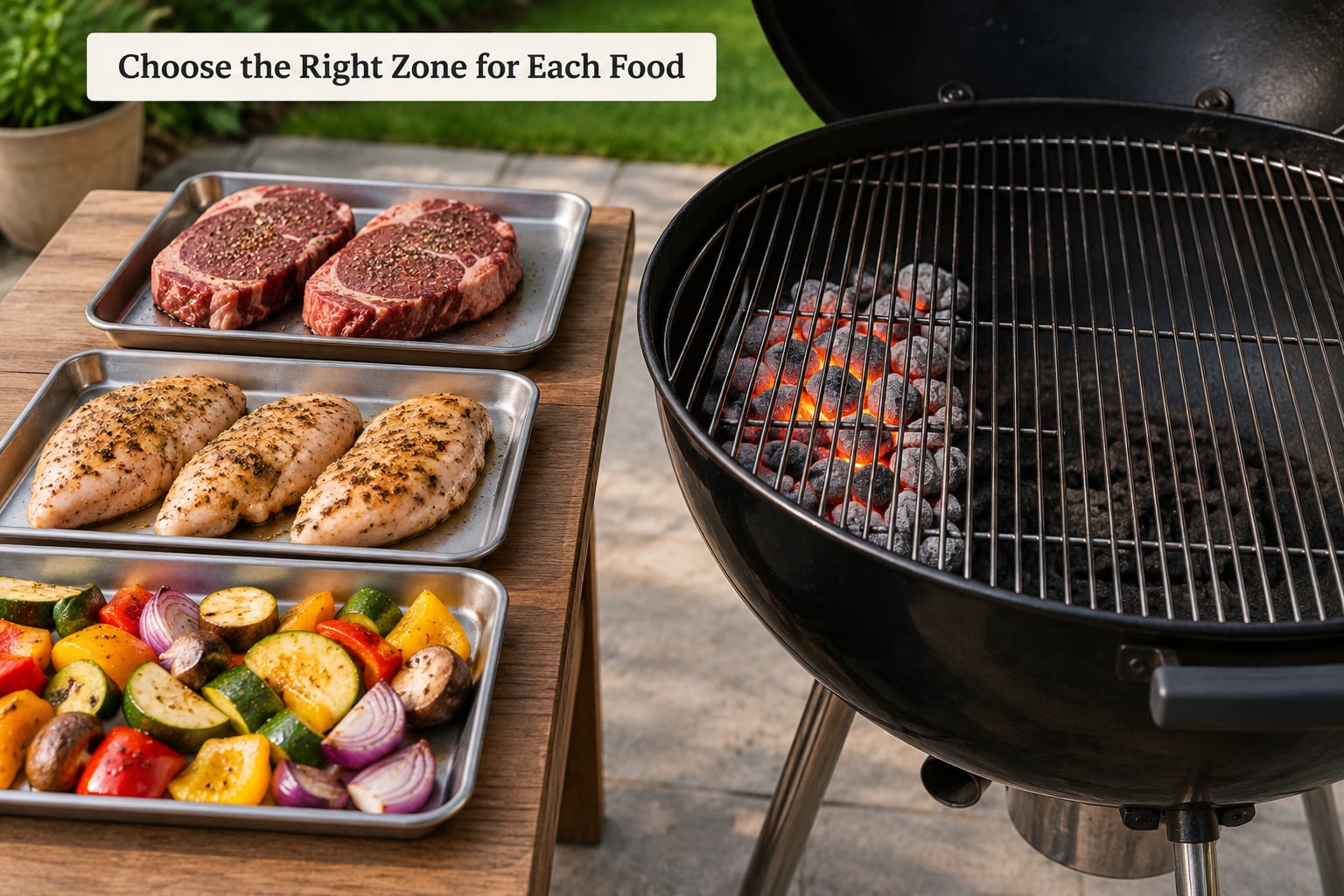
| Food | Where it starts | Where it finishes | Minimum internal temp |
|---|---|---|---|
| Thick ribeye or strip | Cool zone, lid closed | Hot zone, 30-90 seconds a side | 145F with a three-minute rest |
| Hamburgers and hot dogs | Hot zone | Cool zone to finish | 160F for ground meat |
| Bone-in chicken thighs or spatchcock chicken | Cool zone | Hot zone to crisp the skin | 165F |
| Chicken wings | Cool zone until the fat renders | Hot zone to crisp | 165F |
| Pork chops, tenderloin, sausages | Cool zone | Hot zone for colour | 145F whole cuts, 155F sausages |
| Fish fillets | Hot zone for the crust | Cool zone to finish gently | 145F |
| Corn, peppers, onions, potatoes | Cool zone | Hot zone to char | No probe needed, go by texture |
| Whole chicken or pork shoulder | Cool zone for hours | Optional hot finish | 165F poultry, 195-205F pulled pork shoulder |
Two orderings matter. Sear and slide starts on the hot side for a crust and moves the food to the cool side to cook through, which suits pork chops and sausages. Reverse sear starts indirect and finishes with a short blast over direct heat, which gives the most even result on a thick steak.
The cool side doubles as your landing strip. The moment a flare-up starts, move the food to the empty side, close the lid, and give it a minute before deciding whether to move it back. That single move separates two-zone grilling from a one-zone grill with hopes.
Common Mistakes
Crowding both zones. When everything is crammed in, neither side keeps its temperature and the cool zone stops being cool. Cook in batches instead, or move food between zones as the crowd eats.
Trying to run one temperature for the whole grill. A single reading tells you nothing about a two-zone setup. Take a reading over the flames and a second one on the empty side every time you set up.
Placing food over cold fuel. On charcoal, waiting for the grey ash is the difference between a hot zone and a slow one. Same on gas: preheat with the lid closed, not open.
Opening the lid constantly. Every opening drops the chamber temperature and starts drying out whatever is on the grate. If you need to check something, check the probe instead of the meat.
Judging doneness by colour. A badly browned steak can still be raw in the middle, and a well-done pork chop can still be safe. Push the probe into the thickest part and read the number.
Leaving every burner on high. Turning all the burners up and hoping one side is cooler wastes fuel and cooks the outside of the food before the middle catches up. Shut the far burners off.
Skipping the rest. Moving meat straight to the board dumps the juice on the cutting surface. Rest a thick steak five minutes and a roast fifteen before slicing.
Forgetting the weather. In heat or strong wind, the cool side drifts. Wind pushes heat around the chamber and closes the gap between zones, and hot ambient air shrinks it further. Check the cool side again mid-cook and adjust the far burner rather than working around it.
Frequently Asked Questions
Can you do two zone grilling on a gas grill?
Yes, and it is the easiest grill type to split. Light the burners on one side only, leave the middle and far burners off, and preheat with the lid closed for ten to fifteen minutes. Use a dual probe to confirm the lit side reaches 450-550F and the empty side settles between 225 and 300F before you put food down.
How do I set up two heat zones on a charcoal grill?
Light a chimney of lump charcoal until the coals are ashed over, then pour them into a stack against one side of the firebox and leave the other half bare. Set a drip pan on the empty side, leave the lid open briefly to let the coals ignite, then close it. Aim the intake damper roughly a quarter open to hold the indirect side steady.
What temperature should the direct and indirect zones be?
The direct zone should sit between 450 and 550F for searing, and the indirect zone between 225 and 300F for cooking food through. Take a reading over the heat source and a second on the empty side rather than trusting the lid dial, which can be 50F off. Adjust the far burner or the vents until both numbers hold for two minutes.
Should I keep the grill lid closed while cooking on two zones?
Closed, almost always. A closed lid traps heat so the cool zone works as a real oven, cooks the underside of the food, and steadies the chamber temperature. Only open it to place food, check a flare-up, or finish thin items over direct heat. Repeated lid-opening is the most common reason a cool zone never settles.
Which foods should go on the indirect side of the grill?
Anything thick, fatty, or prone to drying out before it cooks through. Bone-in chicken, spatchcock chicken, whole pork shoulder, thick steaks during a reverse sear, pork tenderloin, sausages, corn, peppers, and baked potatoes all belong on the cool side. Move them to the hot zone at the end for crust, colour, or grill marks.
How do I convert leftovers from two-zone grilling safely?
Move cooked food to a shallow container and refrigerate within two hours, or within one hour if it is above 90F outside. Get it cold fast by cutting large pieces into smaller ones. Reheat leftovers to 165F in a microwave, oven, or pan, and eat refrigerated leftovers within three to four days of cooking.
Conclusion
Start with the setup, not the food: light one zone, leave the far end empty, preheat with the lid closed, and confirm both readings with a probe before anything hits the grate. Once 450-550F and 225-300F are both holding, two-zone grilling is just good technique and a thermometer, and every cookout gets easier from there.