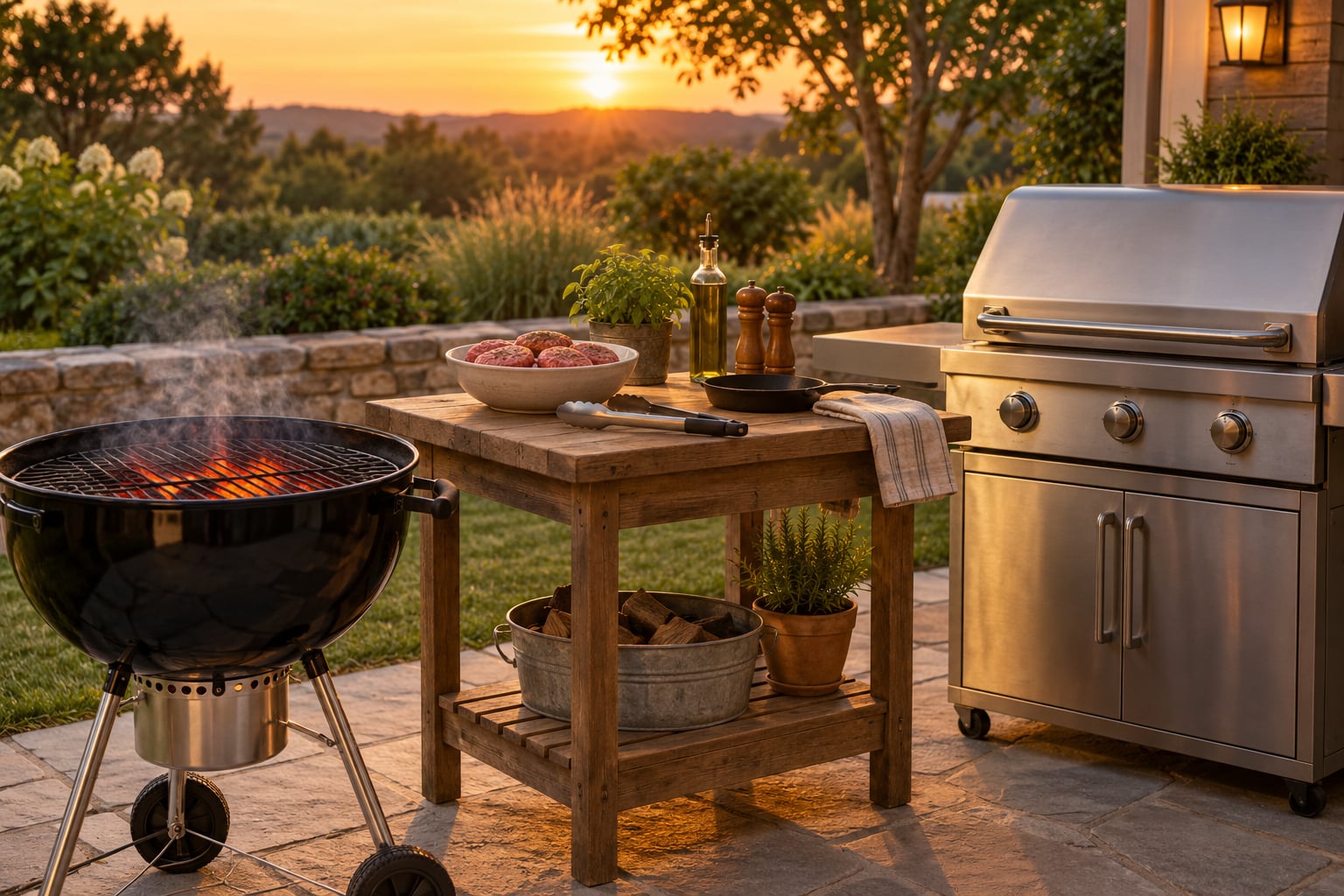
If you care about flavor above everything else, charcoal wins. If you want flavor without the fire, the wait, and the ash, gas wins. That is the honest answer to gas grill vs charcoal grill for flavor, and the rest of this guide explains exactly where the line falls — because the difference is real on a brisket and almost invisible on a Tuesday-night burger.
I cook for a lot of people, and the question comes up at nearly every cookout: which one is better? After years of side-by-side cooking on both, my rule is simple. Anything cooking under about 45 minutes, the two are close enough that the grill barely matters. Anything cooking longer, or anything where smoke is the whole point, charcoal pulls away fast.
Below is the breakdown: where flavor actually comes from, how smoke and heat behave differently, what each grill costs you in time and cleanup, and how to pick based on what you like to cook and how often you host.
Table of Contents
- Gas Grill vs Charcoal Grill for Flavor at a Glance
- Which Grill Produces More Flavor?
- How Smoke and Heat Affect Grilled Food
- Gas Grill vs Charcoal Grill for Flavor by Food Type
- Gas Grill vs Charcoal Grill for Ease of Use
- Which Grill Is Easier to Clean?
- Gas Grill vs Charcoal Grill Cost Comparison
- Which Grill Is Best for Beginners?
- Which Grill Should You Choose?
- Frequently Asked Questions
- Does charcoal really taste better than a gas grill?
- How do I get charcoal taste on a gas grill?
- How do I get smoke flavor with a charcoal grill?
- Can you smoke wood chips on a charcoal grill?
- Is charcoal grilling healthier than gas?
- What does rubbing a potato on the grill do?
- The Bottom Line
Gas Grill vs Charcoal Grill for Flavor at a Glance
| Factor | Charcoal grill | Gas grill |
|---|---|---|
| Flavor | Smoky, deeper, fire notes | Clean, true to the meat |
| Peak heat | Around 700F | Around 500F to 600F |
| Heat type | Radiant plus convection | Mostly convection |
| Preheat time | 15 to 20 minutes | About 10 minutes |
| Temperature control | Vents and air, slower | Knob control, immediate |
| Smoke capability | Built in, free | Needs a smoker box or chips |
| Cleanup | Ash, ash pan, grates | Burner cleaning, grease tray |
| Upfront cost | Lower for equal surface | Several times higher |
| Best for | Long cooks, smoke, searing | Weeknights, crowds, precision |
Which Grill Produces More Flavor?
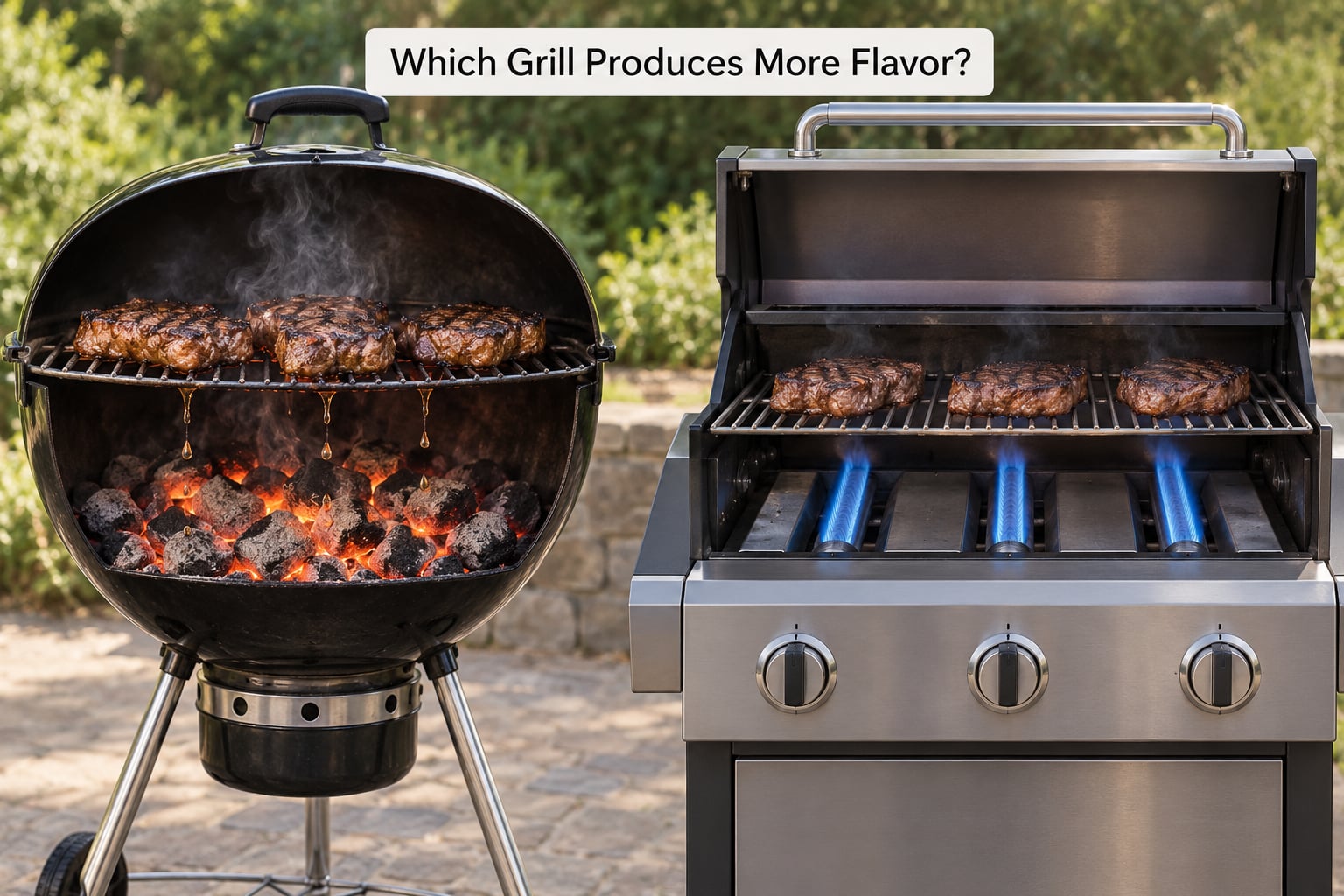
Charcoal produces more flavor, and the reason is not what most people think. It is not that the charcoal itself tastes like anything. Charcoal is roughly 99% carbon. Its contribution is heat, not seasoning.
Real grill flavor comes from three places. The first is the Maillard reaction, browning at high heat, and that happens on any grill hot enough to dry the surface of the food. The second is drippings vaporizing: fat and juices fall onto a hot heat source, break down into smoke, and travel back up over the meat. Charcoal gives this to you constantly because the coals sit directly under the food and radiate upward. A gas grill moves air across the food and sends heat from below, so far less fat ever reaches a surface hot enough to smoke.
The third source is real wood smoke, and this is the part people mistake for charcoal flavor. When you throw hickory or mesquite chips on glowing coals, you get genuine wood compounds layered onto the food over time. That is the campfire note that a gas grill simply does not produce on its own.
Here is the honest counterweight. Weber and Serious Eats have both run blind taste tests and found no significant difference on fast-cooked food. Both of them are saying the same thing about why: a burger that spends six minutes on the grate never absorbs enough smoke to taste different. The difference is not imaginary, it is a function of time.
How Smoke and Heat Affect Grilled Food
Charcoal throws radiant heat. That means energy travels as infrared from the coal bed straight up into the food, which is why a properly built charcoal fire will lay down hard grill marks and give you an edge on a crust without much cooking time. Gas mostly heats the air around the grate, and that hot air is what cooks the food. It is gentler, more even, and far less capable of charring.
That difference matters most on thin, fast food. A ribeye seared hard for three minutes a side, a shrimp skewer, a burger pressed with weight: radiant heat gives you the crust. Gas gives you a nicely cooked burger that still tastes like beef.
Gas Grill vs Charcoal Grill for Flavor by Food Type
- Burgers: Nearly a tie. Sear on charcoal for the crust, gas for the speed.
- Steaks: Charcoal edges it on crust and char. Gas holds a steady medium-rare without babysitting.
- Chicken: Gas for a weeknight roast, charcoal when you want the skin to taste smoky.
- Fish and shellfish: Gas wins. Smoke clobbers delicate flesh, and gas runs cooler for delicate work.
- Vegetables: Gas for clean char on corn and peppers, charcoal for deeper char on onions and eggplant.
- Brisket, ribs, pork shoulder: Charcoal, or a kamado or offset smoker. Not close.
- Pizza and flatbread: Charcoal. It is the hardest radiant heat to fake.
Across every one of those rows, the dividing line is the same: time under the lid. Under roughly 45 minutes, you are choosing convenience and control. Over an hour, you are choosing smoke, and smoke means charcoal.
If you own gas and want more of that smoky character, there are four ways to get it, roughly in order of effort.
- Foil chip pouch. Soak chips 30 minutes, wrap in heavy foil with a few slits, set it on the grate or over a burner. Easiest method, mildest result.
- Cast iron pan. Set a cast iron pan over a burner, add chips, let them smolder, and keep the food on the other side of the grill. Gives you a pan of smoke you can baste from.
- Water and spice pan. A pan of water with peppercorns, cumin, or chili powder does not add smoke, but it stops drippings from scorching and adds aroma. It is a refinement, not a substitute.
- Smoker box. A dedicated tray of chips under the grates on a side burner. The best smoke per unit of effort if your grill has a burner you are not using for food.
One mistake to avoid: scattering dry chips straight onto lit burners. They flash and burn out in seconds before producing anything useful. Chips need to smoulder, and they need a drip pan underneath them to keep grease off the flame.
Gas Grill vs Charcoal Grill for Ease of Use
Gas wins this category so completely that the argument is basically over. You turn two knobs and the grill is at temperature in about ten minutes. Charcoal asks you to build a fire, wait fifteen to twenty minutes for it to be right, and then keep adjusting vents to hold temperature.
That gap shows up most in real life. A gas grill tolerates wind, rain, and a spontaneous decision to cook at eight at night. A charcoal grill in a drizzle is a different hobby. A gas grill also gives you fine control, which is the real reason it sears consistently: a knob change alters heat immediately, and a built-in thermometer tells you the truth.
Charcoal compensates with two things. Its response is slower but stronger, which some cooks like because the sear window is wide and forgiving. And there is no substitute for tending a fire. That is not a flaw, it is the appeal for the people who gravitate to it.
Which Grill Is Easier to Clean?
Gas, again, though not by the margin most people expect. Once the burners are hot, most of the grease residue burns off during preheat, and cleanup becomes scraping the grates, emptying the grease tray, and checking the burners for plugged ports. There is no ash to handle.
Charcoal adds a step that catches people off guard: the fire is finished when the coals are ash, but hot coals feel like coals. The safe move is to close the vents and wait until everything is cold and grey before you touch anything. Then you empty the ash pan, sift the ash for remaining embers, and brush the grates.
Neither grill is maintenance-free. Cast iron grates on either fuel type need to stay seasoned, which means wiping them with oil after use and not soaking them in water.
Gas Grill vs Charcoal Grill Cost Comparison
Charcoal grills have been cheaper for the same amount of cooking surface for as long as anyone has been selling them, and they still are. Gas grills start several times higher and climb into premium territory with side burners, sear stations, and hinged grates. For a first grill on a tight budget, that gap decides it.
Running costs pull the other way, gently. A full propane cylinder gets you roughly two dozen cooking sessions, while a bag of charcoal is closer to three. So a charcoal cook is not free either. The difference is smaller than the sticker gap, and the honest framing is that the grill purchase dominates either running total.
These are typical US ranges that shift with region, fuel prices, and the model you pick. Check current figures where you live before budgeting around them.
Which Grill Is Best for Beginners?
Start with gas if your cooking is burgers, chicken, sausages, and a party of ten on a Saturday afternoon. You will be producing good food in week one, and nothing about a gas grill punishes a beginner for fifteen minutes of hesitation.
Start with charcoal if you want to learn to smoke. The learning curve is real and you will burn the first two batches of ribs, but the skills transfer, and every other grill you own later will be easier for it.
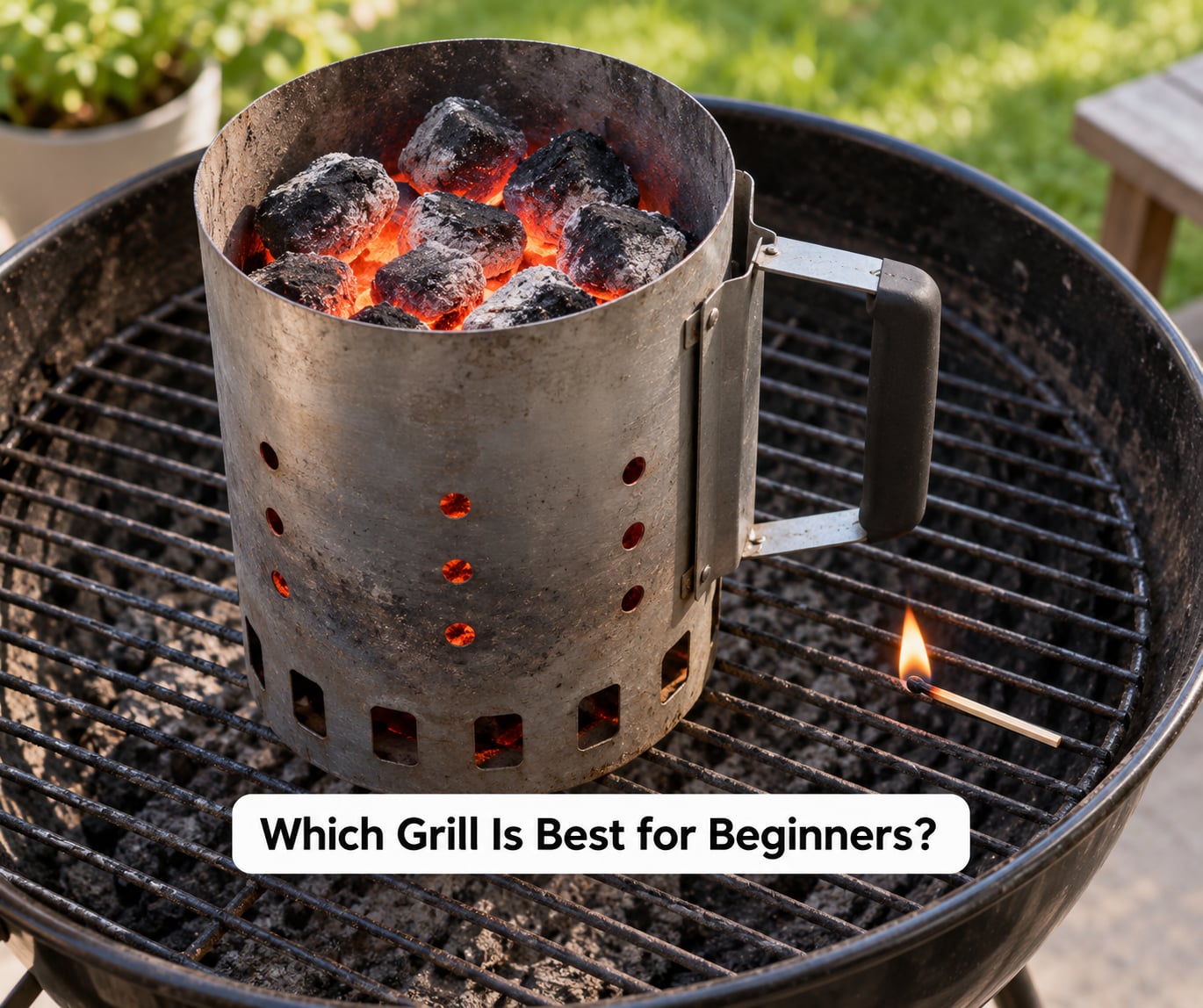
If you do go charcoal, three habits close most of the gap people complain about. Use a chimney starter instead of lighter fluid, because lighter fluid soaks into the coals and follows the smoke straight onto your food as a chemical taste. Light it, set it on the grate, and add charcoal over the top so it burns from the inside out in about ten minutes.
Second, build a two-zone fire. Push all the coals to one side and leave the other side bare. Sear over the coals, then move the food to the empty side for indirect cooking. That one habit replaces most of the temperature control a gas grill gives you for free.
Third, leave the lid closed and trust an inexpensive thermometer instead of guessing.
Which Grill Should You Choose?
Choose gas for weeknight cooking, small patios, and cooks who value repeatability. It wins on precision, on speed, and on feeding a group on a schedule. If your hosting involves fifteen people and a set mealtime, gas is the practical answer, and a smoker box covers the flavor gap well enough that nobody notices.
Choose charcoal for flavor as a priority rather than a preference. Brisket, ribs, pulled pork, whole chickens, pizza, competition-style burgers, anything where you want to brag about the cook.
Consider a third option if you mostly want smoke. A kamado or offset smoker is a charcoal grill built for long cooks, and pellet grills handle unattended smoking with far less fuss than either fuel here. Neither will sear like charcoal, so cooks often keep two.
My own answer is the same one I give everyone: buy the gas grill, add a smoker box and a cast iron pan, and stop thinking about fuel. Most people who claim they need charcoal are chasing one specific flavor and would be satisfied with it delivered another way.
Frequently Asked Questions
Does charcoal really taste better than a gas grill?
For most food, the honest answer is that the difference is smaller than the internet suggests. Blind taste tests from Weber and Serious Eats both found no significant difference on fast-cooked items like burgers or steaks under about 45 minutes. Charcoal pulls clearly ahead on anything cooked longer, where smoke compounds have time to build.
How do I get charcoal taste on a gas grill?
Add smoke, since the burners cannot do it themselves. Soak wood chips for 30 minutes and put them in a foil pouch with slits, or set a smoker box or cast iron pan of chips over a burner you are not cooking on. Never throw dry chips onto a lit burner, where they flash and burn out in seconds.
How do I get smoke flavor with a charcoal grill?
Use hardwood chips or chunks, soaked for at least 30 minutes so they smoulder instead of igniting. Build a two-zone fire, keep the vents partly open so airflow feeds the fire, and add a fresh handful of chips roughly every 30 minutes. Drippings hitting the coals add smoke flavor on their own, so keep the lid closed.
Can you smoke wood chips on a charcoal grill?
Yes, and it is one of the easiest smoke methods available. Soak the chips, then scatter them over hot coals once the ash has gone grey and the flame has died down. Chunks smoke longer than chips, so use them for brisket and ribs and chips for chicken or pulled pork.
Is charcoal grilling healthier than gas?
Both fuels can produce high-temperature compounds. Blackened meat forms heterocyclic amines, and smoke and flare-ups contribute polycyclic aromatic hydrocarbons, which is a real concern on either fuel. Gas burns cleaner, but adding wood chips reintroduces smoke. Trim fat, avoid heavy charring, and use a marinade with acid to reduce it.
What does rubbing a potato on the grill do?
It is a cheap grates cleaner. The starch and moisture act as mild abrasive, and it leaves a light oil film behind as it burns off, which helps season cast iron. Run a halved potato along the hot grates after a cook, then brush off the residue. It takes no flavor with it and adds none.
The Bottom Line
Charcoal for smoke, long cooks, and hard sears. Gas for speed, precision, weather, and crowds. If you only remember one thing from this gas grill vs charcoal grill for flavor breakdown, remember the 45-minute line: below it, the grills are close; above it, charcoal is a different tool. Pick based on the longest cook you actually plan to make, not the best cook you saw on television.