Here is the short version of how to keep food warm on a grill: move finished food off the direct flame and hold it in a covered, low-heat zone. That means the cool side of a two-zone fire with the lid shut, an upper warming rack, a loose foil tent, or a pre-warmed insulated cooler, while everything stays at 140°F or above.
Most cold-food disasters at a cookout are not cooking failures. They are holding failures. A platter sits uncovered on the picnic table while the host is still pulling pork off the grate, and by the time anyone sits down the ribs have gone lukewarm and the burger bun has gone chewy.
What follows is the equipment list, a seven-step system, and the food-safety numbers that decide how long anything can actually sit.
Table of Contents
- What You Need to Keep Food Warm on a Grill
- Step-by-Step
- 1. Create a Low-and-Slow Zone to Keep Food Warm on the Grill
- 2. Keep Small Batches Covered
- 3. Use Residual Heat After Grilling
- 4. Warm Plates and Serving Bowls
- 5. Keep Hot Sauces and Drinks Separate
- 6. Cook in the Order Guests Will Eat
- 7. Check Temperature and Keep Food Safe
- Holding Methods and Times at a Glance
- Common Mistakes
- Frequently Asked Questions
- How long can you keep cooked food warm on a grill?
- Does aluminum foil keep food warm?
- How can I pre-warm a cooler to keep food warm?
- Should I cover grilled food while it is holding?
- How do I keep wings and other crispy food from going soggy?
- How do I reheat food that has been held without drying it out?
- Conclusion
What You Need to Keep Food Warm on a Grill
Nearly all of this is gear you already own or can borrow. None of it is exotic.
- An insulated cooler with a real tight-fitting lid, plus two old towels
- A roll of heavy-duty aluminum foil and a roll of paper towels
- A wire cooling rack to repurpose as a warming rack, or a rimmed sheet pan to hold one above
- A covered pan or two, plus foil packets and a cast iron plancha for the grill edge
- An instant-read thermometer, ideally one with a leave-in probe
- Access to a low oven set between 170°F and 225°F if the kitchen is close to the yard
Your grill may already have the two most useful pieces built in. Almost every gas grill has an upper warming rack above the main grate, and many grills have a warming drawer in the base underneath the burners. Both run on the heat rising off the cook box, which is exactly the gentle, low-temperature environment you want.
One more thing worth borrowing: a folding table with a lip around the edge. Holding stations that sit on the ground lose heat fast and collect dust.
Step-by-Step
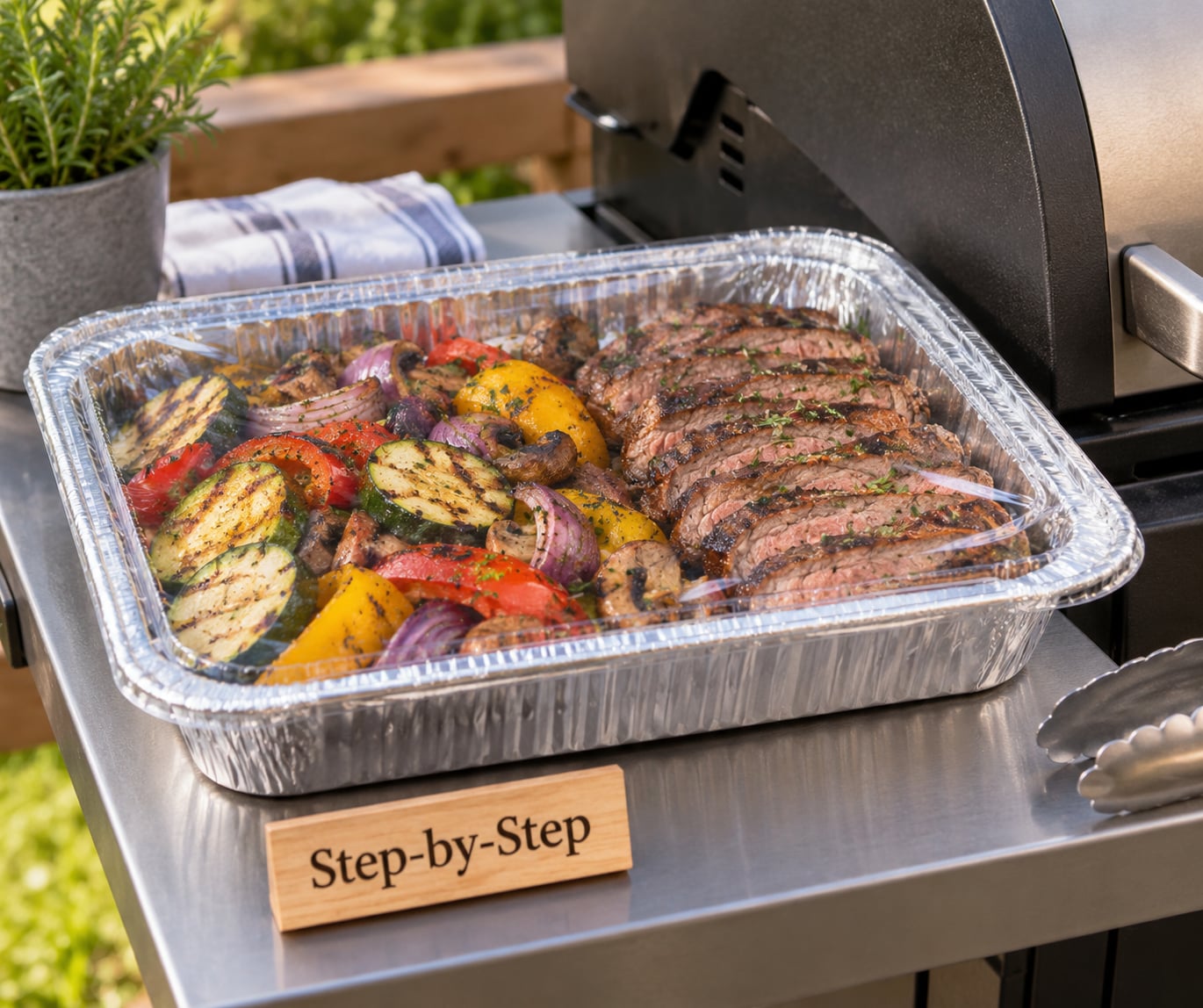
1. Create a Low-and-Slow Zone to Keep Food Warm on the Grill
Indirect heat is what you get when the food sits over no flame at all. The grates radiate heat upward and a closed lid traps it, so the zone over unlit burners or an empty half of the grill runs somewhere around 200°F to 250°F. Direct heat is flame or glowing coals touching the food, and that is what overcooks a held steak in ten minutes flat.
Build that zone first, before you cook anything. On a gas grill, light both burners, sear on one side, then shut off the burner on the opposite side and close the lid. If your burners don’t have a true low setting, turn one to minimum and leave the other off entirely. Hold your hand over the cool side a few inches above the grate: you want warmth, not shimmering air.
On a charcoal grill, tip a chimney of coals to one side once they’ve burned over to ash, leaving the other half of the kettle empty, then put the lid back on. Leave the top damper cracked a finger’s width; if the cool side starts to die, open the bottom damper a crack instead. A small kettle with a charcoal basket in the middle gives you a built-in diffuser and the same result.
Other grill types set up differently, and the same principle applies to all of them:
- Pellet grill — use the keep-warm setting if the controller has one, or set the burner to minimum with the lid closed. Pellet grates radiate less heat than steel grates, so check the zone with a thermometer before you commit food to it.
- Flat-top griddle — turn the burners off and use the far edge of the plate as the holding zone. A flat surface sheds heat quickly, so cover whatever you set there with a dome, a lid, or an inverted pan.
- Offset smoker — a warming shelf on the firebox does the job, and a cast iron plancha on the end of the grate gives you a second surface for smaller items.
2. Keep Small Batches Covered
The fastest way to lose heat is to expose ten pounds of food to open air. Smaller covered pans, foil packets, and heatproof containers lose far less, and they are easy to move around as the crowd thins out. If you only change one habit, make this one: it is the single biggest win when learning how to keep food warm on a grill.
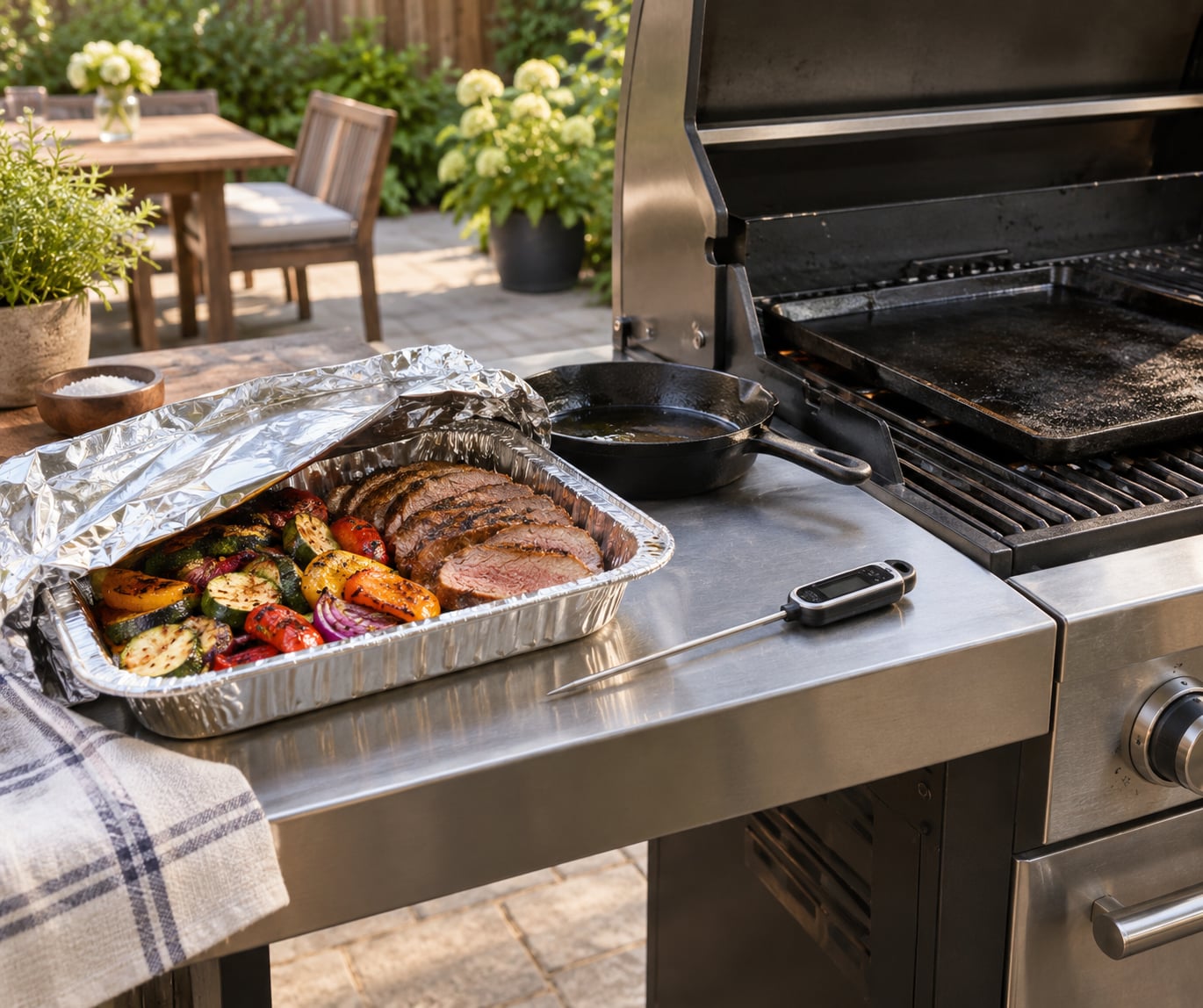
Foil works well here, but tent it loosely rather than wrapping it tight. A tight wrap traps steam against the surface, which softens bark and crisp skin, while a loose tent slows evaporation without steaming the food. A splash of apple juice, broth, or the pan juices under the foil also helps keep the surface from drying out; that trick showed up over and over in an old Smoking Meat Forums thread about holding tri-tip and ribs for a party.
Ribs and brisket, by the way, do not need to be sliced before they sit. Hold them whole, sliced at the table, and you lose almost nothing to drying.
3. Use Residual Heat After Grilling
Once your last batch is off, the grill becomes the holding station instead of an obstacle. Move the food to the cool side, stack the pieces close together in one warm pan so they warm each other, and cover it loosely.
Residual heat is gentler than anything you set up deliberately, which makes it a good fit for the last thirty minutes of a cookout. The exception is a charcoal grill whose coals still have visible life in them: ash the coals out first, or you will cook the food you were trying to hold.
4. Warm Plates and Serving Bowls
A cold plate pulls heat out of the food the instant it lands, and dinner plates are among the worst offenders. Put your serving plates and shallow bowls in a 170°F to 225°F oven while the protein rests, and take them out as you need them.
Cast iron and stone hold heat better than anything else in your kitchen, so they are the better serving pieces if you own them. An insulated casserole carrier is worth having for the same reason, and a pot of boiling water in the oven humidifies the air so nothing dries out while it waits.
5. Keep Hot Sauces and Drinks Separate
Condiments need their own plan because they are not meat. Set bottles in a bowl of hot water, hold gravies and melted butter in a covered pan in a 200°F oven, and warm small batches so you can refresh them quickly.
Never park a squeeze bottle or a jar of barbecue sauce on a grate. Sugar and thin sauces catch, scorch, and smell bad, and warm condiments are better kept warm in water than on steel.
For drinks, fill them at serving time instead of at cook time. Keep the ice in a separate cooler, or drop bottles into a galvanized bucket of ice water on the side of the grill where they stay cold rather than warm.
6. Cook in the Order Guests Will Eat
Reducing holding time beats every trick in this guide. Sequence the cook so the first food out of the kitchen is the first food on the table, and the fastest cooking items go last.
Start with sides and long-oven items, which hold well and lose the least, then move to the slow proteins, then the quick stuff: burgers, hot dogs, wings. If a party of twelve is sitting down at one o’clock, have the first tray of sides out by twenty to, so nothing waits on a platter while you are still at the grill.
Serving order matters too. Put the sides down as the meal begins and let them go before the last protein comes off, and nobody is ever holding a burger that has been sitting since the salads.
7. Check Temperature and Keep Food Safe
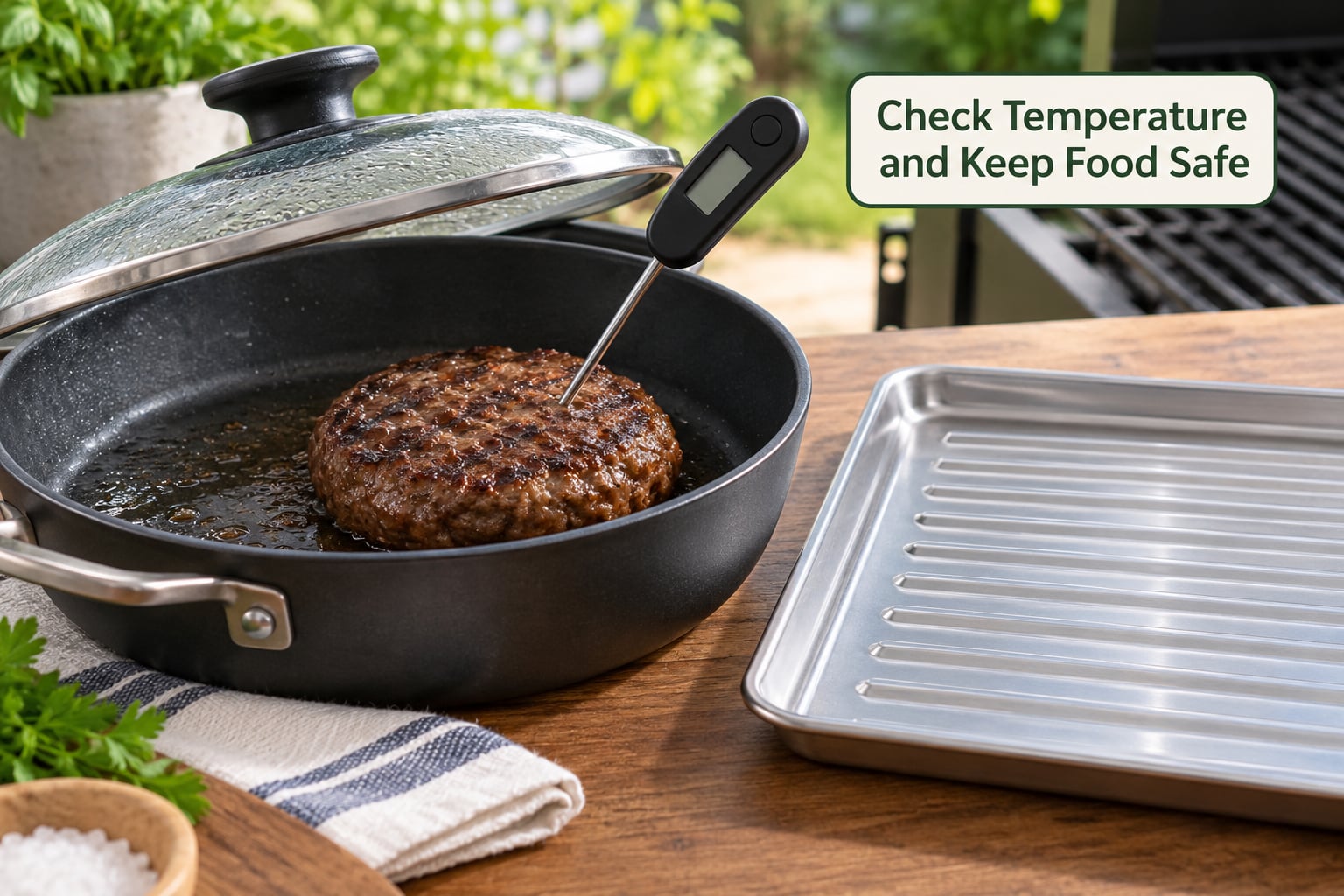
Keeping food warm means holding it at a safe temperature, not reheating it again and again. Hot holding is 140°F or above; the danger zone runs from 40°F to 140°F, and cooked food that drops into that range starts growing bacteria fast.
Take a reading in the thickest part, away from bone, before you call anything done and again before you call it served. These are the safe minimum internal temperatures straight from the USDA:
- Poultry, whole or ground: 165°F
- Ground meat, including ground beef and ground pork: 160°F
- Whole cuts of beef, pork, lamb, and veal, plus fish and shellfish: 145°F with a three-minute rest
- Reheated leftovers and hot-held casseroles: bring to 165°F before they go back in the holding zone
As a rule of thumb, discard cooked food that has been sitting out in the danger zone for more than two hours, or one hour once the air temperature is above 90°F. A lid slows the cooling but does not stop it, so a thermometer is the only honest check.
Holding Methods and Times at a Glance
Here is how the methods compare on the only things that matter: how long a hold realistically lasts, what it suits, and what it costs you to set up.
| Method | Realistic hold | Best for | Effort |
|---|---|---|---|
| Two-zone fire, lid closed | 1 to 2 hours | Ribs, brisket, chicken, anything finishing within the window | Low once set up |
| Upper warming rack | 45 to 90 minutes | Buns, foil packets, small batches of meat | Low |
| Loose foil tent over a pan | 30 to 60 minutes | Steaks, chops, vegetables, one batch at a time | Low |
| Pre-warmed insulated cooler | 3 to 5 hours | A full cook that runs ahead: brisket, pulled pork, ribs | Medium |
| Low oven at 170°F to 225°F | 2 to 3 hours | Sides, potatoes, casseroles, warmed plates | Low |
| Side burner on low | 1 to 2 hours | Warming pans, cider, melted butter | Low |
And here is the hold window per food, which matters more than people expect.
| Food | Best method | Hold window | Watch out for |
|---|---|---|---|
| Burgers and hot dogs | Warming rack or covered pan on the cool side | 30 to 45 minutes | Wrap the meat, not the bun, or the bun steams itself soft |
| Wings | Warmed at serving time rather than held | 15 to 20 minutes | Crisp skin goes soft fast; re-crisp in a 350°F oven |
| Ribs | Foil-wrapped in a pre-warmed cooler | 2 to 4 hours | Leave a vent in the foil so the sauce does not tighten |
| Brisket | Cooler with towels, sliced at service | 2 to 4 hours | Long holds past about four hours turn dry brisket rubbery |
| Grilled vegetables | Covered pan, low oven | 1 to 2 hours | Tomatoes release water; drain them or serve them earlier |
| Baked beans, potato salad | Covered pan in a 200°F oven | 2 to 3 hours | Stir once halfway through or they scorch on the bottom |
| Steak | Low oven on a rack, ten minutes at the end | 20 to 30 minutes | Dries fast; add a splash of pan juices under the foil |
Common Mistakes
Using a zone that is too hot. A holding area should hover around 200°F, not grill temperature. Food held over live coals or an open burner dries out, tightens, and eventually catches, and you will have burned the first batch to hold the third.
Leaving pans uncovered. Even in a closed grill, an open pan loses heat to evaporation. A loose foil cover, a lid, or an upside-down second pan costs you nothing and buys a surprising amount of time.
Overcrowding the grate. A grill loaded edge to edge has no room for a holding zone, so everything ends up fighting for the same indirect heat. Cook in batches and keep the finished food somewhere else entirely, such as a pre-warmed cooler, while the next batch works.
Mixing raw and cooked food in the same container. This is a cross-contamination risk, not a texture one. Raw chicken juices sitting under finished food at holding temperature is the fastest way to make people sick. Keep separate containers, and put raw food on a separate plate from the moment it leaves the grill.
Using a cooler that was never warmed up. A cool cooler with cold or absent water will drop your food through the danger zone in under an hour. The fix is simple: pour hot water in, close the lid, wait about an hour, dump the water, then pack your food in.
Leaving water in the cooler with the food. This is the mistake people correct each other about most often. Fold a towel flat at the bottom as a shelf, or set a wire rack in the cooler, so the meat sits above any water rather than soaking in it. Then drain the cooler completely before you close it.
Wrapping food tight in plastic. Warm plastic against hot food is a poor idea, and sealed plastic also makes crisp surfaces damp. Use foil or butcher paper, loose rather than sealed.
Holding on no time limit at all. Long holds plus a heat source is a slow path to dry, rubbery meat, which is the single most common complaint on the BBQ Brethren forums. Pick a hold window for each dish, write it on the lid, and plan to serve within it.
Opening the lid constantly. Every lift lets the trapped heat out and drops the whole cook box in temperature. Open once, swap the batch, close it again.
Frequently Asked Questions
How long can you keep cooked food warm on a grill?
On a two-zone fire with the lid closed, expect one to two hours before quality drops noticeably. A pre-warmed insulated cooler holds three to five hours, and a low oven at 170 to 225 degrees gives you two to three. Safety is a separate question: keep everything at 140 degrees or above, and discard food that sits in the 40 to 140 degree danger zone for more than two hours, or one hour above 90 degrees outside.
Does aluminum foil keep food warm?
Foil stops air and moisture from moving, which slows heat loss more than an uncovered pan does. The mistake is wrapping tight, because trapped steam softens bark, skin, and crust. Tent the foil loosely over a pan, and put a splash of broth, apple juice, or pan juices underneath to keep the surface from drying out over a long hold.
How can I pre-warm a cooler to keep food warm?
Pour hot water into the empty cooler, close the lid, and leave it for about an hour. Dump the water out, fold a towel flat at the bottom as a shelf or set a wire rack inside, wrap the food in foil, wrap that in two towels, and place it in the closed cooler. Skipping the hot-water step is the single reason coolers disappoint people.
Should I cover grilled food while it is holding?
Yes, loosely. A tented foil cover, a lid, or an inverted second pan slows evaporation, which is the main way held food dries out. Leave a small vent on ribs and other sauced items so condensation does not make the sauce tighten and lacquer. And cover the meat, not the buns, or your hamburger buns will steam themselves soft.
How do I keep wings and other crispy food from going soggy?
Hold them for the shortest window you can, ideally fifteen to twenty minutes, and crisp them at the end. Put them in a 350 degree oven for eight to ten minutes, or back on the grill for a few minutes with the sauce brushed on late, so the surface dries out and tightens again. Sauce early and they will be soft in no time.
How do I reheat food that has been held without drying it out?
Add moisture first, then apply heat briefly. Put ribs or braised meat in a pan with a splash of juice, broth, or barbecue sauce, cover it, and warm it in a 300 degree oven or on a low grill zone for ten to fifteen minutes. Finish uncovered to let the surface dry, and add sauce in the last few minutes so it caramelizes rather than burns.
Conclusion
Set up the covered holding zone before you light anything. A cool side with the lid closed, a pre-warmed cooler, or a 200°F oven takes ten minutes and is the whole difference between a hot meal and a plate of lukewarm food.
Then work in small covered batches, keep the quick items for last, and check the temperature with a probe instead of guessing. Get those three right and how to keep food warm on a grill stops being a problem you think about at all.