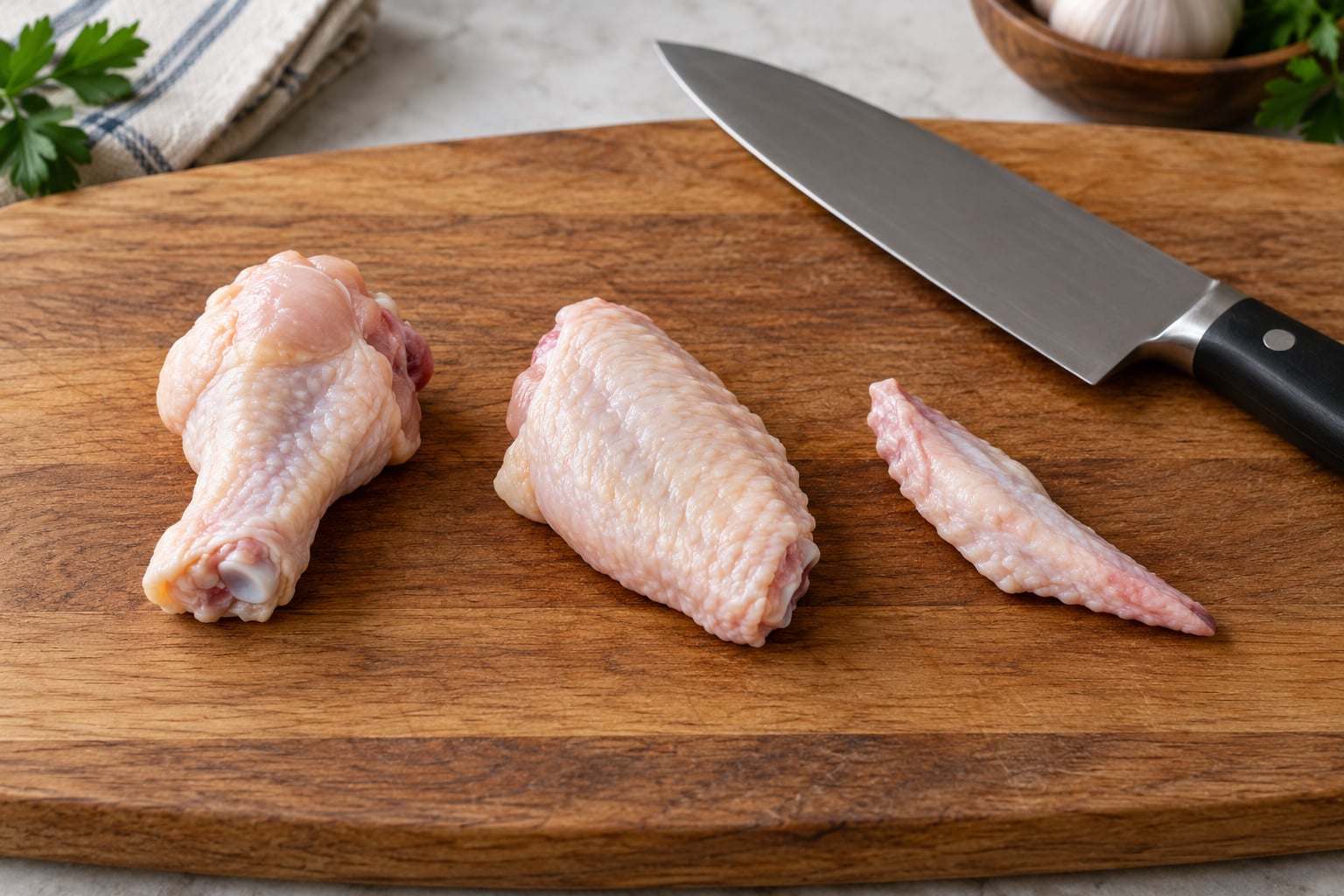
A whole chicken wing comes apart at two soft cartilage joints, and those joints are the only place you ever need to cut. Lay the wing skin-side down, find each joint by bending it with your fingers until it moves freely, then slice straight through the joint space. Never saw through the hard bone. Once you know where to press, a batch of wings takes about two minutes.
That last part matters more than it sounds. The single thing people get stuck on when learning how to cut whole chicken wings into flats and drums is not the knife, it is finding the joint. One poster on r/AskCulinary described spending 45 minutes on 5 pounds of wings because they could not get a feel for the joints with either a knife or shears. That is a very common first attempt, and the fix is usually a technique rather than a better tool.
Table of Contents
- What You Need
- Step-by-Step: How to Cut Whole Chicken Wings Into Flats and Drums
- 1. Identify the three wing sections
- 2. Remove the wing tip
- 3. Separate the flat from the drumette
- 4. Check the pieces and repeat
- Common Mistakes
- Frequently Asked Questions
- Do you have to cut chicken wings before cooking?
- What do you do with chicken wing tips?
- Can you eat chicken wing tips?
- Should I use a knife or kitchen scissors to cut chicken wings?
- How do you know when chicken wings are cooked?
- Are flats or drums better, and which one cooks faster?
- Conclusion
What You Need
A whole wing that has come from the fridge, not the freezer, plus a few basics. Frozen solid wings are miserable to break down because the skin welds itself to the board.
- Whole chicken wings, chilled rather than frozen. Thaw them in the fridge overnight if they arrive solid.
- A sharp chef’s knife or heavy kitchen scissors. A dull blade is the reason so many first attempts end up cutting through bone.
- A sturdy cutting board, ideally plastic or composite. Skip wood for raw poultry; the crevices hold bacteria and there is no reliable way to clean them.
- Paper towels to dry the pieces once they are separated, which stops them from sliding around.
- A bowl or sheet tray to sort the flats and drums into as you go.
Gloves are optional. Cutting board dampened with a paper towel, or a second board set beside it for the finished pieces, will save more time than anything else you could buy.
Step-by-Step: How to Cut Whole Chicken Wings Into Flats and Drums
1. Identify the three wing sections
Before you touch the knife, look at what you are holding. A whole chicken wing is three pieces joined by two joints.
The drumette is the rounded top section, the one attached to the body. It looks like a miniature drumstick and it carries the most meat. The flat, also called the wingette or the flap, is the long middle section with two narrow bones running side by side. The wing tip, or flapper, is the small skin-covered point at the far end.
Turn the wing over. On the underside you can feel the joints as soft dips between the firmer sections, and those dips are exactly where the blade goes. A barbecue pit I read about put it plainer: cut at the cartilage point, every time.
2. Remove the wing tip
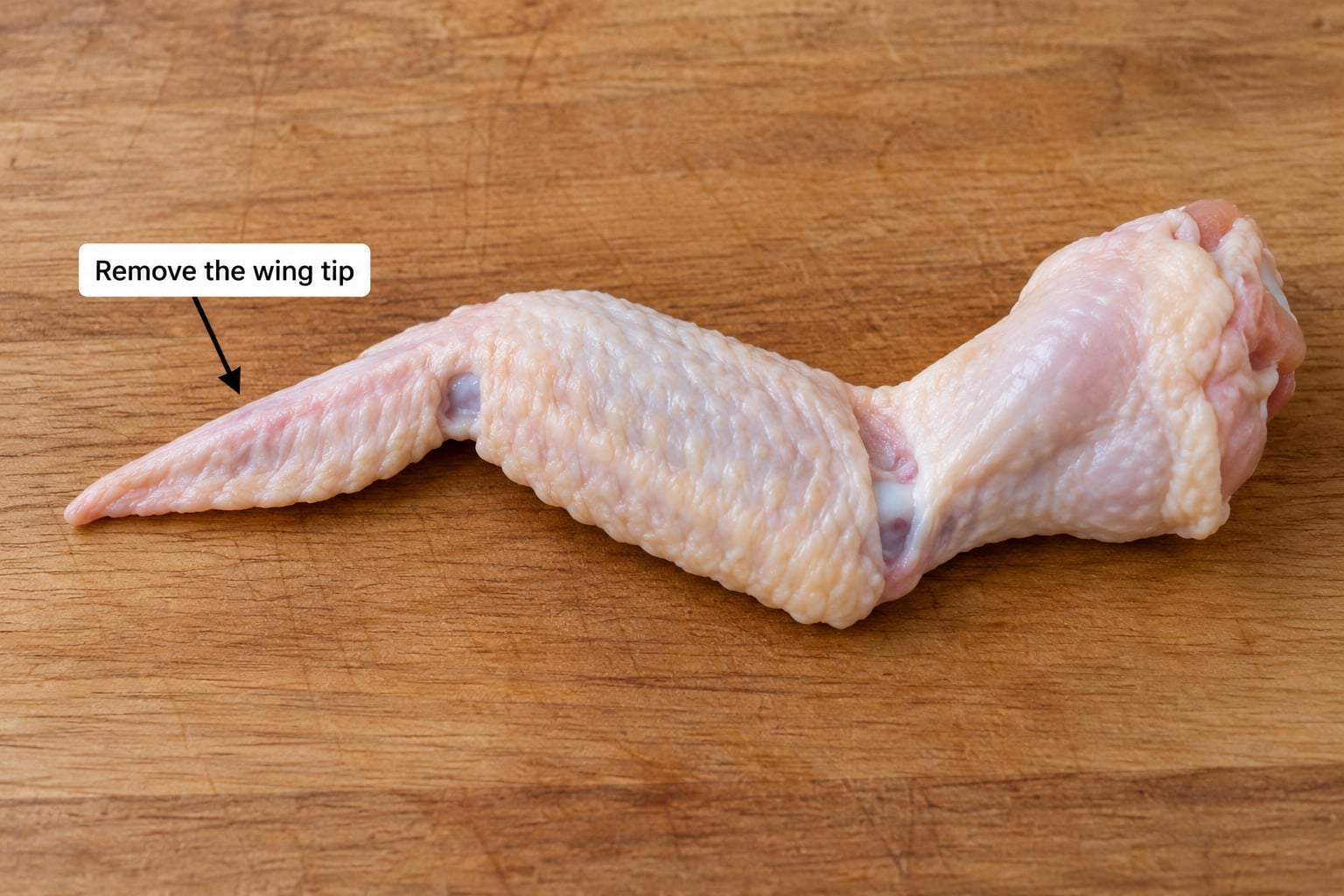
Take the tip off first. It is the easiest cut of the three and it is much harder once the wing is in pieces.
Hold the wing at the drumette end so the tip points away from you, then bend the tip up and back until you can see it flex. Bend it into a V and the joint opens into a visible gap. Set your knife blade perpendicular to the joint and press down once, firmly but without hammering. The blade should meet almost no resistance, because cartilage is soft compared with bone.
Whether you cut the tip off before or after the flat comes away makes no difference to the result. Order matters only for ease.
3. Separate the flat from the drumette
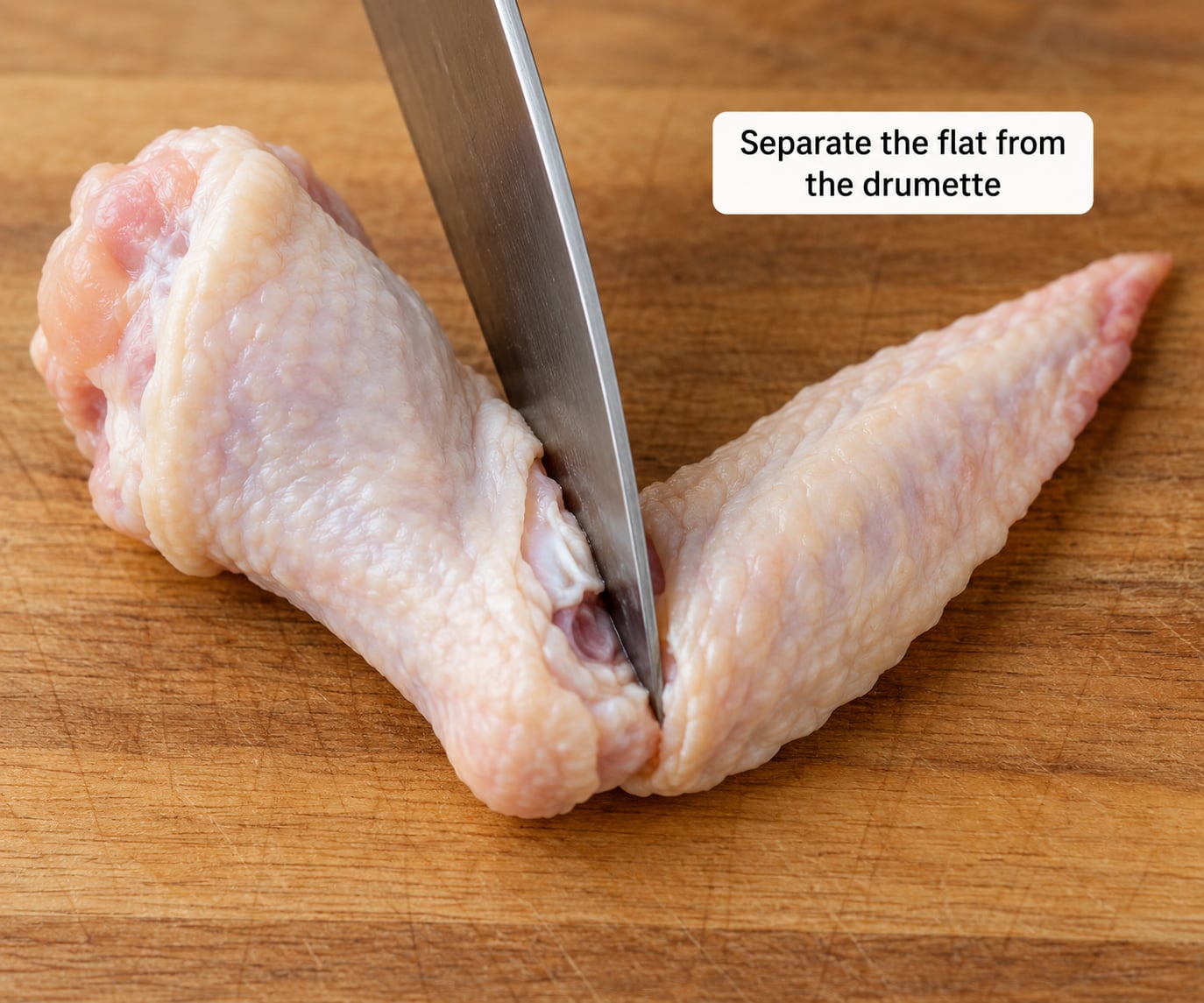
This is the cut people get wrong, so slow down here. Pick up the wing by the drumette end and bend the flat back until the joint opens into a clear V.
Keep the bend steady and cut straight down through the gap, blade perpendicular to the board. A stretched joint is a gap with nothing hard inside it, so the knife glides through on its own weight. If you feel a hard stop, stop pushing and reposition rather than leaning on it.
There is an alternative worth knowing. A Cook’s Illustrated tip suggests slipping a small slit into the inside of the elbow joint, then bending it backwards, the wrong way, so the joint pops open from the inside. It works well on a wing that has been sitting in the fridge and stiffened up, though it makes a messier first cut than the V.
You will feel when the cut is right: the flat comes away in one piece and each piece shows a clean bone end with no white bone dust or ragged bone shaving.
4. Check the pieces and repeat
Hold up what you cut. A correct drumette shows a single round bone end where it separated from the body, and a correct flat shows two narrow bone ends. Bone ends that look chewed or splintered mean the blade drifted into hard bone.
Drop each piece into its pile, pat the pile dry with a paper towel, and move on to the next wing. Ten wings are two cuts each, so twenty quick cuts and you are done.
Refrigerate the separated pieces and cook within a day or two, or freeze them. Spread them across a tray first so they freeze individually, then tip them into a bag. Frozen flats and drums cook from frozen with an extra few minutes, which is handy for game day.
Once you have the hang of it, the same joint logic works on turkey wings and on the leftover whole wings from a roast.
Common Mistakes
Almost every bad first attempt comes down to one of five things.
Cutting through the bone instead of the joint. The joint is a soft dip you can feel with your fingertip; bone is hard and unyielding. The fix is to bend the joint until you can see daylight through it, and only then cut. If the knife meets resistance halfway, it is in the wrong place.
Pressing hard and sawing. Force tears the skin and dulls the cut. Twist the blade slightly back and forth as it descends, a few degrees each way, and let the weight of the knife do the work. A sharp blade through a stretched joint needs almost nothing.
Using dull shears. Blunt kitchen scissors crush the meat instead of separating it. Worn shears also slide off the joint and nick the bone. Test them on a sheet of paper first; if they tear it, they are done.
Pulling the pieces apart instead of cutting. Bending is part of the technique, but twisting until something snaps shreds the meat and pulls skin off the drumette. Bend to open the joint, then cut.
Cutting too close to the joint ends. This leaves a knuckle of bone sticking out, which is uncomfortable to eat and slows cooking. Leave a finger’s width of meat above the cut on both pieces.
Two more things to keep in mind. Never peel the skin off to make cutting easier; the skin is what crisps and holds the sauce. And keep the raw chicken cold while you work, moving cut pieces straight to the fridge or a tray on ice if you are doing a big batch.
Frequently Asked Questions
Do you have to cut chicken wings before cooking?
Not always. If your goal is less waste rather than a specific mix, trim the tips off and leave the flat and drumette attached, and the wing cooks and eats much like a party wing with a little less bone in the way. Full separation is what you want when you are after only flats, only drums, or a controlled mix, or when a large batch has to fit in a fryer or air fryer basket.
What do you do with chicken wing tips?
Freeze them. Tip the trimmed tips onto a tray, freeze until solid, then bag them and keep them in the freezer until you have enough for a pot of stock. They are almost all skin and cartilage, and that is exactly what gives stock its body. They also braise down in sauce, and a small tray of them on the grill crisps up nicely on their own.
Can you eat chicken wing tips?
Mostly skin and soft cartilage, which is perfectly edible, though there is very little meat to get at. The small hard bone in the centre of the tip is not something to chew through, so lift it out and move on. Eaten straight from the bird they are a treat, and cooked slowly they go rubbery, which is the one way to ruin them.
Should I use a knife or kitchen scissors to cut chicken wings?
Either works, and plenty of home cooks say they reach for poultry shears every time. Scissors snip the cartilage joint in a single squeeze and are faster on a big batch. A sharp chef’s knife gives you more control, particularly on the fiddly tip joint where shears tend to wander. Pick whichever you own, and keep it sharp.
How do you know when chicken wings are cooked?
Check the thickest part of the drumette with an instant-read thermometer rather than the flat, and pull the wings at 165°F (74°C) measured in the centre. The flat is thin enough to scorch long before the drumette is done, which is the usual reason a batch of wings comes out dry and leathery on the outside.
Are flats or drums better, and which one cooks faster?
They are different cuts rather than better and worse ones. Flats are thin, take on sauce quickly and crisp in less time, which suits deep frying and air frying. Drums carry more meat, stay juicier on the grill and are easier to eat with a dip because you can hold them by the bone. Cook both to 165°F (74°C) internally.
Conclusion
Start with the first action: put a chilled wing on a non-wooden board, skin-side down, and run your fingers along the underside until you find the soft dip between the drumette and the flat. Bend it back until the joint opens, cut straight down through that gap, then repeat the same move at the tip.
Keep the raw chicken cold while you work, sort the finished flats and drums straight onto a tray, and cook poultry to an internal temperature of 165°F (74°C). Once you have cut a few, the whole job takes about two minutes a batch, and you will never be picking apart party wings at the counter again.