Keeping wings warm for a party is simple: hold fully cooked wings uncovered on a wire rack set over a rimmed baking sheet in a low oven at 170 to 200°F, and add sauce only when you are about to serve. Airflow carries moisture away instead of steaming the skin, which is the whole game. Plan on six to eight wings per guest, and give yourself a two-hour cushion between finishing the cook and the first platter hitting the table.
Wings are a snack food, which means they sit out in waves while people graze, talk, and refill drinks. Anything you cover, stack, or sauce early will turn soft and wrinkled long before the last guest gets to the tray.
Here is the short version: a low oven beats every other method for crispness, a warming tray or slow cooker trades crispness for convenience, and an insulated carrier is for the twenty minutes it takes to move the food. Pick the one that matches how long you need to hold and how far you have to carry.
One more piece of planning pays off before anyone arrives: work backward from your serving time. Wings that wait on a rack for two hours still taste like wings. Wings that wait on a plate are not worth serving.
| Method | Best for | Crisp result | Practical holding window | Watch out for |
|---|---|---|---|---|
| Low oven with wire rack | Holding 30 to 180 minutes | Best, if uncovered | Up to about 3 hours | Stacking wings, using foil to cover |
| Warming tray or chafing stand | Buffet line or serving table | Good for 1 hour or less | 1 to 2 hours | Condensation dripping back onto the tray |
| Slow cooker on warm | Sauced wings only, hands-off | Soft by design | 2 to 3 hours | Crisp skin, and crowding the pot |
| Insulated carrier or cooler | Transport to another house | Good if vented | 30 to 60 minutes | Airtight lids, which trap steam |
| Air fryer on low or warm | Re-crisping right before service | Excellent | 20 to 30 minutes | Small capacity, no true hold setting |
| Foil pan, tented | Last resort with no other gear | Poor after 30 minutes | Under 30 minutes | Steam, which softens skin fast |
Table of Contents
- What You Need
- Step-by-Step: How to Keep Wings Warm for a Party
- Use a Low-Temperature Oven
- Use a Warming Tray or Slow Cooker
- Use an Insulated Carrier for Short Holds
- Keep Wings Crisp While They Wait
- Common Mistakes
- Frequently Asked Questions
- Can I keep chicken wings warm in a crockpot?
- How long can you keep cooked wings warm in the oven?
- How do I keep wings crispy while transporting them?
- How do I make wings ahead of time for a party?
- Should I let wings cool before saucing?
- How do I keep buffalo chicken dip warm at the same time?
- Conclusion
What You Need
The list is short, and most of it costs almost nothing. The single most useful item is a wire cooling rack, because that rack is what keeps the bottoms of the wings from sitting in their own oil.
- Rimmed baking sheet or jelly-roll pan. It catches drips and gives you air underneath the wings. A flat non-rimmed sheet is the enemy of crisp skin.
- Wire cooling rack. Any rack fits inside a sheet pan. No rack? Set the wings on a row of inverted pie tins or upside-down muffin cups so air moves underneath.
- Instant-read thermometer. This is how you know the holding oven is where you think it is. No thermometer? Use an oven thermometer, or trust the dial and check with a drop of water on the rack.
- Low oven or warming tray. An oven set to 170 to 200°F works. A warming tray set low, or a chafing stand with a sterno can, does the same job away from the stove.
- Slow cooker on warm if you plan to hold sauced wings and accept soft skin.
- Insulated carrier, cooler, and clean towels for moving wings across town.
- Shallow serving platter and tongs for the table, plus a second platter for the waves that follow.
- Aluminum foil for tenting a pan in a pinch, though foil is the enemy of long-term crispness.
Two prep items matter more than any gadget. Dry brined wings the night before, uncovered on a rack in the fridge, hold up far better than wings sauced straight from the fryer. And warm your sauce before it touches the food, because a cold sauce on a hot wing drops the serving temperature fast.
Step-by-Step: How to Keep Wings Warm for a Party
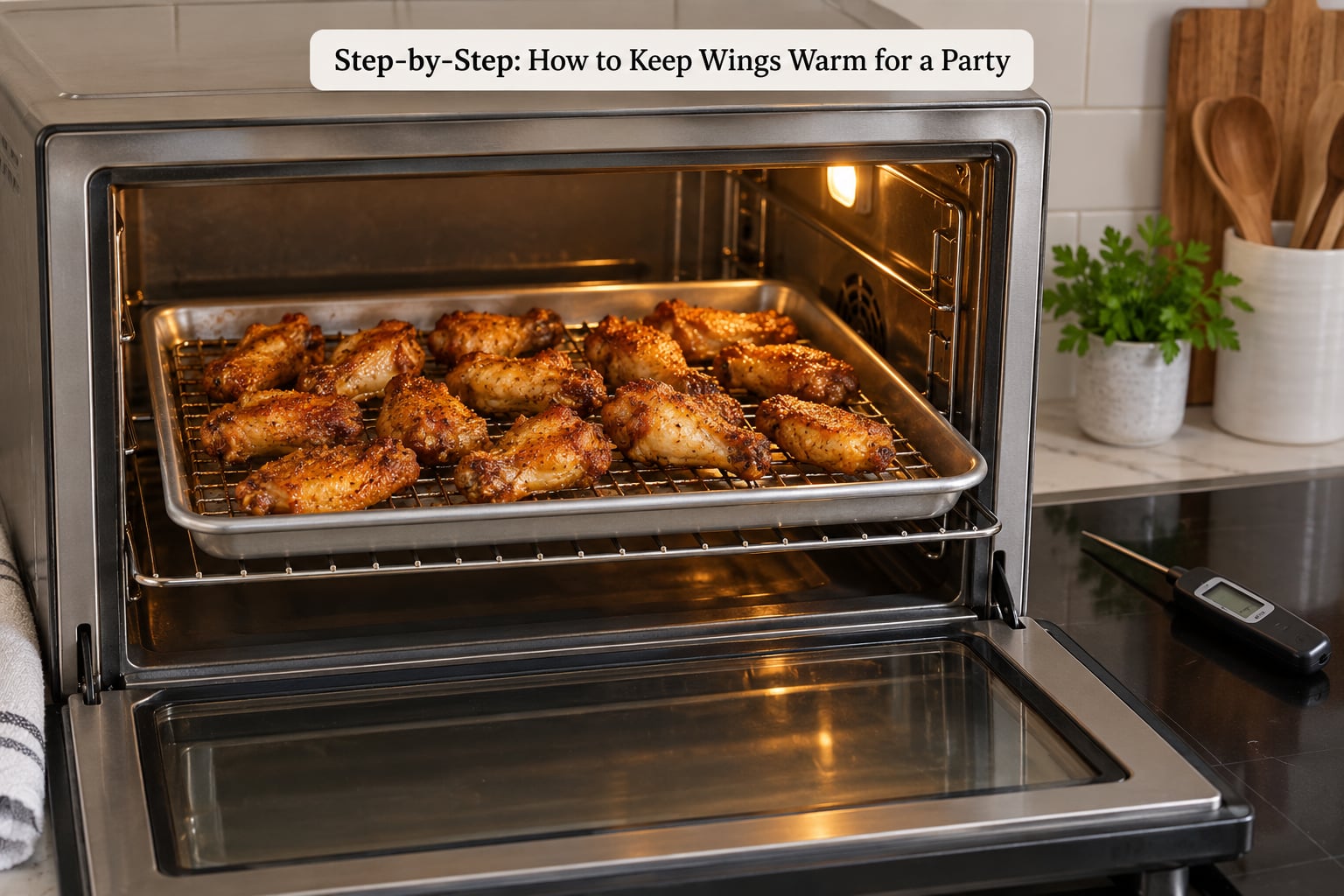
Use a Low-Temperature Oven
A low oven is the best method for anything longer than half an hour, because dry heat and moving air protect the skin that a fryer just created. Set the oven between 170 and 200°F, and use the lower end of that range when the hold is longer than an hour and a half.
Start the oven before you finish cooking. Wings that have to wait for the oven to preheat sit on the counter losing heat, and that is where the two-hour clock really starts.
Cook the wings to an internal temperature of 165°F, which is the safe minimum for poultry, then rest them on the rack for five to ten minutes so the steam escapes before they go on the heat. While that happens, preheat the oven.
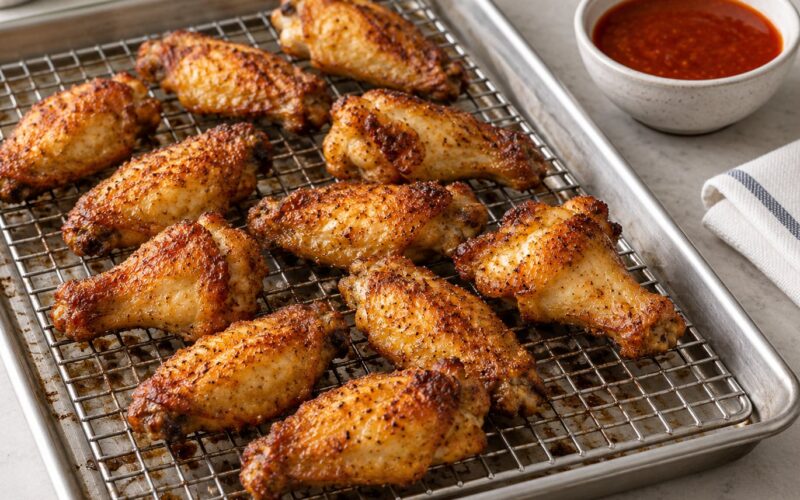
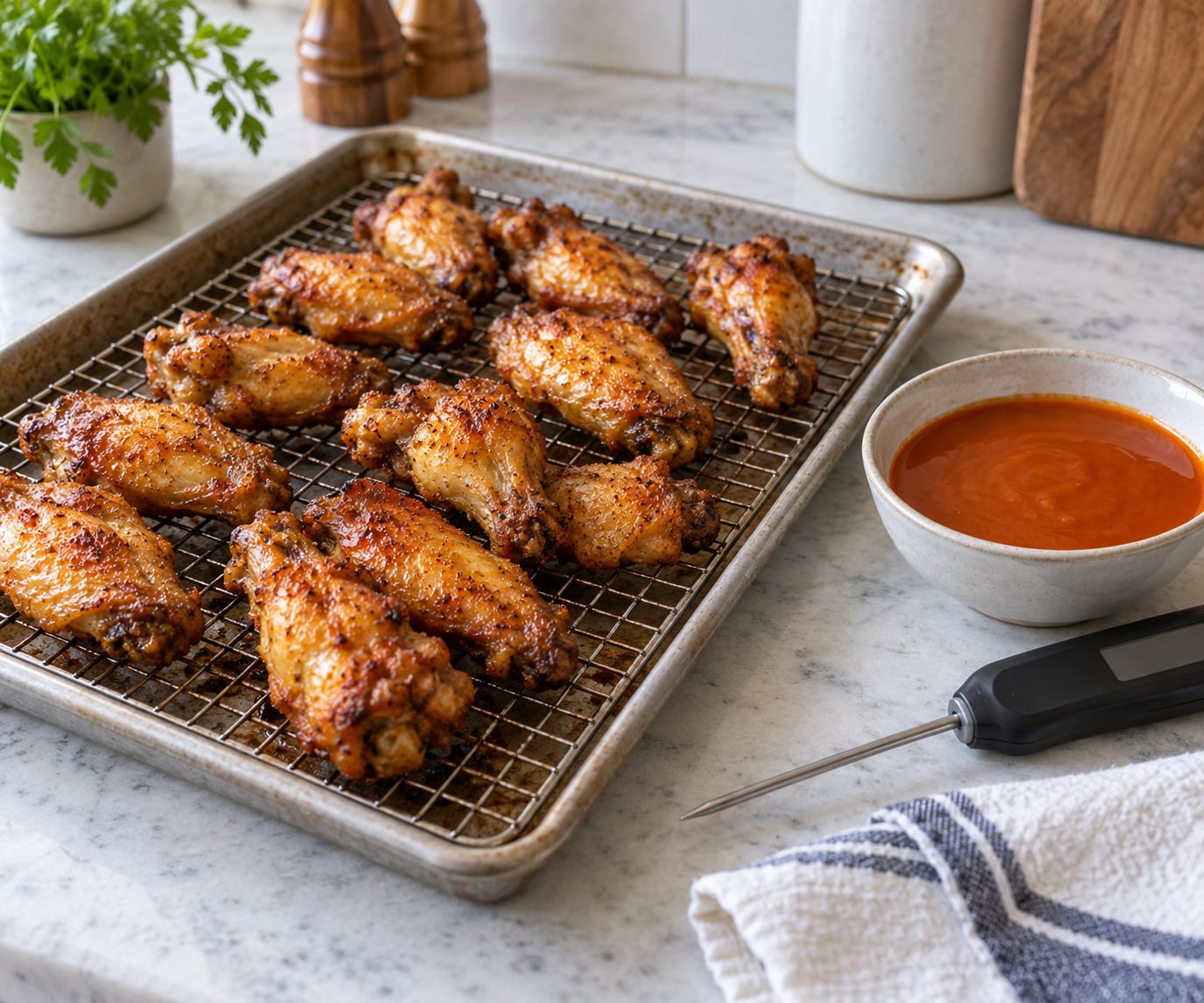
Set a wire rack inside a rimmed baking sheet, arrange the wings in a single layer with a finger’s width between each one, and slide the tray into the oven. A second rack on a lower shelf works if you are holding a big batch, and gives you two trays of capacity instead of one.
Place the rack on the center rack, not the very bottom of the oven. Wings on the floor of a hot oven pick up direct radiant heat and dry out, while wings on a rack with air around them do not.
Check the temperature with your instant-read thermometer once, at the start, and again after about an hour. Ovens run hot or cool, and a dial that reads 200 may be delivering 225. If the wings are drying at the edges, drop the setting another notch and cover nothing, but move the tray up one shelf.
You will know the hold is working when the skin still crackles when you touch it and the sheet pan underneath is collecting clear oil rather than a puddle of sauce.
Two hours is comfortable, and roughly three is the practical ceiling before wings start losing moisture and the sauce thickens onto them. FoodSafety.gov guidance is to keep hot food at 140°F or above, which is exactly the temperature a holding oven runs at.
One caveat about oven keep-warm settings. They are usually a low, gentle heat, and most hold food fine, but the temperature varies wildly by model, some top out near 200°F and others barely warm at all. Treat a keep-warm setting as an unknown until you measure it.
Use a Warming Tray or Slow Cooker
A warming tray or a wire chafing stand is the better choice when the wings are going straight onto a buffet table, because it keeps them at serving temperature without a host hovering over the oven. Set the tray to its lowest setting and check with your thermometer, looking for 140°F or above in the food itself, not in the pan.
Do not use more water or fuel than you need. A chafing stand has a water pan underneath for a reason, and too much steam rises into the tray and lands on the wings as condensation, which is the exact thing you are trying to avoid. Fill the water pan about a third full.
Line the tray with a rimmed sheet pan and a wire rack rather than piling wings directly onto the metal. Standing wings in a single layer also helps them drain instead of sitting in the oil the drippings produce.
A slow cooker on warm holds wings hot for two to three hours and asks nothing of you, which is why so many hosts use one at game day. The catch is honest and worth saying out loud: the gentle moist heat softens the skin, and you will not get crisp wings back out of a crockpot. It is a trade of texture for convenience.
If you use a slow cooker, toss the wings in sauce before they go in, since you are not going to get a crisping step afterwards. Use a lid that is cracked or vented so moisture can escape, and never fill the pot more than halfway or the wings will steam in their own condensation.
You will know the crockpot is working when the wings are steaming when you lift the lid. If there is no steam at all, the warm setting on that model is too low and you should use a light instead.
Use an Insulated Carrier for Short Holds
An insulated carrier or cooler is for transport, not for holding a whole party. It solves the drive across town in cold or mild weather, and it does nothing at all in a hot driveway.
Line the bottom of the cooler with a folded towel, set the wings on a rack or in a vented container above it, and pack rolled-up hot towels in every gap so the wings are held in place and the warm air has nowhere to go. Fillers straight out of the dryer work well, and so do bricks wrapped in foil for a tailgate.
The mistake that ruins cooler wings is sealing everything airtight. Wings in a closed container steam themselves within 20 minutes, and no amount of clever packing fixes that. If you have a small box fan, run it across the top of the load for a short drive and the airflow alone will keep the skin in better shape.
A foil pan is the version most people already own, and it is fine for trips under 20 minutes. Cover it loosely, or better, leave it vented and shove a folded paper towel under the wings to soak up drippings.
Keep the total transport time to 60 minutes or less for the best result. Beyond that, you are better off cooling them quickly, refrigerating, and re-crisping on arrival.
Keep Wings Crisp While They Wait
Skin goes soft from trapped steam and from sitting still in its own moisture, so the fixes all come down to airflow, spacing, and timing the sauce.
Never cover wings tightly. Foil and lids trap steam, and a tented pan is a steam chamber. If you need to keep dust off at a tailgate, use a loose cover and lift it often.
Keep everything in a single layer and leave space between pieces. A piled tray is a pile of soft wings in the middle, and the ones on the bottom cook themselves into the oil.
Hold the wings dry and sauce them to order. Put a large batch of crisp, unsauced wings on the holding rack, and a smaller batch in a bowl at the table that you toss with sauce as guests arrive. This two-tray system is the single change that most people see in the texture.
Let wings sit five to ten minutes before saucing so the surface moisture escapes. Dry skin holds a glossy coat of sauce. Wet skin turns that coat into a sticky film.
Warm the sauce before it hits the wings, in a small pot on low or in a cup in a hot water bath. A bowl of room-temperature buffalo sauce on a hot wing is a fast way to cool the whole tray.
For a buffet line, plan to swap platters rather than top one up. A dressed platter stays respectable for about an hour with guests grazing; after that, put out a fresh batch from the holding rack and pull the old one.
If you notice the skin wrinkling before anyone arrives, you have time to fix it. Spread the wings on the rack, blast the oven at 400 to 425°F for five to eight minutes, then let them rest a couple of minutes before saucing.
Common Mistakes
Nearly every disappointing tray of wings traces back to one of these. The good news is that all of them are recoverable in a few minutes.
| What went wrong | Why it happened | Fast fix | Prevention |
|---|---|---|---|
| Wings soft and wrinkled | Steam trapped under foil or a cover | Rack them, 400°F for 5 to 8 minutes, uncovered | Hold uncovered, always |
| Wings dry and leathery | Holding heat too high, or wings stacked in the oven | Drop to the low setting, spread into a single layer | Use 170 to 200°F, not 250°F |
| Sticky pile of sauced wings | Sauce applied hours before service | Toss a fresh handful to order | Two-tray system, sauce last |
| Greasy or wet underside | Wings sitting directly on a flat pan | Move to a wire rack, blot the bottoms | Rack over a rimmed sheet pan |
| Dressed platter cools in the middle | One platter serving a long party | Swap in a fresh tray from the holding oven | Serve in waves |
| Wings shrink overnight | Repeated reheating | Reheat once, to 165°F, and stop | Hold hot instead of cycling cold and hot |
The mistake that comes up most often in cooking forums is holding at too high a temperature. People read "keep them warm" and set the oven to 250°F, which works fine for a casserole and strips moisture out of a wing within 40 minutes.
The second is the foil pan, sealed and left on a table. It looks tidy and it delivers a plate of soft wings. The third is saucing early because it feels efficient, when it is the opposite.
A safety note that is not optional: keep cooked wings at 140°F or hotter, and do not let them sit in the 40°F to 140°F range. The rule of thumb from USDA guidance is two hours at room temperature, and one hour when the air temperature is above 90°F, which is most summer tailgates.
Frequently Asked Questions
Can I keep chicken wings warm in a crockpot?
Yes, a slow cooker on warm holds wings at roughly 140 degrees for two to three hours, but the skin will be soft. Use it for sauced wings only, fill the pot no more than halfway, and leave the lid cracked so moisture escapes. You cannot crisp skin back up after a crockpot hold, so toss in sauce before the wings go in.
How long can you keep cooked wings warm in the oven?
Hold wings at 170 to 200 degrees for up to about two hours with no loss, and roughly three hours as a practical limit. Keep them uncovered on a wire rack over a rimmed sheet pan in a single layer. FoodSafety.gov guidance is to hold hot food at 140 degrees or above, and to discard anything that has been below that for more than two hours.
How do I keep wings crispy while transporting them?
Use a vented container, not a sealed one, and pack towels around the load so nothing shifts. A cooler works for 30 to 60 minutes in cool weather, filled with hot towels and no open space. Skip airtight lids, because trapped steam softens skin in about 20 minutes. For longer drives, serve cold and re-crisp on arrival.
How do I make wings ahead of time for a party?
Cook the wings to 165 degrees, spread them in a single layer in shallow containers, and refrigerate within two hours. Two hours before the party, reheat to 165 degrees, then spread on a rack and blast at 400 to 425 degrees for five minutes to re-crisp the skin. Sauce only once the wings are hot and you are about to serve.
Should I let wings cool before saucing?
Give them five to ten minutes on a rack, not a full cool-down. That pause lets surface moisture escape so the skin is dry when the sauce lands, which is what keeps a glossy coat instead of a sticky film. Warming the sauce first matters just as much, since cold sauce drops the temperature of the whole tray.
How do I keep buffalo chicken dip warm at the same time?
Use a small slow cooker on low or warm, or set the dip bowl in a hot water bath, so the oven stays free for holding wings. Give the dip a stir every 20 minutes, since the top skins over before the bottom heats through. Keep the wings sauced only after the dip is out, so you are not juggling two hot holding setups.
Conclusion
Start the holding oven or warming tray before you cook, not after. Wings go on a wire rack over a rimmed sheet pan, uncovered, in a single layer, at 170 to 200°F for a low oven, and they stay on that rack until they are sauced and served. The sauce goes on last, every time, in small batches as people arrive.
If you are only holding for 30 minutes or less, any of these methods works and the choice barely matters. Past an hour, the low oven is the one that keeps the skin worth serving, and past two hours, serve in waves from a fresh tray instead of topping off a dressed one. The safety side is simple too: keep wings at 140°F or hotter, and give up anything that has sat below that for more than two hours, or one hour in hot weather above 90°F.