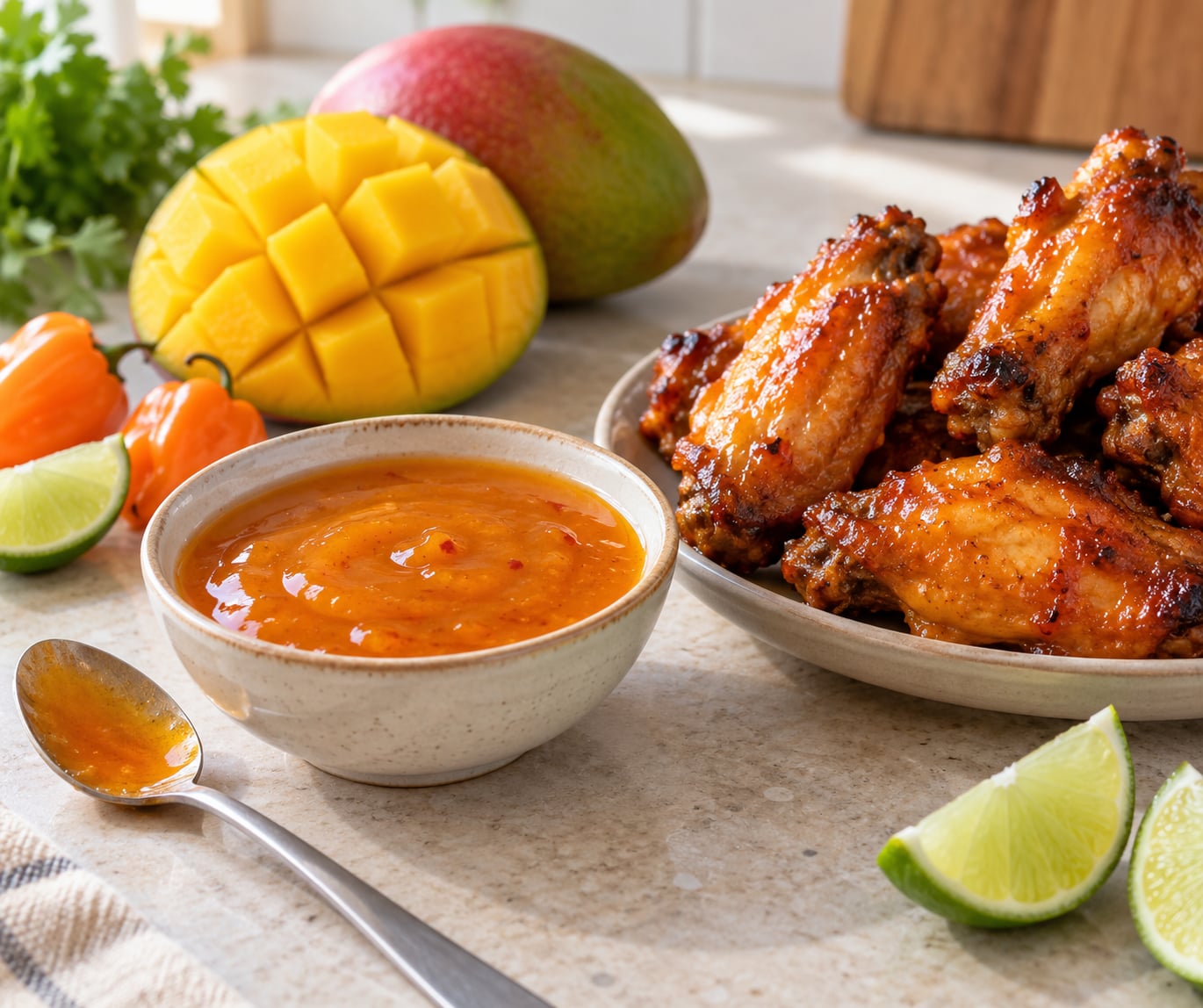
If you want to know how to make mango habanero wing sauce that actually tastes like the restaurant version, the method is simple: cook ripe mango with a small number of habaneros, vinegar, lime, and honey, then blend it until it coats the back of a spoon. From prep to bowl it takes about 35 minutes, makes roughly 1.5 cups of sauce, and is forgiving enough that beginners can land a good batch on the first try.
The one thing that trips most people up is heat. Mango habanero fails in two directions: too many peppers and the fruit disappears, too few and it tastes like sweet salsa. Everything below is built around controlling that dial.
Table of Contents
- What You Need
- Step-by-Step
- 1. Prepare the mango and aromatics
- 2. Bloom the habanero and aromatics
- 3. Blend the mango habanero wing sauce
- 4. Taste and adjust the sauce
- Common Mistakes
- Storage and Serving
- Frequently Asked Questions
- Can I make mango habanero wing sauce without a blender?
- How spicy is mango habanero wing sauce?
- Should I use fresh or frozen mango for this sauce?
- How can I thicken or thin mango habanero sauce?
- How much sauce do I need for a pound of chicken wings?
- How long does mango habanero sauce last?
What You Need
Mango habanero wing sauce needs eight core ingredients, and only one of them is actually hard to find. Both US customary and metric amounts are listed because half measures of a habanero are the whole game here, and guessing gets expensive in flavor.
- Ripe mango, 2 cups diced (about 300 g) — a Haden, Ataulfo, or champagne mango. Ripe means it gives slightly at the neck and smells sweet at the stem. Underripe mango tastes flat and will not fix itself with honey.
- Habanero peppers, 2 to 4 (15 to 25 g) — start at 2. Orange or red habaneros run 100,000 to 350,000 Scoville units, roughly 25 to 40 times a jalapeno.
- Yellow onion, 1 small, or 2 shallots, diced (90 g) — shallots are milder and cleaner.
- Garlic, 3 cloves, thinly sliced
- Olive oil, 2 tbsp (30 ml) — or use 2 tbsp water for an oil-free version that still blooms the aromatics.
- Apple cider vinegar, 1/3 cup (80 ml) — white wine vinegar is brighter, rice vinegar is softer, bottled lime juice is the budget swap.
- Honey, 2 tbsp (30 ml) — maple syrup, brown sugar, or agave all work.
- Lime, 2 (juice plus zest of one)
- Seasoning: 1 tsp smoked paprika, 1/2 tsp cumin seed, 1/2 tsp sea salt
Tools are minimal: a blender or immersion blender, a sharp knife, a cutting board, and a pair of kitchen gloves if you have never handled a habanero. Capsaicin sits in the pepper flesh and clings to your hands, so gloves are cheap insurance against rubbing your eye an hour later.
Worth buying the gloves for a second reason: habaneros mold quickly on the counter, usually within a week. Buy them in small quantities rather than storing a bag for later.
Step-by-Step
1. Prepare the mango and aromatics
Dice the mango into small cubes, roughly half-inch pieces, and take the time to slice the flesh right against the flat seed. A stray strip of seed skin blends into grit that you will find in your teeth later.
Dice the onion or shallots small and slice the garlic thin. Fine cuts matter more than usual here because everything softens in the same pan.
Pull the stems off the habaneros and cut each one in half. Decide now whether you are removing seeds and pith, because this is the single biggest lever on the finished heat level and you cannot adjust it after blending.
2. Bloom the habanero and aromatics
Heat the olive oil in a medium saucepan over medium heat until it shimmers but does not smoke. Add the habanero halves, onion, and garlic, and cook for 4 to 5 minutes, stirring now and then.
You are looking for two visual cues: the onion going translucent and soft, and the skins on the habanero blistering in spots. If the garlic browns in the first minute, pull the pan off the heat — bitter garlic will follow the whole sauce.
Add the cumin seed and smoked paprika now and stir for 30 seconds. Blooming spices in fat is what gives you a warm, smoky base instead of a raw dusty one.
3. Blend the mango habanero wing sauce
Add the diced mango, vinegar, honey, lime juice, lime zest, and salt to the pan. Let everything come back to a boil, then drop the heat to low and simmer for 12 to 15 minutes.
Stir a few times. The liquid should thicken slightly and coat the back of a spoon, and the mango edges should look translucent and soft rather than distinct.
Let the mixture cool for a minute before it goes near a blender lid. Trapped steam will force the lid off and put scalding sauce on your ceiling. If you are using an immersion blender, blend right in the pot with the pan off the heat.
Blend until completely smooth, about 45 to 60 seconds. You are aiming for a consistency that runs off a spoon in a slow ribbon, not a pourable stream.
4. Taste and adjust the sauce
Taste with a clean spoon before deciding the sauce is finished. Adjust in this order, one change at a time, and taste again after each:
- Too hot, mango lost: add 1 tbsp honey or mango, then 1 tbsp lime juice. Sugar and acid both blunt capsaicin, and neither dilutes the fruit flavor.
- Not hot enough: add half a habanero at a time, seeds removed, simmer 3 minutes, blend, and taste.
- Too thin to coat wings: simmer the blended sauce for 5 to 8 more minutes until it thickens. Do not add flour or cornstarch, which turn it gluey.
- Flat or dull: another squeeze of lime and a pinch of salt fixes this more often than more sugar does.
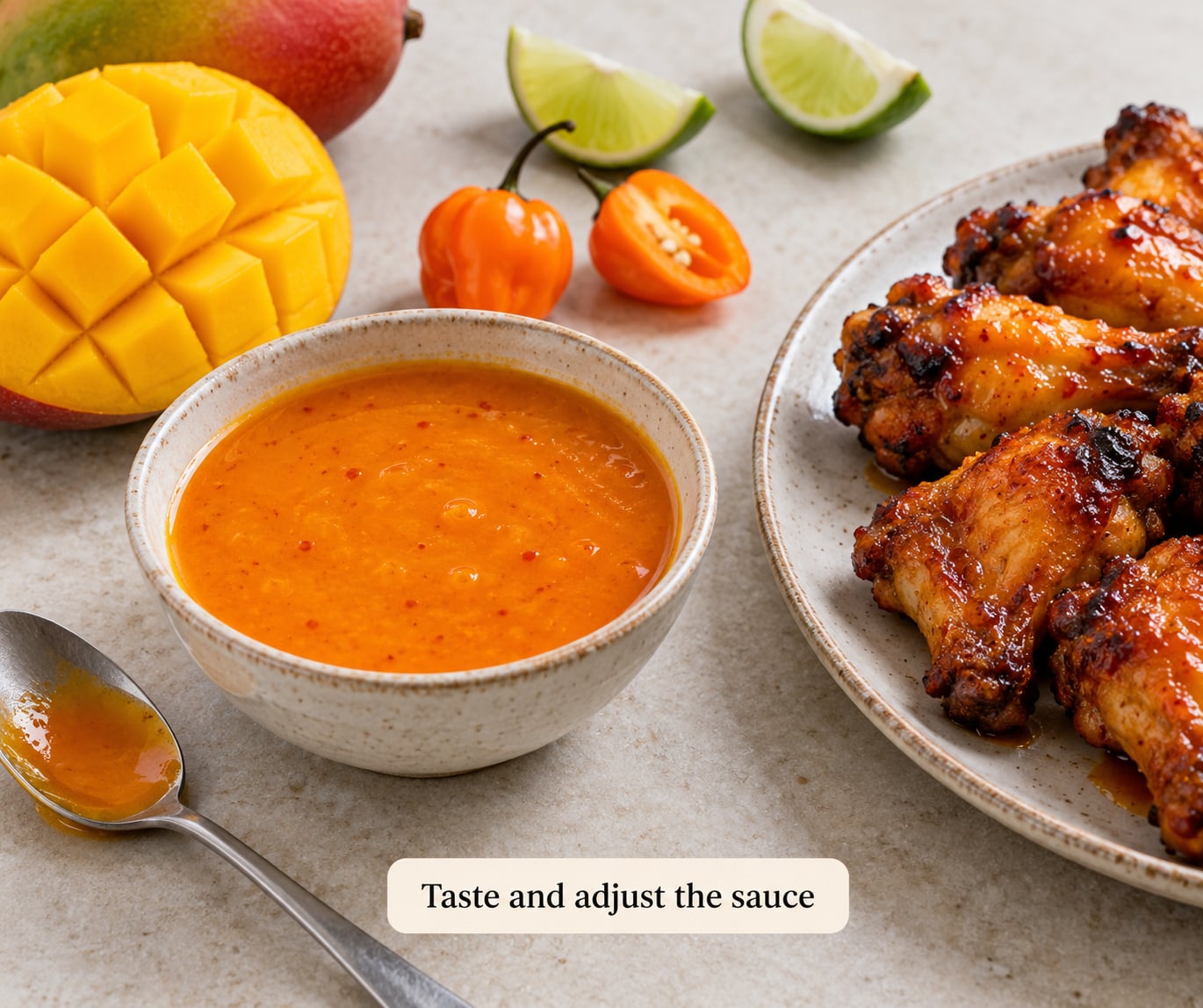
Heat scales predictably once you know the starting point. Mango dilutes capsaicin, and the vinegar and honey cut it further, so the sauce lands noticeably milder than the raw pepper suggests.
| Level | Habaneros for 1 cup mango | Seeds and pith | Vinegar | Sweetener |
|---|---|---|---|---|
| Mild | 1 | Fully removed | 1/4 cup (60 ml) | 2.5 tbsp (38 ml) |
| Medium | 2 | Removed | 1/3 cup (80 ml) | 2 tbsp (30 ml) |
| Hot | 3 | Half left in | 1/2 cup (120 ml) | 1.5 tbsp (22 ml) |
| Extra hot | 4 | All left in | 3/4 cup (180 ml) | 1 tbsp (15 ml) |
For tossing wings, plan on about 1/2 cup of finished sauce per pound (450 g) of cooked wings. Dipping needs closer to 1/4 cup per pound because people dunk instead of pour.
Common Mistakes
The mango disappeared under the heat. This is the most reported problem with this recipe. Fix it by adding sweetness and acid rather than more mango, since extra fruit dulls the sauce and makes it watery. If you are cooking from scratch again, use half a pepper more than you think you want.
The sauce is too thin. Most recipes are built as a dip, and a thin sauce runs straight off a wing. Simmer after blending until it slows to a ribbon, then toss. If you overshoot, thin with warm water or mango nectar one tablespoon at a time.
The sauce is gritty. Either the mango was blended in large pieces or seed skin slipped in during dicing. Sieve it through a fine-mesh strainer if you cannot re-blend.
It tastes flat or cloying. That is usually a ripeness problem. Underripe mango has almost no aroma to amplify the pepper, so the sweetness reads as plain sugar. Choose fruit that smells like candy at the stem.
It is hotter today than it was yesterday. The sauce mellows as it sits, so anyone who tastes it within an hour of blending will perceive more heat than the same sauce on day two. Season slightly hotter than you want for immediate serving, or make it the day before.
You used a mango beverage instead of fruit. Bottled mango drink and nectar thicken a sauce but carry none of the aroma of real fruit, so it reads as flat and overly sweet. Fresh or frozen mango takes 5 minutes of chopping and is worth it.
If you want smoke rather than heat, add 1/2 tsp liquid smoke or double the smoked paprika and cut the pepper count by one. For a jerk-style Caribbean profile, add 1 tsp jerk seasoning in step 2 and a splash of dark rum at the end.
Storage and Serving
Pour the sauce into a jar and refrigerate. It keeps about 2 weeks in the fridge, and the flavor genuinely improves after a day as the vinegar and heat round out. Freeze it in ice cube trays and keep up to 2 months; thaw cubes in the fridge overnight and use them straight from the cube in a pan sauce.
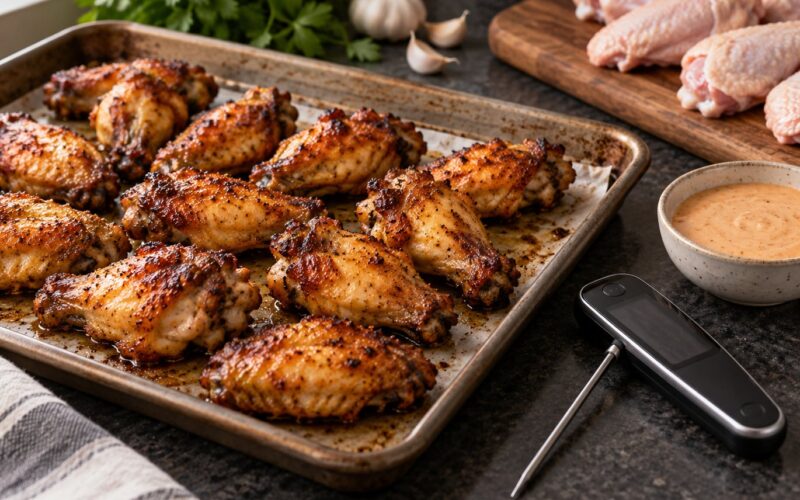
Chicken wings must reach 165°F (74°C) internally before they go in the sauce. Toss the wings while they are still hot so the coating sets on contact, and serve extra sauce in a bowl for dipping.
The sauce works well beyond wings: spooned over grilled jerk chicken, thinned with a splash of water as a dressing for cubed mango, mixed into a grain bowl with black beans, or served as a dip for sweet potato fries and plantain chips.
Frequently Asked Questions
Can I make mango habanero wing sauce without a blender?
Yes. Cook the mango and aromatics until very soft, then mash them with a potato masher or a fork before stirring in the lime, honey, seasonings, and vinegar. The texture will be slightly more rustic and a little thicker, which works well on wings because it clings rather than runs. Let the mixture simmer 5 minutes longer than the blender version so the fruit breaks down further.
How spicy is mango habanero wing sauce?
The heat level depends on the number of habaneros and whether their seeds and pith are included. Start with two seeds-removed peppers for a moderate sauce, strip all seeds and white pith for a milder result, or add peppers gradually after the first taste. Habaneros run 100,000 to 350,000 Scoville units, but the mango, honey, and vinegar pull the finished sauce well below that.
Should I use fresh or frozen mango for this sauce?
Fresh ripe mango gives the brightest flavor and the smoothest texture, but frozen mango works well if you thaw it before blending. Choose fruit that is sweet rather than underripe, since the sauce should taste fruity first and sweet second. Frozen mango tends to blend smoother and slightly thinner, so skim any liquid before adding it to the pan.
How can I thicken or thin mango habanero sauce?
For a thicker glaze, simmer the blended sauce gently until it reduces, stirring often, and check every minute or two. If it goes too thick, add warm water, mango nectar, or lime juice one tablespoon at a time. Simmering gives a cleaner flavor and a shinier coating than a cornstarch slurry, which tends to turn the sauce gluey.
How much sauce do I need for a pound of chicken wings?
Plan on about half a cup of finished sauce per pound of cooked wings for a tossed, fully coated result. Use a quarter cup per pound if the sauce is mainly for dipping, and pass the rest at the table. The sauce thickens noticeably as it sits, so make it slightly thinner than you want the finished coating to be.
How long does mango habanero sauce last?
Stored in a sealed jar in the refrigerator, the sauce keeps about 2 weeks. You can freeze it for up to 2 months using ice cube trays, then move the cubes to a freezer bag so they do not pick up freezer odors. Thaw a cube in the fridge overnight, or drop it straight into a warm pan and stir until it melts.
Start with two habaneros, seeds removed, and one ripe mango cut into honest cubes. Bloom the aromatics for five minutes, simmer 12 to 15, blend smooth, then taste before adjusting anything. Once you make it a second time, you’ll start moving the heat dial without thinking.